Thursday, February 17, 2011

St. Mary's U of Winona & Mpls teams up with NPR's Fred de Sam Lazaro

.
.

PBS NewsHour special correspondent Fred de Sam Lazaro reports from what he calls the "global south," but lives in Highland Park, and has a new Winona-based funder: St. Mary's University.

It's not every journalist in these economically stressed times who can find a university benefactor, but for De Sam Lazaro (disclaimer: MinnPost board member), it's the second.

Fred de Sam Lazaro

Collegeville-based St. John's was an earlier partner for Under-Told Stories, de Sam Lazaro's reporting/teaching project. He would travel to places like Sudan, PBS viewers would see the results, and students at St. John's would get a literally real-world seminar every fall.

Why the move to St. Mary's? "I forgot to write in my contract that the president not die," de Sam Lazaro says.

He had a personal relationship with then-St. John's president Dietrich Reinhart, a dedicated internationalist who resigned in 2008 because of health concerns and died months later. "It happened during an economic downturn, the embrace of the program wasn't there any more," says de Sam Lazaro, whose relationship with the school ended last year.

St. Mary's is funding Under-told Stories at a bigger scale — about a quarter of the project, with the bulk coming from the NewsHour, he explains. The idea is to bring back material that is "valuable in the classroom, anecdotes that don't make it into stories. It's not the same as textbook learning — we speak plain English, and the method seems to appeal to students."

St. Mary's — like St. John's, a Catholic school — offered a couple of differences. St. Mary's Minneapolis campus is 81 miles closer to de Sam Lazaro's front door than Collegeville, and the grad-school student body at that Phillips neighborhood campus includes many émigrés from Under-told Stories countries. (The school also has a Nairobi campus.)

"On balance, it's certainly true that St. Mary's in Phillips is more reflective of the world we go to compared to St. John's, which is much less diverse," de Sam Lazaro says. "But on an intellectual level, there's appeal to both places. It was good to reach behind the 'Pine Curtain,' as they say [at St. John's], but at St. Mary's, the presence of students from around the world changes the interaction."

De Sam Lazaro — whose formal title is Senior Distinguished Fellow at the Hendrickson Institute for Ethical Leadership — says he's out of country about eight to ten days a month. The Under-told Stories roster features stories from Pakistan, India, Israel, Jordan, Cambodia, South Africa and Kenya — and that was only the last half of 2010.

Not bad for a guy who worked for KTCA's "Almanac" for two months in 1985 before becoming PBS's upper Midwest bureau chief, de Sam Lazaro's eventual gateway to the world.

"We try to make the foreign less foreign," he says of Under-told Stories. "Why are we engaged with Malawi, with the Congo, what relevance is there to us as Americans, as Minnesotans? Not just in a moral vacuum, but in terms of economic and security interests, what opportunity there is for students. We also look at social entreprenuerialism as a way to look at the world's problems. We're not sugar-coating stories, but we're casting things as solutions-oriented." MinnPost, David Brauer

Tuesday, February 15, 2011

Divine Mercy Conferences Feb 19 - 23 Fatherl Seraphim Michalenko and Paul Regan

.

The Core of the Divine Mercy Message and The Importance of Divine Mercy Sunday
Father Seraphim Michalenko, MIC, is an internationally recognized authority on the “Divine Mercy Message and Devotion”. He served for twenty years, including many years in Rome, as Vice Postulator in Saint Faustina’s Cause for beatification and canonization. Father Michalenko is a member of the Con-gregation of Marians of the Immaculate Conception and resides at the National Shrine of The Divine Mercy in Stockbridge, Massachusetts. The Marians have been the promoters of the authentic message of “Divine Mercy” since 1941 and are the publishers of the Diary of Saint Faustina in many languages.

Praying the Divine Mercy Chaplet for the Sick and the Dying
Paul Regan is a Eucharistic Apostle of the Divine Mercy. He is the founder of the Divine Mercy Chaplet for the Sick and Dying, a world-wide Eucharistic devotion given papal approval and a per-sonally signed apostolic blessing by Pope John Paul II. Paul is a frequent guest speaker on Catholic Relevant Radio and he is an EWTN participant in the Cenacle of the Divine Mercy. He is an esteemed conference speaker and he has spoken on the Divine Mercy message throughout the world.

Saturday, Church of Saint Anthony February 19 2405 1st Street North | Saint Cloud, MN 56303-4307 | (320) 252-0535
Talks: 12:30 – 2:45 p.m. Father Michalenko, MIC, will hear confessions at 3 p.m. and concelebrate Mass at 4:30 p.m.

Sunday, Cathedral of the Holy Trinity February 20 605 North State Street | New Ulm, MN 56073-1866 | (507) 354-4158 Talks following the 9:30 a.m. Mass Rolls and beverages provided

Sunday, Church of Saint Elizabeth Ann Seton February 20 2035 West 15th Street | Hastings, MN 55033 | (651) 437-4254
Talks following the 6 p.m. Mass

Monday, Church of Saint Bonaventure February 21 901 East 90th Street | Bloomington, MN 55420-3801| (952) 854-4733
Father Michalenko, MIC, will be the main celebrant for the Mass Talks following the 8:45 a.m. Mass Rolls and beverages provided

Tuesday, Our Lady of Guadalupe Shrine of La Crosse, WI February 22 5250 Justin Road | La Crosse, WI 54602 | (608) 782-5440 Talks 9:30 a.m. Mass: 12:15 p.m.

Wednesday, Church of Saint Joseph February 23 1138 Seminole Avenue, West St. Paul, MN 55118 | (651) 457-2781 (Paul Regan ONLY) Talk following the 7:30 a.m. Mass Rolls and beverages provided

Monday, February 14, 2011

Fr. Larry Richards to be Keynote Speaker at St. Cloud Men's Conference on Sat, Feb 26

.


The Diocese of St Cloud diocese having a Catholic Men's Conference on Saturday, February 26, from 8-4:30PM at St John's University. The keynote speaker is Father Larry Richards, who you may have heard on Relevant Radio. He is a very dynamic and direct speaker.
I believe the sign up ends today, Feb 14, but if you call the number below, and speak with a lady named Jan, I'm sure that arrangements can be made for extending the deadline.
TO REGISTER:
Please register online or send your name, address, phone, email, parish name, whether you need special accommodations, and fee to:
Office of Marriage & Family / CMC
305 7th Ave N, Suite 100
Saint Cloud, MN 56303-3633
Questions: 320-252-4721

Saturday, February 12, 2011

Abp. Nienstedt: Letter to the Star Tribune on Abortion

.
Abortion editorial

Board got it wrong, board got it right

I write to express my concern and dismay regarding the Star Tribune's Feb. 8 editorial "Reject new limits on abortion rights."

I agree that reasonable people may differ over abortion based on health, moral, religious and privacy concerns. I cannot, however, agree with the idea that the taking of an innocent life is a woman's right.

The 1973 Supreme Court decision wasn't based on a "woman's right to choose" but rather on the right to privacy. I believe that it is misleading to suggest this decision affirms that, if a woman wants to have an abortion, taxpayers are expected to pay for it.

While it is reasonable to affirm a person's right to basic health care, it's also misleading to say that an elective abortion is a health issue.

Citizens do disagree on civil and legal matters, and when they do, legislative bodies react to their constituents. This is the process we are now seeing played out in Minnesota.

It's democracy at its best.

THE REV. JOHN C. NIENSTEDT

The writer is archbishop of the Archdiocese of St. Paul and Minneapolis.

Thursday, February 10, 2011

The Crusader: Theresa Deisher once shunned religion for science. Now, with renewed faith, she is fighting human-embryonic-stem-cell research in court

.
Theresa Deisher was 17 years old the first time she saw a human fetus. Having graduated from the Holy Names Academy in Seattle, Washington, in 1980, she had taken
a summer job in the pathology lab at the city’s Swedish Hospital when a friend and co-worker miscarried in her fifth month of pregnancy. The fetus arrived fixed in
formalin, and Deisher helped to section it to determine the cause of the miscarriage. The body hardly seemed to be the remains of a sentient, soul-bearing human, as the faith of her upbringing had taught, recalls Deisher.

Instead, “It looked like a space alien,” she says. “I called it ‘the thing’ for so many years.”

Thirty years later, Deisher sees the unborn in a different light. She has reversed her views on embryos and become one of two plaintiffs in a lawsuit filed in 2009, seeking to stop the US government from funding human-embryonic-stem-cell research. The courts hearing the case could issue a decision at any time; many, including Deisher, expect that the matter will end up before the US Supreme Court.

Deisher’s co-plaintiff, James Sherley, an adult-stem-cell scientist at the Boston Biomedical Research Institute in Watertown, Massachusetts, is well known as a provocateur. In 2007, he went on a hunger strike to protest against a decision by the Massachusetts Institute of Technology (MIT) in Cambridge to deny him tenure, which he attributed to racism.

Deisher is less well known. A cellular physiologist educated at Stanford University in Palo Alto, California, she spent 17 years in the biotech industry at companies including Genentech, Immunex and Amgen. Three years ago, she founded a tiny, privately held Seattle firm called AVM Biotechnology — the name is a loose abbreviation for ‘Ave Maria’ — which is dedicated to hastening adult-stem-cell therapies to the market, and to developing alternatives to vaccines and therapeutics made using cell lines from aborted fetuses. She has also launched a non-profit group, the Sound Choice Pharmaceutical Institute, which among other things is investigating, as she puts it, “the potential link between human DNA in childhood vaccines and autism”.

Deisher, who is 48 and goes by the name Tracy, is smart, driven and committed. A devout Catholic and a divorced mother of two boys aged 9 and 12, she rises as early as 3:45 a.m. to ride an exercise bike while praying the rosary. She is casual and unpretentious, with a dry humour and a can-do attitude: she spent New Year’s Eve laying carpet in the 180-square-metre office space that her company recently moved into. See the rest of this important profile published in Nature magazine here.

The Skin Gun: Burn Victims Sprayed With their own Adult Skin Cells; One Healing in Four Days

.

Friday, February 4, 2011

274 Catholics from archdiocese attend largest March for Life ever in Washington

.

Archbishop John Nienstedt stands with Nancy Schulte, left, and Genevieve McCarthy, a senior at Providence Academy in Plymouth, during the rally on the National Mall before the march. Schulte works in the archdiocesan Office for Marriage, Family and Life, which organized the trip from the archdiocese.

It took a 26-hour bus ride, a student conference and a national march of more than 400,000 people for Nicholas Vance, 14, to realize the pro-life movement is more alive than he previously thought — much more alive.

“Before this, I thought, ‘Oh, wow, there’s only a couple of people I know who are pro-life,’” he said. “But when I see today, and see the hundreds of thousands of people who were walking with us and supporting life, I was just amazed that there are that many people who feel the same way — that abortion is wrong.”

Vance was sitting in the grass near the Library of Congress, the late afternoon sun backlighting the Capitol dome behind him. His coat was unzipped, despite the below-freezing temperatures. A parishioner from St. Joseph in West St. Paul, he was one of the 274 Catholics from the archdiocese who participated in the national March for Life in Washington, D.C., Jan. 24.

The annual march commemorates the Jan. 22 anniversary of Roe v. Wade, the U.S. Supreme Court decision that legalized abortion in all 50 states.

The march began with a noon rally on the National Mall where speakers, including members of Congress, urged marchers to support pro-life legislation. Marchers then walked along Constitution Avenue to the Supreme Court building holding signs while praying, singing and chanting pro-life slogans.
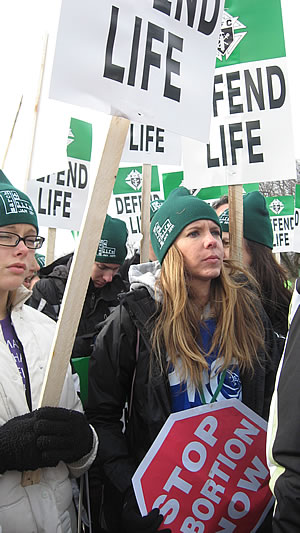
Andrea Gibbs, 29, youth minister at St. Wenceslaus in New Prague, holds a “stop abortion now” sign while standing with members of her parish during the rally. She is excited to see her youth passionate about protecting life, she said.

The March For Life organization estimates the 2011 event was the largest march ever, exceeding the estimated 400,000 participants who attended in 2010, said its president Nellie Gray.

The archdiocesan group included marchers from 17 parishes, four Catholic high schools, and Community of Christ the Redeemer, a Catholic lay group whose members attend various parishes. The archdiocesan Office of Marriage, Family and Life sponsored the trip. Archbishop John Nienstedt joined the group for the rally on the Mall.

The first March for Life began in 1974, one year after Roe v. Wade. It fashioned itself after the marches on Washington that united civil rights activists in the previous decade.

As the annual march’s crowd has grown in number, it has also grown younger.

Bryan Kemper, the founder and president of the pro-life organization Stand True Ministries, estimates that 70 percent of the marchers are young people today. Most of the participants from the archdiocese were high school students and their chaperones.

Others included first-year theology seminarians from St. Paul Seminary and archdiocesan priests.

“Young people have a light in their soul that can be ignited in this kind of atmosphere,” said Mary Ann Porter, a parishioner at St. Henry in Monticello who accompanied her 16-year-old son, Luke. “This is about activism, which is in the heart of every young person.”

Pro-life preparation

The day before the march, students attended a daylong student conference hosted by Students for Life of America, a national organization that supports campus pro-life groups. Although most of the attendees were college-aged, Afua Paintsil, 16, a junior at Benilde-St. Margaret’s School in St. Louis Park, was glad she was there.

“I’ve learned so much,” she said over lunch on Sunday, after hearing the first four speakers.

Seminarians Jon Freidhof, left, Colin Easton and Blake Rozier walk with a pro-life sign during the annual March for Life. Friedhof studies for the Diocese of La Crosse, Wis., Easton for the Diocese of Rockford, Ill., and Rozier for the Diocese of Duluth. They attended the march with other first-year theology students from St. Paul Seminary.

“I’m someone who learns well from being shocked, and I’ve been shocked a lot,” said Paintsil, who attends St. Mary of the Lake in Plymouth. “That’s how you have to teach our generation.”

She added: “We have a mindset that things aren’t a big deal; that it doesn’t concern me so I don’t have to worry about it. We are a pretty selfish generation.”

Yet, the conference drew 1,800 high school and college students, which may be the world’s largest pro-life student rally, SFLA executive director Kristan Hawkins told the crowd. Throughout the conference, speakers asked participants to stand up for the unborn children and mothers who have been affected by abortion. Students heard speakers who described the horror of abortion, the power of adoption, and what students can do to help save unborn children’s lives.

“We’ve been told that abortion is a complex question — it’s not,” Scott Klusendorf, president of the Colorado-based Life Training Institute, told the crowd. The only question that matters is, what is the unborn? If the answer is human — and science says it is — it’s wrong, he said.

Women do not undergo abortion by choice, Mike Schwartz, chief of staff to U.S. Senator Tom Coburn (R-Okla.) said in one of the afternoon breakout sessions. “Abortion is what happens when women run out of choices.”
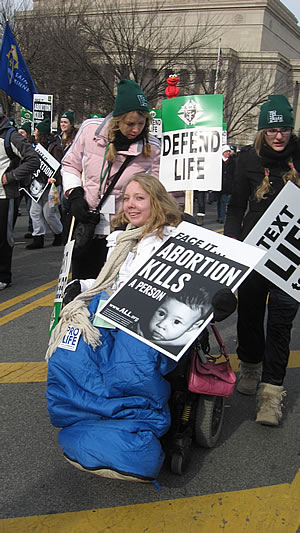
Aly May, 14, and her mother, Maren, head toward the annual March for Life after attending Mass at the Verizon Center. A member of?St. Jude of the Lake in Mahtomedi,?Aly is confined to a wheelchair because of a condition called spinal muscular atrophy. The Mays went to the march to remind others that being pro-life extends beyond protecting the unborn.

Pro-life U.S. congressmen Dan Lipinski (D-Ill.) and Chris Smith (R-N.J.) also spoke at the conference.

“You will make a great impression on the Mall. It makes a difference to legislators,” Lipinski told the students, speaking about the next day’s march. “The pro-life movement is not going away; it’s only getting stronger.”

Friends having abortions

On Sunday evening, Hawkins presented the annual SFLA Defender of Life Award to Abby Johnson, a former clinic director of Planned Parenthood in Bryan-College Station, Texas.

Johnson left the abortion-providing organization in 2009, a year after receiving its employee of the year award. Johnson’s book describing her turn-of-heart, “Unplanned,” shot to the No. 8 bestseller on Amazon.com within 24 hours of its Jan. 15 release.

More than 4,000 abortions happen daily in the United States, Johnson, 30, told the students. “Who are we missing? Who’s not here because of abortion? Siblings? Cousins? Aunts? Uncles? Scientists? The first female president?” she asked.

Johnson urged students to speak out against abortion even though it can be unpopular.

“Guess what — your friends are having abortions,” she said. “They’ll never know they can reach out to you if you don’t reach out to them first.”

In Minnesota, 44 percent of abortions in 2009 were performed on women between the ages of 18 and 24, according to the Minnesota Department of Health. The statistics for 2010 have not yet been reported.

“Keep going. Keep fighting. We are going to be the ones who end abortion in this country,” Johnson said.

Attending Sunday’s conference inspired St. Wenceslaus in New Prague parishioner Steve Bohlke, 50, to make the decision to begin “sidewalk counseling,” or speaking to women entering a clinic for an abortion.

“It got my blood stirred up,” said Bohlke, who was a chaperone. Earlier in the day, he had heard speakers explain how to sidewalk counsel successfully, including what to say and what not to say, he added.

The conference also motivated St. Wenceslaus parishioner Mitch Gareis, 18, to be more passionate about the pro-life cause, and to be a leader, he said.

‘You will be the voice’

On Monday morning, the youth attended the annual Youth Concert and Mass for Life before heading to the march. Organizers split the event between two locations — the Verizon Center and the D.C. Armory — because it drew more than 27,000 thousand youth and adults, most of whom were Catholic. Members of the archdiocesan group worshiped at both sites.

Cardinal Donald Wuerl of Washington and Cardinal Daniel DiNardo of Galveston-Houston presided at the Masses. Cardinal Francis George of Chicago, four archbishops — including Archbishop Nienstedt — 16 bishops and more than 200 priests were among those who concelebrated Mass at the Verizon Center.

“We will be the voice of those who were never allowed to speak, we will cast the vote that they were never able to make, and in about two hours we will march for those who were never allowed to take their first step,” said the homilist, Father Mark Ivany, parochial vicar at the Church of the Little Flower in Bethesda, Md.

He reminded those gathered that it wasn’t enough to just overturn Roe v. Wade, but that “our mission is to change the whole culture of our country.”

After the Mass, marchers made their way to the National Mall, picking up prepared posters dropped in stacks along the blocked streets. In the sea of people, marchers from the archdiocese recognized each other by their dark green knit hats embroidered with “March 4 Life, Jan. 2011” as they followed a blue flag with the archdiocesan crest.

Others held homemade signs, including some that pointed to adoption as an alternative to abortion.

“Thanks Mommy 4 Choosing Adoption,” declared the sign held by Divine Mercy of Faribault parishioner Tricia Anderson, 15.
St. John the Baptist in New Brighton youth minister Libby Dupont held a sign with a picture of her own 5-month-old adopted daughter, Magdalene, next to the words “Adoption is the answer.”

Seminarian David Gockowski, 24, described the march as “beautiful chaos.” It was the second time he had attended the national march. “Everyone is here representing their community, their church,” he said. “You realize that this is a great cause, and it’s bigger than we are.”

Attending the march and accompanying pro-life events made St. Joseph parishioner Micah Zimmerman, 14, think of abortion as a “holocaust,” he said. “I knew it was killing, but not like that,” he said. “Now I feel like doing something about it.” Catholic Spirit


Why Christianity lacks a Holocaust literature

.


Here’s a question that astute observers of the religious landscape find themselves asking these days, and which deserves a serious response: Why doesn’t Christianity have its own Holocaust literature?

By that, of course, no one means to minimize the absolute singularity of the Holocaust against the Jews during the Second World War, and the moral imperative of keeping that memory alive. Yet the question persists: Given the harrowing realities of Christian martyrdom during the 20th century, and the rising global tide of anti-Christian violence in the early 21st century, why isn’t there a budding genre of Christian analogs to Night by Elie Wiesel, or Spielberg’s “Schindler’s List”?

(A rare example is the compelling 2010 French film “Of Gods and Men,” based on the assassination of a group of Trappist monks in Algeria in 2006. It’s too bad the movie wasn’t nominated for “Best Foreign Language Film” at the Oscars, which would have given it broader exposure to American audiences. The U.S. debut is Feb. 25.)

More broadly, why don’t attacks against Christians in places such as Egypt, Iraq, Nigeria, India and Pakistan, to cite just a few recent examples, generate the same outrage among Christians in the West that similar oppression directed against followers of other faiths elicits among their coreligionists?

According to the German-based relief agency “Aid to the Church in Need,” fully 75 percent of all acts of religious intolerance in the world are directed against Christians. Yet in the court of popular opinion, the mythology persists that Christians are more likely to be the oppressors than the oppressed.

The most recent example of reticence came Tuesday, when the Foreign Ministers of Europe, meeting in Brussels, couldn’t agree on a specific reference to Christians in a declaration condemning religious persecution. The fact that Europe is the cradle of Christendom makes the omission not only ironic, but also an index of Europe’s ambivalence about its Christian heritage.

Without any pretense of being definitive, here are four factors I suspect are in play.

First, especially when it comes to Americans, the myopia of the broader culture is faithfully reflected in church circles. The roughly 67 million Catholics in the United States may represent just six percent of a global Catholic population of 1.2 billion, but you’d never know it by surveying most American Catholic books, blogs and newspapers, or even what’s bubbling in the pews. If something isn’t happening in the States, it’s often not perceived as a matter of Catholic concern.

Second, although Islamic radicalism has no monopoly on anti-Christian prejudice, it’s a primary incubator these days. As a result, concern for Christian persecution is often swept up into the broader politics of relations between Islam and the West, especially legitimate concern not to foment Islamophobia.

A recent controversy in the diocese of Springfield, Ill., illustrates the point.

In his Christmas Eve homily, Bishop Thomas Paprocki called the recent attacks on Iraqi Christians the latest chapter in a “centuries-long onslaught of Muslims against Christians.” Among other things, Paprocki appeared to support racial profiling in airport security, saying that if 83-year-old grandmothers get the same pat-downs and body scans as “Muslim Arabs from the Middle East,” then “we’re wasting a lot of time and money for nothing.”

“You can’t fight a war if you can’t identify the enemy,” Paprocki said.

The homily brought a Jan. 22 response from Viatorian Fr. Corey Brost in a local newspaper, arguing that “the vast majority of Muslims around the world live and preach” the values of peace and religious tolerance. Brost also warned that Paprocki’s argument could unintentionally stoke what he described as a spreading “hatred of Islam” in America.

Brost clearly endorsed Paprocki’s concern for Christians suffering persecution. Nonetheless, the dispute seemed to underline internal Catholic divisions, rather than to project a united front in defense of Christians in Iraq or anywhere else.

Third, some Christians in the West are hesitant about campaigns against anti-Christian persecution abroad because they’re often bundled with protests against purported anti-Christian bias at home, such as the so-called “War on Christmas,” or art exhibits, TV shows, and journalistic commentary which some pious souls find offensive. Other Christians find such complaints exaggerated, if not hysterical, and don’t feel represented by the people who voice them most loudly.

To put that point into Catholic terms, some people just don’t want to get behind the likes of Bill Donohue, whose Catholic League and its protests against the Smithsonian, “The Simpsons,” and other makers of culture both high and low, inspire applause in some quarters and a reflexive rolling of the eyes in others. In any event, the group is not in a position to speak on behalf of all Catholics about anti-Christian persecution or anything else.

A similar point could even be made about the U.S. bishops. Some Catholics these days read official statements from the bishops largely to find out what they’re supposed to be against.

Fourth, some social justice activists in the church find a specific focus on anti-Christian persecution overly sectarian. We should be in favor of religious freedom for everyone, they argue, not just Christians; and violence against anyone ought to engage our concern, no matter what their religious affiliation. They worry that a focus on Christians weakens the case for religious liberty by making it seem like special pleading or institutional self-interest, rather than a principled stand in favor of human rights.

These four points may add up to an explanation, but they are no excuse.

No matter what the causes, it’s appalling that the suffering of Christians around the world has not stirred the Christian conscience in the West to a greater degree. It’s especially shocking that American Christians have not reacted more strongly to anti-Christian violence in Iraq, given the responsibility the United States bears for creating the conditions in which that insecurity could metastasize.

Disappointment ought to be particularly acute among Catholics, since Catholicism prides itself on forming a communion of saints linked by bonds of solidarity that transcend both time and space.

Perhaps what the Christian world needs is precisely the call to conscience that a thoughtful, evocative Holocaust literature would elicit. May its moment come, and that right soon. National Catholic Reporter

Bishop Piche' Spoke and the Beth El Synagogue Congregation Applauded

.

On April 13, 1986, Pope John Paul II visited the Great Synagogue of Rome for Sabbath services. He became the first Pope – ever – to visit a synagogue. It was among a number of “firsts” for him in connection with the larger Jewish world which included making a formal Papal trip to Israel in March, 2000 and a visit to Auschwitz in 1979. He also issued in 1998: “We Remember: A Reflection on the Shoah.” The memory of Karol Jozef Wojtyla, the first Polish Pope – who lived through the Holocaust – is that of a good name which will endure throughout Jewish and world history.

In that spirit of Pope John Paul II, the Auxiliary Bishop Lee A. Piché, representing the Archdiocese of St. Paul and Minneapolis and Archbishop John C. Nienstedt, visited Beth El Synagogue in St. Louis Park on January 29, 2011. He was warmly welcomed by the congregation and its Rabbis, Alexander Davis and Avi Olitzky.

Archbishops, bishops and other leading Catholic figures in the Twin Cities have long been visiting synagogues and paying their respects to their Jewish neighbors and congregations. Many Catholic institutions such as the Jay Phillips Center at the University of St. Thomas have long been involved in providing high level Jewish studies and dialogue between Catholics and Jews. The JCRC has for many years partnered with the Minnesota Catholic Conference (as well as with the Minnesota Council of Churches and Islamic Center of Minnesota) on Minnesota’s unique Joint Religious Legislative Coalition and with Catholic Charities, the Greater Minneapolis Council of Churches, and the St. Paul Area Council of Churches in support of Minnesota FoodShare. The relationship of Temple Israel and the Basilica of St. Mary’s – neighbors in Minneapolis – is a moving story of interfaith cooperation among congregations, as was the deep friendship of Rabbi Max Shapiro and Monsignor Terrence Murphy.

Building upon this foundation of Jewish-Catholic friendship in the Twin Cities, the JCRC (with the assistance of Father Erich Rutten of the University of St. Thomas) facilitated the giving of a d’var Torah (a commentary on the Torah portion) at a Beth El Synagogue Shabbat service. (Thank you to Beth El Synagogue and Rabbis Alexander Davis and Avi Olitzky for their openness and graciousness in providing their bima – pulpit – to Bishop Piché.)

Before even delivering the d’var Torah, Bishop Piché made a great and lasting impression upon the congregation – a Conservative synagogue founded in 1929 on the north side of Minneapolis. Rabbi Davis invited Bishop Piché to join the processional following the Torah which winds its way through the congregation at the conclusion of the Torah service. Following the Torah held by the Bat Mitzvah, Delia Koolick and the rabbis with the congregation singing a prayer, Bishop Piché exchanged warm greetings with congregants – many of whom were eager to shake his hand and welcome him to Beth El. Wearing his Bishop’s cassock, zucchetto (skull cap) and pectoral cross, Bishop Piché appeared as much at home in the Beth El sanctuary under the stained glass depicting Isaiah’s vision of beating swords into plowshares as he might be at the Cathedral of St. Paul. Metaphorically, it represents the distance traveled between Jews and Catholics in the Twin Cities. (Capture the scene in your mind’s eye because there are no photographs or videotape due to the observance of Shabbat prohibitions in the synagogue.)

Following the Torah processional, Bishop Piché ascended the bima and stood before the Aron Hakodesh – the holy ark – as the Torah was returned to it. Respectfully, the Bishop stood with the congregation as Etz Chaim (“Tree of Life” representing the Torah) was sung. From a few feet behind the Bat Mitzvah, the Bishop heard Ms. Koolick recite her special Bat Mitzvah prayer.

A few minutes later, Rabbi Davis welcomed Bishop Piché to the Beth El bima with his interpretation of a passage for interfaith relationships. (Please click here for comments from Rabbi Davis.)

Bishop Piché then delivered his d’var Torah – a talk/homily/sermon about the meaning of the Shabbat Torah portion. (Each Shabbat a different parseh – portion – is read in the synagogue chanted by the Bar/Bat Mitzvah and other congregants.) The Torah portion was Mishpatim which Bishop Piché interpreted with evident study and reflection demonstrating great erudition, faith, love for God and gentle flashes of warm humor. This brought smiles to the faces of a rapt congregation – there was barely a whisper, cough or sound as the congregants listened intently.

Here are a few highlights of the Bishop’s d’var Torah which does not do justice to the experience of hearing the d’var Torah at Beth El in the “House of God”, Beth El’s English translation. (Please click here for the text of Bishop Piché’s d’var Torah.):

  • Dayenu, it would have been enough to be welcomed to the synagogue but I’ve been given the honor of commenting on the “very word of God. This is truly a great honor.”;
  • I feel connected to you because we have a shared reverence for the word, the divinely revealed truth that comes from God;
  • The revelation and discussion of rules in the Torah portion – Mishpatim – stands out in our society where people increasingly flout the rules. Moreover, acceptance of rules also “implies a living relationship with the law giver” – this provides for closeness and communion with God;
  • The rules of Mishpatim are also an expression of a covenantal relationship with God. The rules of Mishpatim are also about “protecting and advancing the relationships within the human community – creating an environment of peace, trust and security in which human life can prosper.”;
  • The importance of the rules of Mishpatim in breaking cycles of violence and cycles of greed.

Take time to read the Bishop’s d’var Torah. This summary paraphrasing does not do it justice.

Concluding with the words “[f]or you welcomed the stranger into your midst today. Not only did you not oppress the stranger, but quite to the contrary you honored him.” Bishop Piché finished his d’var Torah. There was a moment of silence – then, a loud round of applause.

This is highly unusual – indeed, rare – during a Shabbat or holy day service for it is not consistent with decorum in the sanctuary on these days. Spontaneously, though, this reservation was temporarily set aside in favor of expressing deep appreciation for the special visit and important and indelible words spoken. Indeed, the Bishop spoke and the congregation applauded.

As Rabbi Olitzky noted:

“I was warmed to see how "at home" Bishop was speaking from the bima. There was a very present and strong connection to a sense of kodesh/kedushah (holiness) within our shared scriptural tradition--one that I'm not sure members of the Jewish community usually recognize. However, in Bishop Piche's presentation of the text, it was clear we are brothers in faith and in peace. And in the world today, for the Church to be a true friend of the Jewish community speaks volumes--some of which the Bishop eloquently relayed on this past Shabbat morning.”

In this vein, Father Rutten commented:

“Pope John Paul II and Pope Benedict XVI have both been clear that we consider Jews to be our elder brothers and sisters in the faith.

While it is obvious intellectually that Jesus of Nazareth was a Jew, I suspect we don't know very deeply just what this means. My attendance at the Shabbat service gave me a greater glimpse at who Jesus really is. As Bishop Piché said, we begin to feel a great closeness to our Jewish brothers and sisters.

It is a tremendous joy when tensions are relieved and when strangers become friends. When the congregation applauded I felt a great sense of gratitude and relief and hope that even more can be done.

At this time, when it seems that tensions seem to be rising all over the world between people of differing faiths, it is important that we not allow extremists and/or the media to get in the way of face to face, neighbor to neighbor, relationship building.”

I had the honor of thanking Bishop Piché after his d’var Torah. I told the Bishop we were praying for the safety of all people in the Middle East during this time of upheaval including Christians who have been subject to persecution and terrorism in the cradle of Christianity where Christians have lived since antiquity.

Then it was my turn to smile as I presented gifts to Father Piché – first, a book by the great Rabbi and philosopher Abraham Joshua Heschel (who marched with Rev. Martin Luther King, Jr. in Birmingham). Next, I told the story about Bishop Piché teaching me the name for Bishop Piché’s skullcap – zucchetto – Italian for “little gourd.” I then presented Bishop Piché with a skullcap which we, Jews, call a yamulke or kippah. And with a smile, Bishop Piché carefully removed his zucchetto and donned his kippah. Star Tribune

Georgetown's CARA survey reports on recent women religious vocations

.
The typical newly-professed woman religious is a 43-year-old cradle Catholic who prayed the Rosary and participated in retreats and Eucharistic adoration before entering religious life, according to a survey released by the United States Conference of Catholic Bishops.

583 major superiors of US women religious responded to the survey, which was conducted by the Center for Applied Research in the Apostolate. 79% of superiors who belong to the Leadership Conference of Women Religious (which is under Vatican investigation) responded to the survey, while 58% of superiors who belong to the Conference of Major Superiors of Women Religious (which emphasizes fidelity to the Magisterium and the wearing of a habit) responded. Only 31% of superiors of contemplative communities responded to the survey.

Among the survey’s findings:

  • 84% of superiors reported no new religious professions in 2010, while 13% reported only one
  • 64% of newly-professed women religious came from families with four or more siblings
  • 13% of the newly professed are converts, typically from Protestantism
  • 62% are white, while 19% are Asian and 10% are Hispanic
  • 71% were born in the US, while 14% were born in Mexico, the Philippines, or Nigeria; the typical foreign-born newly-professed religious entered the US in 1993
  • 51% attended a Catholic elementary school, while only 26% attended a Catholic college; 7% were home schooled
  • 59% have at least a bachelor’s degree
  • 20% participated in one of the World Youth Days, and 6% participated in a Franciscan University of Steubenville conference as a high school student
  • 74% had attended a retreat before entering religious life, 65% regularly prayed the Rosary, and 64% regularly took part in Eucharistic adoration
  • the typical newly professed woman religious began to consider a religious vocation at the age of 20, was familiar with her institute for six years before entrance, and made her profession at the age of 43
  • 51% reported that a parent or family member discouraged them from entering religious life; only 26% said their mother encouraged them to consider a religious vocation, and an even smaller 16% said their father encouraged them to consider a vocation
  • 52% say they were encouraged by a religious sister to consider religious life, 44% by a friend, and 39% by a parish priest

    Source(s): these links will take you to other sites, in a new window.

  • Wednesday, February 2, 2011

    Who says young Catholics don't go to church? In Texas they do!

    .
    Where can you find a Catholic chaplaincy
    at an institution of higher learning that's looking to expand its church to seat 1,400, because the current 850 seats just aren't enough?

    South Bend, Indiana, perhaps? Well, no, actually: College Station, Texas, where the Catholic chaplaincy at Texas A&M, St. Mary's Catholic Center, is setting a new national standard for Catholic campus ministry.

    Aggie Catholicism is something to behold. Daily Mass attendance averages 175; there were closer to 300 Catholic Aggies at Mass on a weekday afternoon when I visited a few years back. Sunday Masses draw between 4,000 and 5,000 worshippers. There are ten weekly time slots for confessions, which are also heard all day long on Monday. Eucharistic adoration, rosary groups, the Liturgy of the Hours, and the traditional First Friday devotion are staples of Aggie Catholicism's devotional life.

    A rich retreat program is available, and each year some 1,250 students make or staff a retreat sponsored by St. Mary's. "Aggie Awakening," an adaptation of Cursillo for students, is one of the cornerstones of the campus ministry; other, specially designed programs include a silent retreat and a retreat titled "Genius of Women." In 2009-2010, 200 students participated in biweekly spiritual direction programs, and another 70 took part in the "Samuel Group," an exercise in Ignatian discernment that includes a commitment to curb what one campus minister describes as "unnecessary TV and Internet use." Two thousand A&M students, not all of them Catholics, have participated in introductory sessions exploring the theology of the body, and many have continued that exploration in follow-on study groups.

    Then there is service. Aggie Catholics participate in domestic and international missions, work with Habitat for Humanity, take part in a ministry to prisoners, and are involved in various pro-life activities. In fact, the 40 Days for Life program is an outgrowth of the Catholic campus ministry at Texas A&M; the national office of 40 Days is staffed by Aggie grads. The campus ministry also works with a local Life Center that helps mothers and families in difficult situations.

    All this energy has had a discernible effect on vocational formation and discernment. Since 2000, the campus ministry has averaged some nine students per year entering the seminary or religious novitiates; 132 Catholic Aggies have been ordained priests or made final religious vows in the past two decades. And then there is the vocation to marriage and family, which the campus ministry takes very seriously. Aggie Catholics are also a powerful witness to the rest of Aggieland: 175 new Catholics have entered the Church the past two years through St. Mary's RCIA program.

    The Catholic renaissance at Texas A&M is staffed by two full-time priests, three part-time and semi-retired deacons, one part-time priest, three full-time lay campus ministers, three sisters from the Apostles of the Interior Life, three part-time campus ministers, and four part-time student interns. That probably strikes many campus ministers as a rather large staff. In fact, the people who lead St. Mary's are stretched -- and they began where many others are today.

    Catholic campus ministry at Texas A&M is a striking example of "If you build it, they will come." The program is unapologetically orthodox. There is no fudging the demands of the faith. And yet they come, and come, and come, because Aggie Catholicism shows the campus a dynamic orthodoxy that is not a retreat into the past but a way of seizing the future and bending it in a more humane direction. The premise that informed Pope John Paul II's approach to students his entire life -- that young people want to be challenged to lead lives of heroic virtue, in which the search for love is the search for a pure and noble love -- is the premise that guides Catholic campus ministry at College Station.

    Texas A&M is a special place, culturally; in many respects, it seems to have skipped the 1960s, such that its 21st-century life is in palpable continuity with its past. That's a deeply Catholic cultural instinct, which St. Mary's has seized to build a program that is a model for the entire country. George Weigel, Inside Catholic

    Aggies? How come they call their students "Aggies?" Well, the official name of Texas A&M used to be "Texas Agriculture and Mining University," Texas' first public university, located in College Station, TX. That's why.

    Tuesday, February 1, 2011

    Abp. Thomas Gullickson, Papal Nuncius in the Caribbean, with sharp words about bishops who resist Summorum Pontificum.

    .
    Archbishop Gullickson is originally a priest from Sioux Falls. He was born in Sioux City, Iowa, on 14 August 1950 and was ordained to the priesthood on 27 June 1976. He has a degree in Canon Law and speaks English, Italian, French and German.

    Archbishop Gullickson entered the diplomatic service of the Holy See on May 1, 1985 and has been appointed successively to the Diplomatic Missions in Rwanda, Austria, Czechoslovakia, Jerusalem and Palestine and Germany.

    Father Z's Emphases and Comments.

    Yesterday we saw with the help of Rorate and Messa in Latino that an Italian bishop had some things to say about other bishops who resist Pope Benedict’s visions and provisions.

    Today, our friends at NLM clue us in about the remarks of a Papal Nuncius concerning bishops and others who resist Summorum Pontificum.

    My emphases and comments:

    In his homily for last Sunday, January 30, 2011, the Apostolic Nuncio to the Antilles Islands, H.E. Most Rev. Thomas E. Gullickson [WDTPRS has written about the Archbishop before HERE. He is an American, a priest of Sioux Falls.], Titular Archbishop of Bomarzo, had some pointed remarks about bishops resisting the implementation of the motu proprio Summorum Pontificum:

    Why, even three years after the issuance of Summorum Pontificum (just to name one example), are well-meaning lay folk still treated with such great disdain by no less than bishops, bishops in communion (of heart, soul, mind and strength?) with the Successor of St. Peter when they ask for Mass in Latin? Is this anything other than blind hypocrisy (the plank!)? [This is great... this should qualify him for instant promotion....] You tolerate no small amount of bad taste, bad music and caprice, while begrudging some few a port in the storm of liturgical abuse which seems not to want to subside? [And that "few" is slowly growing larger.] Can we be after His own Heart and not just claim to be members of Christ’s Body while still acting so at odds with the example set by the Holy One of God, meek and humble of heart? Such prelates are at counter or cross purposes to the sense in which the Church wants to go; they are ignoring what the Spirit is saying to the Churches and doing so with a backhand to some who are branded common and contemptible, but certainly not in the eyes of Christ… Let me say it more clearly! My issue is with the contempt shown for an outstretched hand, contempt such as would not be shown toward someone asking for some other benefit.

    When the Holy Father speaks of his will to see these two forms of the Roman Rite (ordinary and extraordinary) enrich each other, when he and others express eagerness for a recovery of the sense of the sacred in our churches and in how we worship, I am convinced that he has indicated the true nature of the rupture which has indeed occurred and needs to be mended or healed. You would think that those in communion with the Pope would seek to understand him and embrace his point of view. There is too much room for caprice and hence the need to reform contemporary Catholic worship. This is evidenced time and again, by way of one example, in the sense of helplessness many priests experience when confronted by musical groups moving into church with inappropriate repertoires, not to mention the dance and puppet troupes which should have been banished long ago. If a bishop does not want to discipline at least he can respect and foster those seeking good order. [This underscores how Summorum Pontificum was a huge gift to priests. It was the first document in a long time that actually did something concrete to help priests.]
    Archbishop Gullickson has spoken out repeatedly about both the usus antiquior and the reform of the reform; have a look at his thoughts here.

    He also implements these thoughts practically: In 2009, he began to exclusively celebrate Holy Mass ad orientem in the chapel of the Apostolic Nunciature in Port of Spain, Trinidad & Tobago. See his detailed explanation here.

    Monday, January 31, 2011

    St. Mary's U tops in Nation for Minorities in Science, Technology, Engineering and Math

    .
    Forbes Magazine: MIT comes in 18th; 35% at SMUM get their degrees in science, technology, engineering or mathematics. The national average is 10%.

    Saint Mary’s University of Minnesota is the nation’s top-ranked college for minorities in science, technology, engineering and math (STEM) programs, according to a recent Forbes report.

    Forbes ranked colleges and universities for helping racial or ethnic minorities succeed in STEM programs. Forbes compared the percentages of blacks, Hispanics and American Indians (groups typically underrepresented in STEM) to whites and Asians (groups typically well-represented in STEM). Forbes excluded from its analysis those schools with a student body that is almost entirely minority students.

    Saint Mary’s University offers STEM programs in its traditional four-year bachelor of arts program at its Winona campus, as well as STEM programs within the bachelor of science completion programs for adult learners at its Twin Cities campus.

    The Forbes report cited data from the Saint Mary’s undergraduate graduating class in 2008. Forbes said that class included about 10 percent underrepresented minority students, just above the national median for ranked colleges. “But of those minority students,” Forbes said, “35 percent received their degrees in STEM – well above the median among all colleges, which is 10 percent.”

    Bob Conover, vice president for communication, noted that Saint Mary’s undergraduate STEM programs “combine a strong academic component with opportunities for hands-on research and student interaction with professors. I believe it’s this combination which helps us reach underrepresented populations.” Conover added that “as a Lasallian Catholic university, Saint Mary’s is student-centered and committed to preparing learners for success in an increasingly complex and multicultural world.” Winona 360

    To read the complete Forbes article, with the top twenty colleges in the competition.

    Local Bloggers Doing Well in National Ratings

    .
    The Divine Life blog has compiled a list of Most Popular Catholic Bloggers by calculating the number of people who have "subscribed" to them by using Google Reader. Reader is an application that will grab blog posts and given them to you in one list, sorted by time. It works very slick and I used it for my news gathering. It's a great way to visit many websites quickly to check out new information without doing a lot of clicking.

    Congratulations to The Inimitable "Father Z", the Minnesota Mom, Adoro, I.C., Father Anthony Ruff, O.S.B at St. John's Abbey, Terry and Cathy of Alex

    As of January 27, 2011

    (See explanation for this list here)


    (1) What Does the Prayer Really Say?: 6738

    (2) Whispers in the Loggia: 6386

    (3) Catholic and Enjoying It!: 5154

    (4) The Curt Jester: 4858

    (5) Charlotte Was Both: 4319

    (6) Conversion Diary: 3195

    (7) New Advent Blog: 2005

    (8) Creative Minority Report: 1632

    (9) Patrick Madrid: 1507

    (10) Damian Thompson: 1486

    (11) Standing on my Head: 1419

    (12) The Hermeneutic of Continuity: 1345

    (13) Rorate Caeli: 1125

    (14) The New Liturgical Movement: 1093

    (15) Ask Sister Mary Martha: 1043

    (16) First Thoughts: 1035

    (17) Mere Comments: 916

    (18) Ignatius Insight Scoop: 915

    (19) Catholic Cuisine: 836

    (20) By Sun and Candlelight: 832

    (21) Nadafarm: 828

    (22) Testosterhome: 779

    (23) The Crescat: 763

    (24) Happy Catholic: 745

    (25) La Bella Vita! Bella's Beautiful Life: 740

    (37) Minnesota Mom: 520

    (61) Adoro Te Devote: 359 Adoro
    (91) The Ironic Catholic: 274 I.C.
    (99) PrayTell - Worship, Wit & Wisdom: 255 St. John's Abbey
    (124) Abbey Roads: 193 Terry
    (157) The Recovering Dissident Catholic: 165 Cathy of Alex


    As of June 2, 2010
    (see explanation for this list here)

    (1) What Does the Prayer Really Say?: 4841
    (2) Whispers in the Loggia: 4685
    (3) Charlotte Was Both: 3053
    (4) Conversion Diary: 1817
    (5) New Advent Blog: 1429
    (6) Creative Minority Report: 1248
    (7) Patrick Madrid: 1173
    (8) Standing on my Head: 1156
    (9) The Hermeneutic of Continuity: 1053
    (10) Damian Thompson: 954
    (11) Rorate Caeli: 933
    (12) The New Liturgical Movement: 892
    (13) Ask Sister Mary Martha: 867
    (14) Mere Comments: 811
    (15) Catholic and Enjoying It!: 796
    (16) Ignatius Insight Scoop: 749
    (17) By Sun and Candlelight: 712
    (18) Catholic Cuisine: 648
    (19) The Shrine of the Holy Whapping: 643
    (20) Testosterhome: 638
    (21) Happy Catholic: 607
    (22) The Crescat: 573
    (23) Domine, da mihi hanc aquam!: 521
    (24) Shower of Roses: 481
    (25) Wildflowers and Marbles: 474
    (29) Minnesota Mom: 438
    (51) Adoro Te Devote: 304
    (117-tie) The Ironic Catholic: 173
    (145-tie) PrayTell - Worship, Wit & Wisdom: 138
    (158) Abbey Roads: 127
    (165-tie) The Recovering Dissident Catholic: 125


    Sunday, January 30, 2011

    Catholics objecting to Michael Kinsley's anti-Catholicism

    .
    Last Sunday, Jan 23, the Star Tribune picked up a Michael Kinsley column from the Los Angeles Times that mocked Pope John Paul II and the Catholic Church for the proposed beatification of our former pope this coming May 1.

    Kinsley, an atheist who is also suffering from Parkinson's Disease was upset to discover that the required miracle needed for the beatification involved a woman who was cured of her case of Parkinson's. Kinsley, among other things thought he should have been cured, too. Of course since he never prayed for a cure, I wonder why he thought that.

    Why the Strib picked up that foolish column is one thing to muse about. But this Sunday, they did publish letters from Catholics objecting to Kinsley's screed. If they published three, they must have received a lot more. You no doubt will recognize at least one of the objectors.

    POPE JOHN PAUL II

    Columnist too skeptical about role of miracles

    In a recent commentary, Michael Kinsley's dismissive assertion that what the Catholic Church really demands of its candidates for sainthood is "an old-fashioned, abracadabra type of miracle" either ignores or is ignorant of the church teaching ("Please, John Paul, make me your miracle," Jan. 23). Candidates for sainthood must be found to have exhibited extraordinary holiness during the course of their lives, in addition to the intercessory acts (or miracles) that can be attributed to such a person after their death. The faithful among us would call them acts of God. Kinsley obviously rejects such notions.

    J. MARIE CHOUINARD, ANOKA

    • • •

    I'm disappointed that the Star Tribune chose to run the Kinsley column. The article ridicules the Catholic Church's belief in miracles and mocks the legacy of the late Pope John Paul II. Kinsley's failed attempt at satire is a thinly veiled attack on the Catholic Church in general and the papacy in particular. I seriously doubt if the Star Tribune would dare to publish a similar article mocking the beliefs within the Jewish or Muslim traditions.

    THE REV. John C. Nienstedt

    The writer is archbishop of the Archdiocese of St. Paul and Minneapolis.

    • • •

    Kinsley's commentary was a cheap, ad hominem attack on the Catholic Church. In addition, he's factually wrong in his explanation of church opposition to stem cell research. The church opposes embryonic stem cell research, which has yet to produce any positive therapeutic outcomes. But adult stem cell research actually works, does not kill unborn humans and is consistent with Catholic bioethics. Kinsley may view "surplus embryos" as human wastage, but the church does not.

    DICK HOUCK AND Pat Phillips, Roseville

    The writers are leaders of the Catholic Defense League.

    Star Tribune --- Kinsley op-ed


    Catholic Spirit Editorial by Publisher Joe Towalski

    Please, Mr. Kinsley, present the church’s teaching accurately

    In his op-ed commentary in last Sunday’s StarTribune, Michael Kinsley, a former editorial page and opinion editor at the Los Angeles Times, sadly resorts to mocking the Catholic Church and the late Pope John Paul II while making an ultimately unpersuasive argument in support of embryonic stem-cell research.

    Kinsley’s premise in “Please, John Paul, make me your miracle” is that, while the church recently approved a miracle attributed to the intercession of Pope John Paul in the case of a French nun suffering from Parkinson’s disease, the church remains one of the main obstacles to finding a cure for the illness because of its stance on stem-cell research.

    Kinsley, who suffers from Parkinson’s, as did Pope John Paul, says he and millions of others would like their own miracle cure — not necessarily the “old fashioned, abracadabra type” that Kinsley mockingly characterizes as part of the church’s beatification process, but a miracle cure of a different sort.

    Kinsley writes: “The most likely source of miracle cures for all sorts of diseases, with Parkinson’s foremost among them, is stem-cell research. The church opposes stem-cell research on the grounds that it uses, and in the process destroys, human embryos. These are surplus embryos from fertilization clinics that will be destroyed, or permanently frozen, anyway. They are not fetuses; they are clumps of a few dozen cells.”

    He continues: “But of course none of this matters if you believe they are full human beings like you and me.”

    Several of Kinsley’s points require correction and clarification.

    First, the church doesn’t oppose stem-cell research. It opposes stem-cell research that destroys human embryos. But it supports, and even promotes, research that uses adult stem cells — those found in adult human tissue and blood, not embryos. Adult stem cells are being used today for a variety of therapies and in research that has the potential to save lives, including research that could result in treatments for those with Parkinson’s.

    The argument that surplus embryos from fertilization clinics would be destroyed anyway and that they only amount to “clumps of a few dozen cells” doesn’t make destroying them for utilitarian purposes any more moral.

    This is nascent human life after all (check your Biology 101 textbook) and society has a duty to nurture and protect it — no matter its age, abilities or perceived usefulness to others. The end doesn’t justify the means: You can’t intentionally destroy human life in order to benefit others without embarking down a very slippery moral slope.

    A question we should be asking is why all those “surplus” embryos are being created and stored in the first place. They shouldn’t be. But when they are, they shouldn’t be destroyed for research, as Kinsley would allow, because they will die anyway. One could argue that terminally ill patients will die anyway, too, but that certainly doesn’t give anyone the right to kill them in the name of research.

    The fact that Kinsley and millions of others have to struggle with Parkinson’s is sad. No one likes to see anyone suffer through an illness. The Catholic Church, which Kinsley targets for criticism, devotes huge amounts of resources every day to treat millions of ill people in this country and around the world, especially the poorest and most vulnerable who could not afford care at many other hospitals or clinics.

    Throughout his pontificate, Pope John Paul II spoke out in support of health care as a human right. At the end of his life, he was one of the vulnerable who needed special care. He certainly suffered in his final years as the world watched, but he would never compromise good moral principles, even for his own personal benefit.

    The church will continue to promote stem-cell research that has the potential to help people without destroying innocent human life. It’s not an issue of science vs. morality — it’s an issue of ensuring science is grounded on a solid foundation of morality and ethics for the benefit of all.

    Friday, January 28, 2011

    Praying and Marching for Life

    .

    From left, Duane, Eric, Kathryn, Anne and Emilia Fredrickson of St. Dominic in Northfield sing during a prayer service for life at the Cathedral of St. Paul on Jan. 22, the anniversary of the U.S. Supreme Court decision Roe vs. Wade that legalized abortion in America. Archbishop John Nienstedt led the prayer service, with Bishop Lee Piché of St. Paul and Minneapolis and Bishop Paul Sirba of Duluth also attending. Hundreds braved single-digit temperatures to come to the Cathedral and march to the State Capitol afterward to take part in a rally sponsored by Minnesota Citizens Concerned for Life.

    Youth from Maternity of Mary in St. Paul carry signs as they march from the Cathedral to the State Capitol.


    You might also like these Catholic Spirit articles:

    Thursday, January 27, 2011

    Archbishop Nienstedt’s remarks at 100th anniversary of the Catholic Bulletin/The Catholic Spirit

    .

    (Remarks of Archbishop John Nienstedt at The Great Catholic Get-Together of 2011, a celebration of the 100th anniversary of the Catholic Bulletin/The Catholic Spirit – January 6, 2011.)

    As we celebrate 100 years of The Catholic Spirit, we could point to so many achievements. Imagine the number of words that have been written over that time! The moments of great joy and deep sorrow that appeared on the pages. Life changing events for our world and the Church that were captured by a camera. And the discourse of a few archbishops!

    While we cannot minimize these human achievements and the manifestation of the creative talents of so many, what is it really that The Catholic Spirit has meant to the hundreds of thousands of Catholics, and others, who have read its pages week after week?

    Above all else, The Catholic Spirit has been and continues to be a tool to bring the faithful into closer relationship with Jesus Christ. The Catholic Spirit is at its best when it unpacks the news of the day through the lens of the teachings of the Catholic Church. It helps Catholics really understand how to live out their faith in the workplace, at school, at play, in the public square. It does this by telling stories – the important stories that are present in our parishes, in our Catholic schools and in places great and small throughout this archdiocese. And the hope is that in each story, column or editorial, the reader encounters Jesus, is strengthened by his presence and brings the fruits of this encounter to those around him.

    In November, the Pope himself affirmed the irreplaceable role Catholic newspapers play in forming Christian consciences and reflecting the Church’s viewpoint on contemporary issues. Where the secular media often takes a relativistic and skeptical attitude toward truth, Benedict tells us that the Church must bring the truth of Christ to the world and the Catholic newspapers play in encouraging dialogue among readers as a way to form “critical and Christian consciences.”

    The Catholic Spirit strives to be this formative influence in the life of this archdiocese. As publisher of The Catholic Spirit, I am grateful for the care the staff takes in ensuring that the truths of our Catholic faith shine through on the pages of the newspaper – and on the website, Facebook and Twitter, for that matter. And as the words written by those who contribute to The Catholic Spirit will most certainly be delivered in very different ways in the future, the purpose of those words – to bring all who encounter them closer to Jesus – will never change. Catholic Spirit