Showing posts with label South Dakota. Show all posts

Friday, July 29, 2011

Restored and Renovated St. Joseph Cathedral, Sioux Falls, Opened

.
.
Monday of this last week (July 25), the historic St. Joseph Cathedral in Sioux Falls, South Dakota, marked the completion of its renovation with the blessing of the cathedral doors and a sneak peak inside. (NLM wrote about the restoration back when it was on the drawing board in 2009).

St. Joseph was designed and built by French Beaux-Arts master Emmanuel Masqueray (1861-1917) from 1915 onward, being completed after his death; the renovation, which included the creation and installation of a new baldachin, altar rail, ambo and more in a complementary classical style, marble flooring, and a new, more vibrant color-scheme, was helmed by Duncan Stroik, who needs no introduction here, and includes a number of sculptural works by Cody Swanson, a young master and teacher at the Florence Academy of Art, including crucifix, ambo relief, cathedra tympanum relief, altar frontal reliefs and monograms, baptismal font artwork, and the angels ornamenting the baldachin.

Masqueray also was the architect for the St. Paul Cathedral, the Basilica of St. Mary and the church of St. Louis King of France in downtown St. Paul. He also built many other churches in the upper Midwest

The event will be further celebrated by a concert of antiphonal sacred music (sung by double-choir and accompanied by brass and organ) including works by Gabrieli, Guerrero, Monteverdi, Bach and Dupre on September 2 of this year.

The renewed interior is a model for an approach to church re-ordering that is both sensitive to the past while still developing a distinctly new beauty within the liturgical and artistic tradition of the Church. Past progress on the project can be found on a photo gallery on the cathedral website here, and a couple of photos of the stunning renovated interior follow below, courtesy several alert readers, and also from Mr. Stroik's site. New Liturgical Movement

More photographs may be seen on the New Liturgical Movement site

Saturday, July 9, 2011

Bishop Samuel Aquila of Fargo urges sacrament of confirmation before First Eucharist

.

Bishop Samuel J. Aquila

Bishop Samuel J. Aquila of Fargo in a recent lecture examined the sacrament of confirmation and explained his reasons for believing children should receive it before First Eucharist.

“One can speak of the many effects of confirmation and the impact it makes upon one’s life, but it is always important to remember that the divine person of the Holy Spirit is received in confirmation,” he said in July 6 remarks at the Liturgical Institute at Mundelein Seminary. “We need the gifts of the Holy Spirit, every day, every hour, every minute and every second to live a life that gives glory to the Father as Jesus glorified the Father.”

The bishop explained that he had initially favored the view that confirmation was a “sacrament of maturity” that should be reserved to high school students only. However, his view changed after further studies, work with the sacraments of initiation and experience with young children who were confirmed when they entered the Church.

Placing confirmation after First Communion “only muddied the primacy of the Eucharist as the completion of initiation into the Church and the life-long nourishment of the relationship established with the Trinity and the Church in the sacraments of baptism and confirmation,” the Fargo bishop said.

In an August 2002 pastoral letter, Bishop Aquila instructed that after children receive the sacrament of reconciliation in second grade, they should receive confirmation and First Eucharist in the third grade during the same Mass.

The bishop’s July 6 remarks surveyed the history the sacrament. Originally, confirmation was part of a “continuous rite of initiation” leading up to the reception of the Holy Eucharist. This is still the practice in the Eastern Catholic Churches.

After the fifth century, Bishop Aquila said, it became difficult in the West for a bishop to travel to all parishes to baptize and confirm all at once and so the administration of the sacraments became separated.

The custom of receiving First Communion as a second grader and later receiving confirmation in middle or high school is “a recent practice of the Church” and the Second Vatican council had called for a revision of the rite of confirmation.

Turning to the present administration of the sacrament, Bishop Aquila questioned whether the common placement of confirmation in late adolescence treats it as “a reward, or worse, as something earned or deserved for attendance and work in a parish catechetical program.”

“Should the fear of not receiving a sacrament ever be used as a means to keep a young person involved in the life of the Church? Should the gift and strengthening of the Holy Spirit be denied young persons in their most formative years?” he asked.

Bishop Aquila also wondered whether the special attention and length of preparation given to confirmation makes many perceive it to be more important than baptism and the Eucharist.

The view that confirmation is a way for young people to make a personal commitment to their faith “distorts” the sacrament, he said.

“Confirmation is not marked by a choice to believe or not believe in the Catholic faith. Rather as disciples we are chosen by God to receive the fullness of the Holy Spirit, to be sealed with the gift of the Holy Spirit generously bestowed by God, and we are called to cooperate with that grace,” he explained.

Confirmation confers a gift of the Holy Spirit that is ordered to “the life of worship,” the bishop said while summarizing Catholic thought. It helps the person achieve a “more perfect integration” into the Body of Christ. This helps us understand how confirmation is ordered to the Eucharist.

In this light, it appears “odd” to have someone participate in the Eucharistic life of the Church if he or she has not received “the seal of the Holy Spirit which perfects the personal bond with the community.”

While some have said that maturity is necessary for the sacrament, the bishop said that children can be mature spiritually.

“If they are mature enough to receive the Eucharist, the crown of the sacraments, are they not mature enough to receive a sacrament that is ordered to it?” he asked.

“I have found the third graders to be most receptive to the gifts of the Holy Spirit and their childlike trust and wonder is beautiful to behold. Many times their ability to see the truth and have complete trust in God is strikingly better than our own. It allows for a deeper receptivity of the graces of the sacrament.”

By contrast, too many young adults have regressed spiritually into a state of indifference or despondence towards God.

He suggested that restoring the order of the sacraments of initiation will aid the local community in forming effective catechesis which acknowledges growth in faith as a life-long process. Catholic News Agency

Thursday, June 2, 2011

From Sacramentary to Roman Missal; a Presentation by Bishop Blase Cupich to the Priests of the Diocese of St. Petersburg, FL

.
Last October, Bishop Blase Cupich, then of Rapid City, now of Spokane, gave a presentation to the priests of the Diocese of St. Petersburg on the new Roman Missal that will be used by the Church beginning with the First Sunday of Advent this Fall. Bishop Cupich is an old friend of St. Peterburg's Bishop Robert Lynch. The presentation was recorded as three videos.

From Sacramentary to Roman Missal

Part 1 - 57' 21" -- Introduction. History of the use of language of the Roman Missal and the timeline between 1965 and 2011. And the reasons for the need for the changes in this third Roman Missal since Vatican II. Some talk about the difficulties of gaining agreement among all the countries of the English speaking countries.

Part 2 - 46' 45" -- The parts of the people and illustrates the differences and rationale in the new translation of the Roman Missal Lots of questions on why certain words and phrases were or weren't used.

Some talk at about the 35' mark on the proper use of deviations from the Roman Missal text. Most significantly, not all prayers of the Mass will appear in the Roman Missal. For example, there are approved prayers for children's liturgies not in the missal. Specific parts of the Mass there were mentioned as being appropriate for "deviation" would be at the beginning, and at the introduction to the Our Father.

At the very end, the subject of rubrics, the priest's movements, were brought up. Should the priest, after the Consecration "elevate" high the Host and the Chalice, offering it to God?" No, the Latin words is "ostende", for "showing" it to the people; so they need not be raised high if the priest is facing the people.

Many Catholic take great offense when they hear the celebrant of the Mass deviating from what we are reading in our missalette. So it seems that some deviations are permitted. This looks to be a good research project for somebody.

Part 3 - 45' 59" -- Looking specifically at the orations and prayers of the priest in the new translation of the Roman Missal. Lots of questions on why certain words and phrases were or weren't used. Mostly translation and grammar issues. This part is probably the least interesting for a layperson.

Here's a blog comment by Bishop Lynch on the reaction of his priests, 247 of whom, out of 261, were in attendance.

Physician sees profit motive behind Planned Parenthood's S. Dakota lawsuit

.
Planned Parenthood is suing the state of South Dakota, saying its new abortion law threatens women's privacy and free speech. The co-founder of a South Dakota crisis pregnancy center says the real threat is to abortion provider's business model, which relies on women being coerced into abortion.

“A woman who's being asked to destroy her unborn child with a 72-hour waiting period – a time to learn all about what this procedure is, to think about it, and to get as much information as possible – is a major threat to Planned Parenthood, because it's going to affect their bottom line,” said Dr. Allen Unruh, a physician who founded the Alpha Center with his wife Leslee in 1984.

Planned Parenthood filed a lawsuit on May 27 with the U.S. District Court in Sioux Falls, seeking to block the July 1 implementation of the abortion bill that was signed into law on March 22.

The statute requires women to wait three days before having an abortion, and to receive medical information about the procedure along with information about alternatives.

A doctor must also certify that the woman is seeking an abortion voluntarily, rather than being coerced by someone else.

Dr. Unruh, who studied abortion for a state task force in 2005, said that Planned Parenthood maintains willful ignorance about the majority of women who have abortions against their will.

The threats often come from a boyfriend, husband, parent, or other party.

“The task force revealed it was 65 percent,” Dr. Unruh told CNA in a May 31 interview. “Planned Parenthood admitted under oath that they don't have anybody who has any training, of any kind, in counseling to determine when a woman's being coerced.”

Sarah Stoesz, president and CEO for Planned Parenthood of Minnesota, North Dakota and South Dakota said that South Dakota's new law “goes farther than any other in the country in intruding on the doctor-patient relationship and putting women and families at risk.” [See More]
Catholic News Agency

Thursday, May 26, 2011

Davenport Cathedral Rector named Bishop of Rapid City

.
Among the Native Americans who comprise a quarter of its faithful, the Rapid City church’s last two bishops, Bishop Charles Chaput and Bishop Blaise Cupich, were respectively known as “Rustling Wind” and “White Thunder”....

But now, the question begs itself: what will they dub a pilot?

Putting Stateside Catholicism’s longest vacancy to rest, at Roman Noon the Pope named Msgr Robert Gruss, 55 -- heretofore rector of Davenport’s Cathedral of the Sacred Heart, and a onetime vice-rector of the Pontifical North American College in Rome -- as the next head of western South Dakota’s 30,000-member diocese: one of the US church’s smallest outposts by population, sure, but a seat whose most recent occupants have gone on to enjoy significant national prominence.

A native of Wisconsin (and the second NAC #2 to be beamed up since February), the bishop-elect worked for several years as a commercial airplane pilot and flight instructor before entering seminary formation. Following his 1994 ordination (at 38) by the Iowa church’s now-retired Bishop William Franklin, Gruss spent a decade in parish work before being named Davenport's Vocations Director, then Chancellor in 2005. Two years later, he was returned to the Gianicolo -- where, not long before, he had studied -- as deputy head of the nation’s Roman seminary. Last July, the nominee came home again, this time as rector of Sacred Heart, whose three weekend Masses include one in Vietnamese.

Notably, Rapid's incoming captain will be welcomed by a familiar face on touching down. Much like his next Boss, the diocese’s interim administrator, Fr Steven Biegler, was formed at the NAC and ordained in his mid-30s (a year ahead of Gruss) and subsequently returned to the College, in his case as Director of Pastoral Formation from 2003-2006. Having served as chaplain to the see-city’s Catholic schools and Newman center since his return, following his election to look after things following Bishop Blase Cupich’s June 2010 transfer to Spokane, what one local called Biegler's "low key-super organized job" has garnered high reviews among his own.

As noted above, even for the diocese's small population, its last two bishops have garnered an outsize standing in the wider church even before subsequent assignments. Named to the Black Hills at age 43 in 1988, Rapid City's sixth bishop -- now-Archbishop Charles Chaput OFM Cap of Denver -- had already carved out a national reputation for media-savvy candor before getting the call to the Rockies in 1997. And not long after his 1999 appointment, Cupich's more progressive profile as a keen "conference man" and management guru began to take flight, culminating in the Omaha native's continuing stint as the US bishops' point-man on clergy sex-abuse.

In accord with the norms of the canons, Gruss' ordination and installation must take place within four months. Whispers in the Loggia


Pastor of Sacred Heart Cathedral will become Bishop of Rapid City

Monsignor Robert D. Gruss, pastor of Sacred Heart Cathedral in Davenport, will become the bishop of the Diocese of Rapid City in South Dakota.

Pope Benedict XVI has named Gruss, 55, pastor of Sacred Heart Cathedral in the Diocese of Davenport, to the position, according to a news release issued today by the Diocese of Davenport.

Bishop-designate Gruss will become the ninth bishop of the Diocese of Rapid City, which serves more than 30,000 Catholics and 82 congregations throughout western South Dakota. Thirteen percent of the total population is Catholic. Twenty-seven percent of the Catholics are Native American, and 10 percent are Hispanic.

“It is with deep humility and gratitude that I have accepted the Holy Father’s appointment as the next bishop of the Diocese of Rapid City,” Gruss said in the news release. “While it all seems a bit overwhelming at the moment, I am deeply grateful for the opportunity to serve God, the Church and the people of this diocese.”

Bishop Martin Amos of Davenport said, “As a bishop when I install a new pastor for a parish, one of the final things I say to him is ‘My brother, be a loving father, a gentle shepherd and a wise teacher.’ I pray that Bishop-designate Gruss will be that for the people of the Diocese of Rapid City….a loving father, a gently shepherd and a wise teacher. I join my prayers to the people of the Diocese of Davenport and the people of the Diocese of Rapid City for God’s blessings upon him as he begins this new ministry.”

Gruss was born on June 25, 1955, in Texarkana, Ark. He holds an associate degree in civil engineering from Madison Area Technical College, Madison, Wis., a bachelor’s in theology from St. Ambrose University, a bachelor of sacred theology from the University of St. Thomas Aquinas (Angelicum), Rome, Italy, and a master’s in spiritual theology from the University of St. Thomas Aquinas (Angelicum), Rome, Italy.

Before entering the seminary, he earned his commercial pilot’s license (instrument rating and multi-engine rating) from the Spartan School of Aeronautics, Tulsa, Okla. He worked for various companies as a charter pilot, flight instructor and corporate pilot.

Gruss was ordained a priest for the Diocese of Davenport in 1994 following his seminary formation at the Pontifical North American College, Vatican City. He also completed spiritual direction training from the Institute for Priestly Formation.

After ordination to the priesthood, he was named parochial vicar of St. Paul the Apostle Church, Diocese of Davenport. Quad City Times

Friday, May 13, 2011

Archbishop Carlson of St. Louis says Catholic homes play major role in fostering vocations

.

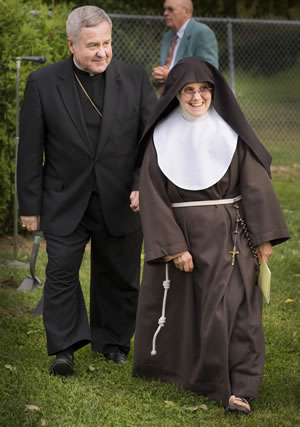
St. Louis Archbishop Robert J. Carlson walks with Sister Mary Michael, a Poor Clare nun, after a 2009 groundbreaking ceremony in St. Louis.

The theme of Pope Benedict XVI’s message for the upcoming World Day of Prayer for Vocations points to the important role Catholic home life plays in the promotion of vocations to the priesthood and religious life, said Archbishop Robert J. Carlson of St. Louis. [Formerly Auxiliary Bishop of the Archdiocese of St. Paul and Minneapolis, Bishop of Sioux Falls, SD, and Bishop of Saginaw, MI].

“The theme which the Holy Father chose places the burden on the local church to reflect on how it develops a culture of vocations,” said the archbishop, chairman of the U.S. Conference of Catholic Bishops’ Committee on Clergy, Consecrated Life and Vocations. “We know that the vocation comes out of the home.”

The papal message for the day of prayer, which will be observed May 15, was released Feb. 10 at the Vatican. The 2011 theme is “Proposing Vocations in the Local Church.”

“Every Christian community, every member of the church needs consciously to feel responsibility for promoting vocations,” especially in an era when God’s voice “seems to be drowned out by ‘other voices’ and his invitation to follow him by the gift of one’s own life may seem too difficult,” the pope said.

Pope Paul VI instituted the day of prayer in 1964 as a way for Catholics to focus on and pray for vocations.

In an interview with Catholic News Service while he was in Washington in March, Archbishop Carlson said the majority of newly ordained priests said they were influenced by the parish in their discernment for the priesthood.

According to results of a survey of members of the 2011 ordination class, released April 25, 66 percent of the respondents said it was their parish priest who encouraged them. Forty-two percent identified their mothers as having a major influence on their decision.

The annual national survey is conducted by the Center for Applied Research in the Apostolate at Georgetown University for the USCCB’s Secretariat of Clergy, Consecrated Life and Vocations.

CARA contacted ordinands by email, phone or fax to explain the survey; asked them to complete a brief survey online; and then followed up with respondents by email, phone or fax. This year, CARA reported that the response rate was 69 percent; 329 ordinands responded out of a total of 480 identified by theologates, houses of formation, religious institutes, and archdioceses and dioceses.

Survey results also showed that the average age of ordinands in the class of 2011 is 34. More than nine in 10, or 94 percent, reported they had some type of full-time work experience prior to entering the seminary, most often in education. On average, ordinands reported they were about 16 when they first considered becoming a priest.

Archbishop Carlson said parishes need to find a way to encourage the wider community to be more supportive of young men who choose a vocation to the priesthood, since many of them begin the discernment process at age 16.

Nine in 10 ordinands reported being encouraged to consider the priesthood by someone in their life. Of those responding ordinands who reported that they were encouraged to consider the priesthood, two in three (66 percent) say they were encouraged by a parish priest.

The survey showed that 57 percent of ordinands in the class of 2011 said they were discouraged from pursuing a vocation by friends and classmates; 52 percent said they were discouraged by a parent or other family member.

“Most young people don’t understand what discernment is all about,” Archbishop Carlson told CNS while he was in Washington to attend bishops’ committee meetings. “They have not been taught from the pulpit or in the religion classes how to discern.”

The archbishop said he was interested in the influence Catholic education had on vocations this year. Results showed that 47 percent of the ordinands surveyed went to a Catholic elementary school and were somewhat more likely to attend Catholic high school. Thirty-nine percent of them attended a Catholic university or college, compared to 7 percent of all U.S. Catholic adults.

“We are going to make sure our Newman chaplains and our campus ministers are talking to young people about vocations,” the archbishop added.

Asked if the clergy sex abuse scandal had had any effect on vocations, Archbishop Carlson said it has not affected the interest or number of vocations. He noted that the survey showed that amid this challenge, more young people are responding to vocations.

“They were not involved in the scandal, and they believe that as they live out their vocation they can make the whole community, the body of Christ, stronger,” he said.

The 2011 survey also showed a continued pattern of growing cultural diversity in the ordination class, especially religious order priests. Ten percent of the class are Asian/Native Hawaiian/Pacific Islander; 4 percent of the U.S. Catholic population are Asian.

Fifteen percent said they were Hispanic/Latino; by contrast, about 34 percent of the U.S. adult Catholics are Hispanic/Latino. The remaining results showed 69 percent are Caucasian, 5 percent African-American and 1 percent other.

“There is a beautiful mixture of the people who make up the church in the U.S.,” said Archbishop Carlson, but added there was a need to foster vocations in the Hispanic/Latino community to address the needs of that growing segment of the U.S. Catholic Church.

For young men, parents and youth ministers who have questions on the discernment process, every diocese has a local website and vocation director’s office. The USCCB also has a website http://www.ForYourVocation.org. According to the 2011 survey, the majority of young people turn to such websites for information first, said Archbishop Carlson.

The archbishop said he prays that those discerning the priesthood will have the courage to listen and respond to their vocation.

“We invite them to listen to what they are hearing deep within themselves as to how God might want them to live their life,” said the archbishop. “And then (we) give them the support so they can have the courage to say yes.” Catholic Spirit

Tuesday, February 1, 2011

Abp. Thomas Gullickson, Papal Nuncius in the Caribbean, with sharp words about bishops who resist Summorum Pontificum.

.
Archbishop Gullickson is originally a priest from Sioux Falls. He was born in Sioux City, Iowa, on 14 August 1950 and was ordained to the priesthood on 27 June 1976. He has a degree in Canon Law and speaks English, Italian, French and German.

Archbishop Gullickson entered the diplomatic service of the Holy See on May 1, 1985 and has been appointed successively to the Diplomatic Missions in Rwanda, Austria, Czechoslovakia, Jerusalem and Palestine and Germany.

Father Z's Emphases and Comments.

Yesterday we saw with the help of Rorate and Messa in Latino that an Italian bishop had some things to say about other bishops who resist Pope Benedict’s visions and provisions.

Today, our friends at NLM clue us in about the remarks of a Papal Nuncius concerning bishops and others who resist Summorum Pontificum.

My emphases and comments:

In his homily for last Sunday, January 30, 2011, the Apostolic Nuncio to the Antilles Islands, H.E. Most Rev. Thomas E. Gullickson [WDTPRS has written about the Archbishop before HERE. He is an American, a priest of Sioux Falls.], Titular Archbishop of Bomarzo, had some pointed remarks about bishops resisting the implementation of the motu proprio Summorum Pontificum:

Why, even three years after the issuance of Summorum Pontificum (just to name one example), are well-meaning lay folk still treated with such great disdain by no less than bishops, bishops in communion (of heart, soul, mind and strength?) with the Successor of St. Peter when they ask for Mass in Latin? Is this anything other than blind hypocrisy (the plank!)? [This is great... this should qualify him for instant promotion....] You tolerate no small amount of bad taste, bad music and caprice, while begrudging some few a port in the storm of liturgical abuse which seems not to want to subside? [And that "few" is slowly growing larger.] Can we be after His own Heart and not just claim to be members of Christ’s Body while still acting so at odds with the example set by the Holy One of God, meek and humble of heart? Such prelates are at counter or cross purposes to the sense in which the Church wants to go; they are ignoring what the Spirit is saying to the Churches and doing so with a backhand to some who are branded common and contemptible, but certainly not in the eyes of Christ… Let me say it more clearly! My issue is with the contempt shown for an outstretched hand, contempt such as would not be shown toward someone asking for some other benefit.

When the Holy Father speaks of his will to see these two forms of the Roman Rite (ordinary and extraordinary) enrich each other, when he and others express eagerness for a recovery of the sense of the sacred in our churches and in how we worship, I am convinced that he has indicated the true nature of the rupture which has indeed occurred and needs to be mended or healed. You would think that those in communion with the Pope would seek to understand him and embrace his point of view. There is too much room for caprice and hence the need to reform contemporary Catholic worship. This is evidenced time and again, by way of one example, in the sense of helplessness many priests experience when confronted by musical groups moving into church with inappropriate repertoires, not to mention the dance and puppet troupes which should have been banished long ago. If a bishop does not want to discipline at least he can respect and foster those seeking good order. [This underscores how Summorum Pontificum was a huge gift to priests. It was the first document in a long time that actually did something concrete to help priests.]
Archbishop Gullickson has spoken out repeatedly about both the usus antiquior and the reform of the reform; have a look at his thoughts here.

He also implements these thoughts practically: In 2009, he began to exclusively celebrate Holy Mass ad orientem in the chapel of the Apostolic Nunciature in Port of Spain, Trinidad & Tobago. See his detailed explanation here.

Sunday, January 2, 2011

Fr. Steve Biegler fills in for bishop in Diocese of Rapid City

.

The Rev. Steve Biegler has been running the Diocese of Rapid City in the absence of a bishop. Biegler is one of the Rapid City Journal's 11 in 2011. (Ryan Soderlin/Journal staff)

He does not get to wear a mitre or carry a crosier, but as the diocesan administrator for the Diocese of Rapid City, the Rev. Steve Biegler has most of the authority of a bishop.

“The hat and the stick? No … the crosier and mitre don’t go with the job,” said Biegler, describing the temporary position that has him leading the diocese in the absence of its bishop.

Western South Dakota Catholics have been without a bishop since September, when Bishop Blase Cupich left for the Diocese of Spokane. Biegler, 51, was chosen to manage the daily affairs of the diocese until a new bishop is appointed, which could happen as early as May or June, he predicts, or might take a year or longer.

Biegler can, however, perform confirmations, preside at diocesan-wide celebrations, admit seminarians and vote as a member of the U.S. Conference of Catholic Bishops — which he did at the conference’s most recent meeting in Baltimore.

The 51-year-old Catholic cleric, who grew up on a Timber Lake cattle ranch in a family of 13 children, didn’t go to seminary until he was 27. Educated in Rome and fluent in Italian, Biegler also was tapped by the diocese to oversee its Terra Sancta project, an ambitious $10 million-plus renovation that will convert the former St. Martin Monastery property into a spiritual retreat center and Catholic elementary school.

Like most big remodeling projects, Terra Sancta is complicated, especially since it is essentially two projects sharing one fundraising budget.

“It’s exciting. Is it a headache some days? Sure, but it’s exciting,” he said.

Doing double duty as diocesan administrator and a construction project manager is exhilarating, not exhausting, Biegler says.

But no matter how efficiently a diocese operates without a bishop in place, its people are anxious for a spiritual shepherd, Biegler said.

“Without a bishop, there’s something missing in the diocese,” he said. Rapid City Journal

Sunday, October 3, 2010

All new life shows us 'God's smile', Archbishop Carlson teaches

.

Archbishop Robert Carlson of St. Louis

Taking as his theme the statement of Pope Benedict XVI, that “every child brings us God's smile,” Archbishop Robert Carlson of St. Louis wrote on Wednesday that the defense of all members of humanity, from conception to natural death, is ultimately rooted in joy and gratitude for God's gift of life. Archbishop Carlson is a former Auxiliary Bishop of St. Paul and Minneapolis and a Bishop of Sioux Falls and Saginaw, Michigan

God, the archbishop taught, is “not cold or uncaring,” but “loving and joyful,” creating the universe and every human person for the sake of love. Archbishop Carlson expressed his thoughts in the St. Louis Review, in anticipation of this year's Respect Life Sunday on October 3.

“At just 11 weeks in the womb,” he observed, “an unborn child smiles. Skeptics say this is simply an involuntary contraction of face muscles. People of faith know better. We believe that this unborn child has already begun his or her lifelong journey as a child of God.”

“Because we are confident that every child brings us God's smile, we believe that the smiling child in his or her mother's womb is telling us something important.”

The same goodness of God, the archbishop pointed out, could be seen throughout nature. “Out of God's goodness comes all of creation - with its natural wonders, its breathtaking loveliness, and its marvelous diversity,” he enthused. “Minerals, plants, animals and human beings all come into existence because of the goodness of God.”

“Our human sinfulness,” the archbishop taught, causes us to “turn the smile (God) gave us into a frown or a scowl or even bitter tears. But that is not the way God made us.” Rather, he explained, we are meant to love and protect one another, understanding that “life is a precious gift to be treasured and nurtured and shared.”

Life's beginning and end, he said, both illustrate this truth vividly. “The innocence of the unborn child, and the vulnerability of those who are unable to care for themselves because of sickness or old age, remind us that we are responsible for supporting and caring for each other.”

The prelate warned that those who treat persons as an inconvenience or burden, are in reality only dehumanizing themselves.

“How we care for an unexpected child, a parent suffering from cognitive impairment or an infant with a disability does not reflect the degree of their humanity, but our own,” he stated. “We are as dependent on them as they are on us.”

“Every child, at every age of development, brings us God's smile and invites us to smile in return,” he continued, “to be grateful and loving and generous in sharing God's wonderful gift of life with others.”

Evoking Christ's central precept to “love one another as I have loved you,” Archbishop Carlson frankly described both the rigor and the beauty of a true respect for life. “There are be no compromise with the standard Jesus set and continually calls us to,” he affirmed. “The measure of love is to love without measure!” Catholic News Agency

Friday, July 9, 2010

Archbishop Carlson: Good Catholics cannot be pro-choice; The Fifth Commandment demands respect for life as God's most precious gift

.
Archbishop Robert Carlson of St. Louis, former auxiliary in St. Paul-Minneapolis and Bishop of Sioux Falls and Saginaw, Michigan:
God's law in the Old Testament is clear and unambiguous: You shall not kill. Jesus is even more demanding: Every one who is angry is liable to judgment.

Sins against the Fifth Commandment are easy to commit. Any time we think, speak or act out of anger or hatred or jealousy or revenge, we abuse God's commandment that we respect His most precious gift, the gift of life — especially human life.

Human life is sacred because, from its beginning until its natural end, it involves the creative action of God. The Fifth Commandment forbids direct and intentional killing as gravely sinful. God alone is the Lord of life. No one has the right to end arbitrarily what God has begun, and sustained, through the gift of His love.

In the account of Abel's murder by Cain (Genesis 4:8-12), Scripture reveals the presence of anger and envy in humankind, consequences of original sin, from the beginning of recorded history. God declares this as wicked, and He asks the question to be answered over the ages: "What have you done?" Today this question is asked not only of those who kill someone, but also of those responsible for violence, anger, hatred and vengeance in any form.

It is a shame that there are so many violent words expressed between members of the same family day in and day out. Anger and intolerance are also pervasive in our Church and in society. Such attitudes are destructive and sinful. They are of the Evil One and not of God.

The Fifth Commandment does not stop someone from self defense, because someone who defends his or her own life is not guilty of murder. Legitimate defense can be not only a right but also a grave duty for someone responsible for another's life, the common good of the family or the security of a nation. We risk our lives to protect ourselves and others because we value human life and freedom so dearly. They are gifts from God that we are bound to cherish and defend.

Since the first century, the Church has addressed the moral evil of abortion and the killing of a defenseless baby in the womb. People who are casual about the sin of abortion and who choose to view it as a political issue rather than the serious moral issue that it is are guilty of violating the Fifth Commandment. You cannot be "pro-choice" (pro-abortion) and remain a Catholic in good standing. That's why the Church asks those who maintain this position not to receive holy Communion. We are not being mean or judgmental, we are simply acknowledging the fact that such a stance is objectively and seriously sinful and is radically inconsistent with the Christian way of life.

The Fathers of the Second Vatican Council said, "God, the Lord of life, has entrusted to men the noble mission of safeguarding life, and human life must be protected with the utmost care from the moment of conception: Abortion and infanticide are abominable crimes" ("Gaudium et Spes," No. 51.3). That's why formal cooperation in an abortion constitutes a grave offense. The Church attaches the canonical penalty of excommunication to this crime against human life (see canons 1398,1314, and 1323-1324).

The Fifth Commandment also directs us to work for justice and peace — avoiding war whenever possible — and to limit the use of capital punishment to the most extreme (and rare) circumstances required to protect human life. Only God has the right to take the life of another human being. When we take that action into our own hands — in self-defense or in defense of others — we had better be sure that all other options have been exhausted!

In addition, euthanasia or deliberately taking of the life of someone who is sick, dying, disabled or mentally ill is morally unacceptable. The Church calls for the ordinary care owed to a sick person, but medical procedures that are burdensome, dangerous or extraordinary are not necessary. If you are unsure about the moral implications of health care procedures that are being proposed for someone you love, contact your pastor or the archdiocese's Respect Life Apostolate. They will be happy to help you consider approaches that are in accordance with our Church's teaching about care for those who are sick or dying.

Taking proper care of our health, respecting others and showing respect for the dead are all matters covered by the Fifth Commandment's demand that we reverence God's most precious gift — human life. St. Louis Review

Friday, June 25, 2010

Diocese of Sioux Falls to Sponsor Chant Camp for Children and an Intro to the Pipe Organ for Junior High and High Schoolers

.

If a geezer like me can learn some chant, it should be a piece of cake for your kids who sing rock music at the top of their lungs around the house.

July 12-16, 10:00am – 3:00pm

A week-long day camp for Catholic children, ages 7-13, exploring the basics of Gregorian Chant in a fun and prayer-filled environment. The students will discover the beauty of ancient psalm-tones and Gregorian melodies and sing the Holy Mass every day while being challenged in the areas of music theory, composition, and conducting.

St. Joseph Cathedral School, 523 N. Duluth Ave. Sioux Falls, SD

Registration forms and more information available by downloading the brochure:


A pipe organ encounter for piano students and beginning organists (ages 12+) that will include an in-depth orientation to the pipe organ, its complex components and exciting abilities. Students will get several hours of private instruction and hands-on
opportunities on local instruments, a tour of pipe organs, and a thrilling virtuosic performance by a professional concert organist.

Friday, July 30th
10am-4pm field trip to National Music Museum in Vermillion (optional, add’l charge)
7:00pm Concert: Organist Chad Winterfeldt, DMA
Augustana’s Reconciliation Chapel
open to the public, suggested donation: $10/person

Saturday, July 31st
9:00am Pipe organ encounter group class at First Congregational Church
10am-12pm Local Organ “crawl”, tour of instruments in downtown Sioux Falls
12pm-1pm Pizza Lunch provided
1pm-3pm Private Instruction on area instruments
3:30pm Concert by area high school organists
4:00pm dismissal and pick up at First Congregational Church


Costs: Saturday Event: $30/student, includes lunch and handouts
additional optional Friday Vermillion Trip : $20

To Register, please print, send information and checks payable to:
SDAGO
attn: Lisa Knutson, 220 N. Summit Avenue, Sioux Falls, SD 57104
for questions, please email: ldknutson@gmail.com

Tuesday, March 9, 2010

St. Joseph's Cathedral beautificatiion, Sioux Falls

.
.
There's been a lot of progress made to the St. Joseph's Cathedral. The Catholic Church is undergoing a $16 million makeover and Monday, we got a tour of the inside where the beautification phase is well underway.

Crews began renovating the Cathedral last June, a tall order when you're talking about a 60-foot ceiling.

"It's very exciting. We are at a stage where we can see some of what's coming. The painting, which is part of the beautification. We have some wonderful things to show now," Bishop Paul Swain said.

The bishop is talking about all the detailed paintings in the alter area and at the side stations. They were once all one color, but with labor intensive painting, the church is beginning to show its true colors.

"It really is exciting because it's more than we anticipated. I have had priests who have come in here who served years ago and said, 'I didn't even know that was there.' So the beauty is coming out and what a gift that is," Swain said.

All the wiring and electrical work have been replaced, which was a huge safety concern. With it complete, the Catholic Church will now have air conditioning for the first time, plus the church will be able to stream church services on the internet.

The bishop says all the scaffolding will be out by June and then they can begin the next phase: installing the marble floor. It will come from Italy.

"They'll lay it out there in pieces and then they'll bring it here and put it together in pieces like a jigsaw puzzle, so hopefully their directions are accurate," Swain said.

The work on the Cathedral is expected to be done by the summer of 2011. KELO-TV

Tuesday, January 26, 2010

Bishop Kettler of Fairbanks, formerly of Sioux Falls, starts abuse reconciliation mission

.
For Bishop Donald Kettler, Monday’s bankruptcy settlement is taking him on a continuing journey he began in August 2002 when he was ordained the fifth bishop of the Fairbanks Catholic Diocese.

Kettler’s appointment came 22 months after the death of the Most Rev. Michael Kaniecki in 2000 and when the Catholic sexual abuse cases were just being publicly filed.

In a 2002 interview, the former Sioux Falls, S.D. parish priest and canon lawyer said he had just six hours to accept or reject the vacant Fairbanks bishopric.

“It was a shock; I didn’t expect it,” Kettler said at the time. “It was too much to be a coincidence.”

In the nine years since, Kettler has been at the center of hundreds of sexual abuse lawsuits levied against the missionary diocese. In March 2008, the diocese declared bankruptcy.

Following Monday’s reorganization settlement and as the diocese emerges from bankruptcy, Kettler faces a new deadline from by the Creditors Committee, which represents nearly 300 abuse victims.

A non-monetary section of the settlement puts the burden of making personal amends to the hundreds of abuse victims and their communities on the bishop.

Kettler will be making personal visits to apologize to victims who wish to meet with him, and he will read a statement of apology from the pulpit in communities where abuse took place and encourage parishioners to support victims. He will also hold healing ceremonies and continue holding listening sessions.

“It was something we had hoped for and it said to me you’ve got a lot of work to do for healing, and a lot more work yet to do.

“I have no objection. Most of what they asked us to do I had already started to do,” Kettler said. “It will be my primary task.”

The bishop’s list of directives is extensive and specific. It ranges from identifying by name all the sexual abuse perpetrators who have served in the diocese to encouraging all future abuse victims to report abuse to law enforcement or health care professionals.

All of Kettler’s visits to rural parishes will have to be publicized in advance in specific places announced on radio station KNOM in Nome.

In addition, a general letter of apology will be posted for 10 years on the diocese Web site with the names of suspected abusers.

Kettler said he is going to ask an Intercultural Advisory Group in the Yukon-Kuskokwim region for advice on how to communicate the message he wants to give in the healing services.

At Monday’s court hearing, California attorney James Stang, representing the abuse victims, said it was an honor to represent Alaska constituency.

Stang, who has been involved with five other similar diocese bankruptcy cases, said, “These people are certainly unique and their ability to come forward is a testament to their bravery. The remoteness of people from each other makes it more extraordinary.”

“This has been mostly about money,” Stang said, referring to the settlement. “But those non-monetary provisions are just as important, if not more important. All we want to make sure is that this does not happen to anyone ever again.

“Oftentimes, this is a final chapter, but there is no final chapter for the survivors. This case has become part of who they are. It just doesn’t end with them. It affects their children, their grandchildren and it affects the whole Alaska society.”

Friday, January 22, 2010

Sioux Falls Church Realignment Proposal Spurs Debate

.
MessagAfter six months of study and discussion, a Catholic study group unanimously approved this week its final recommendations for allocating four priests among 10 area parishes including Yankton. However, the 10 parish representatives expressed strong differences of opinion — and high levels of passion — throughout the process.

In fact, Monday’s meeting in Lesterville produced a 6-4 vote on one proposal. At the end of the evening, all of the members voted for the final package of one preferred proposal and two alternatives.

In the end, Bishop Paul Swain of the Sioux Falls Diocese could reject all recommendations, said Deacon Roger Heidt, the diocesan planning director. Proposals are limited to four priests in the region, with no priest celebrating more than three Masses per weekend. “Once the bishop makes a decision and announces it, he will come to one of these parishes and have a meeting,” Heidt told the group Monday. “He will answer questions and discuss his decision with you.”

The Yankton study group’s major discussion has fallen along three lines. Members have talked about the needs of the two Yankton parishes with a combined 2,100 families; keeping alive rural churches that might be closed; and which parishes should be combined under one priest.

Swain has said changes are needed because of a growing priest shortage in the diocese, covering the eastern half of South Dakota. Swain will receive the Yankton study group’s proposals later this month.


The proposals will also be sent to the diocesan planning committee, priest council and affected pastors. The preferred proposal would have one priest at St. Benedict in Yankton; two priests (a pastor and associate pastor) at Sacred Heart in Yankton; and one priest at Tabor, Scotland and Lesterville. The Sacred Heart associate pastor would also celebrate Mass at Sigel and Mayfield parishes on alternating weekends. He would provide other leadership and sacramental ministry in those parishes.

In addition, Springfield and Tyndall parishes would move to another planning group and unite with Assumption Church of Dante. It is also proposed that the pastor of these parishes be responsible for ministry at the state prison and academy in Springfield. Finally, St. Boniface of Idylwilde (rural Freeman) would be assigned to a group of parishes that includes Parker and Lennox.

A Heavy Burden

During Monday’s meeting, study group members talked about the priests’ possible workload. The two Yankton members — Lori Leader of St. Benedict and Colleen Chase of Sacred Heart — noted an even greater burden on priests if they are required to serve three or even four parishes.

The proposals place the weight on the priests, not the parishioners, Leader said. “I have some concern of the message being sent to Bishop Swain,” she said. “All three plans we send, only one group is sacrificial here, and it’s the priests. I don’t think we as a people are being very sacrificial.” Leader worried the heavy workload would lead to burnout or even worse for the priests. “There is only so much that humans can do and take. You can only stretch them so far,” she said. “Then, they may have guilt because they feel they are not doing what they have taken vows to do, and they can have depression.”

Leader fears that men will leave or not enter the priesthood if they face an overload of responsibilities. “They lead by emotion. I have family and friends who are in the priesthood, and I know their struggles,” she said. “They are not going to be too interested if they are going to be running (many) parishes. They will not be taking vocations.”

Chase believed the study group discussions were moving the wrong way. Under the proposals, the priests were being forced to travel long distances to serve multiple parishes, she said. “With the bishop’s proposal, we are (supposed to be) bringing people to the priests. Here, the priests are being taken to the people,” she said.
“I think we are changing it around (with these proposals). For the priests of Yankton to take it on and travel all over, I don’t know if it’s feasible.”

However, study group member Joe Healy of St. Columba at Mayfield said the rural parishes are taking on a share of the burden. “I thought that Tyndall and Springfield are willing to sacrifice, and Mayfield and Sigel are willing to accept alternating Masses,” he said. “I think we try to do the best we can to help out the priests with the work they do.”

The rural parishioners’ needs must be met, said study group member Lawrence Andersen of Idylwilde. “What would you do, throw these smaller parishes to the wolves? They need to be served,” he said.

Looking At The Numbers

The Yankton deanery shows a wide variety of membership among area parishes. In 2012, the diocesan Web site forecasts there will be 119 households for St. Boniface at Idylwilde, 158 for St. George at Scotland, 228 for St. Wenceslaus at Tabor, 306 for St. Leo at Tyndall, 875 for St. Benedict and 1,234 for Sacred Heart. The Web site does not list 2012 estimates for four other parishes, which would no longer have regular liturgies under a current plan. However, the diocese currently lists 37 families for St. Agnes at Sigel, 53 for St. Vincent at Springfield and 44 for St. Columba at Mayfield. Another parish, St. John the Baptist at Lesterville, did not have figures listed for it.

The small churches offer a strong bond and should be kept alive, said study group member Bernie Hunhoff of St. Agnes at Sigel. “Smaller parishes have value. We have 180 or more parishes that have already consolidated,” he said. “I don’t think you just come and say, ‘You’re closed.’” The bishop did not allow the study group to include options such as foreign priests and retired priests, Hunhoff said. He hopes those avenues are restored. “We can send a message that small parishes are very important if they are viable and active,” he said. The priest shortage affects more than just small churches, Hunhoff said. “It’s gotten to the point where we won’t have enough priests for larger parishes,” he said. “We have to make it work in the future with fewer priests.”

Andersen worried that rural parishioners will lose their close-knit relationships if they are forced to attend large parishes.

It’s up to each Catholic to strengthen his or her faith, Leader responded. “You can be as involved as you want to be,” she said. “You can be as active as you want in a large parish, or as lost as you want to be in a small parish. You can be as involved or you can get lost in either parish.”

Parish membership is not the only measure of a priest’s workload, Heidt said. The number of Masses, sacraments and ministries are also part of everyday life, he said.

Under one of the study group’s proposal, Sacred Heart Church in Yankton will be cut from the current four Masses per weekend to three.

That could create problems for the proposal, said study group member Martin Sieverding of St. George in Scotland. “I believe the sticking point (is limiting) Sacred Heart to three Masses and one priest,” he said. “There isn’t enough for two but too many for one.” On the other hand, priests serving multiple rural parishes face challenges, Sieverding said. “If you take into account the prep time for a Mass or funeral, then you need to take drive time into account,” he said.

Discussion also arose over the possible grouping of parishes under one priest.

Ken Kocer, a study group member from St. Wenceslaus of Tabor, recommended some changes among the proposals’ parish assignments. “I don’t think the load is fairly distributed,” he said. “Putting Tyndall and Tabor together is a big load.”

Sieverding agreed, suggesting a swap of Scotland and Lesterville under one proposal. He also expressed concern about confusion over alternating Mass times under the proposals.

The meeting featured one newcomer, as Greg Schneider of St. Leo in Tyndall filled in for regular member John Cihak. “It’s been a difficult process,” Schneider said. “The group did the best it could with the parameters before you. I commend you from a spectator’s point of view.”

Keeping The Faith

Monday’s meeting drew reaction when the floor was opened for audience comments. One man said priests should expect to work long hours and travel great distances. “If Jesus would tell His disciples that they don’t have to go away, where would Christianity be?” he asked. “If you go into the priesthood, (you) have to travel from Day One.” The audience member said traveling priests make financial sense. “With this economy, all these people travel to one priest who is further away than one priest who comes closer to the people, with the parish paying for the gas?” he asked. “Should we always expect to go to the priest, when he could go to the people and spread the Word?”

One woman wondered if the Broom Tree diocesan retreat, near Irene, couldn’t be incorporated with parish activities at St. Columba at Mayfield and St. Agnes at Sigel.

Heidt commended the study group members for their dedication. “It’s a long process, but it’s really important to go through the process,” he said.

While the seven planning meetings sparked spirited discussion, they also brought a sense of hope and optimism for the area parishes. Many of the meetings drew a full room, as audience members spoke of the importance of their Catholic faith and keeping their parishes alive.

The planning process has brought numerous benefits, Heidt said. “It’s a blessing for us to come out and learn about the deep faith that people have,” he said. “The Catholic faith is important to us as individuals and as a community. I’m glad to see the deep faith in these communities.”

After growing up on a small farm near a small town, Father Bob Lacey of Sacred Heart Church in Yankton said he understands the passion for rural parishes. “I have been (assigned) to Aberdeen and Pierre, and now here, and it’s been a great blessing to serve so many parishes,” he said. “I look forward to serving you (rural parishes) someday.”

Similar optimism was expressed by Father Joe Puthenkulathil of St. Wenceslaus Church in Tabor and St. John the Baptist Church in Lesterville. “I am grateful to all of you,” he told the audience. “I hope they find a way to keep all of these parishes open.” Yankton Press & Dakotan


Monday, January 4, 2010

Search for a new bishop shrouded in secrecy

.
There have been quite a few episcopal appointments in the area in recent years.


2002 -- Fr. Donald Kettler of Sioux Falls became Bishop of Fairbanks, Alaska.
2004 -- Bishop Raymond Burke of La Crosse became Archbishop of St. Louis and then in 2008 went to Rome
2004 -- Bishop Robert Carlson (formerly an Auxiliary in St. Paul-Minneapolis) left Sioux Falls for Saginaw and then went as Archbishop to St. Louis in 2008
2004 -- Auxiliary Bishop Jerome Listecki replaced Bishop Burke in La Crosse, coming from Chicago, and then today replaced Archbishop Tim Dolan, now in New York, in Milwaukee
2004 -- Bishop Daniel Di Nardo of Sioux City headed off to Galveston-Houston as Archbishop and soon thereafter as Cardinal
2006 -- Fr. Ralph Nickless came from Denver to fill the vacancy in Sioux City as Bishop
2006 -- Fr. Paul Swain came from Madison to fill the vacancy as Bishop of Sioux Falls that had been overlooked because of the simliarity of names, it is thought.
2007 -- Fr. Michael Hoeppner went from Winona to Crookston to fill the vacancy caused by the retirement of Bishop Victor Balke.
2007 -- Fr. Peter Christensen went from Nativity Parish in St. Paul to Superior to fill the vacancy caused by the retirement of Bishop Raphael Fliss.

2008 -- Bishop John Nienstedt, originally from Detroit, came to St. Paul Minneapolis from New Ulm as Coadjutor Archbishop. He succeeded in 2009
2008 -- Fr. John LeVoir went from St Paul Minneapolis to New Ulm to fill the vacancy caused by the departure of Archbishop Nienstedt.
2008 --Auxiliary Bishop Richard Pates in St. Paul Minneapolis went to Des Moines as Bishop
2008 --Auxiliary Bishop John Quinn came from Detroit to Winona to fill the vacancy caused by the retirement of Bishop Bernard Harrington.
2009 -- Fr. Lee Piche' became the Auxiliary Bishop in St. Paul Minneapolis
2009 -- Bishop Dennis Schnurr of Duluth went to Cincinnati as Coadjutor Archbishop and just recently succeeded.
2009 -- Fr. Paul Sirba just became Bishop of Duluth.

So where do all these bishops come from? How do they decide in Rome who gets to be a bishop and who gets moved or promoted? The Diocese of Scranton, Pennsylvania, is now awaiting the appointment of a successor to their bishop who retired for health reasons. The newspaper there has printed an informative article on the appointment process.


Four months after Bishop Joseph F. Martino resigned as head of the Roman Catholic Diocese of Scranton, the search for his successor is well under way. But the exact progress of the search is unclear because the timeline for selecting a bishop is not fixed and the process is largely kept secret.

A spokesman for the diocese declined to specify the status of the process or to say whether the diocese's administrators have submitted a report on the condition and needs of the diocese to the Vatican's ambassador, or apostolic nuncio, in Washington, D.C. - an early step in the process of appointing any diocesan bishop.

In a written statement, spokesman William Genello said, "The process to select a new bishop typically includes inquiries by the papal nuncio to people in the diocese, regarding conditions in the diocese and potential candidates. This is confidential. It is not known who might have been contacted."

The clearest timeline for the selection process was outlined by Cardinal Justin Rigali, the apostolic administrator of the diocese who also sits on a key Vatican council that helps select bishops, on the day that Bishop Martino's resignation was accepted by the Vatican.

"I would hope - and it is only my hope - I would hope that within six months we would have a bishop," he said during an Aug. 31 press conference. "Maybe sooner, maybe it will take longer."

If the selection process takes six months, which would fall around the end of February, the appointment of Martino's successor will have taken far less time than many appointments of U.S. bishops. The four vacant sees most recently filled in the U.S. waited an average of a year to receive a new leader.

The process for selecting a bishop begins before a see is vacant. During periodic meetings, the bishops in each province vote on well-regarded priests to add to a list of potential bishops to be sent to the nuncio. Scranton is part of a statewide province whose metropolitan is Rigali, the head of the Archdiocese of Philadelphia.

Once a bishop resigns, is appointed elsewhere, or reaches the retirement age of 75, the nuncio, currently Archbishop Pietro Sambi, requests a report from the leader of the diocese about its condition, needs and challenges. The nuncio also does his own investigation into the needs of the diocese and suitable candidates to lead it. He consults past bishops of the diocese, other bishops in the province and around the country, and the metropolitan. He may also consult priests and lay members of the diocese.

Once he narrows the list to a handful of candidates, the nuncio sends confidential questionnaires to people who know the candidates, including priests, religious and well-respected laity. Those who receive the questionnaire are bound by the code of papal secrecy: they cannot tell anyone that they have received the letters or what they write in response.

The nuncio then gathers the information and writes a report including a list of three candidates, a terna, and notes his preference, which he sends to the Congregation for Bishops at the Vatican, the body of about 30 cardinals, including Rigali, that oversees the selection process.

An English-speaking cardinal assigned to review the Scranton position studies the file and makes a recommendation to the body of cardinals at one of its twice-monthly meetings. The congregation then votes for its preferred choice, which may not be the same as that selected by the nuncio or the presenting cardinal, or it may ask for more information or to be given a new terna.

Once the congregation agrees on its choice, that information is passed on to the pope during a Saturday meeting with the head, or prefect, of the congregation. The pope can follow the council's recommendation or, in a rare case, make a different decision. He is ultimately responsible for selecting the bishop. The Citizens' Voice


In further musing on the subject of the appointment of bishops, I am struck by the fact that there is indeed another factor in the nominations. Some cardinals, understandably with lots of connections in Rome, have a reputation as heads of "bishop factories" and are able to get deserving priests and bishops from their archdiocese or province (group of dioceses which they head) appointed as bishops in other parts of the country. Right now Cardinals Mahony of Los Angeles, Rigali of Philadelphia and Retired Cardinal Maida of Detroit are known for this. Cardinal Law of Boston was known for it also.


Wednesday, December 30, 2009

Sioux Falls Diocese Narrowing Options When it Comes to Reducing Parishes

.
The decision regarding how many priests should serve area parishes came one step closer to the end Tuesday night.

The Catholic Diocese of Sioux Falls — which covers the eastern half of South Dakota — is facing a shortage of priests in the next decade, which puts some area parishes at risk of closing. A 10-member study group that has been looking for alternatives; the group settled on its three main options Tuesday night at a meeting at St. Leo Catholic Church in Tyndall.

“We’re going from six priests to four priests in this area some time in the future,” said Deacon John Devlin, who represented the diocese at the meeting. “It depends on some decisions by the bishop, and it depends on retirements and things like that — but the reality is, it’s going to happen.”

The first proposal calls for a priest from Dante to serve Tyndall and Springfield, with another priest serving Tabor, Scotland and Lesterville, and three priests serving Yankton, Mayfield and Sigel.

The second proposal calls for two priests in Yankton — one for St. Benedict and one for Sacred Heart — and two priests to serve a combination of Tabor, Tyndall, Springfield, Scotland, Lesterville, Sigel and Mayfield.

The third proposal calls for one priest to serve St. Benedict, two to serve at Sacred Heart (with one of them serving Scotland, Lesterville, Mayfield or Sigel) and one priest to serve Tyndall, Tabor, Springfield or Lesterville.


All three proposals specify that a parish in Idylwilde will be assigned to a group of churches in Lennox and Parker.

Ken Kocer of St. Wenceslaus in Tabor spoke in favor of the first proposal.

“I think it’s thinking out of the box, and it really serves the parishes in our area the best,” he said. “I think it’s the best way to serve our parishioners.”

Due to the number of parishes the priests would be serving under the proposals, Masses would have to be held on an alternating basis between communities.

This was not looked at favorably by some of the group members.

“I personally don’t like the idea of alternating Masses,” said Martin Sieverding of St. George in Scotland. “Would I want to go to Mass in Scotland one Sunday, and then have to go someplace else the next Sunday? After a period of time, how would I end up? Would I keep doing that, or would I go someplace else (to attend Mass)? And I’ve come to the conclusion I would go someplace else.”

Bernie Hunhoff of St. Agnes in Sigel said, “I think the saddest thing about this whole series of meetings ... is the way it’s kind of come down to what’s more important: the parish versus priests. And that’s a sad situation.”

The three proposals will be sent to Bishop Paul Swain of the Sioux Falls Diocese to be considered in his final decision.

A final meeting of the study group will be held at 6 p.m. Jan. 18 at St. John the Baptist Church in Lesterville.
Yankton Press & Dakotan

Sunday, December 27, 2009

Pew Research study shows South Dakota ranks in middle of U.S. states in attitudes, participation

.
An overwhelming majority of South Dakotans say they believe in God, but only about half of the state's residents say religion is very important in their lives, and a smaller portion than that attend services each week, according to a new survey examining religion.

The degree to which South Dakotans are religious ranks the state firmly in the middle of the pack compared to other states, according to findings by the Pew Research Center.

Mississippi, followed by several other Southern states, was tops in religious fervor, according to the survey, which asked questions about worship attendance, frequency of prayer, belief in God and religion's importance in one's life.

Some clergy in Sioux Falls said they would have expected South Dakota's ranking to be higher.

"Particularly in terms of volunteerism," said Father James Mason, pastor at St. Lambert's Parish. "When I had a rural parish, if I thought out loud, it got done. There was no one on staff; everyone just did the work."

Pastor Paul Stjernholm, senior pastor at Peace Lutheran Church, said he thinks the actions of people in South Dakota demonstrate their faith.

"When I look at what I'll call the quality of life that we have here in South Dakota, that is possible because there are people who are, though they might not be going to church every week, they are choosing to live their faith."

The Pew study shows that no state has worship attendance higher than 60 percent.

In Catholicism, Mason said, there is a strong emphasis on practice and the communal aspect of religion, which is atrophying across the country, not just here.

"We live in an individualistic society," Mason said, "People can believe in God and never practice the faith. We have lost the importance of community and the communal aspect that is essential. Catholic means universal, the coming together to celebrate the Eucharist."

He added: "I would say the most popular religion is 'me-ism,' where you can take a little bit of everything."

The other states at the top of the list in terms of how important religion ranks in the lives of citizens are Alabama, Arkansas, Louisiana, Tennessee and South Carolina, where at least seven in 10 people say religion is a big part of their lives.

At the other end of the spectrum, with populations professing the least importance of religion, are several Northeastern states - Rhode Island, Connecticut, Maine, Massachusetts, New Hampshire and Vermont - as well as Alaska. Fewer than four in 10 people in these states say religion is very important to them.

For South Dakotans, about 56 percent say religion is a big part of their lives, which also is the national average.

South Dakota's strongest showing in the survey results comes in the number of people who say they believe in God: 79 percent.

"That would be my observation," Stjernholm said. "Even people who haven't been in church five years or more, they still have a belief in God."

South Dakota falls slightly below the national average in fervor for prayer, with 58 percent of the population saying they pray at least once a day.

The portion of South Dakotans who attend weekly worship services is 42 percent, but the state with the highest attendance, Mississippi, has only 60 percent.

"This next generation of adults that is coming into its own, their entry place is not the worship services, the traditional entry point," Stjernholm said. "Their entry point is through being involved with the members of the church in activities outside of the church - service, or service projects or social activities."

That sort of religious participation was not addressed in this survey.

Building relationships with those involved in fellowship or study, Stjernholm said, then develops interest in the more traditional settings.

"Worship is the end of the process, not the beginning."
Sioux Falls Argus Leader

Tuesday, November 24, 2009

Restoring St. Joseph's Cathedral in Sioux Falls ... A "Beacon Of Hope".

.
Restoring St. Joseph's Cathedral...A "Beacon Of Hope".


Catholic Church officials say they are trying to restore what they call a "Beacon Of Hope" for all to enjoy. We were inside the Cathedral on Monday to see how the 16 million dollar project is coming to life.

It's an effort that's well underway at St. Joseph's Cathedral. The church is in its third and final phase of restoration. With 90 years of history in these walls, church officials say they're thrilled to be getting the Cathedral back to its original glory. And with the original architects vision in mind, they say they're giving the community something to look up to.

"We need beacons of hope in our culture these days and we are going to continue on after we are done," Bishop Paul Swain told us.

And from the restored wooden pews to marbleized columns, city officials say it will be a historic point of interest many will come to see.

Mayor Dave Munson: "When it's done, people will come and visit this facility and just be overwhelmed by the beauty of it."

Painters who specialize in restoration are hard at work, painting art renderings that will tell the story of the Catholic faith. When it's done, around 900 worshipers will be able to take in the sights many have been waiting anxiously for years to see.

Bishop Swain: "It means a lot to have it restored and people will say 'this is a beautiful place' and they will bring folks with them and it means a lot to people."

Church officials expect to have this final phase of the restoration completed by June or July of 2011.

And the Cathedral will be open to the public for its "Christmas At The Cathedral" concerts December 17 through 20. KSFY

Saturday, October 31, 2009

Diocese of Sioux Falls Opposes Embryonic Stem Cell Vote

.
Sioux Falls Catholic Diocese today asked it's 128-thousand parishoners to not support a movement to bring legalizing "embryonic stem cell research" to a public vote next year.

Tonight, we talk to Diocese Chancellor Jerry Klein and to the man behind the public vote effort, David Volk.

The statement from Sioux Falls Catholic Bishop Paul Swain was released this afternoon, urging Catholics in the diocese not to support a proposal to legalize embryonic stem cell research, saying in part "Catholics should not circulate or sign a petition to place it on the ballot".
Jerry Klein is the Chancellor of the Sioux Falls Catholic Diocese. "The church encourages research and particularly research that can help bring cures..." But the research the church supports involves adult stem cells, which can be harvested from people with minimal harm.
Klein says embryonic stem cells require the destruction of a human life. "The distinction needs to be made though that when that involves research that destroys life then there would be a concern about that."

The effort to legalize embryonic stem cell research is backed by former South Dakota State Treasurer David Volk. "I quite frankly respectfully disagree with the Bishop."

Volk tells Action News, embryonic stem cell research respects human life by easing the suffering of those with debilitating, fatal illnesses and believes it to be more effective than adult stem cell research. "The embryonic stem cells are much more flexible, much more capable of helping us find cures."

David Volk says tonight, the process of collecting signatures to bring embryonic stem cell research to a public vote will begin sometime next week. KSFY

Tuesday, October 27, 2009

Restoring a Treasure: The Cathedral of St. Joseph in Sioux Falls

.

The Diocese of Sioux Falls in South Dakota is undertaking a $30 million restoration of its cathedral. Architect Duncan Stroik of the University of Notre Dame, who is renowned for his appreciation of classic forms of architecture, is overseeing the restoration, which is intended to bring to fruition the original design of Franco-American architect Emmanuel Louis Masqueray (1861-1917).


[Who wouldda thunk it? Another magnificent church designed and built by Masqueray, who built the Cathedral of St. Paul and the Basilica of St. Mary at about the same time. Few are probably aware that he also built the church of St. Louis King of France in downtown St. Paul, another architectural masterpiece.]
Among the two dozen churches that he built, besides those listed above were:
  • St. Paul's Episcopal Church on the Hill, St. Paul (1912)
  • Bethlehem Lutheran Church, 655 Forest Street, St. Paul[7]
  • University Hall at the University of St. Thomas, St. Paul
  • The Church of the Holy Redeemer, Marshall, Minnesota (1915)
  • Chapel of St. Thomas Aquinas, 121 Cleveland Ave., St. Paul, 1918[8]
  • The Cathedral of the Immaculate Conception, Wichita, Kansas

One of the most prominent structures in the region is getting a multi-million dollar makeover.

Built in 1919, the St. Joseph Cathedral is a sacred and civic landmark. But it's been showing its age. So the decision was made to restore the Cathedral to its original splendor; a massive undertaking that will cost $30 million and two years to complete.

When architects designed the Cathedral, their vision extended beyond what the original builders were able to complete.

Now, the diocese is fulfilling their dream.

This past June, workers began gutting the Cathedral, removing all of its pews and other fixtures in order to remodel this sacred treasure.

For anyone who's ever been inside the Cathedral, seeing it like this under construction, is quite a drastic change, especially for the Bishop.

"It makes me very nervous, not so nervous now, we're now beyond most of the destruction so we are beginning to rebuild to restore and beautify this great treasure," Bishop said.

"There's this beautiful building which is 90 years old in need of repairs, just basic things to keep a building like this going, nothing had been done for over 35 years," Catholic Bishop Paul Swain said.

In fact, the Cathedral still had some of its original wiring, which is now being replaced along with many other fixtures.

"There'll be a marble floor, a new altar and a lot of other elements that have yet to come which will be next year, because it's going to take us another year and a half to get it all done," Bishop Swain said.

One of the most impressive sites here at the Cathedral during the construction phase are the scaffoldings. It took three semi loads and three weeks to set up.

Hundreds and hundreds of pipes connected together in order to reach 60 feet in the air, allowing skilled artists to freely paint the architectural designs on the ceiling without fear of falling.

"The artists who are doing the painting is the same company who did the painting back in the 30's and 40's are doing it now and have some of the old drawings, obviously very different because of computerization, but it's very labor intensive, it's not just painting, it's figuring out how does this all fit together in a way that highlights the beauty of the artwork," Bishop Swain said.

Crews are also in the process of picking the colors for tall columns, as well as the paint for the three dimensional figures of the Apostles, the Nativity scene above the altar and the Stations of Cross.

"They look at it they try things and then we say do we like this or not and try something else, it's really quite an amazing process," Bishop Swain said.

A process the Bishop hopes parishioners will appreciate when its complete.

"I hope there's several reactions, one is wow what a beautiful place that lifts the spirit and if it lifts the spirit perhaps brings a prayerful sense to people. Our hope is that we're not creating a beautiful place to come and look, but a place that can be nourishing to people spiritually and be a place of sacred music and concerts and those uplifting things," Bishop Swain said.

While the Cathedral is under construction, mass is being held in a gymnasium. But the annual "Christmas at the Cathedral" will still be performed this year inside the Cathedral from December 17-20. There's also been a Web site has been set up so you can follow the progress being made at the Cathedral. KELO-TV, Sioux Falls

See KELO videos of the restoration

Restoration Web Pages