Showing posts with label Winona. Show all posts

Sunday, September 9, 2012

Basilica of St. Stan's: A church built from hard work by Winona’s Polish community

.


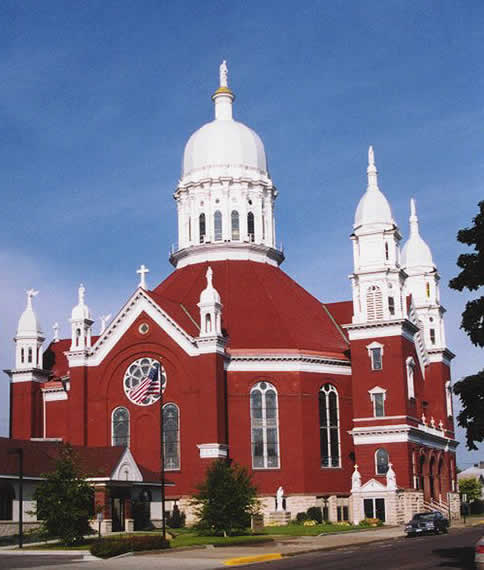
The Mass of Elevation for the Basilica of St. Stanislaus Kostka is today, Sunday, Sept. 9, 2012, in Winona. The original church was built in 1895. Winona Daily News)
Today the parish church built with the nickels, dimes and faith of lumber workers and packing house men becomes one of the pope’s very own.
Long known locally as the Polish Cathedral, for more than a century, the Basilica of Saint Stanislaus Kostka has stood as testimony in brick and stone to the faith and pride of the Polish immigrants to Winona, and of their children and grandchildren.
These were the people Cardinal John Krol — the first Polish-American priest to become a cardinal — spoke of when he addressed the Winona Polish Heritage Society in 1978: “The Polish people have an independent spirit. ... The Polish people are long suffering. ... They have been instrumental in handing down their Polish heritage — traditionally God first and then country, not forgetting their roots.
“We have inherited this culture.”
God first. The two things an immigrant Pole looked for when he arrived in his new home was a job and a Catholic Church. The first Poles to arrive in Winona sought a spiritual home at St. Joseph’s Church. St. Joseph’s was a German parish, and, as most of the Polish immigrants to Winona were Kashubian, a region of Poland that had been incorporated into Prussia, most also spoke German — although the sounds of the German language, rather than making them feel at home, was a reminder of an often painful past.
In 1871, the Rev. Alois Plut,
pastor of St. Joseph’s, helped his Polish parishioners organize a new parish of their own. About 100 families made up the new parish — designated by the Vatican as a national church for Polish-speaking Catholics. They raised $350 to buy two lots at the corner of Fourth and Carimona streets, and then raised $950 more to build a simple, wood-frame church. The church was completed in September 1872 and incorporated as the Church of Saint Stanislaus Kostka — though a shortage of Polish-speaking priests meant they would wait until 1873, and the arrival of Rev. Joseph Juszkiewicz, for St. Stan’s to have its first resident pastor.
Over the next 20 years the Polish community grew, filling and overfilling the church, forcing a decision on the part of the community — split into two parishes or build a new church big enough to hold them all.
They chose to build, and the Basilica of Saint Stanislaus Kostka is the result.
“They wanted to make a statement with this church,” the Rev. Robert Meyer said during St. Stan’s centennial celebration. “They came from beautiful European structures, and they wanted something that reminded them of home.”
But in Europe, the great and beautiful churches were built by the fortunes of counts, dukes and barons. In Winona, it was the sacrifice and dedication of the parishioners that raised the $85,000 — the equivalent of $2.2 million today — to pay for a church of their own. Four thousand people stood in the rain to watch Bishop Cotter bless the cornerstone, and even more crowded the streets and filled the pews for the dedication just a year later — appropriately enough, Thanksgiving Day, 1895.
Seating 1,800, with more than 17,000 square feet of floor space, St. Stan’s challenged the bluffs for domination of the Winona skyline — its brilliant white dome, topped by a 13-foot-tall statue of its patron, rising 172 feet above the street.
“It’s probably one of the best known churches in the Midwest and certainly among the most beautiful,” Meyer said, from his 100-year vantage point, “You can no longer put a price on it.”
Still, a church, however priceless, is not meant to be a museum but the spiritual home for the people it serves, and like any home, its décor and furnishings change with the time — and not always by choice.
On June 5, 1966, a bolt of lighting struck the dome. Fire did extensive damage to the dome, and the force of the bolt shattered two of the supporting pillars and smoke and water ravaged the interior. Disaster was met with resolve, and just six months later, on Dec. 11, Mass was again celebrated at the altar.
The Rev. Thomas Hargesheimer, rector of the basilica, sees a dynamic and growing parish with deep roots in its community.
“We have a lot more kids now,” he said. The surrounding neighborhood and the city as a whole is changing, bringing new people into the parish and the community. “We’re more diverse throughout the city,” he said, “and the parish has gotten larger and younger.”
Still, pride in being Polish is deeply rooted in the people of St. Stan’s. Many of the family names have been on the parish roster for well over a century.
“That pride is kept alive,” Hargesheimer said, “about the history … about the heritage … that we’re Polish.”


Sunday, February 26, 2012

Archbishop Vlazny of Portland, OR, former Bishop of Winona, to Retire

Archbishop Vlazny turns 75 today and will be sending
his mandatory resignation letter to the Pope

Archbishop John G. Vlazny

Archbishop John G. Vlazny


Born in Chicago February 22, 1937, Archbishop Vlazny attended Quigley Preparatory Seminary in Chicago and St. Mary of the Lake Seminary, Mundelein, IL., where he received a Bachelor of Arts degree in 1958. He attended the North American College and the Pontifical Gregorian University in Rome earning Sacred Theology Bachelor degree in 1960 and a Sacred Theology Licentiate degree in 1962. He later earned a Master of Arts degree in the Classics from the University of Michigan in 1967, and a Master of Education degree in School Administration from Loyola University, Chicago, in 1972. Archbishop Vlazny was awarded an Honorary Doctor of Ministry degree from St. Mary's University, Winona, in 1998, an Honorary Doctor of Laws degree from the University of Portland, Portland, OR, 1999, and an Honorary Doctor of Theology degree from Mount Angel Seminary in 2010.

He was ordained a priest at St. Peter's Basilica, Rome, on December 20, 1961. As a priest of the Archdiocese of Chicago, Father Vlazny served as Associate Pastor in five parishes between 1962 and 1979. At the same time he served on the faculty of Quigley Preparatory North in Chicago from 1963 to 1979. He was Dean of Studies at Quigley Preparatory North from 1969 - 1979.

Father Vlazny was President of the Presbyteral Senate for the Archdiocese of Chicago 1976 to 1977. He was appointed Pastor of St. Aloysius Parish in Chicago, where he served from 1979 - 1981. He was appointed Rector of Niles College Seminary in 1981, and served in that position until 1983.

He was named a Bishop by Pope John Paul II, and was ordained an Auxiliary Bishop of Chicago at Holy Name Cathedral, Chicago, on December 13, 1983. As Auxiliary Bishop, he served as Episcopal Vicar for Lake County and Northwestern Suburban Cook County. He was appointed Bishop of Winona, MN., by Pope John Paul II on May 19, 1987, and was installed as the sixth Bishop of Winona on July 29, 1987. On October 28, 1997 he was appointed the tenth Archbishop of Portland in Oregon.

Archbishop Vlazny previously served on United States Conference of Catholic Bishops (previously National Conference of Catholic Bishops) committees:
Chairman of the NCCB Vocations Committee,
Chairman of the NCCB Committee on Evangelization,
Chairman of USCCB Committee on University Presidents and
Bishops,
Chairman of USCCB Committee on Women in Society and in the Church,
Chairman of USCCB Committee on the Economic Concerns of the Holy See,
Chairman of the USCCB Committee on National Collections
Member of the USCCB Administrative Committee
Member of the Committee on Migration and Refugee Services,
Member of the NCCB Priestly Formation Committee,
Member of the NCCB Subcommittee on the Millennium,
Member of the NCCB Committee on Consecrated Life,
Member of the USCCB Committee for the North American College in Rome,
Member of the USCCB Committee for Hispanic Affairs,
Member of the USCCB Committee on the Relationship between
Eastern and Latin Catholic Churches,
Member of the USCCB Committee on Catechesis,
Member of the USCCB Committee on Diocesan Audits,
Member of the USCCB Committee on Conciliation and Arbitration
Member of the USCCB Committee on Shrines
Member of the USCCB Task Force on Faith Formation & Sacramental Practice
Consultant, USCCB Committee on African-American Catholics
Consultant to the USCCB Committee on Divine Worship

Chairman, Region XII Catholic Bishops

Other Episcopal Services:
Member of the board of Sacred Heart School of Theology, Hales
Corner, WI (1985 - 1994),
Member of the board of the Catholic Communications foundation
(1989 - 2007),
Chairman of the Board of Oregon Catholic Press (1997 - Present),
Chairman of the Board, Oregon Catholic Conference
(1997 - Present),
Member of the Board of Directors, Mt. Angel Seminary,
St. Benedict, OR (2000 - Present),
Episcopal Moderator, Catholic Cemetery Conference
(2000 - 2009),
Episcopal Liaison, National Council of Catholic Women
(2001 - 2006),
Trustee of the Catholic United Investment Trust, Christian Brothers Investment Service (2000 - 2007),
Member of the Board of Advisors, Erasmus Institute, Notre Dame University (2001 - 2006).

Coat of Arms Explained

Archbishop Vlazny's column in the
Catholic Sentinel

Archbishop Vlazny's Catholic Sentinel Columns on the Child Sexual Abuse Situation

Archdiocese of Portland, OR

Monday, December 19, 2011

Winona Now Has a Minor Basilica

.


The diocese of Winona is announcing that St. Stanislaus Kostka church in Winona has been elevated the to the status of a Minor Basilica by Pope Benedict XVI. The decree from the Pope was made on November 10, 2011 and announced to the congregation of St. Stanislaus this past weekend.

The papal decree is intended to “strengthen the relation of this church with the Chair of Peter and to make it an ideal center of special liturgical and pastoral ministry” in the diocese, said Archbishop J. Augustine De Noia, OP, the secretary to the Vatican congregation.

St. Stans, as those of us from Winona fondly call her, is a stunning building of beauty. It was built by the Polish immigrants in that city, literally by donation of dimes and nickels from the poor wage earners of the time. It has been remarkably preserved and restored.

One unspoken yet key person in all of this has been Deacon Justin Green who, with Janice Market and others, put in a tremendous amount of time and effort to gather and present all the materials and necessary paperwork for this to be forwarded to the Holy See.

Congratulations to all involved! To the rest of you, come to Winona and see St. Stans for yourselves!

Here is a copy of the press release from the diocese.

December 19, 2011

CONTACT: Joel Hennessy – Director of Stewardship and Advancement

Phone: 507-8581249

Email: jhennessy@dow.org

WINONA

VATICAN NAMES SAINT STANISLAUS KOSTKA PARISH A MINOR BASILICA

Through the faculties granted by the Holy Father Pope Benedict XVI, the Congregation for Divine Worship and the Discipline of the Sacraments has declared that Saint Stanislaus Kostka Parish, Winona, Minn., has assumed the status of “Minor Basilica,” emphasizing the special bond that the parish has with the Pope and with the whole Catholic Church. This Decree was made on November 10, 2011 and announced to the congregation this past weekend.

In May, His Excellency, Bishop John M. Quinn of the Diocese of Winona sent a petition to the Congregation for Divine Worship and the Discipline of the Sacraments, an office of the Vatican, so that Saint Stanislaus Kostka Parish, Winona, might take on the status of “Minor Basilica.” In November, the Congregation replied in favor of the petition, conferring this title of Minor Basilica on the parish. The decree is intended to “strengthen the relation of this important church with the Chair of Peter and to make it an ideal center of special liturgical and pastoral ministry” in the diocese, Archbishop J. Augustine Di Noia, OP, the secretary to the Vatican congregation wrote to Bishop Quinn.

One way the link is demonstrated is by celebrating feasts in a special way that are linked to the papal office, including the feast of the Chair of Peter, the feast of the Apostles Peter and Paul and the anniversary of the election of Pope Benedict XVI. The papal symbol of crossed keys may be exhibited on banners and furnishings and on the seal of the basilica and those who devoutly make a visit to the basilica on certain feast days may obtain a plenary indulgence.

”Saint Stanislaus Kostka is now a member of a small number of churches in the United States to be recognized as a Minor Basilica, and only the second in Minnesota. The other being the Basilica of St. Mary in Minneapolis, which was the first U.S. church designated as a basilica in 1926.” stated Bishop Quinn. “It is a very significant and important occasion for not only the parish and the diocese, but the entire region.”

The word basilica comes from the Greek term for “royal hall.” There are two kinds of basilicas: major basilicas, the six great Roman churches, and the minor basilicas, which are important churches in Rome and abroad which the Holy Father has honored with this title.

A church designated as a minor basilica must be a center of active and pastoral liturgy with a vibrant Catholic community and may have unique historical, artistic or religious importance. In seeking the distinction, the parish must provide a detailed report with an albumof photographs documenting the origin, history and religious activity of the church and its exterior and interior form, particularly regarding celebration of the sacraments.

Conferring the title of Minor Basilica is also a formal recognition of the beauty and dignity of the parish church. Father Thomas Hargesheimer, pastor of Saint Stanislaus Kostka, says that one of the reasons that the petition was sent was due the extraordinary architectural quality of the parish, as well as the significant Polish heritage that accompanies it.

“We really wanted to recognize the Polish immigrants that settled in the Winona area. Their heritage has had such a large impact on the development of the region. We also want to honor this parish as a faith community that contributes to not only the religious aspects of the community, but also the secular side of society as well,” said Father Hargesheimer.

This church was built and paid for by Polish immigrants and dedicated to God in honor of St. Stanislaus Kostka, a popular saint from Poland on Thanksgiving Day 1895. Now, alongwith The Polish Cultural Institute, more commonly known as The Polish Museum, Winona has truly become a destination and pilgrimage center for people of Polish heritage. Fr. Paul Breza, founder of the museum said “the news about St. Stans is very exciting – the church was built on “nickels and dimes” by the Polish immigrants during a time when wages were only around a dollar per day. This will be a great opportunity for people to learn more about the Polish heritage of Winona.”

Fr. Hargesheimer said a Mass of elevation, with Bishop Quinn presiding, will take place in 2012 at a date to be announced. For more information, contact the Saint Stanislaus Parish office by calling (507)452 Deacon Bob Yerhot

Sunday, December 11, 2011

Catholic Worker community has served Winona's homeless and those in need for almost 20 years

.
buy this photo

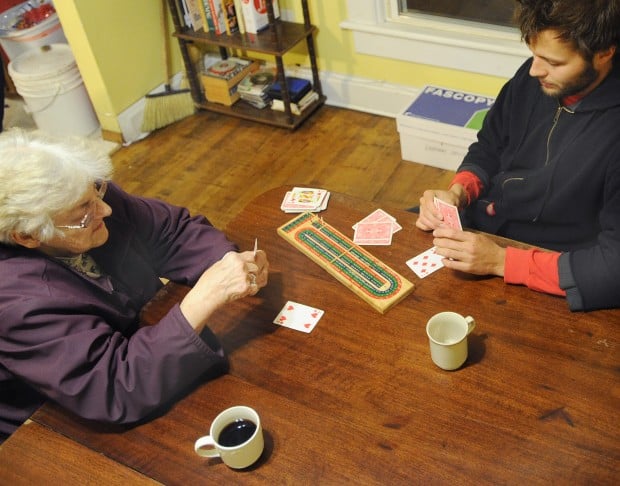
Dan Wilson, a live-in volunteer at the Bethany House in Winona, plays a game of cribbage with Sue Wallow, of Winona, over a cup of coffee Wednesday, December 7, 2011, at the Bethany House. Wilson has been volunteering at Bethany House for almost two years. (Rory O'Driscoll/Winona Daily News)

  • Winona Catholic Workers
  • Winona Catholic Workers
  • Winona Catholic Workers
  • Winona Catholic Workers

What is Catholic Worker?

The Catholic Worker movement was founded by Dorothy Day and Peter Maurin in 1933 among the poor of New York City. The movement is grounded in a firm belief in the God-given dignity of every person.

Today, 213 Catholic Worker communities remain committed to nonviolence, voluntary poverty, prayer, and hospitality for the homeless, exiled, hungry, and forsaken. Catholic Workers continue to protest injustice, war, racism, and violence of all forms.

Learn more at www.catholicworker.org. For more information on the Winona community, visit www.winonacatholicworker.org.

All they ask is your first name. Every day, the Winona Catholic Worker community breathes life into the words of the Gospel, offering home, help and a hot meal to whoever comes to the door. "Knock and it will be opened," the Gospel reads. No questions asked. "There are no forms to fill out," said Laurie Watson, a live-in community member at Bethany House. "We don't check IDs or ask questions, except ‘What is your first name?'"

Winona Catholic Workers have been opening doors to people in need since the Dan Corcoran House opened in 1992 at 802 W. Broadway. The house was named in honor of the Rev. Dan Corcoran, a chaplain at Winona State University's Catholic Newman Center who inspired a generation of students with his commitment to living the message of Jesus, according to Mary Farrell, one of the founding members of the Winona Catholic Worker community. The two-story house that had long been student housing offered shelter and hospitality to women and families in need of a place to stay. Four years later, when a house just down the block came up for sale, the community was able to open Bethany House, 832 W. Broadway, to offer hospitality to single men. It's the only non-referred emergency shelter in Winona County, Watson said, "and there's a real need."

The faces of need

That need has many faces, and speaks in a diversity of voices.

There's Bill, who on a recent evening spoke of how he spent the wee hours of Black Friday with the crowds in a Walmart parking lot. He wasn't there to shop. He was trying to catch a couple hours' sleep in his broken-down van before resuming his search for a job the next day.

There's Dan, who had hot chow and a bunk while on deployment in Iraq, but neither waiting for him when he came home.

There's Stacy, who needed a place to land while she got her financial and emotional feet back under her. Her stay at Dan Corcoran gave her the time she needed to find her niche in the larger community.

"People who come here are in crisis," said Molly Greening, live-in volunteer at Dan Corcoran. "They literally need to take time to breathe." "We need to meet them where they are. Help them feel secure. Feel at home." Greening speaks of providing a "ministry of presence" to the people who share the home. "Just being there," she said-to listen, to comfort, to play a game of cards or run an errand in an unfamiliar city-is as important as meeting physical needs for food, clothing and shelter.

Openness to the whole person and the recognition of every individual as a person of equal worth and value is at the heart of the Catholic Worker movement, Watson said. It's demonstrated as community members live in the same house, eat the same food, and for the most part have the same income as the guests living temporarily among them. Voluntary poverty puts workers on equal footing with guests, Watson said, allowing them to see the world from a perspective closer to those they serve.

A simple, welcoming routine

In practice, voluntary poverty means the six live-in community members and their guests depend on donations and their own enterprise to meet daily needs.

Winona Catholic Worker provides beds for up to five live-in guests at Bethany House, and beds for up to 14 at Dan Corcoran. They offer open hospitality Monday through Friday from 4-7 p.m. at Bethany House, a time when anyone is welcome to come in and relax with the community, take a shower, do laundry, and enjoy a good hot meal.

Guests are asked to comply with two simple rules at Bethany, Watson said. No drug or alcohol use, and be in the house by 10 p.m. Dan Corcoran has a few additional rules intended to avert potential friction in a larger house. Guests are not asked to sign in and out, attend religious services or perform household chores. "You don't ask guests to clean your bathroom," said community member Mike Abdoo.

Both houses are paid for, Farrell said, largely through the generosity of the Winona community. Day-to-day needs are met through donations of food, both groceries and food left over from events or prepared by friends. Cash donations cover other expenses and donations of clothing, furniture and services help meet the needs of guests and community members.

Live-in community members purposefully limit work time outside the community to about 15 hours a week, to prevent commitments from interfering with providing hospitality and presence to guests, Watson said.

"There's a joke that Catholic Workers aren't Catholic and they don't work," said community member James Johnson-adding that there is an element of truth lurking in the sentiment. "To be present to someone you have to be here," Greening said. "It's really as simple as that."

Catholic with a small ‘c'

"Dorothy Day (one of the founders of the Catholic Worker movement) was Catholic, so we're Catholic Workers," Johnson joked. The reality is that while the movement has a definite Christian and Catholic flavor, expressed in the traditional emphasis on the importance of performing traditional Works of Mercy and service to the poor, Catholic Worker volunteers and their supporters are more likely to be non-Catholic than members of the Catholic Church, Johnson said.

"We are definitely not ‘that homeless shelter run by the Catholic Church,'" Greening said. There are no formal ties between the institutional Catholic Church and the Catholic Worker movement, or the local Catholic Worker community, Watson said. Nor is Catholic Worker affiliated with Catholic Charities.

Catholic Worker communities are also independent of government programs and assistance, Watson said. Not being involved with government programs means communities are able to offer hospitality as they see the need, rather than abiding by government standards and limitations, she said. Independence from government extends to refusing to file for tax-exempt status, meaning donations to the Catholic Worker community are not tax-deductible.

Catholic Worker communities not only stand apart from the government, they are often critical of it. Social action is deeply ingrained in the Catholic Worker tradition, and members of Catholic Worker communities are supported and encouraged to join in protesting injustice. Community member Matt Byrne said the way of life reminds workers every day of the need to fundamentally change elements of society.

"These houses exist," he said, "because we live in a society that forces some people to be homeless." Winona Daily News

Tuesday, October 18, 2011

Archbishop Vlazny of Portland: Life Matters

.

October 18th, 2011 by Most Rev. John Vlazny [Former Bishop of Winona]

Back when Pope John Paul II wrote his masterful encyclical entitled The Gospel of Life, he called for “a general mobilization of consciences and a united ethical effort to create a great campaign in support of life.” Here in the United States such a campaign takes such place every year during October when Catholics in the USA observe Respect Life Month. Our message this year is a simple one: life matters. Yes, every human life really and truly matters.

The theme for 2011 Respect Life Program is taken from the words of Jesus in Chapter 10 of St. John’s gospel, “I came so that all might have life and have it to the full.” Who doesn’t want to have life to the full? We all do. But today’s culture, which exalts the freedom and glamour of the rich and famous, deludes too many people about the nature of a “full life.” Again and again we learn about so many “beautiful” people whose private lives are exceedingly unhappy. We think they have it all and really and truly they have little or nothing.

The self-destructive pursuit of the good life leads far too many of us to turn our backs on an ill-timed baby or a neglected aging relative in a nursing home who longs for a visit. We Christians know that we were created to love and to be loved. Earthly things can never satisfy us fully. When Jesus walked this earth he showed us the true meaning of love by his words and actions. When we truly love God and others, then our deepest needs are fulfilled and we do have life “to the full.”

The greater the sacrifices made out of love, the greater will be our joy and peace. But the notion of sacrifice is taboo to far too many people nowadays. Yes, many will agree that my life matters, but the life of another who might inconvenience or sidetrack me in pursuit of the so-called good life is something that tends to be eliminated or ignored. That is why it is so important for us to open eyes, minds and hearts to the truth of the gospel of life.

As Catholics we see no distinction between defending human life and promoting the dignity of the human person. In his most recent encyclical Caritas in Veritate, Pope Benedict asserts that “the church forcefully maintains this link between life ethics and social ethics, fully aware that a society lacks foundations when, on the one hand, it asserts values such as the dignity of the person, justice and peace, but then, on the other hand, radically acts to the contrary by allowing or tolerating a variety of ways in which human life is devalued and violated, especially when it is weak or marginalized.” Human life is a gift from God, sacred from conception to natural death. The right to life is the first and most fundamental principle of human rights. This is why Catholics across the globe work actively to promote greater respect for human life together with greater commitment to justice and peace.

This year’s Respect Life Program focuses on some of the major attacks on human life and dignity. First and foremost we again bemoan the loss of so many innocent children because of abortion. Mothers are also harmed physically and emotionally, as well as fathers, families and society. The opposition of the Catholic Church to abortion is based on the fundamental dignity and equal value of every single human life. Opposition to abortion is the only moral choice, even for non-believers.

A more neuralgic issue is the death penalty. Back in 1995 Blessed John Paul II stated that “the nature and extent of punishment must be carefully evaluated and decided upon, and ought not go to the extreme of exterminating the offender except in cases of absolute necessity; in other words, when it would not be possible otherwise to defend society. Today, however, as a result of steady improvements in the organization of the penal system such cases are very rare if not practically non-existent.” Elimination of the death penalty is a goal of our Respect Life Program. It is the way of Christian mercy and reconciliation, a challenge to all of us who call ourselves Christian.

This year’s Respect Life Program also calls our attention to embryo research. There are many who support the protection of vulnerable adults and children, even animals, but they have a moral blind spot with respect to research involving human embryos. They totally disregard the fact that embryos are human beings. Human life begins with the fusion of a sperm cell and an egg. They are not simply biological material. Their use for purposes of research is absolutely immoral. Research on adult stem cells, however, is permitted since they cannot develop into mature human beings. There may very well be a sincere concern to develop new therapies and cures for diseases through such experimentation. But the end never justifies the means.

In the final months and days of a human life, life still matters. The way in which we deal with persons who are in the last stages of life speaks loudly about the kind of society we have become. Bringing death about directly goes against the fifth commandment, “You shall not kill.” On the other hand, caring for a dying person is both humane and Christian. The ethical issue is whether a dying person is killed or allowed to die. Those seeking to respect human dignity at the end of life will find true companions in the hospice movement, not the euthanasia movement. Whereas it may be possible to withhold extraordinary or expensive medical procedures in the view of a patient’s impending death, it is never allowed to “help” a person die. Ordinary care of any dying person should never be discontinued. Improvements in palliative care have been significant in recent years. The use of medications that are painkillers, not people killers, is consistent with the ethic of life that, until recent times, had been the hallmark of our human family.

On October 1st, at the Rosary Bowl in Keizer, we prayed the rosary for the success of our efforts to teach and live the gospel of life. We regret that too many of our neighbors sometimes look upon the lives of the unborn and the frail elderly as inconveniences and obstacles to their pursuit of the good life. We have waged a battle with these folks over the years with argumentative words. We need to keep speaking the truth. But this month I invite you, as I invited the people at the Rosary Bowl, to fall on your knees with your beads in your hands and to ask God to change hearts and minds so that more and more of God’s children will have life and have it to the full.

This article is courtesy of the Catholic Sentinel, the official newspaper of the Archdiocese of Portland, Oregon.

Saturday, August 27, 2011

Worthington and SW Minnesota: Murphy, O'Shea and Mulligan - they didn't stay

.
It is said that when [Arch-] Bishop John Ireland died at St. Paul (1918) his funeral was attended by eight archbishops, 30 bishops, 12 monsignors, 700 priests and 200 seminarians.

Wow! [Archbishop Ireland, the "Consecrated Blizzard of the Northwest", was an extremely powerful person in the U.S. Catholic Church and it had been expected that he would have been made a Cardinal. But, among other things he got tangled up in the Americanism movement and never got the red hat].

We have been talking about Norwegians, Germans and Dutch in southwest Minnesota. Bishop John Ireland is largely responsible for the Irish in southwest Minnesota, and for the fact that there are not many more Irish.

Bishop Ireland, born in Ireland, was a founder of the Irish Catholic Colonization Association. Working with the Western railroads and the state of Minnesota, beginning in 1876, Bishop Ireland brought 4,000 Catholic families out of the slums of New York, Philadelphia and Boston and began efforts to settle his substantial flock on 400,000 acres of land in southwest Minnesota. Catholic settlement focused (among several prairie towns) on Adrian in Nobles County and on Avoca, Iona and Fulda in Murray County.

Southwest Minnesota might have been known to this day as Little Ireland. Trouble was, the Irish didn’t like it here. They wouldn’t stay.

Many Irish people, many Irish city dwellers, came to America in the time of the great potato famine. They and their children had limited training, and they faced great prejudice when they sought work:

NINA: No Irish Need Apply.

That prejudice is remembered to this day.

(As a current story goes, Murphy, O’Shea and Mullligan went for a construction job. They were told the foreman dislikes Irish. Murphy suggests they give English-sounding names. O’Shea enters the foreman’s office. The foreman asks his name. O’Shea looks out window, sees a JC Penney store and says his name is JC Penney. “Get out!” shouts the foreman. Mulligan looks out the same window, sees a billboard and says his name is B.F. Goodrich. “Get out!” shouts the foreman. Murphy is last. The red-faced foreman asks his name. Murphy takes a long look out the window and replies Ken. “Thank heaven,” says the foreman. “ Ken who?” “Tuckeyfriedchicken,” says Murphy.)

The early Irish immigrants, mostly jobless, lived in squalor in the shadowy slums of America’s eastern cities.

“Well,” said Bishop Ireland, “Let’s bring them to Adrian, or Avoca. Give them land and let them farm and may they live happily ever after.” Four hundred thousand acres of Irish farmers.

Trouble was — well, there were a lot of troubles. The Irish had no money, and even in the days of settlement it took money to begin farming. Most of the Irish had no kind of experience with farming; they didn’t know what to do. Life in a crude shack in a Minnesota winter seemed worse than life in a Boston slum. What is more, through all their days these people had lived with friends and kin, almost cheek-to-jowl. Now they lived alone, separated from other humans sometimes by miles.

The general reaction: “Let’s get out of here!”

The Great Irish Settlement was followed by the Great Irish Get-away.

Oh, not all of them fled. In his “History of Nobles County,” A.P. Rose has short stories of the lives of 737 Nobles County pioneers. Twenty-one are from Ireland.

Some stories told of the Irish settlers are memorable. Patrick Glynn was born in Ireland in 1845, the first year of the great famine. He was grown and living in Cleveland when he came upon an advertising folder prepared by Bishop Ireland which told, especially, of the colonization effort in Nobles County. On May 20, 1879, at the age of 34, Patrick purchased a quarter-section of land in Westside Township for $7 an acre.

The Glynn family lived on the farm near Adrian for 13 years. Patrick and his wife, Mary Kinsella Glynn, came to have nine children. Mary was a native of County Carlow, Ireland.

The children were Patrick’s special focus and concern. In his far corner of the prairie he judged school facilities were poor. He wanted the kids to have the best of educations.

In 1892, Patrick sold the $7-an-acre land and bought a $16-an-acre farm southwest of Adrian. The price was more than twice what he paid for the land on which the Glynn family had made their home, but there were better schools available. This was issue on which Patrick Glynn made his decision. Worthington Daily Globe


See this excerpt of James P. Shannon's book, "Catholic Colonization on the Western Frontier."

Monday, August 15, 2011

As the Spirit Moves Me: Brick by brick, Rochester's St. John's remains strong, vibrant

.
To write a story about Church of St. John the Evangelist, Rochester's first Catholic church, we must reach back nearly 150 years to a time shortly after Minnesota became the 32nd state in 1858. Through the decades, building anew and renovations, the church's location at 11 Fourth Ave. S.W. remains the same.

Being formed in 1863, the first church building was dedicated Dec. 1, 1872, at a cost of $40,000. At that time, the Rev. James Morris had purchased three lots near the old courthouse as a site for the church. The courthouse has long been gone, but the three lots never moved, and neither has St. John’s.

By the turn of the century into the 1900s, a growing St. John’s parish felt the need for expansion. A new cornerstone was set Oct. 12, 1900, and the new house of worship was dedicated on April 27, 1905, at a cost of $60,000.

Because the city was growing rapidly, it’s likely some of the parishioners at St. John’s wondered when they would need to build again. Many efforts were turned to education during the next 50 years.

In 1913, three new schools were completed and opened for classes in September. First, there was a grade school for boys and girls. Soon there was a high school for the girls known as St. John’s, taught by the Sisters, and Heffron High School for boys.

Heffron High School was named for the Most Rev. Patrick R. Heffron, bishop of the Winona Diocese from 1910 until 1927.

Another name that always raised my curiosity was Cotter High School in Winona. That school was named after the first bishop of the Winona Diocese, the Most Rev. Joseph B. Cotter.

Another Catholic milestone was the opening of Lourdes High School in January 1942. The Rev. Louis D. O’Day came to St. John’s from St. Thomas parish in Winona and started plans to replace the 1905 church building. Within two years, another dedication, this time a Mass by Father Joseph Mountain on Jan. 27, 1957.

A fine story teller, Father James Mc Cauley became the church priest in 1991, leading up to the Rev. Msgr. Gerald A. Mahon, who has led this congregation of 1,350 households for the past 16 years.

This has been a time for a complete turnaround for St. John's. Following a needs assessment survey in 1998, showing many concerns, it was determined that more space was needed to provide education for liturgy and environment.

The liturgical committee had a vision with a long list of “needs” to make everything about St. John’s the Evangelist Church perfect. Some of the suggestions included were to provide a separate sacred space for small liturgical celebrations and personal prayer, improvement of lighting and acoustics, handicap accessibility to all areas of the parish facility, and to provide a separate area for funeral luncheons and other functions.

Another is the beautiful baptismal spot where families can gather while little ones are baptized.

In response to their vision statement in 1999, architects developed a final proposal. This created a gathering and fellowship area in the old school gym and added a chapel to the Fourth Avenue side of the church. This made available an entrance for church members and hundreds of folks coming from Mayo Clinic.

A new subway connects St. John’s and Mayo Clinic. Church renovation began in 2001 and the dedication at the new sanctuary took place May 19, 2002. This was the Feast of the Pentecost.

Old friend Bishop Bernard J. Harrington (now retired) was at this celebration as he served the Diocese of Winona as bishop.

On May 5, 2002, Father Mahon wrote in the church bulletin, “During the past five years our dream has unfolded in front of us brick by brick and we are prepared to be a strong, vibrant parish community for the next 100 years.”

Now the oldest Catholic church in Rochester, St. John the Evangelist, known as a “Welcoming Catholic Community,” is preparing for its 150th anniversary in 2013. Rochester Post Bulletin

Saturday, August 6, 2011

Donor gives a copy of "St. John's Bible" to the Austin Public Library.

.
A rare hand-written replica of the Saint John's Bible has been donated to the Austin Public Library.

The Austin Daily Herald reports ( http://bit.ly/ok8qvw) the family of Don and Dorothy Hodapp donated the Heritage Edition of the Saint John's Bible, which valued at $145,000.

The Saint John's Bible consists of seven volumes that are 2 feet by 3 feet when open. The Heritage Edition is a precise printing of the original Saint John's Bible, which was created using medieval techniques.

The original bible is at Saint John's University in Collegeville, Minn.

Jim Triggs, executive director of the Heritage Program at Saint John's University, says there are only 299 Heritage Editions and no new copies will be made.

Four of the seven volumes will be delivered this fall. Star Tribune


Monday, August 1, 2011

Winona's St. Mary’s Catholic Church celebrating 100 years

.
On August 14, 2011, St. Mary’s Catholic Church of Winona will be celebrating 100 years as a faith community. Plans for the day will include 10:30 Mass with Bishop Quinn, a catered dinner, a program and then a social gathering following the program in the church hall – a time to visit with the priests, sisters and all who have so graciously served the parish over the years.

In 1911 Patrick Heffron, the second bishop of Winona, announced he would build a chapel for the growing Catholic population in the west end of Winona. Heffron purchased a house and four lots on West Broadway from the Rochester Franciscans. Construction of the chapel began in the summer of 1911 and Bishop Heffron dedicated St. Mary’s Chapel on August 13 with the assistance of Fathers T.F. O’Connor, the new pastor, F.T. English, P.J. Gallagher and P.A. Tibesar. The ceremony attracted a standing room only crowd to the little church – the pews were not installed until October. The church was a small white frame building located about midway in the block between Gould and Vila streets on West Broadway on the block where the Roger Bacon Center now stands. Near the west end of this block was a large frame house which served as the first parsonage for St. Mary’s Church. The frame church was narrow and deep. The interior consisted of a single center aisle and about twenty pews on each side extending to the wall with no outside aisles. The altar and communion railing were simple wooden structures.

There were approximately 250 people in the parish when it was established in 1912. By 1930 the size of the congregation had doubled to over 500 members. The growing parish created pressure to build a new church. The trustees proposed to build a combination church, residence, and parish hall of the same building materials as the College of St. Teresa building. The trustees hoped to avoid locating a new church out on the “new Broadway extension”, a plan proposed by the college officials who wanted to expand on the block where the church and rectory were located. The parish trustees thought that the proposed site two blocks west was a remote location for a new church because it was at “the extreme end of the parish”.

In 1929 Mother Leo, President of the College of Saint Teresa, offered to exchange a square block of St. Michael’s field for the four lots owned by the parish with an additional cash payment of $9,000. Parish opposition to this offer was so severe that it brought the negotiations to a close for a while.

Even though the question of location was not resolved, and the country was suffering from the Great Depression, a building fund was started and although modest in size, grew steadily. The appointment of Father John Sherman as pastor in 1934 crystalized the decision to build a new church. The location was still not decided until 1939. Father Sherman wanted to build on the present site but that was not to be. Work began on the new church on June 30, 1939, at the St. Michaels site on West Broadway. The cornerstone was laid September 17. The church was completed early the next year. On February 3, 1940 the first mass offered in the new church was a nuptial mass celebrated by Father Sherman. The total cost of the church was approximately $82,000. The parish rectory was constructed in 1951. The new rectory cost $40,000 and was built to replace the house on West Broadway, which had served as the rectory for fifty years. St. Mary’s School was built in 1953. Soon after, the convent, which is now the Parish Center, was built. A few years later the gymnasium and additional classrooms were added to the school to accommodate the “baby boom”.

Memories play a large part in any event and so to keep those memories a part of St. Mary’s Parish, parishioners were asked to share some of their special memories. A special Centennial booklet is being prepared.

St. Mary’s Parish has played a big role over the years in serving the Winona community. It takes great pride in helping others so in commemorating 100 years, those planning this event have come up with the following projects in order to celebrate our 100 years and at the same time, give back to our community. Those plans include:

• 100 hours of Eucharistic Adoration
• 100 “shares” in the international Catholic Relief Services “Give the Gift of Hope” program
• 100 hours of service refurbishing the Winona Catholic Worker houses
• 100 boxes of cold cereal for Winona Volunteer Services
• 100 bingo prizes for Saint Anne Extended Healthcare
•100 boxes of Kleenex for St. Mary’s School

In looking back, St. Mary’s was a small, wood-framed chapel just down the street from its present location in 1911. It survived the great depression of the 1930s. One can only imagine the sacrifice made by these parishioners to complete the worship space that all enjoy today.

If you would like more information about any of the Centennial events, please contact the Parish Office at 507-452-5656. Winona Post

Saturday, June 18, 2011

Former La Crosse bishop holds high position in Catholic church in Rome

.

"You just keep doing what you believe the Lord wants you to do, and who knows where it leads you eventually," Burke said during a recent interview in his Rome residence. "That's the only way I can describe it."

Burke, the former bishop of the Roman Catholic Diocese of La Crosse, was elevated to the position of Prefect of the Supreme Tribunal of the Apostolic Signatura in June 2008 - equivalent to chief justice of the Supreme Court of the Catholic church - and was named a cardinal by Pope Benedict XVI in November 2010. Burke is one of nine active U.S. cardinals and one of 179 cardinals in the world.

Burke, 62, was born in Richland Center and later moved with his family to Stratford. He was ordained a priest in 1975, was bishop of the La Crosse Diocese from 1994 to 2003 and later was archbishop of St. Louis from 2003 to 2008. Burke was active in rural life issues during his time in Wisconsin and often became embroiled in controversy because of his conservative positions. But he stood firmly by his stances and said he was simply sticking up for the values of the Catholic church.

In his new role as head of the Catholic church's highest tribunal, Burke makes decisions on specific cases and issues related to the laws of the church. He said it's not a glamorous job, but it's an important one. "It happens to be an aspect of the church that is not very pleasant, but it's an aspect of the church that someone has to deal with," Burke said. "I always say no one comes to our office who is happy, but when they leave, even if they don't get the decision they want, they leave with the knowledge that the highest authority in the church has examined their case and given them a decision. Even if they don't like it, at least they know they've done every-thing they could and they have a decision from the pope's highest tribunal."

Burke and a college of judges hear cases on Catholic church issues from throughout the world. The judges are all cardinals or ex-bishops. Burke is the only full-time judge in the tribunal. He sits in on every case unless he is personally involved with one of the parties. That hasn't happened in the three years he's held the position, Burke said. "The Mass and daily prayers have to be the center of your life, otherwise you would be crushed (by all of the issues)," Burke said. "You have to see it as a service of our Lord and his church.

"I always say it's a very humble service in the sense that it has none of the beauty of the sacred liturgy or the teaching of the faith, but yet it's essential because if the church doesn't respond to people with a just decision, how can you she talk about charity?"

Burke is no longer involved in rural life issues, although he continues to read and be concerned about issues such as large animal confinement, the health of food and the plight of small farmers. "All that is still very much in my heart, but I don't have the occasion to do anything directly," Burke said.

He begins an average day by saying Mass in his private chapel with the religious sisters who work for him. He has breakfast about 7 a.m. and walks about 40 minutes to work. The tribunal office is in the same place in Rome that it has been since the 1300s, Burke said. His job consists of a lot of reading, studying reports and writing, Burke said. He anticipates living and working in Italy for the rest of his life.

Burke said he returns to Wisconsin twice a year, once in the summer and a second time in early December. He said he tries to visit around the time of the Feast of Our Lady of Guadalupe on Dec. 12 and celebrate Mass at the shrine he helped create just outside La Crosse. "The shrine is one of the best things that God did while I was bishop of La Crosse," Burke said.

Burke said he doesn't have much occasion to work directly with Pope Benedict, although he and the other tribunal judges had a meeting with the pontiff in early February. As a cardinal under the age of 80, Burke would be eligible to vote the next time there is an election for a pope. Only the cardinals vote and only a cardinal can be elected pope.

He said he doesn't know if there will ever be a U.S.-born pope, but he believes it is possible. "I wouldn't anticipate it any time soon, but I think it could happen," he said. "We've had a Pole and a German. For 450 years it was always an Italian, and we presumed it would always be an Italian. But now that pattern is broken, and good cardinals readily think of a pope being from other parts of the world."

Burke said he can remember "as clearly as if it was yesterday" being a parishioner at St. Mary's Catholic Church in Richland Center and later attending Holy Cross Seminary in La Crosse. "It just all happened very quickly," Burke said.

He said his life in Rome is "quite different" than it was when he was a bishop, but yet he's just doing God's work in a unique way. "Here I try to serve the universal church, but I don't have a flock that's entrusted to my care as I did in La Crosse and St. Louis," he said. "I'm helping other bishops and dioceses, but I don't have my own diocese. It's quite a different life." Eau Claire Leader Telegram

Thursday, June 9, 2011

Diocese of Winona welcomes Raymond de Souza as Director of Evangelization and Catechesis

.

Bishop John Quinn of Winona announced that Mr. Raymond de Souza will join the diocesan staff as Director of the Office of the New Evangelization and Apologetics. Last December, de Souza spoke at the Cathedral of the Sacred Heart in Winona. He and the bishop began to talk about the new evangelization and about the growing need to prepare Catholics to explain and defend their faith. The conversations led to an invitation to join the staff and de Souza accepted. Because he has so many speaking engagements already planned in Africa, Europe and Australia over the next few months, de Souza will be a consultant. At some point in the future, he will become a full time member of the diocesan staff.

De Souza describes himself as "Brazilian by birth, Catholic by grace, Australian by choice." As an internationally renowned speaker, he has given over 3,000 talks on issues of apologetics and Catholic social teaching in countries on five continents. More information about his activities and ministry can be found at http://saintgabrielinternational.com. His programs on EWTN air on Mondays at 5 PM and Fridays at 9:30 AM. He is very active in the Knights of Columbus and welcomes the Knights’ support of the New Evangelization. He sees the Knights as potential leaders in the continuing struggle against de- Christianization. Raymond is married to Theresa, a Californian born on the fourth of July. Their marriage has been blessed with eight children. They moved from Australia back to the United States, and settled in Sugarloaf, Pa., five years ago.


Apologetics is a long respected ministry that presents a well-reasoned defense of the hope that is in us, of the faith we proclaim, of the charity we live. It has nothing to do with ‘apologizing’ for something we have done…! The tradition goes back to St. Justin Martyr in the second century. Catholic apologists focus on the importance of logic, consistency, kindness and courage in the affirmation of the faith. In this way, they show that the faith has real-life applications to modern day and temporal society.


To make his mission and ministry known in the diocese, de Souza has begun to meet with priests in their deanery meetings. Within a short time, he plans to bring his ministry to every parish in the diocese. de Souza does not stop with making presentations. He intends to form apologetic teams in every parish to energize and prepare Catholics to defend the truth as revealed to us by Jesus and found in the teachings of the Church. That is a challenge at a time when the world prefers to see everything in relative terms and to ignore the presence of evil. Pope Benedict XVI has identified relativism as a major challenge to the Gospel in today’s world, and de Souza intends to form an army to fight for truth. As he says, the goal is to put Logic at the service of the Faith throughout the diocese, and beyond!


Parishes, schools or youth groups interested in arranging for a visit by Raymond de Souza may contact his office at the Winona Pastoral Center (507) 858-1265, or at rdesouza@dow.org. Winona Courier


Raymond de Souza is a world class speaker and a world class Catholic. And Winona has him. More information about him may be found at some of his websites.


http://www.hli.org/index.php/about/hli-experts/885-hli-expert-raymond-de-souza


http://saintgabriel-international.com/list%20of%20seminars.htm

Join Raymond de Souza in this dynamic 45 minute presentation on "De-Christianization and the Catholic Counter-Revolution". The Popes are his starting point. History is his whiteboard. Catholic social teaching his guidelines.

This is one of Raymond's best talks.

Read the LifesiteNews.com cover article on this Talk.

Raymond analyzes the de-Christianizing process within the current economic, political and legislative crisis. From the genocidal failure of Communism to the abuses of liberal capitalism and the cultural anarchy of modern day, Raymond provides the feasible solutions of Catholic Action. Prayer, Study and Action. But which prayers? What to study? What to do? Raymond has answers. Don’t miss them.

WATCH THE FULL DVD ONLINE


Thursday, February 17, 2011

St. Mary's U of Winona & Mpls teams up with NPR's Fred de Sam Lazaro

.
.

PBS NewsHour special correspondent Fred de Sam Lazaro reports from what he calls the "global south," but lives in Highland Park, and has a new Winona-based funder: St. Mary's University.

It's not every journalist in these economically stressed times who can find a university benefactor, but for De Sam Lazaro (disclaimer: MinnPost board member), it's the second.

Fred de Sam Lazaro

Collegeville-based St. John's was an earlier partner for Under-Told Stories, de Sam Lazaro's reporting/teaching project. He would travel to places like Sudan, PBS viewers would see the results, and students at St. John's would get a literally real-world seminar every fall.

Why the move to St. Mary's? "I forgot to write in my contract that the president not die," de Sam Lazaro says.

He had a personal relationship with then-St. John's president Dietrich Reinhart, a dedicated internationalist who resigned in 2008 because of health concerns and died months later. "It happened during an economic downturn, the embrace of the program wasn't there any more," says de Sam Lazaro, whose relationship with the school ended last year.

St. Mary's is funding Under-told Stories at a bigger scale — about a quarter of the project, with the bulk coming from the NewsHour, he explains. The idea is to bring back material that is "valuable in the classroom, anecdotes that don't make it into stories. It's not the same as textbook learning — we speak plain English, and the method seems to appeal to students."

St. Mary's — like St. John's, a Catholic school — offered a couple of differences. St. Mary's Minneapolis campus is 81 miles closer to de Sam Lazaro's front door than Collegeville, and the grad-school student body at that Phillips neighborhood campus includes many émigrés from Under-told Stories countries. (The school also has a Nairobi campus.)

"On balance, it's certainly true that St. Mary's in Phillips is more reflective of the world we go to compared to St. John's, which is much less diverse," de Sam Lazaro says. "But on an intellectual level, there's appeal to both places. It was good to reach behind the 'Pine Curtain,' as they say [at St. John's], but at St. Mary's, the presence of students from around the world changes the interaction."

De Sam Lazaro — whose formal title is Senior Distinguished Fellow at the Hendrickson Institute for Ethical Leadership — says he's out of country about eight to ten days a month. The Under-told Stories roster features stories from Pakistan, India, Israel, Jordan, Cambodia, South Africa and Kenya — and that was only the last half of 2010.

Not bad for a guy who worked for KTCA's "Almanac" for two months in 1985 before becoming PBS's upper Midwest bureau chief, de Sam Lazaro's eventual gateway to the world.

"We try to make the foreign less foreign," he says of Under-told Stories. "Why are we engaged with Malawi, with the Congo, what relevance is there to us as Americans, as Minnesotans? Not just in a moral vacuum, but in terms of economic and security interests, what opportunity there is for students. We also look at social entreprenuerialism as a way to look at the world's problems. We're not sugar-coating stories, but we're casting things as solutions-oriented." MinnPost, David Brauer

Monday, January 31, 2011

St. Mary's U tops in Nation for Minorities in Science, Technology, Engineering and Math

.
Forbes Magazine: MIT comes in 18th; 35% at SMUM get their degrees in science, technology, engineering or mathematics. The national average is 10%.

Saint Mary’s University of Minnesota is the nation’s top-ranked college for minorities in science, technology, engineering and math (STEM) programs, according to a recent Forbes report.

Forbes ranked colleges and universities for helping racial or ethnic minorities succeed in STEM programs. Forbes compared the percentages of blacks, Hispanics and American Indians (groups typically underrepresented in STEM) to whites and Asians (groups typically well-represented in STEM). Forbes excluded from its analysis those schools with a student body that is almost entirely minority students.

Saint Mary’s University offers STEM programs in its traditional four-year bachelor of arts program at its Winona campus, as well as STEM programs within the bachelor of science completion programs for adult learners at its Twin Cities campus.

The Forbes report cited data from the Saint Mary’s undergraduate graduating class in 2008. Forbes said that class included about 10 percent underrepresented minority students, just above the national median for ranked colleges. “But of those minority students,” Forbes said, “35 percent received their degrees in STEM – well above the median among all colleges, which is 10 percent.”

Bob Conover, vice president for communication, noted that Saint Mary’s undergraduate STEM programs “combine a strong academic component with opportunities for hands-on research and student interaction with professors. I believe it’s this combination which helps us reach underrepresented populations.” Conover added that “as a Lasallian Catholic university, Saint Mary’s is student-centered and committed to preparing learners for success in an increasingly complex and multicultural world.” Winona 360

To read the complete Forbes article, with the top twenty colleges in the competition.

Thursday, January 20, 2011

Before W-K school there was Kosciusko (01/19/2011)

.
By Frances Edstrom

Submitted photo
Kosciusko school


February will be a big month at Washington-Koscuisko elementary school, affectionately called W-K. On February 4, the school will celebrate the birthday of Thaddeus Kosciusko, one of the men after whom the school is named. And then at the end of the month comes Presidents’ Day, when we honor George Washington, the other man the school’s name reflects, and whose birthday is February 22. Both men are heroes of the Revolutionary War.

When W-K was built on Mankato Ave. and opened in 1935, it replaced three schools — Washington, Kosciusko, and Sugar Loaf. Sugar Loaf started as a country school, and didn’t become part of the Winona school system until 1891. Washington was built as the fledgling town was growing, and by 1888 the schools were so crowded that night classes were being held, and the age of starting school was raised from 5 to 6. Even in 1937, there were more than 100 country schools open in Winona County.

The Fourth Ward schools became more and more crowded, so in 1889, the Polish Stock Company Hall was converted to a school. By 1891, that school was called the Mankato Ave. School, unlike the others in town not a U.S. president’s name, reflecting the school board’s hope that it would be a temporary building. (Jefferson, Madison and also a Jackson School were on the West End.)

After a lot of wrangling, in 1892 the school board knew they couldn’t accommodate the growing population in their present schools, so voted to build an East End school at Sanborn and California streets. (That is according to the 1913 History of Winona County, but that was either a misprint, or the name of the street was changed later to Chatfield.) The school cost $25,000 to build, including the lot, and was dedicated in 1894, after the city was redistricted.

It was about that time that the school board installed a telephone in each school. Perhaps the wires were burning up with talk of the argument over what the name of the new East End school should be. Finally, with Benard Stoltman and Joseph Winczewski as Fourth Ward representatives on the board, Kosciusko was chosen over Columbia.

The school population continued to grow, and the school board continued to talk about building more schools or adding on to existing schools. But some warned that when the Catholic parishes built their own elementary schools, as they were talking of doing, there wouldn’t be a need for a Kosciusko school if St. Stanislaus parish built a school. In fact, when the parishes did open their own schools around 1913, the public school population fell by 1,000 students.

Thaddeus Kosciusko

Kosciusko (pronounced Kos-chew-skoe, according to Paul Libera, quoted in a newspaper article in 1973) was born son of a nobleman in 1746 in Poland, where he attended at the King’s Corps of Cadets, with military studies as well as the liberal arts. He then studied for five years in Paris. When he returned home, there was no post for him in the greatly reduced Polish army, as the country had been divided up by the Russians, Prussians and Austrians. He left Poland in 1775, and in Paris heard about the American Revolution. He came to America, served as a volunteer in the new army, and in 1776 was named a Colonel of Engineers in the Continental Army. He went to work building forts to protect the army from the British. It was Kosciusko who designed West Point, at the behest of George Washington (Benedict Arnold tried to give the plans to the British). He then traveled south to join forces there, and for the first time encountered chattel slavery, which he grew to abhor (he gave his army salary to Thomas Jefferson, and instructed him to buy slaves with the money, free them and educate them. He freed his own serfs in Poland before his death.)

After seven years of distinguished service to the American Revolution, Kosciusko was promoted by Congress to the rank of brigadier general. He also received American citizenship. He returned to Poland to fight against the Russians, who had invaded. But the Polish army was woefully out manned, and Kosciusko surrendered to the Russians. He then fled Poland, and joined a group planning the ouster of Russia from Poland. But the cause failed, and Kosciusko was captured by the Russians and imprisoned. It wasn’t until 1796 that Kosciusko was freed. He declined to fight with the Napoleon-allied Polish Army, and rebuffed overtures from the Russians to build a Kingdom of Poland, a small and ineffectual plan that Kosciusko called a joke. He died in Switzerland in 1817 of typhoid. He is a national hero in Poland, Lithuania, Belarus and the United States. Winona Post

Wednesday, December 15, 2010

Farmer Spreads $3 Million Around his Small Town

.
Mower County Farmer Spreads $3 Million Around his Small Town

LEROY, Minn. (AP) - A retired farmer had a reputation in his small Minnesota town for being very frugal. So, when the checks arrived at the senior center, fire department, churches and other places in Le Roy following the farmer's death, surprise would be an understatement.

Ninety-four-year-old Loren Krueger spread $3 million around the Mower County community of about 900. Krueger outlived two wives and a son and lived in a simple white house on Le Roy's main street, quietly amassing a fortune.

Checks for more than $400,000 arrived at two local churches. St. Patrick's Catholic Church received about $1 million. The senior center, which was getting by on $600 in county funding each year, got $220,000.

KARE-TV says while many in Le Roy tagged Krueger as frugal, now they're remembering him as generous.

Wednesday, November 17, 2010

New Catholic saint, St. Andre Bessette, has Winona relatives

.
If there is a saint in your family, this is how you might tell people: My aunt is a saint …being married to that husband of hers.

But there are folks in the Winona area who really do have a saint in the family since Brother André Bessette, CSC, was canonized by Pope Benedict XVI on October 17, 2010.

Winona resident Lynn Kujak, Plainview resident Mary Deming, and Richard Leonard of Mantorville are all great-grandchildren of Lucie Bessette, a fifth cousin of Saint André, or Frere André, as he was a French Canadian member of the Holy Cross Brothers, and is sometimes referred to as Saint André of Montreal.

Their father, Vincent Leonard, was born in Delavan, Minnesota, in 1905, the son of Alexander Leonard and Rosana Perrizo and the grandson of Joseph Leonard and Lucie Bessette of Blue Earth, Minnesota. Vincent married Louise Duellman in 1937 at St. Mary’s Church in Winona, and he died in Winona in 1990. The surname Leonard is an Anglicized version of their French name, Lyonnais.

Vincent’s father died in 1919, the result of tuberculosis contracted in the Influenza Epidemic of 1917. In 1921, he was sent to the boarding school in Rollingstone, after which he worked for local farmers, surviving the Depression. His mother and two siblings died of tuberculosis, and his remaining two brothers moved to California. But Vincent found work in Winona, met Louise Duellman, married, and settled in Rollingstone, where they bought a home in 1942. During WWII, Vincent moved to California to work in the shipyards, but returned to Rollingstone where he raised his family. He was widowed in 1953 when Louise died.

Vincent’s distant cousin, Alfred Bessette, was born August 9, 1845, in a small town southeast of Montreal, Quebec. He was so frail at birth that the priest gave him an emergency baptism. He was one of ten children of Isaac Bessette and Clothilde Foisy Bessette. His father was a lumberman, and was killed by a falling tree when Alfred was nine years old. His mother died three years later of tuberculosis.

Alfred went to live with an aunt and uncle, who tried to find him work, but with no education and frail health, finding him any long-term manual labor proved difficult. At the age of 20, he emigrated to the U.S., where he worked in a New England textile mill making cloth for the Union Army uniforms. He returned to Canada in 1867.

His parish priest, recognizing Alfred’s spiritual nature, sent him to the Congregation of Holy Cross in Montreal, saying in a prescient note to the superior, “I’m sending you a saint.” His health made problems for him again, but he was finally accepted by the order of brothers and took the religious name André.

Brother André was given the job of porter, or doorman, at a college in Quebec. He joked that when he came to the college he was shown the door and stayed for forty years. He acted as receptionist and general handyman.

He soon became known for his great devotion to St. Joseph, and people claimed that they had been cured of sickness through Brother André’s intercession. It was André’s influence that accomplished the building of the basilica of St. Joseph Oratory of Mount Royal.

After his death in 1937, at the age of 91, a million people paid their respects. Because of his reputation as a holy man and what seemed to be his healing powers, Brother Alfred was beatified by Pope John Paul II in 1982 and attained sainthood this year.

In addition to the Winona area relatives, Saint André Bessette’s other contemporary relatives include Madonna (born Madonna Louise Ciccone), Céline Dion, and Jack Kerouac. Winona Post