Sunday, October 16, 2011

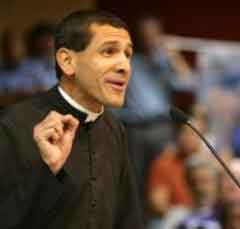
Priest Under Fire An Interview of Father Michael Rodriguez

.

Priest Under Fire

An Interview of Father Michael Rodriguez

by Michael J. Matt

Father Michael Rodriguez

Michael J. Matt (MJM): First off, Father, I'd like to thank you for the stand you've taken in recent months in defense of the Church's moral teaching, especially with respect to so-called 'gay marriage'. Catholics all across the country have been following your case, and we're delighted to have a chance today to ask you a few questions. Before we get into the "controversy", however, I wonder if you'd mind telling us a little something about your personal background?

Father Rodriguez (FR): Not at all. I was born in El Paso, Texas, on August 23, 1970, the middle child of five. Many years later my parents adopted a sixth child, my youngest sister. As I grew up in the early '70s, I was completely unaware of the disastrous post-Vatican II revolution that was sweeping throughout our beloved Catholic Church. Thanks be to God, I was raised by parents who were staunch Catholics with their childhood roots in the pre-Vatican II Catholicism of México. An example of the depth of these roots is that my maternal grandmother (born in 1906, in Aguascalientes, México) never accepted the Novus Ordo. She left this passing world in August 2002, always true to the Ancient Rite. Requiescat in pace. Even though my parents had accepted and adapted to Novus Ordo Catholicism during their post-collegiate years, they nevertheless raised us similar to how they had been raised: fidelity to Mass (albeit the Novus Ordo) and Confession, praying the Holy Rosary at home in the evenings, praying novenas and the Stations of the Cross, etc. As I reflect back on my childhood, it was a time of great grace and blessings. Even though my parents failed to hold fast to all the venerable traditions of our Faith and the Ancient Rite, they still did an excellent job of instilling the Faith in us. Interestingly enough, we four older children (born between '67 and '74) are now ardent supporters of the Traditional Latin Mass, even more so than our parents


Michael J. Matt (MJM): First off, Father, I'd like to thank you for the stand you've taken in recent months in defense of the Church's moral teaching, especially with respect to so-called 'gay marriage'. Catholics all across the country have been following your case, and we're delighted to have a chance today to ask you a few questions. Before we get into the "controversy", however, I wonder if you'd mind telling us a little something about your personal background?

Father Rodriguez (FR): Not at all. I was born in El Paso, Texas, on August 23, 1970, the middle child of five. Many years later my parents adopted a sixth child, my youngest sister. As I grew up in the early '70s, I was completely unaware of the disastrous post-Vatican II revolution that was sweeping throughout our beloved Catholic Church. Thanks be to God, I was raised by parents who were staunch Catholics with their childhood roots in the pre-Vatican II Catholicism of México. An example of the depth of these roots is that my maternal grandmother (born in 1906, in Aguascalientes, México) never accepted the Novus Ordo. She left this passing world in August 2002, always true to the Ancient Rite. Requiescat in pace. Even though my parents had accepted and adapted to Novus Ordo Catholicism during their post-collegiate years, they nevertheless raised us similar to how they had been raised: fidelity to Mass (albeit the Novus Ordo) and Confession, praying the Holy Rosary at home in the evenings, praying novenas and the Stations of the Cross, etc. As I reflect back on my childhood, it was a time of great grace and blessings. Even though my parents failed to hold fast to all the venerable traditions of our Faith and the Ancient Rite, they still did an excellent job of instilling the Faith in us. Interestingly enough, we four older children (born between '67 and '74) are now ardent supporters of the Traditional Latin Mass, even more so than our parents.

MJM: And are there one or two persons in your life that mentored you and helped you to remain open to God’s call?

FR: My parents, Ruben and Beatrice, were the ones who were most instrumental in my eventual discernment of a vocation to God's holy priesthood. Through my father, God blessed me with discipline, fortitude, perseverance, and a love for study. Through my mother, God graced me with the convictions of faith, awe for the Catholic priesthood, a tender devotion to our Blessed Mother, and a love of religion.

MJM: At what point in your life did you know you had a vocation?

FR: I was raised in El Paso, TX, but spent four years (1981-1984) living with my family in Augsburg, Germany. We returned to El Paso, and I began high school. Following my junior year, I spent the summer (1987) at M.I.T. University in Cambridge, MA. I was participating in a special program for gifted minority students from around the nation. The program was geared to recruiting us to study engineering and science at M.I.T. as undergraduates. Well, our good God had different plans for me! I left El Paso that summer thinking I'd study electrical engineering (like my father) upon graduating from high school, only to return from Boston six weeks later, announcing that I wanted to enter the seminary! My mother was overjoyed.

MJM: Clearly, someone was looking out for you. Do you have a favorite saint, by the way?

FR: My favorite saints are: St. Michael the Archangel, St. John the Baptist (largely due to my 9 1/2 years at this El Paso parish), St. Paul the Apostle, St. Ignatius Loyola, St. Alphonsus Liguori, and, to no surprise, the holy Curé of Ars. I have a special devotion to the Blessed Virgin Mary under three of her specific titles: Immaculate Conception (I was ordained to the priesthood on Dec. 8, 1996), Mater Dolorosa, and Nuestra Señora de Guadalupe.

MJM: And, liturgically—where would you place yourself? I know you offer the traditional Latin Mass, but is it accurate to describe you as an outright “traditionalist”?

FR: Liturgically, I'm 100% behind the Traditional Latin Mass, which is without question the true Mass of the Roman Catholic Church. Theology, liturgy, Catholic spirituality and asceticism, and history itself all point to the obvious superiority of the Classical Roman Rite. Unfortunately, all of my seminary formation was in the Novus Ordo, and I only "discovered" the Latin Mass about six years ago, so I still have a lot to learn in terms of "real Catholicism," i.e. "traditional Catholicism."

MJM: What was it initially that led you to begin offering the old Mass?

FR: About six years ago, several members of the faithful began asking me if I would be interested in offering the Traditional Latin Mass. At the time, there was serious concern on the part "El Paso's remnant" of traditional Catholics that the Jesuit priest who was offering the Latin Mass twice a month (under the 1988 Ecclesia Dei "Indult") was going to be transferred. Thus, they were looking for another priest who would be willing to offer the Latin Mass. At first, I declined, not so much because I wasn't interested, but due to the immense workload which I was already carrying.

As the weeks passed, I began to study the prayers and theology of the Traditional Latin Mass. The more I studied, the more my awe and amazement grew. I was "discovering" not only the true Catholic theology of the Mass, but also the true Catholic theology of the priesthood, and so much more! Throughout my first nine years of priesthood, I had struggled to make sense of the very serious problems which exist in the Church. At this point, it was obvious that an extreme crisis pervaded the Church and her hierarchy, but why? I just couldn't quite understand how all of this "diabolical disorientation" had come to pass . . . until the brilliant light of the true Catholic Mass ("Emitte lucem tuam et veritatem tuam . . .") began to penetrate my priestly soul. This "discovery" of the Traditional Latin Mass has been, by far, the greatest gift of God to my poor priesthood.

MJM: So this gives us an idea of how Pope Benedict's motu proprio Summorum Pontificum can and does impact priests who might otherwise never have had the opportunity to discover this great treasure. Given how it impacted you, how do you believe Summorum Pontificum will impact the Church long term?

FR: Unfortunately, both Summorum Pontificum and Universæ Ecclesiæ have plenty of weaknesses. Nevertheless, these documents do represent an initial step in what will probably still be a long and arduous "Calvary," i.e. the quest of traditional Catholics to restore the Cross, the Mass, the kingship of Jesus Christ, and true Catholic doctrine, outside of which there is no salvation. In Article 1 of Summorum Pontificum, Pope Benedict XVI writes that "due honor must be given to the Roman Missal promulgated by St. Pius V for its venerable and ancient usage." This directive of our Holy Father is currently being disobeyed almost universally. In the accompanying letter to the world's bishops (July 7, 2007), Pope Benedict XVI writes, "What earlier generations held as sacred, remains sacred and great for us too, and it cannot be all of a sudden entirely forbidden or even considered harmful. It behooves all of us to preserve the riches which have developed in the Church's faith and prayer, and to give them their proper place." These remarkable words of our Holy Father are also being disrespected and disobeyed almost universally, especially by many bishops. Finally, Universæ Ecclesiæ, No. 8, states very clearly that the Ancient Rite is a "precious treasure to be preserved" and is to be "offered to all the faithful." Where in the entire world of Catholicism is this directive actually being obeyed? The same number from Universæ Ecclesiæ emphasizes that the use of the 1962 Roman Liturgy "is a faculty generously granted for the good of the faithful and therefore is to be interpreted in a sense favourable to the faithful who are its principal addressees." This is an astounding statement. This statement from Rome means that the use of the 1962 Missal doesn't depend on a particular bishop's liturgical views, preferences, or theology. It's not about the bishops! On the contrary, it's about the faithful! Where in the entire world of Catholicism is this directive actually being obeyed?

MJM: Are you now able to offer the old Mass exclusively?

FR: Since I began my new assignment (Sept. 24, 2011) out in the rural, isolated missions of the El Paso Diocese, I've offered the Traditional Latin Mass exclusively. I consider this to be a marvelous and unexpected blessing from Providence in the midst of a very difficult trial. I hope to continue offering the Traditional Latin Mass exclusively. If it were strictly up to me, I would never celebrate the Novus Ordo Missæ again. However, the sad reality of having to "obey" in the Novus Ordo Church that has largely lost the Faith, and the need to reach out patiently to Novus Ordo faithful who have been so misled, means that I will probably be "forced" to celebrate the Novus Ordo occasionally. In these instances, however, it will be the Novus Ordo ad orientem, with the Roman Canon, the use of Latin, and Holy Communion distributed according to traditional norms.

MJM: Up until last year, I believe, things were pretty quiet in your priestly life. What happened to change all that?

FR: The local, and even national, "controversy" that has engulfed me is due to the fact that I have been vocal in promoting what the Roman Catholic Church teaches in regard to the whole issue of homosexuality. It's a disgrace, but the City Council of El Paso has been adamant in trying to legitimize same-sex unions. This goes completely contrary to Catholic Church teaching. I've made it clear to the Catholics of El Paso (and beyond) that every single Catholic has a moral obligation before God Himself to oppose any government attempt to legalize homosexual unions. A Catholic who fails to oppose this homosexual agenda, is committing a grave sin by omission. Furthermore, if a Catholic doesn't assent to the infallible moral teaching of the Church that homosexual acts are mortally sinful, then such a Catholic is placing himself / herself outside of communion with the Church. These are the Catholics who are actually excommunicating themselves, not the Society of St. Pius X!

MJM: I can understand why the civil authorities and media might find this “controversial”; but why would your ecclesial superiors find it so?

FR: The dismal response of both civil and ecclesiastical authorities to the authentic teachings of the Catholic Church in regard to homosexuality demonstrates how extreme the current crisis of faith actually is. It really can't get much worse. There's hardly any faith left to lose! Even a pagan, bereft of the light of faith, can arrive at the conclusion that homosexual acts are intrinsically evil. Reason, natural law, and consideration of the male and female anatomy more than suffice to confirm this moral truth.

MJM: And yet you must go where the bishop tells you to go. Is this difficult for you?

FR: In my particular circumstances, obedience to my bishop has been incredibly difficult. Nevertheless, obedience is essential to the priesthood, and I intend to be obedient. One consoling aspect of "sacrificial," "death-to-self" obedience, is that the Holy Ghost will always come to one's assistance. I'm reminded that my poor sufferings are nothing compared to those of Mater Dolorosa and our Divine Redeemer. If I'm counted as one even slightly worthy to suffer for the Faith and the Traditional Latin Mass, I will consider myself profoundly blessed. God is so good.

MJM: As you are already living through a form of persecution, I assume you foresee more to come not only for you personally but for all Catholics who stand in defense of Church teaching. But what about the future? Any hope?

FR: Yes, I do foresee plenty of persecution still to come for all those who remain steadfast in the Faith and in their adherence to the Ancient Rite. However, the promise of our Savior cannot but fill our souls with hope, "Blessed are they that suffer persecution for justice's sake, for theirs is the kingdom of heaven. Blessed are ye when they shall revile you, and persecute you, and speak all that is evil against you, untruly, for My sake. Be glad and rejoice, for your reward is very great in heaven." (Mt 5:10-12)

MJM: How can lay Catholics best survive this crisis of faith?

FR: In order to overcome this crisis of faith, we must (1) do everything in our power to recover the Catholic Faith: the Ancient Rite, traditional Catholic teaching in doctrine and morals, the theology and philosophy of St. Thomas Aquinas, traditional Catholic piety and devotions, and a traditional Catholic “code of living” or “rhythm of life.” (2) On a daily basis we must strive to pray, study, fast, do penance, and practice charity with the aforementioned goal in mind. Finally, I strongly urge all faithful Catholics to (3) pray the Holy Rosary daily and heed our Blessed Mother's Message at Fatima.

One of the hallmarks of the Traditional Latin Mass is its exquisite and concentrated focus on eternity. If we are to survive and overcome this terrible crisis of faith in the post-Vatican II Catholic Church, we have to keep our intellect and will focused on eternity. We cannot lose hope when, from a worldly perspective, all seems lost. Jesus Christ promises “the kingdom of heaven” to those who endure persecution, and “a great reward in heaven” to those who suffer for His sake. (Mt 5:10-12) The final goal is heaven! Like St. Paul, we must press ahead towards the ultimate “prize” (Phil 3:14) and never cease to “seek the things that are above, where Christ is sitting at the right hand of God.” (Col 3:1)

MJM: Like so many others, Father, I find myself deeply moved by your powerful witness not only to the Faith itself but also to the Catholic priesthood, which, as you know so well, is under diabolical attack. Thank you for this example of what it means to be a Catholic in an era of persecution. May all of us have the courage to follow your lead through the rough seas still ahead. The Remnant October 16, 2011

Archdiocesan Communications Day - St. Paul & Minneapolis

.

I just returned from Communications Day 2011 in the Archdiocese of St. Paul and Minneapolis. It was a full-day event for parish, school and ministry leaders about sharing the Good News via Social and Digital media.

I’d never been to Minnesota. Unfortunately, I was only there for one day, but I must say the weather was perfect and the people were lovely and welcoming. I was honored to be one of the presenters, along with my good friend Lisa Hendey and some other speakers you may have heard of, like Lino Rulli (The Catholic Guy), John Allen Jr. (author and journalist), Paul Henderson (USCCB) and Lou Carbone (“experience” engineer).

What I liked about the event:

1) It was a really good mix of various perspectives on communication within and as the Church.

2) It was fun.

3) It was extremely well organized, managed and emceed.

4) It was well attended. I think there were between 500-600 parish/school/ministry leaders from around the diocese and neighboring dioceses.

5) I enjoyed great conversation and a meal (or two) with some wonderful people. I also got to drink a beer (or two) with Lino Rulli and Lisa Hendey. I got to see a picture of Lino’s friend Goob.

6) I didn’t say “uhm,” too much. I don’t think. And I yammered on too long about the same thing only a few times.

7) I got to hear Lino sing.

8) I was reminded that the work of the Church is filled with messy interruptions because we’re messy people. And the only reason our Church is still here as a final bastion of truth, goodness and beauty is because God loves us enough to have made it so. And I love it.

9) I was also reminded that there are a lot of people out there who need the Church and don’t know it. And that one thoughtful gesture you make today to change that person’s “experience” of the Church could change that person’s life forever (literally).

10) I was affirmed in the fact that there are a lot of dedicated and amazing ground-level leaders in our Church who don’t get new media - but want to, because they know it will help the Church.

11) I was also affirmed in the fact that there are some diocesan leaders out there now who do get it and are working to make it better.

12) Finally, I love that the Archdiocese of St. Paul & Minneapolis, The Catholic Spirit and the coalition of those who put the event on are planning to continue the event in the future. They are also putting together a group of people from their diocese who want to come together, share best practices and help each other better communicate and build relationships in our Church. And particularly via the use of new and social media, of course.

I would encourage you to tell your own diocese to contact the Archdiocese of St. Paul & Minneapolis and ask them how to duplicate an event like this in your own diocese (this event was done very well). Every diocese should have one every year. And every diocese should be recruiting attendees from it to build a year-round community that collaborates and shares best practices as you forge ahead as pioneers on the digital continent - together.

There are many more of these kinds of events to come in the Church. And that’s a very good thing.

You can check out the tweets from the event by clicking here (#CommDay11). And you can take a look at the setup here. National Catholic Register

Lino Rulli, the Catholic Guy, Talks of Life, Faith and His New Book - Sinner


Rulli's new book, Sinner, can encourage many who want to become Saints.

Lino Rulli, host of The Catholic Guy on SiriusXM Radio, wrote a book with an intriguing name - "Sinner." The book is not a showcase for sin but a support system for ordinary Catholics to encourage them in a life of faith in our extraordinary God. Though humorous, Lino is also a man deeply serious about his Catholic faith. The book touches people where they live and encourages them to take their faith seriously.


WASHINGTON, DC (Catholic Online) - Lino Rulli believes that if he can live the Christian life there's hope for everyone. The daily host of The Catholic Guy on SiriusXM Satellite Radio, Lino wrote a book to encourage people just like him - ordinary people - to keep going.

Raised in the Catholic Church in the heartland of the upper Midwest, his life was anything but saintly. He was, as he says without hesitation, a sinner, but a sinner who was in search of God's grace. With grace working in his life, he knew his faith can grow and, building on small personal victories, his spiritual life would deepen in devotion.

Lino's new book, "Sinner, The Catholic Guy's Funny, Feeble Attempts to Be a Faithful Catholic," is not a biography. Like album of snapshots, he presents snippets of his life that reveal something about a sinner who knows he needs God's grace to grow in his faith. This handful of stories will help the reader get to know Lino Rulli just a little better.

"I probably started with a hundred stories," Lino said in a recent interview. "I think that one of the most important things that I did was say to myself, 'Who do I want to have read this book?'

"I'll get myself in trouble here. so why not start right off the bat. I don't care if some priest or archbishop or cardinal reads it. I wrote it for someone like myself, or more importantly, someone like myself before I started working in Catholic Media, in other words, just a regular person.

"I picked stories where I thought people would say, 'Oh, that's funny! Oh, that's relatable. I get that.'"

Lino writes about his life, as a "single desperately lonely human being."

"I wanted to talk about my insecurities, the things that led me to be the person I am today, in terms of not just faith, but in terms of my absolute desire to be liked. to be needed. to be wanted. The only way you can find out those things about me is to find out about some of those whacky stories about me in the past."

As you meander through his life, you'll read that, as a boy, his father wanted to be an organ grinder. Guess who had to substitute for the monkey?

You'll also learn about his dream to visit to see David Letterman tape his show, adventures in the confessional, temptation in Thailand, living in the Bahamas, working in media and much much more.

Perhaps the most controversial story involved his visit Thailand, where he was encouraged to get a prostitute and learned what it is like to experience victory over temptation.

We talked about the fact that this story puts the spotlight on the darker side of humanity and the temptations many people face.

"Maybe it's not prostitution for somebody," Lino commented, "maybe it's something else. I'm hoping someone who reads this might say, 'I'm not the only person out there who's been tempted in Thailand. or Las Vegas. or wherever. But it's a story about victory over temptation."

Written in a very honest and transparent style, he never gives you a hint at how things will turn out at the end of a chapter. You just hold on and wait for the surprise.

"There are things I didn't understand at the time but make sense now. I think it's important for everybody to look back and say, 'Now, where was God in this?'"

While Lino does a show called "The Catholic Guy," his website is entitled "Lino Rulli - A Man With a Big Nose." When you talk with him, however, you don't think about physical characteristics; however big his nose might be, his joy and enthusiasm for life as a Catholic is much bigger.

I had to confess to him I had to make one major adjustment in my thinking as I began his book. He seems so "New York," when, in fact, he grew up in Minnesota.

He laughed and said, "There's something that comes from being in what people call 'fly-over land.' I'm the regular person , I get it. I'm the guy from the Midwest. I know what it is to grow up in an average middle-income family, to have those values and roots of the Midwest.

"I approach my Catholicism the same way. I could sit here and talk about the inside things going on in the church - what about this cardinal moving, what about this bishop, what about that decision?

"It's important for me to keep those roots about where normal people are from and take an average Catholic look at life without getting swept up in the 'inside baseball' of the Church.

"For me its about I know what I want to do and I know what I should do; now, let's see what happens."

Without trying to give away too much of the book, one chapter that really sticks out deals pants - not the pants themselves but how he would just leave them around the house. By the end of the story, his pants ended up where they were supposed to be - a small victory we talked about.

"The fact that I can come home and put them away properly means I can change. Just like everything in life, you start small then ... you build up. There are victories in life and, no matter how small they are, we need to look at them and say that I can make a change in my life in the small things. Maybe God can help make the bigger changes."

Lino is a larger than life personality who fills a room the moment he enters. He is honest in his communication, whether in person or on the radio. I asked him about the writing project and how people around him responded when he mentioned he was going to do it.

"A lot of people were afraid I was going to write a crazy book glamorizing sin. I was very conscious this whole time - Am I writing a book that says 'go out, get drunk, have fun, do what you want and then later just go to confession?' No! I concerned for my soul, too, and certainly don't want to mess around with anyone else's."

Always ready to make you laugh, he is also a man deeply serious about his faith. He wants the book to have entertainment value, but, even more, that it really touches people where they live and encourage them to take their faith seriously.

We also talked about whether there would be "Sinner, Part II," coming out and whether he would do more in this medium.

"Yes, I am. I enjoyed the process of writing. especially (being) in radio where it's so fleeting. You go do your three hours and then it goes away, you know; never to be heard from again. I like doing something that can be a little more tangible and a little more concrete.

"I've been really lucky to have a couple of publishers approach me with some ideas. I don't know what I want yet and I certainly don't know what people want. I learning toward doing a second version of sinner.

"I really did pray about this for a very long time - should I write a book? So I did it. Whatever happens next I have to re-start that prayer and re-discern all these things.

"I respect other media forms and I know what it takes to be a good writer - and I don't know if I am or not - but I know what it takes for me to become a halfway decent writer, so I can't crank out another book in two months. It's gonna be awhile and I have to make the decisions.

"I really do enjoy how much people loved the book, so I'm in the business of saying, 'All right, if I can bring some sort of peace and happiness in people's lives and encouragement to Catholicism along the way; yeah, I'd better start writing."

Lino has an ability of bringing unique worlds together. He has friends like Gary Dell'Abate, the executive producer of the Howard Stern Show and others who are deeply involved in the work of the church. He knows that the only way those who walk in the one world to honestly experience the Lord is through real Catholics - honest and open Christians - connecting with them.

"For me, one of the proudest things that happened was that the two endorsements on the back of the book are from the guy in charge of the Howard Stern Show and the guy who is in charge of the bishops in the United States.

"It's important to me that guys like Gary, who I really like - I think he's just an excellent human being - and I know a lot of Catholics who can't stand him because he's associated with the (Howard) Stern Show, and maybe that's what's turning him off to religion. If a guy like Gary and (Archbishop) Dolan get together they would have nothing but fun. If I can be the bridge that brings what other people would think are two completely different worlds together I'm all for it."
Catholic Online

"Sinner," by Lino Rulli, is published by Servant Books from St. Anthony Messenger Press.


St. John's of St. Paul celebrates 125 years

.


This is the original St. John's Church, built in 1886. The photo on the left is from a postcard postmarked in 1909. The photo on the right comes from the booklet "Picturesque Dayton's Bluff" published in 1909 by the Dayton's Bluff Commercial Club.

October 11, 2011

Although the first St. John’s Catholic church building wasn’t dedicated until December of 1886, this August marked the official start of the 125th year of St. John’s existence as a parish in Dayton’s Bluff.

In early 1886, Bishop John Ireland asked Rev. Louis Cornelis, pastor at Mendota, to look into the possibility of organizing an English-speaking Catholic parish on Dayton’s Bluff. Sacred Heart Church had been founded in 1882 to care for the German speaking residents of the district, but ever growing numbers of English speaking people coming into the neighborhood seemed to make the establishment of a separate parish for them a logical step in the growth of the diocese.

Although St. John’s is often thought of as an Irish parish, just as Sacred Heart was a German national parish and St. Casimir’s was a Polish parish, it was actually a territorial parish. It just happened that in the 1880s most English-speaking Catholics in the area were Irish. When parish boundaries were originally drawn up, the western edge was marked by Payne and Maria Avenues, and the southern edge by the river bluffs. There was no need for northern and eastern boundaries because the land past Dayton’s Bluff in those directions was largely unsettled and not part of St. Paul proper.

Father Cornelis canvassed the Bluff for funds, and collected over $1,100 of which the people of the new parish contributed $200. The Corporation of the Church of St. John was organized under the laws of the State of Minnesota on August 4, 1886, and its first meeting was held on August 29. One of the first acts of the corporation was to purchase nine lots in Dayton’s Bluff on Frances (now Fifth) Street, between Forest and Cypress.

The contract for building the church was let early in September 1886 and the Church of St. John of St. Paul became the twelfth Catholic church in St. Paul when it was dedicated on December 19, 1886.

The church structure was typical for its time. The architect, H. G. Terherne, designed a plain frame building with stained glass windows along each side and a large circular stained glass window above the main entrance. A small, cross-crowned belfry topped off the building. The church could seat 450 people on its black walnut-finished pews. The octagonal sanctuary housed a white altar and the sacristy could be used as a chapel. This church served the parish until 1922 when a much larger, brick church was built.

St. John’s will begin its 125th anniversary celebration on Saturday October 22 with a Mass at 4:15 p.m attended by Archbishop John C. Nienstedt.

As part of the celebration St. John’s is putting together a commemorative history booklet. We are looking for photos, memorabilia, stories, facts or anecdotes concerning St. John’s Church and School particularly in the period of 1940 through 1980. If you have anything you would like to share with us, please contact St. John’s at 651-771-3690 or stjohns@stjstp.org.

Please visit www.stjstp.org to learn more about St. John’s and its history. Twin Cities Daily Planet

Saturday, October 8, 2011

Bishop Aquila of Fargo predicts state attempts to silence Catholic Church

.

Bishop Samuel J. Aquila

An American bishop has predicted that government authorities may one day attempt to silence the Catholic Church in the United States.

“We could see the possibility of it within the United States where we are no longer free to preach the truth from the pulpit or to present Catholic teaching,” Bishop Samuel J. Aquila of Fargo, North Dakota, told CNA on a visit to Rome October 7.

“It will then become important for us to take a very strong stand, as we have done with human life and the unborn child, to continue to speak the truth and to speak it clearly and with charity.”

Bishop Aquila cited two recent examples where he believes religious liberty is being undermined: the closure of Catholic adoption agencies in states that have legislated for same-sex “marriage” and the new government health mandate requiring private insurers to provide women with coverage for contraception and sterilization.

“It’s very, very important for us to realize that we are in a very real clash between the culture of death and a culture of life,” said Bishop Aquila, summing up the former culture as one where “rights are eroded and where lies are being presented as truth.”

Bishop Aquila said he doesn’t know how the present stand the stand-off between Church and state will be resolved, but he is certain that Catholics “will have to stand for the truth” and “speak clearly to the truth no matter what the cost.” He doesn’t rule out the possibility of civil disobedience.

“Either we’re going to have to enter into conscientious objection and say we won’t do this or we will need to co-operate – which we cannot do and still be faithful,” he said.

And he worries that in those states where the practice of the Catholic faith in areas such as adoption and fostering has been declared illegal, that the preaching of that same faith may also eventually face legal sanction.

“I tell our seminarians: you must be prepared to enter into this battle because it’s a battle we need to enter into and speak the truth,” he said.

Bishop Aquila was in Rome for the ordination of one of those seminarians to the diaconate, one of four new deacons for the Diocese of Fargo this year. His words of congratulation to them, though, have also been mingled with words of warning.

“There will be people who will hate you because of the stand which you take, there will be people who ridicule you, yell at you,” he said, “and they did all the same things to Christ when he proclaimed the truth and we can expect no less in the times in which we live.” Catholic News Agency

Interview: Jason Adkins, Executive Director of Minnesota Catholic Conference

.
In the Catholic Servant newspaper, By David Hottinger
[Editor’s Note: In March of this year, Jason Adkins, J.D., was appointed the executive director of the Minnesota Catholic Conference. “The Catholic Servant” recently interviewed
him.]

“The Catholic Servant”: Briefly, what is the Minnesota Catholic Conference (MCC)?

Jason Adkins: The MCC is the public policy voice of the Catholic Church in Minnesota. It represents all of Minnesota’s bishops — and by extension, the whole Church in Minnesota— at the Legislature to advocate for laws that promote human dignity and the common good; that defend marriage and family life; and that promote other tenets of Catholic social
doctrine.

“The Catholic Servant”: As an organ of the Church, should you really be meddling with politics?

Jason Adkins: The MCC assists the bishops in their teaching office of transmitting the Church’s social doctrine to the faithful, but also by bringing the Church’s voice into the public arena. The Church’s primary responsibility is not to provide technical solutions to every conceivable public policy problem, but instead to help form the consciences and worldview of Catholics so that they can bring Catholic teaching into the public square.
But oftentimes, the Church will step in and make prudential judgments that certain public policies are necessary to promote the common good of all society, particularly families, which are the first and natural cornerstone of civil society. Still, the bishops’ primary responsibility in the realm of politics is to provide the ethical and moral framework within which the laity and politicians can develop specific answers to difficult public policy questions.
One common misunderstanding among Catholics and the general public alike is why the Catholic Church, a religious institution, has any role or any say in the formation of civil laws. This misunderstanding often generates a certain hostility when the Church participates in the public square.
Yet the Church has a responsibility to society as one of its principal actors to speak out and share its wisdom, collected over the centuries, about the principles that should guide public policy decisions. The Church proposes; she never imposes.
Like any other institution or political actor, the Church must convince the public of the wisdom of her positions. But she is certainly not excluded from participation simply because of her religious identity. Martin Luther King, Jr. was not excluded from speaking about civil rights because he was a Baptist minister and used theological arguments in his quest for a more just society.

“The Catholic Servant”: Is it ever the case that the MCC advocates for a policy which reasonable Catholics could differ over?

Jason Adkins: Often, when the MCC advocates for or against certain public policies, some degree of prudential judgment is involved. But some issues are more clear-cut.
The Church and the bishops have a responsibility to speak whenever the institutional integrity or mission of the Church is threatened. Similarly, it is compelled to speak when there are laws proposed that specifically undermine human dignity or threaten the common good of society.
In any given session of the Legislature, thousands of bills are authored and in the vast majority of instances, the bishops do not take a position for or against them. Yet there are some instances in which the bishops, through the MCC, will counsel legislators and other officials to enact a specific piece of legislation because they deem it so fundamental for promoting human dignity and the common good. Examples of such issues include many types of abortion restrictions;
ensuring that cuts are not made to assistance programs for children, elderly, and the disabled;
comprehensive immigration reform; and seeing that parental choice in education is expanded,
especially for the poor.
When making these determinations, the bishops and conference staff must view each piece of legislation in light of the principles of Catholic social doctrine, specifically the protection of human dignity, promoting the common good, along with the twin principles of solidarity and subsidiarity.

“The Catholic Servant”: You mentioned the “M” word: Marriage. With the Marriage Amendment on the ballot next fall, what will the MCC do in the interim?

Jason Adkins: The MCC is supporting a statewide ballot campaign called Minnesota for Marriage which seeks to encourage other Minnesotans to vote for an amendment to the Minnesota constitution defining marriage as the union of one man and one woman.
The MCC will be working with other organizations supporting Minnesota for Marriage to build a statewide, grassroots campaign composed of many volunteers who will register voters, knock on doors, and seek to convince others to vote for the amendment. The MCC, for its part, will be working with Catholics of every diocese to help build this campaign.
We know it is not enough for us to simply get enough votes to pass the amendment. We also have to educate Catholics about the vital role that marriage plays as a cornerstone of a healthy society. If we don’t take this opportunity to educate and inform Catholics of the importance of the institution of marriage and the role it plays in nurturing healthy families and healthy children, then over the long term we will not be able to sustain laws protecting traditional marriage.
Therefore, it is absolutely vital that Catholics take on their responsibility as faithful citizens to educate themselves about the issue and help in whatever way they can with the marriage amendment campaign.

“The Catholic Servant”: And why should Catholics— why should anyone—be concerned about preserving traditional marriage?

Jason Adkins: Fundamentally, what’s at stake are two competing arguments about the nature of marriage. There is a movement around the country and around the world to redefine civil marriage laws. The public needs to be well aware that those seeking to promote what’s called same-sex marriage are not out to create a separate institution that same-sex couples can enter into. Instead, people opposed to traditional marriage seek to redefine marriage for the rest of society.
And despite their very vocal presence in the culture and in the media, the actual number of
these advocates is very small. According to the census, only one percent of all couples in
Minnesota are living together in same-sex relationships. Such a small minority of the population
should not have the ability to redefine a bedrock social institution.
The consequences of redefining marriage will be profound. Redefining marriage redefines
parenthood and the family. By extension, redefining marriage will reshape, in radical ways, civil society.
Marriage as an institution in civil law is ordered toward the nurturing and well-being of children and not around the supposed happiness of adults. When proponents of redefining marriage say that government has no business telling them who they can love, they are absolutely correct. But they have missed the point of the civil institution of marriage altogether. It is not about regulating relationships between consenting adults. It’s about the care and wellbeing of children.
Those who seek to redefine marriage want to turn the institution into a system of government-
sanctioned love licenses. [If that happens] people will quickly see this counterfeit version of marriage for what it is and decline to enter into it. Thus, the practical effect of redefining civil marriage will be to redefine it out of existence.

“The Catholic Servant”: And what can you tell us about our opponents in this fight?

Jason Adkins: Those opposed to the marriage amendment are well-financed and well-organized. The movement to end traditional marriage laws is led by persons whose sexuality, whose very identity, is wrapped up in the issue. So they will focus everything they have on the campaign. They have been working at this for years and already have the framework in place to run a
campaign. Not only that, but their supporters hold the commanding heights of our culture;
in academia, in politics, even in the entertainment industry. It presents quite a hurdle to overcome.
Our side, on the other hand, is disadvantaged in the sense that the groups involved in promoting
the marriage amendment do a lot of other things besides just marriage policy. Additionally, we have the challenge of putting a statewide campaign together from scratch.
But we are confident that we can win because the arguments are on our side. We just have to show the majority of Minnesotans—who know in their gut that just as the sun rises in the east, marriage is between one man and one woman; that supporting traditional marriage is not bigotry or discrimination; that you can be kind to your neighbor without
being forced to redefine the bedrock institution of society. To ultimately succeed, however,
we will need all Catholics’ prayers, hard work, and support.

David Hottinger is a freelance writer from the Twin Cities who is attending the University of Minnesota Law School.

This article was funded by the St. Benedict Chair of Writing sponsored by an anonymous patron of The Catholic Servant.
.

["Shy and Retiring, Tim Drake"] St. Joseph man plays role in faith-based film 'Courageous'

.
Tim Drake of St. Joseph, senior writer for the National Catholic Register [EWTN radio anchor and Catholic Defense League Board Member, Father, and Farmer, among other things], stands next to a poster for “Courageous” on Tuesday at Parkwood 18 in Waite Park. Drake covered the filming and became an extra on the set in the faith-based movie, which opens Friday.


Tim Drake of St. Joseph, senior writer for the National Catholic Register, stands next to a poster for “Courageous” on Tuesday at Parkwood 18 in Waite Park. Drake covered the filming and became an extra on the set in the faith-based movie, which opens Friday. / Jason Wachter, Tim Drake doesn’t have an agent, an entourage or an endorsement deal.

What the St. Joseph resident does have is a bit part as an extra in “Courageous,” a faith-based movie about fatherhood in theaters starting Friday.

“This film was produced by Sherwood Pictures, an outgrowth of Sherwood Baptist Church,” said Drake, a senior writer for the National Catholic Register.

“Courageous” will be the fourth film to be released by the megachurch’s 3,000 members. The “action-packed police drama” is rated PG-13 and features Alex Kendrick, an associate pastor who also directed and co-wrote the movie.

“That’s something that has inspired other groups and other churches to do likewise,” said Drake, who was on the set during filming in 2010. “It’s an interesting phenomenon.”

Spiritual cinema

Movie theaters and religion may seem like an odd combination to some, but Solid Rock Family Church has been holding weekly services at Parkwood 18 in Waite Park for almost a year.

“Movie theaters, in some ways, are like the churches of the modern world, so why not use that media to try to reach the younger generation with positive messages?” said Drake, who was at last month’s premiere of “Courageous” in Atlanta.

Radio station Spirit 92.9 is offering discounted tickets for opening weekend showings of “Courageous” at Quarry Cinema in Cold Spring through the local Christian radio station’s website.

“I definitely think the topic of fatherhood is worth exploring,” Drake said. “If we look culturally, there are a lot of absent fathers in families, so the fact that this film is taking a look at that topic is very timely.”

Ben Reiners is the general manager of Parkwood 18. He said his theater has been fielding calls for more than a month about the movie, which was made for an estimated $1 million and stars relative unknowns.

“What we play is determined by our corporate office, and we thought it would be a good film to play in the St. Cloud area,” Reiners said of the Marcus Theatres-owned venue.

“I think it will do well. We’ve had a lot of people calling, wondering about show times, wondering if we are playing it, so, yes, I think it will do well. And if it does well, we have no problem continuing to book these kind of films.” St. Cloud Daily Times

St. Cloud Diocese: How many Sunday Masses are enough?

.
In light of fewer priests, the diocese seeks a balance in what’s best for pastors, parishioners and the integrity of the Mass itself
In light of fewer priests, the diocese seeks a balance in what’s best for pastors, parishioners and the
integrity of the Mass itself
By Sue Schulzetenberg
The Visitor
Note: Bishop John Kinney has charged the Planning Advisory Council of the St. Cloud Diocese to design a plan or a planning process for the diocese. The council’s goal is to present a proposal to the bishop by spring 2012. The council is looking at many dynamics in the diocese, including statistics like the number of priests, number of Catholics and Mass attendance as well as parish vibrancy and growing opportunities for lay leadership. One of its parameters for planning is that no priest should be responsible for more than three weekend Masses that use the Sunday readings. This article, part of an occasional series on diocesan planning, explores the rationale for the three-liturgies parameter and the challenges and advantages associated with it.
Every weekend, September through May, about 232 Masses are celebrated in parishes in the 16 counties of the St. Cloud Diocese.
More and more, priests celebrating these Masses are reaching retirement age. Already, about 25 percent of the priests serving are 70 years old or older. As the diocese is faced with the prospect of fewer priests in the future, the question arises: Who will preside at these Masses?
Some parishioners offer what seems at first to be a simple answer: Have the remaining priests preside at more Masses every weekend. In practice, however, this approach is fraught with complications. And it fails to address a legitimate question: Are all those Masses necessary?
Protecting priests and the Mass
Bishop Kinney issued a guideline in 2009 stating that no priest should be expected to celebrate more than three liturgies with Sunday readings per weekend. This guideline refers to canon law, which states that the local ordinary can allow priests to celebrate Mass twice a day for a just cause, or if pastoral necessity requires it, even three times on Sundays and holy days of obligation. The guideline also notes that the Eucharist is the summit and source of all worship and Christian life and that priests should prepare themselves properly through prayer before Mass and offer thanks afterwards.
The guidelines are designed to protect the integrity of the Mass, help the Mass be seen as a celebration rather than another obligation and protect priests from simply becoming worn out, said Father Robert Rolfes, diocesan vicar general, in a 2010 Visitor article.
“It’s not feasible” to continue to ask priests to celebrate more and more Masses, said Planning Advisory Council member Deacon Steve Pareja of St. Francis Xavier Parish in Sartell. He said priests are very busy people with hours not limited to nine-to-five.
“To fully pray with presence and [to] truly [focus] on the Word and on their homily takes a tremendous amount of energy,” said Rita Clasemann, a member of the Planning Advisory Council and parish life coordinator at St. Mary Parish in Mora and St. Kathryn Parish in Ogilvie. “I think that by the time you get to the fourth or fifth one, you’re running out. The Eucharist should not be something that you’re doing just going through the motions.”
Father Kevin Anderson, pastor of Christ Our Light Parish in Princeton and Zimmerman, said it is important to think about the health of priests in the long run. He said priests are not only celebrating Masses on weekends, but also providing reconciliation and presiding at funerals and weddings. All of those activities added up can take a toll on priests.
Celebrating one Sunday liturgy every Saturday evening and two every Sunday, Father Jerry Dalseth, pastor of St. Joseph Parish in Pierz and St. Michael Parish in Buckman, says he would not recommend more than three Masses per priest per weekend. In addition to the length of the Mass, time is needed for preparation and traveling. His weekends also often include weddings, funerals and baptisms.
“It takes a lot of energy. You have to be very intent and prayerful and concentrate. It’s more strenuous than a lot of the physical exercises,” he said.
Fewer Masses can also mean more collective energy from the congregation and stronger participation with a fuller church, Father Anderson said.
Bishop George Speltz, a former bishop of the St. Cloud Diocese, addressed the importance of having churches full for Mass back in 1985. At that time, he recommended eliminating any Masses in which attendance was less than 50 percent of the church building’s capacity.
“The assembly itself is the primary sign of the liturgy and the gathering of that assembly into one body — at one time and
CUTTING continues on page 7
under one roof — was the ideal practiced in the early Church and insisted upon by the Church Fathers. . . . The purpose of the Eucharist — binding us into one body in Christ our head — is defeated by an approach which puts individual convenience before the gathering together of the whole parish community,” Bishop Speltz wrote.
Parishioners at Christ Our Light in Princeton and Zimmerman have experienced a reduction in the number of Masses offered several times. Christ Our Light is the result of the merging of St. Edward Parish in Princeton and St. Pius X Parish in Zimmerman. Before the parishes twinned, each had three Masses every weekend. After they twinned, four Masses were offered between the two parishes. Then the Masses dropped to three, which is the number still offered today.
Confronting the challenges
A negative of cutting Masses is that people get accustomed to the time when Masses are offered, said Father Anderson. Also, he added, universally, the overall number of people that attend Mass initially drops when Masses are cut. Christ Our Light has recuperated from the decrease with the attendance back up and is doing well financially, he said.
Statistically, when Masses are eliminated, attendance and financial contributions drop but return within six months, said Jane Marrin, director of the Planning Office for the Diocese of St. Cloud.
Deciding which Masses to cut can be difficult. Father Dalseth recalls when St. Joseph’s and St. Michael’s were twinned 11 years ago and both parishes wanted Masses at the same time. Since then, the parishioners have become comfortable in attending Masses at each of the churches as well as other churches in the area.
“Maybe it’s our responsibility in each parish to do some educating on the priority,” Clasemann said. “What is our priority when it comes to our Lord?”
Parishioners could be asked to reflect on how far they travel for other events and what kind of flexibility they show to attend them, she added. “Doesn’t our Lord deserve the same kind of consideration?”
Tom Ehlinger, Planning Advisory Council member and member of St. Anne Parish in Kimball, said limiting Masses will affect parishioners, but he encourages them to look at the parish as a whole.
“If the parish currently has three Masses on a weekend but all of the Masses are only one-third of their capacity, they could get by with one or two Masses,” he said. “Parishioners would need to adjust their schedules to attend a Mass at a different time, but bringing together a larger group of parishioners at Mass may have many benefits in itself.”
Although eliminating a Mass at any parish brings challenges, some Masses might be easier to eliminate than others. Already, many parishes have only one weekend Mass or less, like All Saints on River Street in Holdingford, which has only weekday Masses.
“Ideally, the Eucharist would be celebrated in every faith community that knows and supports each other,” said Franciscan Sister Clara Stang, a member of the Planning Advisory Council. “With the smaller number of ordained priests, it’s just plain difficult. That’s probably the saddest thing that’s happening in the Catholic Church — the lack of priority people give to Eucharist and the restraints that come about when there aren’t enough clergy.”
Sister Clara said the ideal solution is for there to be more ordinations. Although 19 men are in the seminary for the Diocese of St. Cloud, their numbers do not make up for the number of priests approaching retirement. Only 15 diocesan priests are less than 50 years old.
“There is no perfect solution that will satisfy every single person,” said Deacon Pareja. “I think what we need is open dialogue. What we need to do first is open our hearts up to the Holy Spirit and say, ‘Lead me Lord.’”
FOR BOX
By the numbers
In the St. Cloud Diocese:
78: priests assigned to parishes
15: diocesan priests less than 50 years old
132: parishes
232: Approximate number of Sunday liturgies celebrated each weekend September through May
139,000: Approximate number of Catholics in the diocese
45: percentage of registered Catholics attending Mass on any given Sunday in 2010

Note: Bishop John Kinney has charged the Planning Advisory Council of the St. Cloud Diocese to design a plan or a planning process for the diocese. The council’s goal is to present a proposal to the bishop by spring 2012. The council is looking at many dynamics in the diocese, including statistics like the number of priests, number of Catholics and Mass attendance as well as parish vibrancy and growing opportunities for lay leadership. One of its parameters for planning is that no priest should be responsible for more than three weekend Masses that use the Sunday readings. This article, part of an occasional series on diocesan planning, explores the rationale for the three-liturgies parameter and the challenges and advantages associated with it.


Every weekend, September through May, about 232 Masses are celebrated in parishes in the 16 counties of the St. Cloud Diocese.

More and more, priests celebrating these Masses are reaching retirement age. Already, about 25 percent of the priests serving are 70 years old or older. As the diocese is faced with the prospect of fewer priests in the future, the question arises: Who will preside at these Masses?

Some parishioners offer what seems at first to be a simple answer: Have the remaining priests preside at more Masses every weekend. In practice, however, this approach is fraught with complications. And it fails to address a legitimate question: Are all those Masses necessary?

Protecting priests and the Mass

Bishop Kinney issued a guideline in 2009 stating that no priest should be expected to celebrate more than three liturgies with Sunday readings per weekend. This guideline refers to canon law, which states that the local ordinary can allow priests to celebrate Mass twice a day for a just cause, or if pastoral necessity requires it, even three times on Sundays and holy days of obligation. The guideline also notes that the Eucharist is the summit and source of all worship and Christian life and that priests should prepare themselves properly through prayer before Mass and offer thanks afterwards.

The guidelines are designed to protect the integrity of the Mass, help the Mass be seen as a celebration rather than another obligation and protect priests from simply becoming worn out, said Father Robert Rolfes, diocesan vicar general, in a 2010 Visitor article.

“It’s not feasible” to continue to ask priests to celebrate more and more Masses, said Planning Advisory Council member Deacon Steve Pareja of St. Francis Xavier Parish in Sartell. He said priests are very busy people with hours not limited to nine-to-five.

“To fully pray with presence and [to] truly [focus] on the Word and on their homily takes a tremendous amount of energy,” said Rita Clasemann, a member of the Planning Advisory Council and parish life coordinator at St. Mary Parish in Mora and St. Kathryn Parish in Ogilvie. “I think that by the time you get to the fourth or fifth one, you’re running out. The Eucharist should not be something that you’re doing just going through the motions.”

Father Kevin Anderson, pastor of Christ Our Light Parish in Princeton and Zimmerman, said it is important to think about the health of priests in the long run. He said priests are not only celebrating Masses on weekends, but also providing reconciliation and presiding at funerals and weddings. All of those activities added up can take a toll on priests.

Celebrating one Sunday liturgy every Saturday evening and two every Sunday, Father Jerry Dalseth, pastor of St. Joseph Parish in Pierz and St. Michael Parish in Buckman, says he would not recommend more than three Masses per priest per weekend. In addition to the length of the Mass, time is needed for preparation and traveling. His weekends also often include weddings, funerals and baptisms.

“It takes a lot of energy. You have to be very intent and prayerful and concentrate. It’s more strenuous than a lot of the physical exercises,” he said.

Fewer Masses can also mean more collective energy from the congregation and stronger participation with a fuller church, Father Anderson said.

Bishop George Speltz, a former bishop of the St. Cloud Diocese, addressed the importance of having churches full for Mass back in 1985. At that time, he recommended eliminating any Masses in which attendance was less than 50 percent of the church building’s capacity.

“The assembly itself is the primary sign of the liturgy and the gathering of that assembly into one body — at one time and under one roof — was the ideal practiced in the early Church and insisted upon by the Church Fathers. . . . The purpose of the Eucharist — binding us into one body in Christ our head — is defeated by an approach which puts individual convenience before the gathering together of the whole parish community,” Bishop Speltz wrote.

Parishioners at Christ Our Light in Princeton and Zimmerman have experienced a reduction in the number of Masses offered several times. Christ Our Light is the result of the merging of St. Edward Parish in Princeton and St. Pius X Parish in Zimmerman. Before the parishes twinned, each had three Masses every weekend. After they twinned, four Masses were offered between the two parishes. Then the Masses dropped to three, which is the number still offered today.

Confronting the challenges

A negative of cutting Masses is that people get accustomed to the time when Masses are offered, said Father Anderson. Also, he added, universally, the overall number of people that attend Mass initially drops when Masses are cut. Christ Our Light has recuperated from the decrease with the attendance back up and is doing well financially, he said.

Statistically, when Masses are eliminated, attendance and financial contributions drop but return within six months, said Jane Marrin, director of the Planning Office for the Diocese of St. Cloud.

Deciding which Masses to cut can be difficult. Father Dalseth recalls when St. Joseph’s and St. Michael’s were twinned 11 years ago and both parishes wanted Masses at the same time. Since then, the parishioners have become comfortable in attending Masses at each of the churches as well as other churches in the area.“Maybe it’s our responsibility in each parish to do some educating on the priority,” Clasemann said. “What is our priority when it comes to our Lord?”

Parishioners could be asked to reflect on how far they travel for other events and what kind of flexibility they show to attend them, she added. “Doesn’t our Lord deserve the same kind of consideration?”

Tom Ehlinger, Planning Advisory Council member and member of St. Anne Parish in Kimball, said limiting Masses will affect parishioners, but he encourages them to look at the parish as a whole.

“If the parish currently has three Masses on a weekend but all of the Masses are only one-third of their capacity, they could get by with one or two Masses,” he said. “Parishioners would need to adjust their schedules to attend a Mass at a different time, but bringing together a larger group of parishioners at Mass may have many benefits in itself.”

Although eliminating a Mass at any parish brings challenges, some Masses might be easier to eliminate than others. Already, many parishes have only one weekend Mass or less, like All Saints on River Street in Holdingford, which has only weekday Masses.

“Ideally, the Eucharist would be celebrated in every faith community that knows and supports each other,” said Franciscan Sister Clara Stang, a member of the Planning Advisory Council. “With the smaller number of ordained priests, it’s just plain difficult. That’s probably the saddest thing that’s happening in the Catholic Church — the lack of priority people give to Eucharist and the restraints that come about when there aren’t enough clergy.” Sister Clara said the ideal solution is for there to be more ordinations. Although 19 men are in the seminary for the Diocese of St. Cloud, their numbers do not make up for the number of priests approaching retirement. Only 15 diocesan priests are less than 50 years old.

“There is no perfect solution that will satisfy every single person,” said Deacon Pareja. “I think what we need is open dialogue. What we need to do first is open our hearts up to the Holy Spirit and say, ‘Lead me Lord.’”


By the numbers in the St. Cloud Diocese:

78:
priests assigned to parishes
15: diocesan priests less than 50 years old
132: parishes
232: Approximate number of Sunday liturgies celebrated each weekend September through May
139,000: Approximate number of Catholics in the diocese
45: percentage of registered Catholics attending Mass on any given Sunday in 2010

WDIO Duluth/WIRT Hibbing to televise Sunday Mass at Basilica of National Shrine in Washington

.
Sunday Mass at Basilica of National Shrine to be televised

By Kyle Eller
The Northern Cross

Ever since the Diocese of Duluth stopped sponsoring a televised Sunday Mass broadcast about five years ago, there has been a steady stream of requests hoping to see the broadcast returned. That hope will soon be fulfilled — Sept. 18 at 9:30 a.m. on WDIO-TV to be exact.

“Many, many seniors have written asking for a resumption of the Sunday Mass,” said Mike Bilden, development director for the diocese. He said the letters and calls have come not only from the Duluth diocese but also the neighboring diocese in Superior, Wis., the northern portion of which also receives coverage from Duluth television stations.

With the help of a three-year decreasing grant from the Catholic Extension Society of Chicago, the diocese will again be able to broadcast a 30-minute televised Mass throughout most of the diocese. The National Catholic Society of Foresters also has contributed money that will be used for promoting the Mass, Bilden said.

The broadcast will have a higher profile than it did previously on another station, where it aired earlier in the morning. The 9:30 a.m. time this fall and winter will directly precede the Minnesota Vikings pregame show.

“It’s a super time to have this Mass,” Bilden said.

As part of the arrangement, WDIO will also air 10 30-second promotions of the Mass throughout the week at random times. Bilden said Steve LaFlamme Sr. at WDIO, whose son Steve Jr. is a diocesan priest, worked to make things work out so well at the station.

The broadcast itself should also be of very high quality. It is a 30-minute Mass originating from the Basilica of the National Shrine of the Immaculate Conception in Washington, D.C.

Diocesan officials looked at five different options, Bilden said. “This one of course fit the criteria in every way,” he said, being the right length, liturgically sound, current with the liturgical calendar and affordable.

Bilden said the demand has been considerable. A televised Mass does not substitute for the Sunday Mass obligation, but many people who cannot get to Mass because they are homebound, in a rest home or simply stuck in bad weather want to see the Mass and participate in the life of the church even though their obligation is lifted.

Bilden said the service was a priority for Bishop Paul Sirba. “It’s Bishop Sirba who’s really intent on reaching out to everyone in the diocese,” he said.

The three-year grant covers the broadcast for the first year. After that, the diocese will have to start covering part of the cost through donations, and at the end of the three-year period will be responsible for the cost.

“I think there’s a good chance that it will become self-sustaining,” Bilden said.

But for that to happen, there will have to be sufficient donations to cover the cost of the broadcast. He said he also hopes for some support in the Superior diocese, where officials have agreed to send out bulletin announcements asking for individual donations.

Accessing the broadcast will vary based on where a person is located and how a person gets television. Bulletin announcements with more detailed information are being sent to parishes. Those with questions may also contact the diocese at (218) 724-9111.
Northern Cross

Some of those parishes in northeastern Minnesota are located a long way from their parishioners.

Duluth's diocesan strategic planning moves on to next phase

.
Six months — half of the diocesan strategic planning process — was devoted to the local committees with lay and clergy representatives from each parish. That part of the process is now coming to a close, said Father Peter Muhich, who is chairing the process.

And with that, the diocese is one big step closer to the plan that will guide planning decisions for the next five years.

The local groups were arranged into five regional groups called deaneries, and they were given wide latitude to accept, modify or even scrap proposals for their deaneries that had been drawn up by a diocesan committee. Already the Cloquet, Duluth and Hibbing deaneries have submitted their responses. Those responses have been posted on the diocesan website.

That leaves the Virginia and Brainerd deaneries. “They are wrapping up, as well,” Father Muhich said.

“They all were able to add some insights and definitely, I think, improve the work that was done by the diocesan committee,” Father Muhich said. He said the proposals coming back from the deaneries are not drastically different from the drafts they began with but are definitely refined.

“There’s a few things we missed or got wrong,” he said of the initial proposals.

He said that while it appears all the deaneries will be able to reach consensus, in a couple of cases there will also be “minority reports” filed, giving individuals a chance to share some differences.

“We’re trying to be respectful of those differences,” he said.

The last deanery planning meetings are scheduled for September. They began meeting back in April. Parishes have also been asked to hold town hall meetings following the conclusion of the deanery part of the planning process, to explain the revised proposals and the reasoning behind decisions, to answer questions and to note any additional concerns, which would be passed on to the diocesan committee.

Father Muhich said the local conversations from his perspective have been handled respectfully and have been a blessing. “I think they’re taking this very seriously and doing a good job,” he said of the groups.

He cited one instance in a deanery committee meeting where most representatives were still locked into defending their “turf” until representatives of a relatively small parish that under the diocesan proposal would have only been clustered differently broke ranks. The representatives observed that members of another small parish, which, under the diocesan proposal, would be merged into a larger parish, had even longer drive times than their own, and that perhaps their own parish would be a better candidate to be merged into a larger parish.

Father Muhich said that spirit of being willing to sacrifice showed in the local planning process.

Once all the deanery responses have been received, the diocesan committee will pull that information together and pass it on to the diocesan Presbyteral Council, the group that represents the priests of the diocese and advises the bishop. The revised proposals will also be the major focus of the annual clergy conference this fall.

The Presbyteral Council will then make its recommendations to Bishop Paul Sirba toward the end of the year. He will take the whole process into consideration.

“He’ll be able to make any adjustments he sees necessary,” Father Muhich said.

Bishop Sirba will likely approve the final plan early next year.

However, with the end of one process, another will begin: the implementation process. Contrary to a popular misconception, the plan will not necessarily be acted on all at once. Rather, it will be implemented as needed over the next five years. That could mean implementing all of the plan or only part of it.

Father Muhich said the bishop is still considering how exactly the implementation process will work and who will advise him on it.
Northern Cross

Wednesday, October 5, 2011

Annual Candlelight Rosary Procession

.>

The Annual Candlelight Rosary Procession in the Archdiocese of St. Paul and Minneapolis, is an event to honor our Blessed Mother as Our Lady of the most Holy Rosary.

Catholic tradition places devotion to Our Lady of the Rosary in the month of October. Our procession is held the First Friday of October.

Bring your family, friends, priests and religious as we pray the Rosary in procession from the State Capitol to the Cathedral of St. Paul.


  • Friday, October 7th, 2011
  • Assemble at the State Capitol at 6:30 p.m.
  • Procession to the Cathedral begins at 7 p.m.
  • Prayer Service and Benediction held inside the Cathedral
  • A free will offering will be taken to help support the Processions

Michael Voris: The Catholics Responsible for Obama's Agenda

.

Michael Voris: Obama and Evil

.

Doing a 180: Pro-Life Documentary Video Goes Viral

.

National Catholic Register


If you haven’t yet seen the powerful documentary “180”, do yourself a favor and take 30 minutes out of your day to watch the attached film. It’s worth taking a look at and sharing with others. Just a warning - the film does contain graphic images.

Created by evangelical pastor Ray Comfort, the film features interviews with people on the street, many of them college students.

At first, you’ll be dismayed at the students’ ignorance of history, but keep watching.

Comfort goes on to present each of them with a hypothetical situation that goes like this:

It’s 1943. A German officer has a gun pointed at you. He wants you to get into a bulldozer and drive it forward. In front of the bulldozer is a pit in which there are 300 Jews who have just been shot. Some of them are still alive. He wants you to bury them alive! If you don’t do what he says, he is going to kill you and do it himself. If you do what he says, he will let you live. Would you drive it forward?

Comfort said that he was both surprised and sickened by many of the initial responses.

“I was surprised that so many said that they could bury another person alive. I felt sickened, but at the same time I don’t know if I believed others when they quickly said that they would take the bullet, rather than do it,” Comfort told The Christian Post. “I guess it takes a lot of soul-searching. It certainly is a character-test for each of us.”

Then, Comfort transitions to the topic of abortion. With just a few questions, Comfort is able to get many of them to reconsider their position on abortion. It’s amazing to see how they change their minds in just a matter of seconds.

Released just over a week ago, the YouTube video has already received more than half a million views. The film’s Facebook page has received between 800 and 1,000 “Likes” per day.

Comments

Post a Comment

About a year ago, Archbishop Chaput wrote a column about the Mission of Catechesis…. he starts with a reference to Shirley Jackson’s short story, “The Lottery” and a conversation he had with a teacher who taught the story over a nearly 20 year span. In the 70s (and 80s - I remember it in my college lit class) students expressed shock and indignation… discussed the meaning of sacrifice and tradition —in the 90s… students just found the story ‘boring’. When pushed to discuss it… they excepted the story as accepting different cultures.

the article is here: http://www.archden.org/index.cfm/ID/4728

The point being… no one is teaching the difference between right and wrong (or critical thought for that matter). An exercise as Drake describes (my plug in won’t let me watch the video… ) is critical for our society at any age to understand self and sacrifice…

Myself…. I’m not afraid to die. I long to see my heavenly father’s face… and my sister and dad. So I’d take the bullet - particularly to save others . Easy.

This movie is really powerful. I highly recommended watching it and sharing with your friends.

This video is a powerful way to see the two worlds in which we all live in tension: the one of devil and the one of the Holy Spirit. Our daily life is made, in fact, of struggle and choice. But the Holy Spirit can give us the hope of success even when we lose the game, thanks to our trust in Him. Veni creator Spiritus!


180 Movie: Interviewing Ray Comfort, The Man Behind The Film
The pro-life community has been buzzing for a week now about the “180? documentary. If you haven’t seen it yet, you can watch it for free at 180Movie.com. I had the opportunity to interview Ray Comfort, the author and filmmaker behind “180,” to ask him some questions about the movie. You can listen to the full audio interview (12 minutes) by clicking here, or you can read the transcript below.

Josh Brahm: Ray, how did you come up with the idea for “180?”

Ray Comfort: Well, I was – actually it wasn’t planned. I wrote a book called Hitler, God and the Bible and told the publishers, WorldNetDaily, that I was going to create a video called Hitler’s Religion and go with it, took part of the manuscript and made it into a TV script and found it was just too big, too long, and too confusing and I actually gave up. I said, “Look, I’m taking a camera out in the streets to find out what people believe about Hitler” and we just abandoned the script. And I came back with 14 interviews of people who didn’t know who Hitler was. That really, really blew me away. And then I bumped into a guy named Steve who was a neo-Nazi, black-hating, Jew-hating, Hitler-loving, America-hating atheist who had a 14-inch blue Mohawk and that was very colorful footage. And then I was heckled by a German neo-Nazi, Jew-hater and we managed to get him on a hidden camera and a hidden microphone and then I bumped into a Russian Jew who happened to have lost his relatives in the Holocaust. http://www.lifenews.com/2011/10/05/180-movie-interviewing-ray-comfort-the-man-behind-the-film/