Showing posts with label Young Catholics. Show all posts

Sunday, October 16, 2011

Lino Rulli, the Catholic Guy, Talks of Life, Faith and His New Book - Sinner


Rulli's new book, Sinner, can encourage many who want to become Saints.

Lino Rulli, host of The Catholic Guy on SiriusXM Radio, wrote a book with an intriguing name - "Sinner." The book is not a showcase for sin but a support system for ordinary Catholics to encourage them in a life of faith in our extraordinary God. Though humorous, Lino is also a man deeply serious about his Catholic faith. The book touches people where they live and encourages them to take their faith seriously.


WASHINGTON, DC (Catholic Online) - Lino Rulli believes that if he can live the Christian life there's hope for everyone. The daily host of The Catholic Guy on SiriusXM Satellite Radio, Lino wrote a book to encourage people just like him - ordinary people - to keep going.

Raised in the Catholic Church in the heartland of the upper Midwest, his life was anything but saintly. He was, as he says without hesitation, a sinner, but a sinner who was in search of God's grace. With grace working in his life, he knew his faith can grow and, building on small personal victories, his spiritual life would deepen in devotion.

Lino's new book, "Sinner, The Catholic Guy's Funny, Feeble Attempts to Be a Faithful Catholic," is not a biography. Like album of snapshots, he presents snippets of his life that reveal something about a sinner who knows he needs God's grace to grow in his faith. This handful of stories will help the reader get to know Lino Rulli just a little better.

"I probably started with a hundred stories," Lino said in a recent interview. "I think that one of the most important things that I did was say to myself, 'Who do I want to have read this book?'

"I'll get myself in trouble here. so why not start right off the bat. I don't care if some priest or archbishop or cardinal reads it. I wrote it for someone like myself, or more importantly, someone like myself before I started working in Catholic Media, in other words, just a regular person.

"I picked stories where I thought people would say, 'Oh, that's funny! Oh, that's relatable. I get that.'"

Lino writes about his life, as a "single desperately lonely human being."

"I wanted to talk about my insecurities, the things that led me to be the person I am today, in terms of not just faith, but in terms of my absolute desire to be liked. to be needed. to be wanted. The only way you can find out those things about me is to find out about some of those whacky stories about me in the past."

As you meander through his life, you'll read that, as a boy, his father wanted to be an organ grinder. Guess who had to substitute for the monkey?

You'll also learn about his dream to visit to see David Letterman tape his show, adventures in the confessional, temptation in Thailand, living in the Bahamas, working in media and much much more.

Perhaps the most controversial story involved his visit Thailand, where he was encouraged to get a prostitute and learned what it is like to experience victory over temptation.

We talked about the fact that this story puts the spotlight on the darker side of humanity and the temptations many people face.

"Maybe it's not prostitution for somebody," Lino commented, "maybe it's something else. I'm hoping someone who reads this might say, 'I'm not the only person out there who's been tempted in Thailand. or Las Vegas. or wherever. But it's a story about victory over temptation."

Written in a very honest and transparent style, he never gives you a hint at how things will turn out at the end of a chapter. You just hold on and wait for the surprise.

"There are things I didn't understand at the time but make sense now. I think it's important for everybody to look back and say, 'Now, where was God in this?'"

While Lino does a show called "The Catholic Guy," his website is entitled "Lino Rulli - A Man With a Big Nose." When you talk with him, however, you don't think about physical characteristics; however big his nose might be, his joy and enthusiasm for life as a Catholic is much bigger.

I had to confess to him I had to make one major adjustment in my thinking as I began his book. He seems so "New York," when, in fact, he grew up in Minnesota.

He laughed and said, "There's something that comes from being in what people call 'fly-over land.' I'm the regular person , I get it. I'm the guy from the Midwest. I know what it is to grow up in an average middle-income family, to have those values and roots of the Midwest.

"I approach my Catholicism the same way. I could sit here and talk about the inside things going on in the church - what about this cardinal moving, what about this bishop, what about that decision?

"It's important for me to keep those roots about where normal people are from and take an average Catholic look at life without getting swept up in the 'inside baseball' of the Church.

"For me its about I know what I want to do and I know what I should do; now, let's see what happens."

Without trying to give away too much of the book, one chapter that really sticks out deals pants - not the pants themselves but how he would just leave them around the house. By the end of the story, his pants ended up where they were supposed to be - a small victory we talked about.

"The fact that I can come home and put them away properly means I can change. Just like everything in life, you start small then ... you build up. There are victories in life and, no matter how small they are, we need to look at them and say that I can make a change in my life in the small things. Maybe God can help make the bigger changes."

Lino is a larger than life personality who fills a room the moment he enters. He is honest in his communication, whether in person or on the radio. I asked him about the writing project and how people around him responded when he mentioned he was going to do it.

"A lot of people were afraid I was going to write a crazy book glamorizing sin. I was very conscious this whole time - Am I writing a book that says 'go out, get drunk, have fun, do what you want and then later just go to confession?' No! I concerned for my soul, too, and certainly don't want to mess around with anyone else's."

Always ready to make you laugh, he is also a man deeply serious about his faith. He wants the book to have entertainment value, but, even more, that it really touches people where they live and encourage them to take their faith seriously.

We also talked about whether there would be "Sinner, Part II," coming out and whether he would do more in this medium.

"Yes, I am. I enjoyed the process of writing. especially (being) in radio where it's so fleeting. You go do your three hours and then it goes away, you know; never to be heard from again. I like doing something that can be a little more tangible and a little more concrete.

"I've been really lucky to have a couple of publishers approach me with some ideas. I don't know what I want yet and I certainly don't know what people want. I learning toward doing a second version of sinner.

"I really did pray about this for a very long time - should I write a book? So I did it. Whatever happens next I have to re-start that prayer and re-discern all these things.

"I respect other media forms and I know what it takes to be a good writer - and I don't know if I am or not - but I know what it takes for me to become a halfway decent writer, so I can't crank out another book in two months. It's gonna be awhile and I have to make the decisions.

"I really do enjoy how much people loved the book, so I'm in the business of saying, 'All right, if I can bring some sort of peace and happiness in people's lives and encouragement to Catholicism along the way; yeah, I'd better start writing."

Lino has an ability of bringing unique worlds together. He has friends like Gary Dell'Abate, the executive producer of the Howard Stern Show and others who are deeply involved in the work of the church. He knows that the only way those who walk in the one world to honestly experience the Lord is through real Catholics - honest and open Christians - connecting with them.

"For me, one of the proudest things that happened was that the two endorsements on the back of the book are from the guy in charge of the Howard Stern Show and the guy who is in charge of the bishops in the United States.

"It's important to me that guys like Gary, who I really like - I think he's just an excellent human being - and I know a lot of Catholics who can't stand him because he's associated with the (Howard) Stern Show, and maybe that's what's turning him off to religion. If a guy like Gary and (Archbishop) Dolan get together they would have nothing but fun. If I can be the bridge that brings what other people would think are two completely different worlds together I'm all for it."
Catholic Online

"Sinner," by Lino Rulli, is published by Servant Books from St. Anthony Messenger Press.


Friday, September 2, 2011

A catechetical training day for teachers in a Catholicschool and CCD program.

.
This might be helpful for teachers and homeschoolers, and those of us whose catechetical education is lacking, or, so far in the past, that it is probably non-existant.

I Don’t Need your Catechism!

A couple of years ago, a pastor asked me to provide a catechetical training day for teachers in his Catholic school and CCD program. One of my first questions to him was what issues had developed that required my assistance. The Pastor voiced to me his concern over poor doctrinal formation he suspected the children were receiving. I asked him how he finally came to this point. He said, “I knew things were off when all I saw was glue, crayons, construction paper and scissors during an eighth grade religion class.” Right there and then I realized what I had to work with.

The inevitable day arrived. As the catechists walked into the parish center, we began with prayer and introductions. I typically begin with a short story reflecting on the catechetical formation for the day. This process helps to gauge the audience and determine when to run when they have had enough. Kidding aside, the first segment involved preparing them for the day, the aim of the instruction — its purpose and goals, their desires, and application for the classroom. A good strategy when teaching teachers is not to patronize them. They are teachers and know everything. I know; I am one of them. In reality, the heart of instruction here lies with an authentic witness of the living Gospel of Jesus Christ in a gradual loving way.

Knowing that many teachers resort to arts and crafts because of a genuine fear and ignorance in teaching the Catholic faith to students I began the training by asking the catechists for the one thing they would like to know about the faith, the one thing they still had questions on. After a subtle pause (pretty typical) hands were raised. The questions asked centered on sin, true presence of Christ in the Eucharist, confession, purgatory, Mass participation, is the Church biblical?, Mary, how to read the bible, other religions, etc. My next question to them was why they wanted to know about these particular doctrines. Their response was nothing short of amazing. They did not know how these particular teachings came to be! Keep in mind, these catechists are supposedly teaching children the Catholic faith. Right there and then I realized we needed to start at the very beginning: Do you believe in God the Father the almighty?

If the teachers do not have a sound understanding of how their live reflect the Gospel, let alone living within the Story of Salvation, then how are they going to impart the story to their students? Hence, the focal point of the problem we face in the catechetical field. Our catechists lack basic doctrinal formation. I charted a different course of action realizing that this group needed a systematic engaging approach to learn and apply Catholic doctrine in the classroom.

The result was a mini-RCIA course where I went through Salvation History and presented to them their role in light of Jesus Christ the Divine Teacher (Heb 11:6). In other words, they needed to see how the Church came to be, their role within the Church, and the graces given to us by Christ at Baptism to continue His work in the Church He founded. A basic outline of the curriculum for this training session looked something like this:

  1. Introduction to God’s plan for salvation in our lives.
  2. Creation and God’s love for us.
  3. Original Sin and the fall from grace because of the first sin.
  4. Proto-evangelium (First Gospel)
  5. God’s covenants with his people i.e. Abraham, Isaac, Jacob, Moses
  6. The role of our Blessed Mother as the “New Eve.”
  7. Summary on Sacred Tradition and Sacred Scripture
  8. Summary on Apologetics
  9. Summary of the Seven Sacraments
  10. Summary of the Ten Commandments
  11. Summary of Mortal Sin and Venial Sin
  12. The Incarnation
  13. Liturgy and the Mass
  14. The Church
  15. Lives of the Saints
  16. The Our Father, Hail Mary, and the Apostles Creed.

It was important the catechists saw the biblical basis for these doctrinal pillars. In addition, they needed to become conversant with how the Catechism references the teachings of the Church through the footnotes. A short primer on how to use the Catechism of the Catholic Church and view the references, cross-references, and article numbers to find a particular teaching gave the catechists a better grasp of the information.

This experience is common. A generation of uncatechized faithful over the past thirty-years has drifted throughout their Catholic life not knowing the graces they received through their Baptism. The recitation of our Baptismal promises appears as an afterthought to many. Since we are asked within the Rite of Baptism, “Do you reject Satan and all his works and all his empty promises? Do you reject sin… and refuse to be mastered by sin?” it behooves us to ask the question to these teachers whether they truly understand what sin is in order to reject it.

When I posed this very question to one of the teachers in the training session, the response was a common one: “Why do we need to concentrate on sin, it is more important to focus on the works of Jesus?” Do you see where this particular catechist has quietly misaligned the purpose of Christ and His Church. Whether its ignorance, issues with the doctrine of sin, or a personal experience initiating this response, the opportunity to discuss the nature of sin was important, but difficult. Now, we must be careful when discussing the doctrine of sin from this pastoral perspective: we do not know what the person has gone through personally, where a certain sinful act may have caused negative, spiritual harm or drawn out a bad experience. It is vital that catechists or trainers of catechists be carefully aware of the audience they are instructing. However, we cannot shy away from addressing the dangers of sin itself.

Another teacher, noting her frustration in sitting through what was, in her opinion, a dreadful class said these magic words:You can keep your catechism! How do you expect me to apply it in the classroom?

This brave soul echoed the sentiments of others who had resisted on using the Catechism in the classroom. This “shot heard around the classroom,” reflected the genuine mentality of many teachers, viewing the Catechism as a useless tool probably because it did not provide pictures for the kids to “color” and “cut-out.” This comment troubled me because of an apparent ignorance towards the application or appreciation of the Catechism. There is legitimacy to the argument that it is not the teachers’ fault. From one perspective, this may be true; nonetheless, it does not negate the fact of what we are dealing with now. St. Augustine — the Father of Catechetics — describes catechizing the ignorant in this way:

The best method for instructing ignorant men in Christian doctrine, one that will bear much fruit is to ask questions in a friendly fashion after the explanation; from this questioning one can learn whether each one understood what he heard or whether the explanation needs repeating. In order that the learner grasp the matter, we must ascertain by questioning whether the one being catechized has understood, and in accordance with his response, we must either explain more clearly and fully or not dwell further on what is known to them etc. But if a man is very slow, he must be mercifully helped and the most necessary doctrines especially should be briefly imparted to him.

As the Catechist trainer in this situation, you cannot scold nor demean these individuals. In many ways, ignorance is rooted in their responses due to a lack of formation. Thus, a gentle but firm disposition serves us well in this type of situation because we do not want to lose them. Our hope rests in a genuine conversion for these teachers (1 Pt 3:15). The “you can keep your catechism” statement by the teacher mentioned earlier should not detract anyone from teaching the faith. My call for this person was to help her find God. An opportunity arose to present the Gospel, reveal the importance of Christ in our lives and provide her with an open opportunity to seek Him.

It is very important that the catechist reveal the relevance of doctrine in the lives of the faithful. Our faith is naturally explicit (1 Thess 2:13) because God has made Himself visible through His Church. Man naturally seeks what is visible and revealed. For instance, when we are able to observe and recognize a moral act the exercise of the doctrinal action takes effect on our senses. We are able to witness doctrine exercised. The liturgy – a public work – provides a visible reality of the existence of faith and the exercise of doctrine.

By the end of the day, the teachers who survived my training session realized in a small way the necessity of teaching doctrine to children. The success of the day came not by how much doctrine I could expose them to, it was helping them realize how little they knew about the faith and what to do about. Not only for their souls but also for the souls of the children they teach.

The religion instructor must be prepared to proclaim the truth of the Catholic Church. His/her responsibility is to aid the development of the person they are instructing by explaining Church teaching carefully and appropriately through a careful transmission rooted in Sacred Tradition, Sacred Scripture and the Catechism of the Catholic Church. The opening to nourishing a soul in Catholic doctrine must be convincing so the person applies these doctrines to everyday life. The need for the Catechism of the Catholic Church is more relevant than ever if we genuinely desire to impart the Catholic faith. Our duty and responsibility is to answer the questions our students have. Clarity of truth is primary in our instruction. And the Catechism gives us clarity of truth if we just use it. CatholicLane.com


Marlon De La Torre, MA, MEd. is the Director of Catechist Formation and Children's Catechesis for the Diocese of Fort Worth. Over the last fifteen years Marlon has served in multiple catechetical diocesan positions in Memphis and Kansas City. He is regular guest on the "Sonrise Morning Show" with Brian Patrick and Matt Swaim. His new book is Screwtape Teaches the Faith: A Guide for Catechists based on The Screwtape Letters and the Catechism of the Catholic Church. His EWTN discussion about the book with Fr. Mitch Pacwa is here.

Sunday, August 28, 2011

Myths vs. truths about Catholic grade schools

.
Bonita Jungels: As we look forward to a new school year, the St. John’s School Advisory Board recently discussed how to share the great news happening at our school.

We talked about the rumors that swirl around the community regarding Catholic schools and decided that we should dispel any myths that exist about St. John the Baptist Catholic School.

Myth: Teachers can be anyone plucked off the street.

Truth: All St. John’s school classroom teachers have teaching licenses. Three of our teachers have master’s degrees as well.

Myth: We can teach any curriculum we want.

Truth: St. John’s school follows the Minnesota state standards. We follow all of the same government regulations including testing that the public schools do. We use Northwest Evaluation Association (NWEA) testing to monitor student growth but do not give the Minnesota Comprehensive Assessments (MCAs) or any other tests that do not benefit the students.

Myth: We are not accountable to anyone.

Truth: In addition to being accountable to the Archdiocese of St. Paul and Minneapolis’ Office of Schools, we are accredited by the Minnesota Nonpublic School Accrediting Association and participate in a review every year as well as a thorough review every seven years.

Myth: Catholic schools are still using chalkboards and clapping erasers; additionally, they do not even know that the Internet was invented.

Truth: We have new iMac computers in our lab and integrate technology throughout our curriculum.

Myth: Catholic schools are only for Catholic students.

Truth: About 10 percent of our school population is non-Catholic.

Myth: Catholic schools have big, combined, multi-age classes.

Truth: Our class sizes are small – typically between 14 and 20 students each.

Myth: We teach willy-nilly academics.

Truth: St. John’s school graduates have been Jordan High School valedictorians in the following recent years: 2000, 2002, 2003, 2004, 2005, 2006, 2008 and 2010.

Most (and sometimes all!) of our 6th grade graduates find themselves on the honor roll in the middle school.

Myth: We are still in the old school across the street.

Truth: We have a wonderful new facility built in 2005!

Myth: Students bring bag lunches every day.

Truth: We have an awesome hot lunch program serving homemade lunches as well as soup and salads.

Myth: We are a separate entity with no support from the public school system.

Truth: The public school system shares resources with us (thank you!) such as special education, title and band.

Myth: Catholic schools have a top down model with no input from parents.

Truth: Parents are involved at St. John’s school in many ways including daily volunteering, the Family Association and the School Advisory Board.

Myth: We do not offer any sports opportunities.

Truth: In fact, we have travelling basketball for boys and girls, and a girls volleyball program.

Myth: We are too small to offer much enrichment.

Truth: We are fortunate to have many resources that allow for field trips to cool places from Wagner’s Apple Orchard all the way to the Minneapolis Institute of Arts and Orchestra Hall.

Myth: Wearing uniforms is a bad thing.

Truth: Parents and students alike love uniforms. They love the simplicity of getting ready in the morning and the beauty of minimized competition in the wardrobe arena.

We hope that if you have any other questions about St. John’s school that you will contact our school office for more information. Have a great school year!

Bonita Jungels is the principal of St. John the Baptist Catholic School in Jordan, MN
Church Website

Jordan News

Wednesday, August 24, 2011

Bishop Samuel Aquila of Fargo to WYD: Ditch Evil Music

.

Shut Evil Music Off Because
It Can Play Constantly
In Your Head

Bishop Samuel Aquila used one of his World Youth Day catecheses to urge young people to scrub “evil” music from their iPods.
Bishop Samuel Aquila

“You need to look at the music you listen to and the words. Don’t fool yourself. It impacts upon you,” said the Bishop of Fargo, North Dakota, at his World Youth Day catechesis session on Aug. 19.

“There is good music out there that you can listen to, but there is also a lot of trash. And it is simply evil. It is the evil because it distorts the gift of human sexuality, the gift of sexual intimacy, the gift of human life.”

Bishop Aquila was talking to several hundred English-speaking pilgrims in the parish church of Virgen del Mar in the Madrid suburb of San Blas.

He told the youngsters how he was recently visiting a friend with two teenage sons who wanted to show him the music they had downloaded onto their cell phones. The title of one particular song grabbed the bishop’s attention.

“A few days later I read the lyrics of that song, and very honestly I was horrified,” he said. “The words used objectified women” and the woman the featured in the song “was very simply a toy for men and their sexual pleasure.”

Bishop Aquila said he’d then asked the two boys if they “would want your sisters’ boyfriends to treat them as the woman is being treated in that song?” That question “stopped the conversation completely, as these boys would defend their sisters to the hilt.”

He concluded by explaining to the young pilgrims that while the witness of a bishop can be effective, it was more important for young people to witness to each other when it comes to ditching “evil” music.

“Be not afraid to get rid of that sort of music from your iPods or your iPads or your iPhones or wherever you put that kind of music. And don’t be afraid to shut it off because it can play constantly in your head. Give witness to that.”

This morning’s catechesis session was only one of 220 being given in 27 languages all around Madrid.

The reaction to Bishop Aquila’s talk seemed overwhelmingly positive.

“I think that it’s important for the youth to hear what he said about music, because that sort of music is all over the place, it’s infected many levels, even young kids are listening to this stuff,” said 17-year-old Sean Palmer from Philadelphia.

“So it’s important that Catholics lead the charge and show the world what music is right and what music should be avoided because it affects our subconscious in ways we sometimes don’t realize,” Palmer said.

His friend, 17-year-old Andrew Parrish also from Philadelphia, agreed, saying that “music is really language and it can be used to express beautiful things or things that aren’t so beautiful.” He added, “it was important to hear that message from Bishop Aquila because you don’t hear it that often.” Courageous Priest

Saturday, August 20, 2011

NCReporter: Protesters, pilgrims face minor confrontations on Madrid streets!!

.
I posted the following comment on the pages of a National Catholic Reporter story early this morning:

Protesters, pilgrims face minor confrontations on Madrid streets!!

You call adult, foul-mouthed, radicals confronting 14 year old Catholic children on a pilgrimage a minor confrontation?

You hypocrites should be so ashamed of yourselves for calling yourselves "Catholic" and a "Reporter." And your numbers are falling so much that I doubt if you qualify as "National" any more.

You're nothing but a political opinion sheet, fighting a losing battle against God and the Church.

Is there anything you like about the Catholic Church? Or do you just exist to steal money from aging Catholic dissidents?


Much of the protesting purportedly was about how much money the Spanish government was spending to subsidize the event. We won't know the offiicial figures for some time, but for 2005, when WYD was in Germany, the German government spend 15 million Euros to support an event with over one million in attendances. At todays rates, $1.5o, that's about $22 per adult and child pilgrim. I wonder how much money those adults and teenagers spent in German hotels, restaurants and souvenir shops and will spend in Spain? And Germany and Spain didn't have to spend a Euro promoting the event. NCReporter did write that article or the headline, but it is typical of their reporting. Nothing suipportive of the Church, just the complaints from old people that they aren't getting their way with the "millenial generation."

It doesn't look like Spanish youth doing the protesting in these Reuters photos. Just like here, aging dissidents.


Saturday, August 6, 2011

St. Paul's Outreach still evolving after 25 years

.
SPO Founders

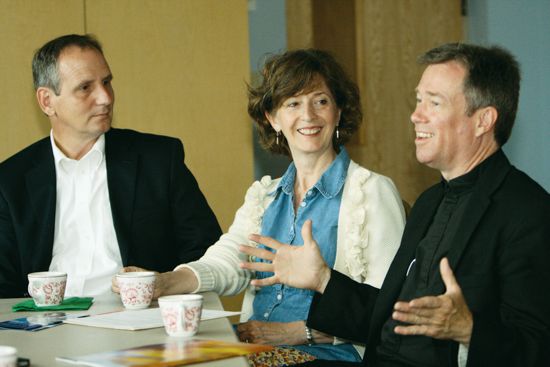
From left, Gordy DeMarais, Christina Smith and Father Kevin Finnegan, pastor of Divine Mercy in Faribault, talk about St. Paul’s Outreach, which the three of them founded 25 years ago. Dave Hrbacek / The Catholic Spirit

Gordy DeMarais, SPO executive director, Christina Smith and Father Kevin Finnegan, SPO board vice president, recently talked with Pat Norby, The Catholic Spirit news editor, about St. Paul’s Outreach, a Catholic ministry on college campuses across the United States that they began in St. Paul 25 years ago in response to the church’s call for a “new evangeliza tion.” SPO reaches out to university students with the life-changing power of the Gospel through building relationships and faith-filled environments. Each year, thousands of students on campuses around the country are impacted by SPO’s work.

Following is an edited version of the conversation.

Founders reminisce about birth of St. Paul’s Outreach

Gordy DeMarais:

In the 1970s, there was a work of renewal that was taking place in the context of the St. Paul Catholic Youth Center (which closed in 1989), and there were a number of expressions of that renewal that were connected and evolved into four distinct organizations:

The first group to separate out from the Catholic Youth Center structure was the Community of Christ the Redeemer. As young people got involved our youth work, our university work, not only were they experiencing a profound reawakening of their faith, they were experiencing a call to live that faith in a very practical daily way, and that’s how it emerged.

The Community of Christ the Redeemer has been this expression of communion, which extends the formative and evangelistic work into marriage and family life.

The community, which provided financial support in SPO’s early days, is trans-generational, people from birth to seniors, now. It was a witness of Christian, Catholic, marriage and family life for the university students as these students were sorting out their vocational choices.

Why were you three chosen to start SPO?

Christina Smith:

I was at the St. Paul Catholic Youth Center and worked as the volunteer coordinator. I knew all the people on the different campuses. I knew all their names, how they related. A lot of those people became outreach staff.

Father Kevin Finnegan:

In the early 1980s, NET Ministries at Catholic Youth Center was doing retreats and the staff for the retreats was college students. The desire was to help college students not just do something good, but be holy and live good lives. St. Paul’s Outreach began to help by getting them in small groups and giving them good teaching.

Gordy and Christina were on staff and I was just coming off a year of NET Ministries. The three of us were just a part of it and we said, “Let’s start meeting to figure out how to do this.”

Gordy DeMarais:

As we thought about these volunteers who would be doing the high-school-youth work, we realized they needed more catechesis and formation and faith development. We divided them up according to their campuses. Then each of the CYC staff persons were assigned to campuses.

You begin to do some formation with them, you begin to pull them together, you have a relationship with them. The more you start to dig into the university world, you see that not only do these people need more faith formation, but there’s a tremendous evangelistic opportunity on college campuses. There were a lot of kids going off to college campuses, even back then, and losing their faith. That’s when we began to think about more direct ministry on college campuses.

How did SPO evolve?

Christina Smith:

I saw the gift of Newman Center on campus, but I also saw its inadequacies — that it was an institutional format. I saw the need for that individual person moving out into the university campus like the yeast in the dough as opposed to the other model that was typical for many Catholic campuses, which set up a lot of programs, but didn’t get into classrooms and into the lunchroom and into the clubs.

Father Kevin Finnegan:

The saying “Location, location, location” is true. The location isn’t here, it’s wherever the student is. On a deeper level, location is wherever that person is personally. Every person is different. You have to bring and be with each person as she or he is and help that person grow in faith.

Gordy DeMarais:

Dormitory life is not conducive to a strong Catholic Christian formation. In fact it pulls you in a different direction.

I had two experiences of somebody reaching out to me and my faith coming alive, then realizing that if I’m going to live that faith well, I need a strong supportive environment and I need someone to teach me how to live that faith well. I think those were the seed experiences that formed the vision for SPO and the method that developed.

Christina Smith:

We really took a relational approach to ministry with the accent being on that one-to-one relationship of sharing faith and believing that faith is catchy.

Father Kevin Finnegan:

A third aspect is the catechesis of formation that goes with it. You are drawn to someone. You are drawn to God. Your faith is awakened. It’s in a community and you see others living their faith, and there is a strong emphasis on how to live, how to relate well, how to say I’m sorry, please forgive me, how to share your faith.

Why is SPO needed today?

Father Kevin Finnegan:

If you go fishing and you want to catch a fish, there are a thousand different lures. Every person is attracted or drawn, distinctly. In SPO, all these people are fishing lures. I may not be the person to reach out to Christina, but to Gordy. But then there is the whole mystery of the faith. It is a gift from God. It is the Holy Spirit working.

Gordy DeMarais:

What is at the heart of our Catholic faith is that God is real, God is present, he has a purpose and a plan in my life. He talks to me, he speaks to me. I can have a relationship with him and that relationship can give purpose and meaning and direction and hope to my life. Every person is built in the structure of their being with this relationship with God. Our approach is to witness to that by our love for God and one another.

Christina Smith:

Students are just searching for something that will make them happy and give them aim in their lives. We are helping them see what they are going after as a source of fulfillment. If it’s not Christ, it’s a dead-end road. I was struck by how hungry young people are for something more solid then what they’re finding on college campuses today.

Father Kevin Finnegan:

People are coming from the wealthiest generation in the history of the world [but many families, today, are fractured and broken]. I think young people today are more open and generous and desiring something more then money. When they have an opportunity to serve and give to people in need, there is something wonderful happening. You have to tap into that. Then you see that fruit in the rest of their lives.

Gordy DeMarais:

One of the great joys is seeing the way our alumni are living their vocation in priesthood, religious life, marriage and family life. This wasn’t just a college experience. This is an experience that has formed the rest of their lives to the point where there are SPO alumni children involved in this work.

We are doing the same thing today as when we began — creating strong, relational environments of faith on college campuses; training young people to embrace their faith, know their faith, live their faith, share that faith with others; sending them out to relationally evangelize their peers; and bringing them into a community of faith and a program that helps that faith become alive and be awakened; and training and forming that faith to maturity in strong, loving communities.

Father Kevin Finnegan:

It’s a whole sense of helping someone realize, “I am loved by God and God has a mission for me,” which is different then, “What do you want to be when you grow up?”

That’s the great question: “What is God’s mission for my life?”

You begin asking the question in the context that: God knows me, God loves me, God cares for me, God tends to me, God delights in me. That’s why parents are so important. A parent says you are loved: “Even if you flunk math, I will still love you.” It gives them freedom to keep getting up and falling down.

What impact did SPO have on your life?

Father Kevin Finnegan

It formed my life. One way is that SPO showed me that the Holy Spirit is alive and doing all kinds of cool things, and I can be a part of that. Also, I learned that ministry is not about the priest doing it, it’s about all of us doing it. It’s about parish, and movement and that the church is broad, and we should be aware of that and attentive to that and be open to that and embrace that. It gives me a sense of hope — there are young people who want to be alive and are alive and it’s not about me making it happen.

Gordy DeMarais

The dynamics of the St. Paul Catholic Youth Center and the young adult community of faith and mission that developed there was instrumental in changing the whole of my life — from not going to church and not living morally, to a deep, profound awareness and experience of God’s love and God’s mercy that set me on a course that impacted and changed the whole of my life.

I seriously looked at single life for the Lord, to priesthood, to bringing me into relationship with this woman [Teresa] who’s become my wife now of 25 years. The fact that this woman would consider marrying me and the rich family life we’ve had, the six children we now have, this movement has changed my whole life.

Being in leadership in SPO has taken that initial experience I had and continually reinforced it, as I see what I experienced being experienced again and again in the lives of so many people throughout the years. What that does is renew your own experience of faith and strengthen it and deepen your faith and confidence and hope in God.

Christina Smith

It’s given me a great sense of confidence in God’s desire to renew the church, just in seeing how he worked in us — the little three.

People ask what SPO was like in the beginning days.

We were just three ordinary people just taking the next step and God blessed that. Seeing the history of SPO gives you a greater hope for God’s marvelous work in our church today of bringing renewal and refreshment for God’s Catholic people. Just seeing how God worked in the past 25 years, and the hope and confidence that he’s behind us.

Gordy DeMarais

I am reminded of the story of the loaves and fishes in the Sermon on the Mount. Jesus was preaching and people needed to be fed and all that the boy had was laughable.

The Lord took that small offering and multiplied it in a way that fed 25,000 people.

That’s my experience of looking back over the 25-year history. I know the human material that’s been involved. You add up the sum of all the human material and you look at the fruit and the fruit far extends what the human material could produce.

That is the testimony to continue to offer — the invitation to live as John Paul II called us to, with generosity of life, offering all we have to the Lord and saying, “Use this for your glory” and he will.

Mother Teresa said we are called to be faithful and obedient and it’s God who gives the grace.

It’s not a business where you do this thing and you will hit this mark. We do not control the essential factors that go into our effectiveness. We have no control over God’s grace. We have no control of a young person saying yes to that grace. All we can do is be a witness to our own life and set up the environment and context, which allows the individual to encounter God and his free gift of faith. As long as we keep doing that, God will use this to minister to his people through us. Catholic Spirit

You might also like: