Showing posts with label Burke. Show all posts

Wednesday, January 30, 2013

Another Upper Midwest Bishop Gets Promoted

Bishop John Vlazny of Portland, OR, formerly Bishop of Winona, 1987-1997, has retired at age 76.
/>
Bishop Alexander Sample of Marquette, who was the youngest bishop in the country when he was appointed as bishop there in 2005, has been appointed Archbishop of Portland, now as the youngest archbishop in the country.

See articles on the appointment of Archbishop Sample by Whispers' Rocco Palmo and Deacon Keith Fournier of Catholic Online in California. 

This just a few months after Bishop Samuel Aquila of Fargo was appointed as Archbishop of Denver.


Other upper midwest bishops with recent promotions are: Bishop Dennis Schnurr of Duluth as Archbishop of Cincinnati, Bishop Robert Carlson, Auxiliary in StP-M, as Archbishop of St. Louis, Bishop Frederick Campbell, Auxiliary in StP-M to Bishop of Columbus, OH, Bishop Richard Pates, Auxiliary in StP-M as Bishop of Des Moines, Bishop David Zubik from Green Bay to Pittsburgh, and of course, Bishop Daniel Di Nardo of Sioux City, IA, to Houston-Galveston as a Cardinal and Bishop Raymond Burke first to LaCrosse and then St. Louis and now a Cardinal in Rome.


There are two local vacancies to be filled this year:  Fargo and St. Cloud (Bishop Kinney has submitted his retirement letter).  Any nominations pass on to the Papal Nuncio in Washington DC.

Thursday, September 15, 2011

Courageous Priests

.
A blog, entitled Courageous Priests, follows the activities of the following American Priests. The highlighted ones are the Upper Midwest's contribution, our priests, to that list.

Monday, September 12, 2011

Gossip: Who will be the New Archbishop in Denver: Bishop Samuel Aquila of Fargo?

.
With today's big event being the installation of His Excellency, Charles Chaput as the new Metropolitan in Philadelphia, I thought it an opportunity to put it out there as to my thoughts as a potential successor for him in Denver.

But first, let's look at what kind of shoes would need to be filled. In the public sphere especially, Archbishop Chaput has been outspoken on the issues of the day, especially giving a strong voice to the pro-life movement.

During the 2008 presidential campaign, he was highly critical of then-candidate Barack Obama, and especially the messiah-complex that he seemed to garner from his supporters.

His book, Render unto Caesar, reiterates this point, encouraging all Catholics to take a more active stance in public life, and for standing up for the truths of the Faith.

He has been especially critical in fighting off the advances of same sex "marriage" advocates, and well articulating the positive position of the Church's teachings in this area, and highlighting the underlying agenda by those who would see that ideology advanced.

As if that weren't enough, he has in the past also publicly disagreed with the prevailing winds of the USCCB-- that is to say, he is not afraid to be his own Bishop.

In addition, ++Chaput is a sincere and personally holy man. I have had the chance to meet him and talk with him briefly, and he is a true pastor.

All of that said, who do I think would be an ideal successor to him in Denver?
Benedictus Dominus

There have been quite a few episcopal appointments in the area in recent years.

2002 -- Fr. Donald Kettler of Sioux Falls became Bishop of Fairbanks, Alaska.
2004 -- Bishop Raymond Burke of La Crosse became Archbishop of St. Louis and then in 2008 went to Rome
2004 -- Bishop Robert Carlson (formerly an Auxiliary in St. Paul-Minneapolis) left Sioux Falls for Saginaw and then went as Archbishop to St. Louis in 2008
2004 -- Auxiliary Bishop Jerome Listecki replaced Bishop Burke in La Crosse, coming from Chicago, and then today replaced Archbishop Tim Dolan, now in New York, in Milwaukee
2004 -- Bishop Daniel Di Nardo of Sioux City headed off to Galveston-Houston as Archbishop and soon thereafter as Cardinal
2006 -- Fr. Ralph Nickless came from Denver to fill the vacancy in Sioux City as Bishop
2006 -- Fr. Paul Swain came from Madison to fill the vacancy as Bishop of Sioux Falls that had been overlooked because of the similiarity of names, it is thought.
2007 -- Fr. Michael Hoeppner went from Winona to Crookston to fill the vacancy caused by the retirement of Bishop Victor Balke.
2007 -- Fr. Peter Christensen went from Nativity Parish in St. Paul to Superior to fill the vacancy caused by the retirement of Bishop Raphael Fliss.

2008 -- Bishop John Nienstedt, originally from Detroit, came to St. Paul Minneapolis from New Ulm as Coadjutor Archbishop. He succeeded in 2009
2008 -- Fr. John LeVoir went from St Paul Minneapolis to New Ulm to fill the vacancy caused by the departure of Archbishop Nienstedt.
2008 --Auxiliary Bishop Richard Pates in St. Paul Minneapolis went to Des Moines as Bishop
2008 --Auxiliary Bishop John Quinn came from Detroit to Winona to fill the vacancy caused by the retirement of Bishop Bernard Harrington.
2009 -- Fr. Lee Piche' became the Auxiliary Bishop in St. Paul Minneapolis
2009 -- Bishop Dennis Schnurr of Duluth went to Cincinnati as Coadjutor Archbishop and just recently succeeded.
2009 -- Fr. Paul Sirba just became Bishop of Duluth.

Saturday, June 18, 2011

Former La Crosse bishop holds high position in Catholic church in Rome

.

"You just keep doing what you believe the Lord wants you to do, and who knows where it leads you eventually," Burke said during a recent interview in his Rome residence. "That's the only way I can describe it."

Burke, the former bishop of the Roman Catholic Diocese of La Crosse, was elevated to the position of Prefect of the Supreme Tribunal of the Apostolic Signatura in June 2008 - equivalent to chief justice of the Supreme Court of the Catholic church - and was named a cardinal by Pope Benedict XVI in November 2010. Burke is one of nine active U.S. cardinals and one of 179 cardinals in the world.

Burke, 62, was born in Richland Center and later moved with his family to Stratford. He was ordained a priest in 1975, was bishop of the La Crosse Diocese from 1994 to 2003 and later was archbishop of St. Louis from 2003 to 2008. Burke was active in rural life issues during his time in Wisconsin and often became embroiled in controversy because of his conservative positions. But he stood firmly by his stances and said he was simply sticking up for the values of the Catholic church.

In his new role as head of the Catholic church's highest tribunal, Burke makes decisions on specific cases and issues related to the laws of the church. He said it's not a glamorous job, but it's an important one. "It happens to be an aspect of the church that is not very pleasant, but it's an aspect of the church that someone has to deal with," Burke said. "I always say no one comes to our office who is happy, but when they leave, even if they don't get the decision they want, they leave with the knowledge that the highest authority in the church has examined their case and given them a decision. Even if they don't like it, at least they know they've done every-thing they could and they have a decision from the pope's highest tribunal."

Burke and a college of judges hear cases on Catholic church issues from throughout the world. The judges are all cardinals or ex-bishops. Burke is the only full-time judge in the tribunal. He sits in on every case unless he is personally involved with one of the parties. That hasn't happened in the three years he's held the position, Burke said. "The Mass and daily prayers have to be the center of your life, otherwise you would be crushed (by all of the issues)," Burke said. "You have to see it as a service of our Lord and his church.

"I always say it's a very humble service in the sense that it has none of the beauty of the sacred liturgy or the teaching of the faith, but yet it's essential because if the church doesn't respond to people with a just decision, how can you she talk about charity?"

Burke is no longer involved in rural life issues, although he continues to read and be concerned about issues such as large animal confinement, the health of food and the plight of small farmers. "All that is still very much in my heart, but I don't have the occasion to do anything directly," Burke said.

He begins an average day by saying Mass in his private chapel with the religious sisters who work for him. He has breakfast about 7 a.m. and walks about 40 minutes to work. The tribunal office is in the same place in Rome that it has been since the 1300s, Burke said. His job consists of a lot of reading, studying reports and writing, Burke said. He anticipates living and working in Italy for the rest of his life.

Burke said he returns to Wisconsin twice a year, once in the summer and a second time in early December. He said he tries to visit around the time of the Feast of Our Lady of Guadalupe on Dec. 12 and celebrate Mass at the shrine he helped create just outside La Crosse. "The shrine is one of the best things that God did while I was bishop of La Crosse," Burke said.

Burke said he doesn't have much occasion to work directly with Pope Benedict, although he and the other tribunal judges had a meeting with the pontiff in early February. As a cardinal under the age of 80, Burke would be eligible to vote the next time there is an election for a pope. Only the cardinals vote and only a cardinal can be elected pope.

He said he doesn't know if there will ever be a U.S.-born pope, but he believes it is possible. "I wouldn't anticipate it any time soon, but I think it could happen," he said. "We've had a Pole and a German. For 450 years it was always an Italian, and we presumed it would always be an Italian. But now that pattern is broken, and good cardinals readily think of a pope being from other parts of the world."

Burke said he can remember "as clearly as if it was yesterday" being a parishioner at St. Mary's Catholic Church in Richland Center and later attending Holy Cross Seminary in La Crosse. "It just all happened very quickly," Burke said.

He said his life in Rome is "quite different" than it was when he was a bishop, but yet he's just doing God's work in a unique way. "Here I try to serve the universal church, but I don't have a flock that's entrusted to my care as I did in La Crosse and St. Louis," he said. "I'm helping other bishops and dioceses, but I don't have my own diocese. It's quite a different life." Eau Claire Leader Telegram

Wednesday, November 24, 2010

Cardinal Burke emphasizes: Catholic teaching on condoms has not changed

.

Catholic teaching on the immorality of the use of condoms has not changed, Cardinal Raymond Burke said in an interview with the National Catholic Register. The prefect of the Apostolic Signatura stated:

I don’t see any change in the Church’s teaching. What [Pope Benedict] is commenting on — in fact, he makes the statement very clearly that the Church does not regard the use of condoms as a real or a moral solution — but what he’s talking about in the point he makes about the male prostitute is about a certain conversion process taking place in an individual’s life.

He’s simply making the comment that if a person who is given to prostitution at least considers using a condom to prevent giving the disease to another person — even though the effectiveness of this is very questionable — this could be a sign of someone who is having a certain moral awakening.

But in no way does it mean that prostitution is morally acceptable, nor does it mean that the use of condoms is morally acceptable.

The point the Pope is making is about a certain growth in freedom, an overcoming of an enslavement to a sexual activity that is morally repugnant [unacceptable] so that this concern to use a condom in order not to infect a sexual partner could at least be a sign of some moral awakening in the individual, which one hopes would lead the individual to understand that his activity is a trivialization of human sexuality and needs to be changed …

The text itself makes it very clear that he says the Church does not regard it as a real or moral solution. And when he says that it could be a first step in a movement toward a different, more human way of living sexuality, that doesn’t mean in any sense that he’s saying the use of condoms is a good thing.

Saturday, November 20, 2010

Cardinal Raymond Burke

.
Raymond Leo Burke, born Richland Center, Wisconsin (1948), Priest of the Diocese of La Crosse (1975-94), Bishop of La Crosse (1994-2003), Archbishop of St. Louis (2003-08), and now Prefect of the Apostolic Signatura of the Roman Catholic Church, is now a Cardinal.

The Apostolic Signatura is the "supreme court" of the Church, and Cardinal Burke is its head. He is also a member of the Congregation for Bishops, giving him a say in the appointment of most bishops, particularly American bishops.

The Catholic Times of the Diocese of La Cross has a 20 page pdf insert that you might like to view on this most holy day in the life of Cardinal Burke.

Saturday, October 23, 2010

Guess which other neighboring state had Cardinals?

.
A disgruntled "Sconnie" as the Minnesota sports geeks call them (in addition to other less flattering nicknames that rhyme with "cheddar") in learning that Fargo had its very own Cardinal, pointed out that three of the Pope's red-hatted advisors have strong connections to Wisconsin.

Of course, Cardinal Raymond Burke, former Archbishop of St. Louis would come immediately to mind. Born in Richland Center, between Madison and La Crosse, he was Bishop in La Crosse from 1994 to 2003, he will be installed at this coming consistory in Rome.

Cardinal Albert Meyer, born in Milwaukee, became Bishop of Superior in 1946, Archbishop of Milwaukee in 1953 and Archbishop of Chicago in 1958. He was elevated to Cardinal in 1959 and died in 1965 at the age of 62.

Cardinal Adam Maida, born in Pennsylvania, a priest of the Pittsburgh diocese, was appointed Bishop of Green Bay in 1983 and Archbishop of Detroit in 1990. He was made a Cardinal in 1994 and retired in 2009.

Wednesday, October 20, 2010

"Former" Archbishop Raymond Burke: "A Plea for Life, Truth, Obedience"

.

Former Archbishop, now Cardinal Raymond Burke (formerly Bishop of La Crosse and Archbishop of St. Louis, now in the Vatican) Addresses Human Life International Gathering

Rome: Obedience to the magisterium and the demands of the natural moral law are not only important for salvation, but are especially required of Catholics if a culture of life is to be advanced in today's world.

This was the thrust of an impassioned speech by Archbishop Raymond Burke to a major congress held in Rome last week hosted by Human Life International. It was a keynote address that was greeted with a standing ovation.

The American prefect of the Apostolic Signatura began by pointing out that society is experiencing "a period of intense and critical struggle" in advancing a culture of life, made worse by temptations to relativize the authority of the magisterium.

"Man is tempted to view the magisterium in relation to his individualism and self-pursuit," he told the large gathering of representatives belonging to the pro-life movement. Referring to the popularly known phrase "cafeteria Catholicism," he called first and foremost on bishops to uphold the natural moral law, reminding them of Benedict XVI's exhortation to bishops "to be aware of the challenges of the present hour and have the courage to face them."

Noting that the bishop, as chief teacher of faith and morals in the diocese, carries an especially "heavy and constant burden" in providing sound teaching that safeguards all life, he stressed that obedience to the magisterium is a virtue, one obtained "through the practice" of such obedience.

"When shepherds of the flock are obedient to the magisterium entrusted to their exercise, then surely the numbers of the flock grow in obedience," he said. "If the shepherd isn't obedient, the flock easily gives way to confusion and error." Quoting the Prophet Zechariah, he said the shepherd can be "especially tempted" by the assaults of Satan who, "if he can strike him, the work of scattering the flock is made easy."

"Faith is first of all personal adherence of man to God," underlined Archbishop Burke, and recalled the words of a wise professor of canon law he knew who would often tell his classes: "Where there are problems of chastity, there are problems of obedience." Rebellion against the moral truth, Archbishop Burke noted, "is a rebellion against God and all that he teaches us."

As if God didn't exist

He acknowledged that obedience to the magisterium is "difficult to master," adding that "Satan does not sleep" and in the culture of today, he is tempting mankind to act "as if God does not exist." Instead, Satan is "teaching us a radical individualism and self interest which leads us away from the love of God and love of one another," he said.

The archbishop also stressed that today's culture "teaches us to believe what is convenient and to reject what is difficult for us or which challenges us," thus leading to a "cafeteria Catholicism" which "picks and chooses which parts of faith to practice." He noted how this happened even among some bishops when they dissented from Paul VI's encyclical "Humanae Vitae." The consequences of that dissent, he said, has "led many Catholics into habits of sin in what pertains to procreation and the education of human life."

Earlier, he had highlighted a presupposition to the current battles to preserve a culture of life: namely that the attack on innocent and defenseless life of the unborn "has its corruption in an erroneous view of human sexuality which attempts to eliminate by mechanical or chemical means the essentially procreative nature of the conjugal act."

He added: "The so-called contraceptive mentality is anti-life and the manipulation of the conjugal act, as Pope Paul VI prophetically observed, has led to many forms of violence in marriage and family life." Once the sexual union is longer seen to be by its very nature procreative, he continued, "human sexuality is abused in ways that are profoundly harmful and in ways destructive of individuals and society itself."

As an example, he drew attention to the "devastation which is daily wrought on our world by the multi-million dollar industry of pornography." The answer, he said, was the advancement of the culture of life through the "proclamation of the truth of the conjugal union in its fullness and the correction of the contraceptive thinking which fears life, which fears procreation."

Public disobedience

Archbishop Burke then turned to the exercise of the magisterium in public life. He spoke of the tendency today to compartmentalize the faith, and the "hypocrisy" of some Catholics in politics, medicine, business or other human endeavors, who claim to personally hold to the truth of the faith regarding the inviolability of innocent and defenseless human life, yet cooperate in attacks on the unborn, the infirm, or those with special needs. He also cited "self-proclaimed" Catholics who support state recognition of same sex marriage.

"It is not possible to be a practicing Catholic and conduct oneself publicly in this manner," he said to loud applause.

But Archbishop Burke made clear that the Church does not impose its confession. Rather it tries to "foster the teaching of upholding the moral law, common to all men and which is at the heart of every true religion." This is why governments have in the past recognized the importance of religion in public life, he said: to protect the teachings and practice of religious faith for the sake of the common good.

He lamented that many have become confused about "the most basic truths," namely the inviolable dignity of innocent human life from conception until natural death, and marriage of one man and one woman "as the first and irreplaceable" source of life and society.

But Archbishop Burke's strongest words concerned the scandal wrought not just by disobedience to the magisterium, but the absence of public reparation for such disobedience. Such actions, or inaction, on laws that destruct innocent human life makes citizens in general "confused," leading them into error "about the basic tenets of the moral law." He noted that in our time, there is a great hesitation to speak about such scandal, as if in some way it's a phenomenon among people of "small or unenlightened minds and therefore a tool of some persons to condemn others rashly and wrongly."

He pointed out the presence of "pharisaic scandal," in which there is a "malicious interpretation" of the morally good, but his main beef was with "true scandal" that leads others into confusion and error. The Lord's admonition of people who lead others into sin was "nothing less than vehement," he reminded listeners. For this reason, he said, the "perennial discipline of the Church [has] prohibited the giving of Holy Communion or the granting of a Church funeral to those who persist after admonition in the grave violation of the moral law."

"It is said that these disciplines which the Church has consistently observed down the centuries presume to pass judgment on eternal judgment of a soul, a judgment that belongs to God alone, and therefore can be abandoned," he explained. "On the contrary, [such] public action[s] of the soul are in violation of the moral law, and do[es] grave harm to all who are confused and led into error by these actions." He added: "The Church invites every soul to the mercy of God which is great beyond all our imagining, but that does not excuse her from proclaiming the truth of the moral law, also by applying her age old disciplines for the sake of the salvation of all."

Public repentance

To much applause, Archbishop Burke said: "When a person has culpably espoused and cooperated in gravely sinful acts, leading many into error and confusion over fundamental questions regarding respect for life and integrity of marriage and family, his repentance of such actions must also be public."

He stressed that responsibility is "especially heavy" for political leaders. "To repair the scandal begins with the public acknowledgment of his own error and a public declaration of adherence to the moral law," he explained. "The soul which recognizes the gravity of what he has done will understand immediately the need to make public reparation."

He further noted that this danger has been heightened in our time because of confusion of the moral law found in public discourse. "It is particularly insidious that our society, which is profoundly confused about the most basic good, also believes that scandal is a thing of the past," he said. "One sees the hand of the father of lies at work in the disregard of the situation of scandal or in the ridicule or censure of those who experience the scandal."

Archbishop Burke also alluded to what he called "one of ironies of the present situation," which is that a person who brings attention to the scandal of gravely sinful actions by Catholics is accused of a lack of charity and of causing division in the unity of the Church.

"In a society's thinking, governed by the tyranny of relativism and where political correctness and human respect are the ultimate criteria of what is to be done, the notion of leading someone into moral error makes little sense," he said. What causes unrest, he continued, is when "someone fails to observe political correctness and therefore seems to be disruptive of the so-called peace of society."

Lying or failing to tell the truth, however, "is never a sign of a charity," he said.

"A unity which is not founded on the truth of the moral law is not unity," underlined the archbishop. "The Church was founded on speaking truth with love."

In conclusion, Archbishop Burke called on those present to be obedient to the magisterium and engage with "new enthusiasm and energy" in the struggle to advance the culture of life in the world.

"The struggle is fierce and the contrary forces are many and quite clever," he said, "but the victory has already been won, and the victor never fails to accompany us in our struggle."

Wednesday, August 18, 2010

Archbishop Burke is on EWTN Live tonight at 7 central with Fr. Pacwa

.
Repeats:
Thursday 12:01 AM Central & 8 AM Central,
Sunday 3 AM Central
Message

Tuesday, June 29, 2010

Three archbishops and the American Catholic future

.

In the abstract, one might not think of Archbishops Thomas Wenski of Miami, Dennis Schnurr of [Sioux City and Duluth and] Cincinnati, and Jerome Listecki of [La Crosse and] Milwaukee as a natural threesome. Yet fate thrust these prelates together today, as the three Americans among 38 newly appointed archbishops from around the Catholic world who are in Rome to receive the pallium.

The pallium is a narrow band of woolen cloth which serves as a symbol of the archbishop’s office, and is bestowed by the pope each year on June 29, the feast of Sts. Peter and Paul. I’m in Rome this week, so I attended the pallium ceremony this morning and then headed up to the North American College for the traditional reception honoring the new archbishops.

Given that these three prelates were in the spotlight today, it’s worth pondering what implications for the American Catholic future are posed by the ascent of a Harley-riding champion of the downtrodden (Wenski), a consummate church insider (Schnurr), and a straight shooting, by-the-book pastor (Listecki).

At one level, there are striking similarities among the three men. All are virtually the same age (Schnurr is 62, Listecki 61, and Wenski 59). Two of the three, Schnurr and Listecki, have roots in the Midwest, and all three are the offspring of Catholic immigrants from central Europe. (Wenski and Listecki are Polish, Schnurr German.)

All three archbishops are solidly pro-life, and all three say they support the “zero tolerance” approach of the American church on sexual abuse. Each man, however, has faced criticism for his handling of the crisis from victims’ groups. Listecki in particular has faced questions since a review by the national bishops’ conference found that his former diocese of La Crosse, Wisconsin, backed accused priests in 64 percent of cases, as opposed to a national average of ten percent.

Yet there are also important contrasts among the three men, which collectively suggest that Benedict XVI is not seeking a rigid uniformity at the senior leadership level of the American church.

Wenski, who previously served as the bishop of Orlando, would likely make most top ten lists among American bishops for “most hip.” He listens to hot Cuban and Haitian music, and likes to hit the road on his motorcycle. (Asked if he had any regrets about leaving Orlando, Wenski said he’d miss the back-roads which allow him to open up the throttle. Traffic around Miami, he said, is more congested.)

Wenski is probably best known in Catholic circles for his social justice efforts, particularly his advocacy on behalf of immigrants and immigration reform. The first native of south Florida ever to serve as the Archbishop of Miami, Wenski was a young priest when he helped found a parish for Haitian immigrants in Miami. He learned Creole in the assignment, and over the years added Spanish and two African tribal languages (Ibo and Kirundi) to his repertoire.

Wenski has a master’s degree in sociology from Fordham, and prior to being named an auxiliary bishop of Miami in 1997 he served as the archdiocesan director of Catholic Charities. In a typical Wenski flourish, he spent the weekend before his appointment to Miami was announced joining a protest march organized by a coalition of farm workers pressing growers and supermarket chains for higher wages for tomato pickers.

During an early round of interviews with Miami media, Wenski said that immigration will continue to be a key concern in his new post.

“The present system, the lack of action, is resulting in the creation of a new underclass of people that are exploitable because they have no legal status, that are afraid of a knock on the door in the middle of the night,” he said. “If they're the victims of crimes, they're reluctant to call the police because they might pay for it with deportation.”

Wenski referred to Miami as “our nation’s new Ellis Island,” a leading port of entry for immigrants and refugees.

“These immigrants are not the problem,” Wenski said. “The problem is the antiquated and inadequate law that needs to be changed."

Cincinnati Archbishop Dennis M. Schnurr speaks at La Salle High  School in Cincinnati Feb. 4. (CNS)Cincinnati Archbishop Dennis M. Schnurr speaks at La Salle High School in Cincinnati Feb. 4. (CNS) Schnurr took a different path to the pallium, growing up in rural Iowa as one of only four Catholic boys in his hometown (two of the rest were his brothers, and the fourth was a cousin), entering the priesthood after briefly flirting with a career as a grocer, and moving swiftly into a series of prominent ecclesiastical jobs.

Known as pragmatic, hard-working, and skilled at nuts-and-bolts administration, Schnurr worked in the Vatican embassy in Washington in the mid-1980s, and was then tapped as Associate General Secretary of the U.S. bishops’ conference in 1989. When John Paul II came to Denver for World Youth Day in 1993, Schnurr was put in charge of organizing the event. The bishops obviously approved of his performance, because he was made General Secretary of the conference in 1994.

Schnurr was named bishop of Duluth, Minnesota, in 2001, and became the coadjutor archbishop of Cincinnati under Archbishop Daniel Pilarczyk in October 2008. He took over last December, when Pilarcyzk’s resignation was accepted by Benedict XVI.

In contrast to Pilarczyk’s reputation as a leader of the church’s more progressive wing, most observers see Schnurr as essentially non-ideological. Among other things, he’s expressed reservations about clergy and religious getting involved in politics. (In 2006, he withdrew an invitation for Sr. Helen Prejean to speak at an education dinner in Duluth because the famed “Dead Man Walking” activist had signed an advertisement calling for the impeachment of then-President George Bush. Schnurr said he admired Prejean’s work, but was concerned about the church seeming “partisan.”)

As bishop, Schnurr’s priorities have been characteristically practical: promoting vocations to the priesthood, strengthening marriage, and improving religious education. In Duluth he had some success with vocations, naming himself the vocations director and increasing the number of seminarians from eight to 24. In Cincinnati he’s strongly backed an ambitious fundraising effort for the local seminary which, among other things, will expand the number of apartments for seminarians from 46 to 72.

Schnurr has also pledged transparency with regard to finances in Cincinnati, saying “the more information we give people on how the money is being managed, the more confidence they have.”

For his part, Listecki grew up on the south side of Chicago, the son of a laborer at U.S. Steel, and describes his vocation to the Catholic priesthood as “womb to tomb,” meaning that he never wanted to be anything else.

Remarkably, Listecki is actually the first Polish-American archbishop of Milwaukee, despite the strong Polish element in Milwaukee’s population.

On the basis of his résumé, one could safely say that Listecki is very much at home in rules-bound, hierarchical structures: Aside from being a Catholic bishop, he’s also a civil lawyer as well as a retired lieutenant colonel in the United States Army, where he served for almost two decades as a chaplain.

So far in his episcopal career, Listecki has succeeded two men whose larger-than-life profiles, according to most observers, he didn’t quite fill: Raymond Burke, a cultural warrior and staunch conservative, who preceded Listecki in La Crosse, Wisconsin, and Timothy Dolan, a back-slapping, charismatic media darling in Milwaukee.

By consensus, Listecki is neither an ideologue in the tradition of Burke, nor a rock star like Dolan.

Certainly Listecki yields pride of place to no one in terms of defending Catholic orthodoxy. He publicly chastised House Speaker Nancy Pelosi for suggesting that Catholic teaching on the beginning of life was up for grabs, and he expressed concern when Marquette University was on the brink of hiring an openly lesbian dean of the College of Arts and Sciences, who has openly challenged official Catholic teaching on marriage and sexuality.

Listecki opposed the recent health care reform bill on the grounds that it opened the door to public funding of abortion, and advised parents not to take their children to the film “The Golden Compass” on the grounds that it “expresses hatred of Christianity and that portrays God, the church and religion as evil and oppressive, and urges children to join fallen angels in a rebellion against God.”

At the same time, Listecki has described denying communion to pro-choice Catholic politicians as a “last resort,” and acknowledged that his criticism of the decision by Notre Dame to award an honorary doctorate to President Barack Obama was mostly a gesture of support for the then-Bishop of South Bend, John D’Arcy.

Repeatedly, people with personal experience of Listecki describe him as “down to earth,” “personable” and “approachable.”

“He doesn’t seem like a terribly polarizing guy, which is a good thing,” said Emily Naczek, a Catholic school teacher in Milwaukee.

To be sure, if Listecki isn’t Burke, he also isn’t Wenski in terms of his personal investment in social justice issues.

“He’s very strong in terms of Catholic identity, basic issues of pro life, gay marriage, stem cell research,” said Ray Stroik, a retired professor and college administrator who worked on the La Crosse diocese's justice and peace commission.

“Yet he’s not doing much on social justice, or global peace,” Stroik said.

On the other hand, Listecki insists that he supports a “consistent ethic of life,” and has vigorously opposed the death penalty. Growing up in Chicago, Listecki said, taught him to appreciate the value of diversity.

In the main, Listecki said, there’s not much point in speculation about what his ultimate objectives may be.

“What you see is what you get,” Listecki said in a recent interview. “I don’t have hidden agenda. I am pretty straightforward and honest.”

* * *
In his homily this morning, Benedict XVI told the archbishops that their connection with the papacy is a “pledge of liberty,” insulating them from the pressure of “local powers, national or international,” and assuring their “full adherence to the truth and to the authentic tradition” of the church.

Benedict also returned to a theme made familiar by the sexual abuse crisis: The greatest threat to the church, the pope said, comes not from exterior challenges but from whatever “pollutes the faith and Christian life … damaging the integrity of the mystical body, weakening its capacity for prophecy and witness, and tarnishing the beauty of its face.”

The pope said that some Catholic communities around the world are threatened by persecution or political interference, but in other places, he said, the challenges are more subtle, taking the form of “misleading doctrine” or “ideological tendencies and practices contrary to the gospel.”

The pope also said that divisions within the Christian family as “symptoms of the power of sin,” and said that Christian unity is “always to be sought and renewed, from generation to generation.” In that context, he welcomed the presence of an ecumenical delegation from the Patriarch of Constantinople, traditionally considered “first among equals” in the galaxy of Orthodox prelates. John Allen, National Catholic Reporter

Friday, April 16, 2010

La Crosse Guadalupe Shrine to Install St. Gianna Molla relic

.
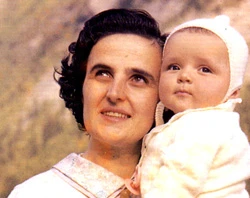
Gianna Beretta Molla(CNA).- The Shrine of Our Lady of Guadalupe in La Crosse, Wisconsin announced the upcoming installation of a first-class relic of St. Gianna Molla that will take place following a Mass which will honor the saint.

On April 25, the shrine will hold Mass along with a prayer service, veneration and installation of the relic. A blessing for mothers and married couples will also be given.

The local La Crosse Tribune reported that the relic consists of three hair strands from the Italian saint.

“We’re very, very honored to have that here. It’s through the graciousness of the family,” said Sister Christa Marie, executive director of the shrine. Sister Christa Marie told the La Crosse Tribune on March 27 that she had asked the saint’s son, Pierluigi, if the family would provide the relic after he spoke at the shrine last July.

St. Gianna died in 1962 shortly after giving birth to her fourth child. The pediatric surgeon developed uterine tumors while pregnant and was advised by doctors to terminate the pregnancy. She refused, and chose to give birth, dying a few days later at the age of 39.

“One person’s life and one person’s death has had such an impact on so many lives,” Sister Christa Marie said. “She lived a beautiful, Christian life. She did live ordinary in an extraordinary way.”

The Shrine of Our Lady of Guadalupe, which opened in 2008 under the direction of Archbishop Raymond Burke, recently installed a first-class relic of St. Faustina Kowalska on Divine Mercy Sunday. The relic of the Polish saint who died in 1938 consists of bone fragments which were brought to the La Crosse diocese from Rome by Archbishop Burke.

Sister Christa Marie spoke to the La Crosse Tribune on the importance of relics, saying, “It’s an ability to connect. It just reminds us that we are one big family.” From Fr. Z


More on St. Gianna!

Monday, January 4, 2010

Search for a new bishop shrouded in secrecy

.
There have been quite a few episcopal appointments in the area in recent years.


2002 -- Fr. Donald Kettler of Sioux Falls became Bishop of Fairbanks, Alaska.
2004 -- Bishop Raymond Burke of La Crosse became Archbishop of St. Louis and then in 2008 went to Rome
2004 -- Bishop Robert Carlson (formerly an Auxiliary in St. Paul-Minneapolis) left Sioux Falls for Saginaw and then went as Archbishop to St. Louis in 2008
2004 -- Auxiliary Bishop Jerome Listecki replaced Bishop Burke in La Crosse, coming from Chicago, and then today replaced Archbishop Tim Dolan, now in New York, in Milwaukee
2004 -- Bishop Daniel Di Nardo of Sioux City headed off to Galveston-Houston as Archbishop and soon thereafter as Cardinal
2006 -- Fr. Ralph Nickless came from Denver to fill the vacancy in Sioux City as Bishop
2006 -- Fr. Paul Swain came from Madison to fill the vacancy as Bishop of Sioux Falls that had been overlooked because of the simliarity of names, it is thought.
2007 -- Fr. Michael Hoeppner went from Winona to Crookston to fill the vacancy caused by the retirement of Bishop Victor Balke.
2007 -- Fr. Peter Christensen went from Nativity Parish in St. Paul to Superior to fill the vacancy caused by the retirement of Bishop Raphael Fliss.

2008 -- Bishop John Nienstedt, originally from Detroit, came to St. Paul Minneapolis from New Ulm as Coadjutor Archbishop. He succeeded in 2009
2008 -- Fr. John LeVoir went from St Paul Minneapolis to New Ulm to fill the vacancy caused by the departure of Archbishop Nienstedt.
2008 --Auxiliary Bishop Richard Pates in St. Paul Minneapolis went to Des Moines as Bishop
2008 --Auxiliary Bishop John Quinn came from Detroit to Winona to fill the vacancy caused by the retirement of Bishop Bernard Harrington.
2009 -- Fr. Lee Piche' became the Auxiliary Bishop in St. Paul Minneapolis
2009 -- Bishop Dennis Schnurr of Duluth went to Cincinnati as Coadjutor Archbishop and just recently succeeded.
2009 -- Fr. Paul Sirba just became Bishop of Duluth.

So where do all these bishops come from? How do they decide in Rome who gets to be a bishop and who gets moved or promoted? The Diocese of Scranton, Pennsylvania, is now awaiting the appointment of a successor to their bishop who retired for health reasons. The newspaper there has printed an informative article on the appointment process.


Four months after Bishop Joseph F. Martino resigned as head of the Roman Catholic Diocese of Scranton, the search for his successor is well under way. But the exact progress of the search is unclear because the timeline for selecting a bishop is not fixed and the process is largely kept secret.

A spokesman for the diocese declined to specify the status of the process or to say whether the diocese's administrators have submitted a report on the condition and needs of the diocese to the Vatican's ambassador, or apostolic nuncio, in Washington, D.C. - an early step in the process of appointing any diocesan bishop.

In a written statement, spokesman William Genello said, "The process to select a new bishop typically includes inquiries by the papal nuncio to people in the diocese, regarding conditions in the diocese and potential candidates. This is confidential. It is not known who might have been contacted."

The clearest timeline for the selection process was outlined by Cardinal Justin Rigali, the apostolic administrator of the diocese who also sits on a key Vatican council that helps select bishops, on the day that Bishop Martino's resignation was accepted by the Vatican.

"I would hope - and it is only my hope - I would hope that within six months we would have a bishop," he said during an Aug. 31 press conference. "Maybe sooner, maybe it will take longer."

If the selection process takes six months, which would fall around the end of February, the appointment of Martino's successor will have taken far less time than many appointments of U.S. bishops. The four vacant sees most recently filled in the U.S. waited an average of a year to receive a new leader.

The process for selecting a bishop begins before a see is vacant. During periodic meetings, the bishops in each province vote on well-regarded priests to add to a list of potential bishops to be sent to the nuncio. Scranton is part of a statewide province whose metropolitan is Rigali, the head of the Archdiocese of Philadelphia.

Once a bishop resigns, is appointed elsewhere, or reaches the retirement age of 75, the nuncio, currently Archbishop Pietro Sambi, requests a report from the leader of the diocese about its condition, needs and challenges. The nuncio also does his own investigation into the needs of the diocese and suitable candidates to lead it. He consults past bishops of the diocese, other bishops in the province and around the country, and the metropolitan. He may also consult priests and lay members of the diocese.

Once he narrows the list to a handful of candidates, the nuncio sends confidential questionnaires to people who know the candidates, including priests, religious and well-respected laity. Those who receive the questionnaire are bound by the code of papal secrecy: they cannot tell anyone that they have received the letters or what they write in response.

The nuncio then gathers the information and writes a report including a list of three candidates, a terna, and notes his preference, which he sends to the Congregation for Bishops at the Vatican, the body of about 30 cardinals, including Rigali, that oversees the selection process.

An English-speaking cardinal assigned to review the Scranton position studies the file and makes a recommendation to the body of cardinals at one of its twice-monthly meetings. The congregation then votes for its preferred choice, which may not be the same as that selected by the nuncio or the presenting cardinal, or it may ask for more information or to be given a new terna.

Once the congregation agrees on its choice, that information is passed on to the pope during a Saturday meeting with the head, or prefect, of the congregation. The pope can follow the council's recommendation or, in a rare case, make a different decision. He is ultimately responsible for selecting the bishop. The Citizens' Voice


In further musing on the subject of the appointment of bishops, I am struck by the fact that there is indeed another factor in the nominations. Some cardinals, understandably with lots of connections in Rome, have a reputation as heads of "bishop factories" and are able to get deserving priests and bishops from their archdiocese or province (group of dioceses which they head) appointed as bishops in other parts of the country. Right now Cardinals Mahony of Los Angeles, Rigali of Philadelphia and Retired Cardinal Maida of Detroit are known for this. Cardinal Law of Boston was known for it also.