.
"Nineteen Eighty-Four" is actually a major work of prophecy.
Professors at Georgetown University, nominally Catholic, don't want to permit Congressman Paul Ryan speak on their Jesuit, nominally Catholic campus because their interpretation of legislation he endorses is in their opinion "anti-poor people."
I find it incredible that lefties don't want to permit freedom of speech at universities. They only want to be exposed to things that they already agree with.
They want to turn our beloved country into one much like in Orwell's "Nineteen Eighty-Four", where the scene is the country of Oceania, where NewSpeak and ThoughtCrime rule the language ["Truth is doubleplus ungood!!!], camera surveillance is everywhere, the Ministry of Truth handles censorship and the Ministry of Peace manages the perpetual war. Have you NOT noticed that Obama has had several wars already in his less than four years?
I once thought that the book Nineteen Eighty-Four would disappear from the public's awareness. But it has become a major book of prophecy under Obama and his Party apparatchiks. I LOVE BIG BROTHER!!!!!
Showing posts with label Commentary. Show all posts
Showing posts with label Commentary. Show all posts
Friday, April 27, 2012


Saturday, August 20, 2011
NCReporter: Protesters, pilgrims face minor confrontations on Madrid streets!!
.
I posted the following comment on the pages of a National Catholic Reporter story early this morning:
Protesters, pilgrims face minor confrontations on Madrid streets!!
You call adult, foul-mouthed, radicals confronting 14 year old Catholic children on a pilgrimage a minor confrontation?
You hypocrites should be so ashamed of yourselves for calling yourselves "Catholic" and a "Reporter." And your numbers are falling so much that I doubt if you qualify as "National" any more.
You're nothing but a political opinion sheet, fighting a losing battle against God and the Church.
Is there anything you like about the Catholic Church? Or do you just exist to steal money from aging Catholic dissidents?
Much of the protesting purportedly was about how much money the Spanish government was spending to subsidize the event. We won't know the offiicial figures for some time, but for 2005, when WYD was in Germany, the German government spend 15 million Euros to support an event with over one million in attendances. At todays rates, $1.5o, that's about $22 per adult and child pilgrim. I wonder how much money those adults and teenagers spent in German hotels, restaurants and souvenir shops and will spend in Spain? And Germany and Spain didn't have to spend a Euro promoting the event. NCReporter did write that article or the headline, but it is typical of their reporting. Nothing suipportive of the Church, just the complaints from old people that they aren't getting their way with the "millenial generation."
It doesn't look like Spanish youth doing the protesting in these Reuters photos. Just like here, aging dissidents.

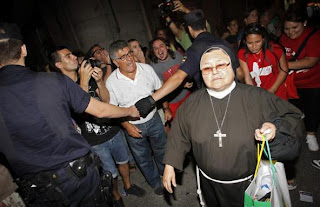


I posted the following comment on the pages of a National Catholic Reporter story early this morning:
Protesters, pilgrims face minor confrontations on Madrid streets!!
You call adult, foul-mouthed, radicals confronting 14 year old Catholic children on a pilgrimage a minor confrontation?
You hypocrites should be so ashamed of yourselves for calling yourselves "Catholic" and a "Reporter." And your numbers are falling so much that I doubt if you qualify as "National" any more.
You're nothing but a political opinion sheet, fighting a losing battle against God and the Church.
Is there anything you like about the Catholic Church? Or do you just exist to steal money from aging Catholic dissidents?
Much of the protesting purportedly was about how much money the Spanish government was spending to subsidize the event. We won't know the offiicial figures for some time, but for 2005, when WYD was in Germany, the German government spend 15 million Euros to support an event with over one million in attendances. At todays rates, $1.5o, that's about $22 per adult and child pilgrim. I wonder how much money those adults and teenagers spent in German hotels, restaurants and souvenir shops and will spend in Spain? And Germany and Spain didn't have to spend a Euro promoting the event. NCReporter did write that article or the headline, but it is typical of their reporting. Nothing suipportive of the Church, just the complaints from old people that they aren't getting their way with the "millenial generation."
It doesn't look like Spanish youth doing the protesting in these Reuters photos. Just like here, aging dissidents.


Saturday, August 13, 2011
The GIRM requirements for the Communion Rite: Section 80
.
This is a comment that I made on the Pray Tell blog today:
RE: The Communion Rite 80 “Faithful who are properly disposed”
The Communion Rite
80. Since the celebration of the Eucharist is the Paschal Banquet, it is desirable that in accordance with the Lord’s command his Body and Blood should be received as spiritual food by those of the faithful who are properly disposed. This is the sense of the fraction and the other preparatory rites by which the faithful are led more immediately to Communion.
Why is this never discussed? Far and away, the greatest liturgical abuse is the reception of Holy Communion by, in most parishes, virtually 100% of the congregation. Yet Confession lines are minuscule in most parishes.
Most recipients of Holy Communion are committing sacrilege in the U.S. (I’ve noticed in congregations with lots of Hispanics that 100% participation doesn’t seem to be the practice). There must be no spiritual benefit to the Church as a whole of most attendance at Mass in the American Church. ‘
In case you question how I could know that people might not be in the state of grace, surveys show that 90% of Catholic couples use artificial birth control, for one. 100% of Christmas/Easter Catholics receive Holy Communion when they do attend. For two.
No wonder Mass attendance is so low and young people in many parishes are non-existent. Subliminally, they must be aware of the hypocrisy and figure it can’t be that important.
I was reminded today that our Bishops have excused us from attending Mass on August 15, the Feast of the Assumption of the B.V.M. Our Bishops keep making Catholic teachings easier and easier, and our Catholic parishioners keep pushing the envelope to make life even more easy for themselves.
Sunday, July 31, 2011
When preachers confuse faith with certainty and evangelism with terrorism, they invite hostility, misunderstanding and hurt feelings.
.
I’ll have what the Freethinkers are having
I’ll have what the Freethinkers are having
By: Father William C. Graham, Duluth News Tribune
Remember “When Harry Met Sally”? The most memorable scene in the movie was set in Katz’s Delicatessen in New York City. Sally’s enthusiasm is heard by everyone when she is loudly enthusiastic during a meal shared with Harry. Another diner, played by the director’s mother, then tells the server, “I’ll have what she’s having.” When Estelle Reiner died in 2008, the New York Times noted that she “delivered one of the most memorably funny lines in movie history.”
I thought of that scene after joining in a deathwatch as a local, faithful Christian prepared to meet the Lord surrounded and supported by family and friends, comforted by the family’s religious practice. A local minister, hearing from one of his congregants about the impending death, sent word to the bedside that the dying person belonged to the wrong denomination of Christianity. The minister wanted to visit and help the dying person profess true belief; otherwise heaven would not be a possibility. And hellfire is even hotter than July 2011 in Duluth.
Hearing this outrage, I had renewed sympathy for and fellow feeling with our local Freethinkers and their desire for freedom from religion. In imitation of Estelle Reiner, I decided, “I’ll have what they’re having.”
Freedom from religion, as I understand it, does not mean I would no longer be free to practice Catholicism or discharge priestly duties. It would mean, I hope, freedom from the tyranny and bad behavior of individuals or congregations whose idea of evangelism is to discourage others, demean other churches and assume an air of infallibility that no pope could ever match.
No Catholic or Orthodox priest, ELCA Lutheran, United Methodist, Presbyterian or mainline protestant minister would be as outrageous as the preacher cited above. We have greater respect for human freedom and dignity and for the Word of God dwelling richly in each of us and in our churches.
Why would someone whose church dates to 1914 or 1988 feel an authority and a certainty that supersedes all others? And what, we might ask, happened to believers who lived and died before his church was founded? Have they all been consigned to hell? They may claim a biblical mandate to issue such claims, but no real student of the Bible or faithful follower of Christ could support such a claim in a way that could be reconciled with the compassionate teaching of Jesus.
When preachers confuse faith with certainty and evangelism with terrorism, they invite hostility, misunderstanding and hurt feelings. They inflict wounds on the Body of Christ that is the Church.
Pope Benedict XVI has expressed his desire that the “Gospel reawaken in all the baptized the awareness of being missionaries of Christ, called to prepare the way for him with words and with the testimony of their lives.” And the Catholic Church routinely prays to God for “all your people and all who seek you with a sincere heart,” as is stated in the Fourth Eucharistic prayer.
No one is outside God’s saving power. That inclusive vision shared by the mainline churches mentioned above, it seems to me, is preferable to the idea that only a certain few can be saved.
When we are confronted with the mean-spirited antics of ministers and the divisive ideas of their fringe groups, which have a dangerously limited grasp of God’s mercy, let’s take Estelle Reiner as our model and respectfully assert, “We’ll have what the Freethinkers are having.”
The Rev. William C. Graham, Ph.D., is a priest of the Catholic Diocese of Duluth. He directs the Braegelman Program in Catholic Studies at the College of St. Scholastica. His latest book, “A Catholic Handbook on Sex: Essentials for the 21st Century,” will be released in September.
Thursday, July 28, 2011
"Religion is for those who don’t want to go to hell. Spirituality is for those who have already been there.”
.
Fr John Bauer
Rector, Basilica St. Mary
An acquaintance, who is involved in a 12 step program, often quotes these words whenever the topic of religion/church comes up. Now I am not naïve enough to believe that organized religion is everyone’s cup of tea. I say this because studies show there has been a dramatic decline in membership and/or attendance at most mainline Christian Churches. At the same time there has been an increase in the number of people who are joining various groups/activities that could loosely be gathered under the heading of “spiritual.” I believe, though, that it is a mistake to set up a dichotomy between religion and spirituality, as though a person can be one or the other, but not both. They both have an important place and serve an important need.
One of the things that religion does best is to give us a perspective and a creed by which to live. It also offers a community that both supports and corrects us. Certainly these things can be found outside of organized religion, but organized religion has been doing them well for centuries. At its worst, religion can become a hollow and sterile set of rubrics and rules that doesn’t engage or involve the individual at a deep level or help them to grow in their relationship with God.
Spirituality on the other hand, offers a direction/stance toward life, and often an intentional way to live. Spirituality invites people to look beyond the surface to a deeper level of life and living. At its best, spirituality encourages people to take their relationship with God seriously and challenges them to make it a priority in their life. (Of course, religion also offers these things, but sometimes they get lost amidst the conventions of a particular religion.) At its worst, spirituality can be reduced to the latest trend that focuses exclusively on the self, with no reference to a higher power.
I believe we need both religion and spirituality in our lives. We need religion to provide the underpinnings and the superstructure for our spiritual lives. We need it to keep us from going off the rails and thinking only of ourselves. Most importantly, though, we need religion because it offers us those things that we can’t provide for ourselves, e.g., formal worship, a community of faith and a tradition of service. On the other hand, we need spirituality because it helps personalize religion and our relationship with God. It reminds us that we need to take seriously our responsibility to develop our relationship with God. Ideally, religion and spirituality work together to help us develop as persons as well as to grow in our relationship with God.
Perhaps the reason there has been a decline in mainline Christian Churches is that they have lost focus on the important and necessary fact that we are all called to a personal and intimate relationship with God. This is what the spiritual life is all about. To the extent that any religion isn’t working to foster the spiritual growth of its members, it shouldn’t be surprising that that religion is losing both members and vitality. Weekly Musings
Comment:
I just heard this on the radio. There are two kinds of church members. The Pillars. We all know them. They join, contribute and support all the ministries of the parish.
Then there are the "Caterpillars." They slither in and out each week and nobody ever knows their name.
They obey the bare minimum of the Third Comandment and only some of the Six Commandments (Precepts) of the Church. (I see they slipped a seventh one in there. Betcha you didn't know that either!).
Which one are you?
Sunday, June 12, 2011
Friday, May 27, 2011
Archbishop Chaput on Hellfire and Brimstone
.
. . .The focus of Christian life is God, not the devil. Paying too much attention to the demonic is just as dangerous as denying its existence altogether. Nonetheless, Jesus clearly believed in the reality of Satan; so did every great saint; and so does the Church down to our own day.
. . .The focus of Christian life is God, not the devil. Paying too much attention to the demonic is just as dangerous as denying its existence altogether. Nonetheless, Jesus clearly believed in the reality of Satan; so did every great saint; and so does the Church down to our own day.
For Catholics, the devil is not a legend or a metaphor or the imagining of pre-scientific minds. The devil and the corrupted spirits who joined him are real, personal beings—in Scripture, fallen angels—consumed by hatred of God and humanity; rebel creatures with limited power but immense ability.
That ability can result in demonic harassment, or in rare cases, even diabolic possession of human beings. The work of the priestly exorcist is to liberate persons suffering from this oppression. . . .
Most people don’t need an exorcist. They need a good doctor or counselor, and a better prayer life. It’s also an unhappy fact that every time a movie or book like “The Rite” appears, impressionable minds too easily see the hand of the devil in their own ailments and difficulties. This is why bishops almost always insist on a medical opinion and the judgment of a person’s pastor before involving an exorcist.
Having said this, it’s also true that profoundly disturbing cases of diabolic oppression and possession do occur—and not just in the Third World, but increasingly in modern developed states.
As Christianity has weakened in consumer societies, superstition, Wicca and dabbling in the occult have grown. Ouija boards and videogames swarming with demons may seem like harmless fun; but they’re not. They open the door, even if only so slightly, to a very real and unhealthy darkness.
Closing that dark door can only be done through personal confession and renouncing the occult in Jesus’ name. In fact, it’s worth reading Scripture about fortune-tellers and those who toy with the spirit world: The Bible is ferocious in rejecting anything that hints of the occult precisely because it violates the First Commandment and the sovereignty of God. There is no God but God; and every occult or spiritual alternative to the true God is the work of God’s (and humanity’s) Enemy.
We cling to God for good reason. The alternative leads down a very different path. Archbishop Charles Chaput, Denver
To read more from Archbishop Chaput, click here.
Why are Physicists Such Bad Philosophers?
.
This is a tangent to my post Discipline Fundamentalism. Here is the physicist Sean Carroll making an example of my point. I’m not interested in refuting his, well, sheer bluster, since it definitely isn’t an argument. You don’t even need to know any philosophy of science to see how the article is basically a huge red herring. I’m just pointing it out as an example.
This is a tangent to my post Discipline Fundamentalism. Here is the physicist Sean Carroll making an example of my point. I’m not interested in refuting his, well, sheer bluster, since it definitely isn’t an argument. You don’t even need to know any philosophy of science to see how the article is basically a huge red herring. I’m just pointing it out as an example.
But I wish to ask a question; why is it that physicists are often such bad philosophers? Other scientific fields have their own philistines as well (i.e. Richard Dawkins, a biologist), but it is physicists who are always rearing their head to speak on matters outside their own field.
First, why is it that physicists feel obliged to speak on metaphysical matters? I think this is largely an inevitable result of modernism, with its insistence on mechanicism. Of course, no modern philosopher is necessarily such a dullard as Carroll proved himself to be (in fact, usually quite the opposite), but the strand of thought begun by Descartes, interpreted through Hume and then Ayer and the logical positivists and their verificationism are who I will blame for producing such a bowdlerized metaphysics. Metaphysics has been reduced to physics; if you look at the projects of reductionism and eliminativism you see the common streak of immediately identifying the immediately apparent physical reality with the totality of reality. “Reality,” “the world,” and such things that used to refer to a vast amount of possible objects under Platonism and Scholasticism, from ideas to angels and intentions, is assumed to be only coextensive with the physical world. Seeing as physics is the study of the physical world, and it is assumed there is only the physical world, then physics is super-posited to be metaphysics, so now whatever physics cannot find or give evidence for, there would simply exist no evidence for in any possible way. This is why physicists raise their heads when the God question comes about, and they blithely assume that their methods used to study the physical world are complete to study the complete world.
So physicists don’t really have many views within philosophy helping them out to understand that the study of physics won’t help to ascertain the existence of the immortal soul. In fact, many philosophers seem to be simply cheering them on to their doom.
Second, I think physics as a scientific discipline has long been void of scientists with a decent grasp of philosophy. I think this is seen in the resulting confusion over quantum physics, which I would guess stems from an inability to give any meaning to the data observed which goes to support quantum physics. This is why you have not disagreements about the data or the formulas, but disagreements about how to interpret them; but most don’t know that the act of interpretation is a primarily philosophical, not physical, pursuit.
Saturday, May 21, 2011


Monday, May 16, 2011
There Be Dragons: A fictionalized movie about the life of Saint Josemaria Escriva during the Spanish Civil War
.
A film ostensibly about the early life up until his 30s of St. Josemaria Escriva, the founder of Opus Dei, who was canonized in 2002 by Blessed John Paul II. There are only tangential references in the film to the lay apostolate founded by the saint in 1928, designed for Catholics to learn to sanctify themselves through their secular work. And not much about St. Josemaria’s early life and education. Today, Opus Dei has 90,000 members around the world with 2,000 priests, most of them deemed to be quite well educated and very influential in the Catholic Church.
It’s a hard story to tell, but I thought that the Director, Roland Joffé, well know for his films, “The Mission” and “The Killing Fields”, did a great job on this complex film featuring love, faith, jealousy, revenge, civil war, family relationships, reconciliation and death. The cinematography and especially the combat scenes I thought were particularly good.
I’ve never known much about the Spanish Civil War, the practice event for World War II. The Germans tested their flying and bombing skills there to great effect. Picasso’s “Guernica” painting is world famous for depicting an early aerial bombing raid of an undefended city. The Russians tried to do that but at the same time, Stalin was purging most of the General Staff of the Soviet armed forces on manufactured grounds of treason. So it didn’t do them much good. Thus, the Spanish nationalists, under General Francisco Franco, ultimately defeated the Republicans supported by Stalin.
When I enlisted in the U.S. Army in 1964, one of the last things I had to do before I took an oath of loyalty to the United States and its Army, was to sign a disclosure sheet stating that I was not then nor ever had been a member of a list of a 100 or so organizations that I had never heard of. Anxious to avoid the draft and combat duty, I diligently plodded my way through the list, pondering each name and checking “no” and then moving on to the next. About halfway through the list, the officer in charge just said to us all, “You haven’t been in those groups, just check ‘no’ and give me the sheets!”. The only two names that I do recall from the list were, the “Abraham Lincoln Brigade”, later that I found out was the most significant American unit in the Spanish Civil War, and the “Chopin Cultural Society.” I never did find out what that was all about. But they both dated to the time of the Spanish Civil War. I passed, and did my four years.
Go see it. It’s good! The film probably won’t be around for long. I attended the 4:45 showing this afternoon and as I left, the cleanup crew seemed to be larger than the number of us who paid to see it. (I missed out on the free tickets that were floating around).
Here is an interesting interview from the National Catholic Register with a professor at Seton Hall University who worked for six years with St. Josemaria and the Opus Dei staff in the sixties:
A film ostensibly about the early life up until his 30s of St. Josemaria Escriva, the founder of Opus Dei, who was canonized in 2002 by Blessed John Paul II. There are only tangential references in the film to the lay apostolate founded by the saint in 1928, designed for Catholics to learn to sanctify themselves through their secular work. And not much about St. Josemaria’s early life and education. Today, Opus Dei has 90,000 members around the world with 2,000 priests, most of them deemed to be quite well educated and very influential in the Catholic Church.
The film tells the complex story of the Spanish Civil War (1936-39) when hundreds of thousands of people in Spain were killed in a fraternal war between the conservative Nationalists backed by fascist Italy and Nazi Germany and the socialist and communist Republicans, backed by the Soviet Union (and lots of intellectuals and kindred souls from the U.S. and other European countries, motivated by the ravages of the Great Depression and the ensuing enthusiasm for revolution). During that war, when thousands of priests, nuns and other religious were singled out and killed, St. Josemaria’s role seemed to be somewhat fictionalized to help tell the complex story. But it’s an interesting story if you’re a history geek like me.
It’s a hard story to tell, but I thought that the Director, Roland Joffé, well know for his films, “The Mission” and “The Killing Fields”, did a great job on this complex film featuring love, faith, jealousy, revenge, civil war, family relationships, reconciliation and death. The cinematography and especially the combat scenes I thought were particularly good.
I’ve never known much about the Spanish Civil War, the practice event for World War II. The Germans tested their flying and bombing skills there to great effect. Picasso’s “Guernica” painting is world famous for depicting an early aerial bombing raid of an undefended city. The Russians tried to do that but at the same time, Stalin was purging most of the General Staff of the Soviet armed forces on manufactured grounds of treason. So it didn’t do them much good. Thus, the Spanish nationalists, under General Francisco Franco, ultimately defeated the Republicans supported by Stalin.
When I enlisted in the U.S. Army in 1964, one of the last things I had to do before I took an oath of loyalty to the United States and its Army, was to sign a disclosure sheet stating that I was not then nor ever had been a member of a list of a 100 or so organizations that I had never heard of. Anxious to avoid the draft and combat duty, I diligently plodded my way through the list, pondering each name and checking “no” and then moving on to the next. About halfway through the list, the officer in charge just said to us all, “You haven’t been in those groups, just check ‘no’ and give me the sheets!”. The only two names that I do recall from the list were, the “Abraham Lincoln Brigade”, later that I found out was the most significant American unit in the Spanish Civil War, and the “Chopin Cultural Society.” I never did find out what that was all about. But they both dated to the time of the Spanish Civil War. I passed, and did my four years.
Go see it. It’s good! The film probably won’t be around for long. I attended the 4:45 showing this afternoon and as I left, the cleanup crew seemed to be larger than the number of us who paid to see it. (I missed out on the free tickets that were floating around).
Here is an interesting interview from the National Catholic Register with a professor at Seton Hall University who worked for six years with St. Josemaria and the Opus Dei staff in the sixties:
Wednesday, April 13, 2011
"Why I Love Jesus" Meme
.
I got "tagged." Pal Cathy of Alexandria, aka Cranky Cathy, Queen of the Twin Cities Catholic Blogging Corps the Recovering Dissident Catholic megasite, must be mad at me. Someone tagged her and she dug up some old grudges and brought me into the recently resurrected meme culture.
A check of Stella's index tells me that I've been involved with a dozen or so memes in the past, but I have been thankful for the past year or so to think that this blog activity had ceased. Uh, uh. Now Cathy sez that I have to give you five reasons "Why I Love Jesus" (I hope I have more than that) and then tag I must tag five more folks to get them to do the same. So be nice to me today and tomorrow or else I might be choosing you.
#5 I Love Jesus because I was born into a good Catholic family, and while people who talk as much as we do occasionally get into arguments, we still talk to each other lo these many years down the line.
#4 I Love Jesus because even after I fell away from the Church as an adult, despite 12 years of elementary and secondary catechism and religion instruction, I still considered myself to be a Catholic, although a very bad one, and ultimately reverted and returned to the Church. I know Jesus had much to do with that. I sure wouldn't have had the discipline to do that myself. Thank you, Jesus.
#3 I Love Jesus because He accepts me despite my many faults. And he gives me the grace of the sacraments, especially Confession, and a loud conscience, that doesn't permit me to go long without retuning to the Confession box. And he has me living in an area where Confession 7/24 is readily available, in walking distance if need be.
#2 I Love Jesus because He keeps trying to improve me. Despite my resistance. A few years back I began to say the Rosary now and then but despite my half-hearted intentions, I was never able to say it seven days in a row. A few months ago, I broke though that "ceiling of sloth" and began to say the Rosary daily, to the point now that I feel guilty If I don't do it. Although I must admit that occasionally I have to revert to the "Emergency Rosary" to get it done within the time limit. [Hail Mary, full of grace, the Lord is with Thee. Pray for me now and at the hour of my Death. Amen.]
#1 I Love Jesus because He does love me. For most of my life I could not understand the Second Great Commandment: "Love Your Neighbor as Yourself." If I didn't love myself, how was it possible for me to "love my neighbor?" Once I understood that Jesus did love me, I began to comprehend that I must be loveable if Jesus did love me, with all my faults. And therefor I should be loving myself, and loving my neighbor, too.
Most of you can start breathing now. Here are the people that I have chosen to play the "I Love Jesus" Meme: Laura, the Crazy Mama, the Ironic Catholic, Sanctus Belle, who blogs at Our Lady's Tears, the Badger Catholic, and Sancte Pater, the internet Photoshop whiz who designed my new header!
Saturday, March 26, 2011
23 Days for Life: Day 1: "Of Gods and Men"
.
40 Days for Life is a community-based campaign that draws attention to the evil of abortion through the use of a three-point program:
This morning, I was browsing through some of the local blogs and came across Cathy of Alexandria's Recovering Dissident Catholic gem of a blog where she is famous for ranting (often) and wailing (occasionally) about one thing or another. This morning she was wondering if there was any merit to praying if God never seems to answer. Angela Messenger, one of Cathy's faithful minions commented in support of Cathy's conclusion that was "Yes, there is much merit" and that drew me to her blog, named after herself, with the patronage of Sts. Michael, Gabriel and Raphael, and where she was on Day 17 of the Forty Days for Life campaign for Lent.
"I could be doing that", I thought. But why wait until next Lent. I'm going to start it right now with only 23 days left. And I might cover other important and aspects of life, besides abortion.
I decided that after having gone to see the movie this evening of, "Of Gods and Men", the story of the martyrdom of seven Trappist monks in Algeria in 1996, by as yet undetermined perpetrators. The theorists are divided between blaming Islamic guerilla terrorists, or the Algerian government, possibly by mistake and covered up.
Local priest, composer and liturgist, Father Michael Joncas has written a review on the Pray Tell blog of Of Gods and Men, that won the second prize at last year's Cannes Film Festival. The photography is stunning and the acting by North Africans and French actors unknown to me, was wonderful. Really great and understandable French subtitles.
It is a wonderful film and be sure to see it if it comes to a theater near you. It gives solid Catholic view of what life in an impoverished Trappist monastery is like in a third world country. In some respects, it is as moving as was "The Passion of the Christ" as the men saw a horrible death coming and decided to stay and face it. The faced it as weak men, somewhat like the 11 Apostles, most of them at first wanting to run, but eventually re-dedicating themselves to their God, their religious vocation, to their Trappist brothers and their ministry to the local, peaceful Muslim community,
Their martyrdom is not shown, but in actuality, their throats were slit. It is playing at the Edina Theater (reviews included) in that Minneapolis suburb.
40 Days for Life is a community-based campaign that draws attention to the evil of abortion through the use of a three-point program:
- Prayer and fasting
- Constant vigil
- Community outreach
This morning, I was browsing through some of the local blogs and came across Cathy of Alexandria's Recovering Dissident Catholic gem of a blog where she is famous for ranting (often) and wailing (occasionally) about one thing or another. This morning she was wondering if there was any merit to praying if God never seems to answer. Angela Messenger, one of Cathy's faithful minions commented in support of Cathy's conclusion that was "Yes, there is much merit" and that drew me to her blog, named after herself, with the patronage of Sts. Michael, Gabriel and Raphael, and where she was on Day 17 of the Forty Days for Life campaign for Lent.
"I could be doing that", I thought. But why wait until next Lent. I'm going to start it right now with only 23 days left. And I might cover other important and aspects of life, besides abortion.
I decided that after having gone to see the movie this evening of, "Of Gods and Men", the story of the martyrdom of seven Trappist monks in Algeria in 1996, by as yet undetermined perpetrators. The theorists are divided between blaming Islamic guerilla terrorists, or the Algerian government, possibly by mistake and covered up.
Local priest, composer and liturgist, Father Michael Joncas has written a review on the Pray Tell blog of Of Gods and Men, that won the second prize at last year's Cannes Film Festival. The photography is stunning and the acting by North Africans and French actors unknown to me, was wonderful. Really great and understandable French subtitles.
It is a wonderful film and be sure to see it if it comes to a theater near you. It gives solid Catholic view of what life in an impoverished Trappist monastery is like in a third world country. In some respects, it is as moving as was "The Passion of the Christ" as the men saw a horrible death coming and decided to stay and face it. The faced it as weak men, somewhat like the 11 Apostles, most of them at first wanting to run, but eventually re-dedicating themselves to their God, their religious vocation, to their Trappist brothers and their ministry to the local, peaceful Muslim community,
Their martyrdom is not shown, but in actuality, their throats were slit. It is playing at the Edina Theater (reviews included) in that Minneapolis suburb.
Monday, March 7, 2011
Archbishop Chaput: Lukewarm Christianity Is A Convient Form Of Paganism!
.
The idols of sex, technology, and the state are particularly prevalent in our day.
The idols of sex, technology, and the state are particularly prevalent in our day.
Archbishop Charles Chaput of Denver warns on the growing crisis of faith, and the many different forms of idolatry which have choked the life out of Christians and the Church as a whole. The Archbishop warns explicitly on the idols of sex, technology, and the state as being particularly prevalent in our day.
Addressing a gathering of European church officials on March 4, Archbishop Charles J. Chaput of Denver warned that many contemporary Christians have reduced their faith to a convenient “form of paganism,” which cannot compete with the widespread “idolatry” of modern consumer culture.
Archbishop Chaput offered his observations at a conference in Paris honoring the late Cardinal Archbishop Jean-Marie Lustiger, a Jewish convert to Catholicism who was the Archbishop of Paris from 1981 to 2005.
The Denver archbishop described Cardinal Lustiger as “an unsentimental realist” who dared to speak about disturbing trends in the Church and society – including a lack of faith among professed Christians, leaving a vacuum that would be filled by other “gods” such as sex and money.

“Lustiger named lukewarm Christians and superficial Christianity for what they are: a congenial form of paganism,” said Archbishop Chaput. “The Church needs a great deal more of his medicine.”
Many Christians Have Reduced God To An Idol
He recalled Cardinal Lustiger’s prophetic warnings against “creating alibis and escaping the implications of our faith.” In a passage cited by Archbishop Chaput, the cardinal wrote that “many Christians,” through evasions and misunderstandings, had “reduced the God of the Covenant to a mere idol.”
“The main crisis of modern Christianity is not one of resources, or personnel, or marketing,” Archbishop Chaput asserted. “It is a crisis of faith. Millions of people claim to be Christian, but they don’t really believe.”
“They don’t study Scripture. They don’t love the Church as a mother and teacher. And they settle for an inoffensive, vanilla Christianity that amounts to a system of decent social ethics.”
The Worst Kind Of Phony Christianity!
“This is self-delusion,” he warned, “the worst kind of phony Christianity that has no power to create hope out of suffering, to resist persecution, or to lead anyone else to God.”
Archbishop Chaput said that these weakened forms of Christian faith would not be able to compete with the many modern cults of instant gratification and success.
Cardinal Lustiger, he recalled, had “warned that one of the deepest and oldest instincts of man is idolatry.” The Denver archbishop said he sees that instinct taking on several forms today.
“There are no real atheists in America – quite the opposite,” he said. “We have a thriving free market of little gods to worship. Sex and technology have very large congregations.”
The Modern State Is A Great Idol!
“I was especially struck,” he noted, “by Lustiger’s description of the modern state ‘as one of the strongest forms of idolatry that exists; it has become the most absolute substitute for God that men have been able to give themselves . . . and it is a tyrant god, feeding itself on its victims.’”
But the Archbishop of Denver said that these human tendencies, leading to the worship of objects and of oneself, could not be driven out by the mere exercise of authority.
To Purge Christianity Of These Great Idols Demands Total Conversion Of Individuals
“The Christian remedy to these idolatries,” he explained, “can never simply be coerced from the outside, by stronger statements from stronger bishops.” He quoted Cardinal Lustiger’s insight that these forms of idolatry “must be exorcised from the inside … To uproot them, we must be converted in depth.”
He also indicated that Cardinal Lustiger’s unique perspective was just as important for U.S. Catholics today as it was for European Catholics during his lifetime. The cardinal’s work, Archbishop Chaput noted, “continues to influence our seminary formation” at Denver’s St. John Vianney seminary.
“He is a Jew who discovers Jesus Christ … His mother is murdered at Auschwitz. He survives the most horrific war in history, but he refuses to hate and despair. Instead, he turns to God more deeply and gives himself to the priesthood.”
“Most of the young men I meet hunger for examples of manliness, confidence, courage and faith,” Archbishop Chaput noted. “Cardinal Lustiger’s personal story is itself a catechesis – an invitation to pursue God heroically.” Courageous Priest.com
Wednesday, January 5, 2011
.
2011 Preview
Coming next year… initial results from the first phase of the most comprehensive study of parish life in the United States in the last two decades are in. The study, conducted by CARA for the Emerging Models of Pastoral Leadership Project, has just completed its first phase of research—a single informant, random sample survey of pastors and other parish leaders in the United States. The second and third phases are underway.
One of the first results from the initial phase mirrors the effects of trends noted in other recent posts. With the combined net effects of a reduction in the number of parishes of -6.6% in the last decade and +8.4% growth in the Catholic population, the “mega-parish” is becoming more common. The number of U.S. parishes with more than 1,200 registered households has increased from 25% in 2000 to 33% of all parishes in 2010. The current average number of registered households in U.S. parishes is 1,167 (compared to 855 in 2000). Are these larger parishes the future? Are we super-sizing the Church?
class="separator">
The number of Masses per parish is on the rise as well, with parishes celebrating four or more Saturday Vigil or Sunday Masses increasing from 44% in 2000 to a majority, 51%, in 2010.
Some Recent Comments from the Gallery
Finally, it appears the recent posts on Catholic population growth and parish closures have inspired some reactions. One kindly suggest I might be being a bit of a cheerleader for the Church while another goes further and says he believes I am just “wrong-headed” and “pretending and minimizing.”
I understand that sometimes the data reveal a reality that does not comfortably conform to our existing opinions and views. For example, I teach a social science research methods class at Georgetown. In the first meeting each semester I always ask the class if they believe we live in a more or less dangerous America now than say a decade ago or even three or four decades ago (and this is just the first of several similar examples like this used in the class…). Specifically I ask them if they believe Americans are at a greater risk of being a victim of a violent crime now than in the early 1970s. Invariably students agree that violent crime is much more likely now. We talk about the “good old days” when you could leave your door unlocked and your kids could walk to school safely. Then I show them this. That is the data, the reality, (multiple sources and multiple methods of collection) and it certainly bucks “conventional wisdom” (which unfortunately is too often not very “wise”). As a class we discuss why there is a perception of a greater threat and often news coverage and the level of violence seen in the media (mostly fictional violence in movies or video games) are put forth as important culprits in the creation of this specific “unreality.”
There are measurable doses of “unreality” in Church discourse these days. Much of it fashioned around anecdotes and agendas. My promise now and in the year ahead to readers of this blog is that you’ll find none of this unreality here.
Nineteen Sixty-four is a research blog for the Center for Applied Research in the Apostolate (CARA) at Georgetown University edited by Mark M. Gray. CARA is a non-profit research center that conducts social scientific studies about the Catholic Church. Founded in 1964, CARA has three major dimensions to its mission: to increase the Catholic Church's self understanding; to serve the applied research needs of Church decision-makers; and to advance scholarly research on religion, particularly Catholicism. Follow CARA on Twitter at: caracatholic.
2010 Review
Here are some statistical nuggets from this year in case you missed them:
Here are some statistical nuggets from this year in case you missed them:
- The U.S. Catholic population continues to grow and is projected to exceed 100 million by 2050.
- At the same time, the number of infant baptisms and marriages in the U.S. Catholic Church has declined in number each year since 2001. In 2009, there were 12.7 infant baptisms and 2.7 marriages in the Church per 1,000 Catholics. Although nearly all Catholic parents continue to baptize their children in the Church (as the birthrate declines) many Catholics are choosing to get married in non-Catholic houses of worship or secular settings.
- Yet even as the recent trend in infant baptisms is down slightly, there are still enough people joining the Catholic Church each year to sustain the population. In 2009, The Official Catholic Directory reported 857,410 infant baptisms, 43,279 adult baptisms, and 75,724 receptions into full communion in U.S. dioceses. This totals 976,413 in one year. To put that in context, the number of new Catholics in 2009 would make this one-year cohort of new Catholics approximately the 26th largest membership Christian church in the United States.
- The likelihood that a Catholic will marry a non-Catholic is strongly and directly related to the likelihood that a Catholic will be in close proximity to other Catholics. In dioceses where Catholics make up only 10% of the total population, the average percentage of interfaith marriages celebrated in parishes is 41%. By comparison, this average is only 16% where 40% or more of the total population in a diocese is Catholic.
- On the institutional side, if the current trend in parish closures were to continue and current priest projections bear out, there will likely be only 12,520 active diocesan priests and 14,825 parishes in the United States by 2035 (also in OSV).
- There has been no measurable decline or increase in Mass attendance percentages nationally in the last decade. Just under one in four Catholics attends Mass every week. About a third of Catholics attend in any given week and more than two-thirds attend Mass at Christmas, Easter, and on Ash Wednesday. More than four in ten self-identified adult Catholics attend Mass at least once a month.
- A majority, 54%, of the adults of the Catholic Millennial Generation (those ages 18-28 in 2010) in the United States self-identify as Hispanic/Latino(a). In the late-2030s there will likely be more Catholics who self-identify as Hispanic/Latino overall than those who do not.
- A minority of Americans of Irish ancestry self-identify their religion as Catholic. At the same time, the size of the Irish Catholic population has been stable in recent decades as Catholics of Italian, German, and Polish ancestry have declined a bit. The number of Catholics noting Mexican ancestry increased dramatically in the 2000s.
- About 3.5 million U.S. residents self-identify their race as Black, African American, Afro-Caribbean, or African and their religion as Catholic. Of these Black Catholics, 42% also self-identified their ethnicity as Hispanic.
- The number of Catholic senators declined from 25 to 22 (or is it 21?).
- 57% of adult Catholics did not vote in the 2010 elections.
- The average tuition for the first child of Catholic parents attending a parish Catholic primary school for 2008-2009 was $3,383. For that same child the per-pupil cost of education for 2008-2009 was $5,436. This means that only 63% of this child’s per-pupil cost was covered by their tuition.
- In the 20 years since Ex Corde Ecclesia, Catholic colleges and universities have seen an increase in student enrollment of 24%.
- Many Catholic colleges are providing a “return on investment” for the tuitions paid. Yet there are mixed short-term effects for changes in Catholic beliefs and practice among those attending Catholic colleges with more consistently positive long-term effects evident as well.
- 13% of active Bishops in the United States were born outside of the U.S.
- 49.4% of the global Catholic population resides in the Western Hemisphere. Yet, in 2011 only 28.9% of the cardinal electors will be from this area of the world.
- Note during the papal visit… there are more weekly church-going Catholics in Great Britain than there are weekly church-going Anglicans.
- A majority of U.S. Protestants express a belief in the Real Presence and those who believe the Bible is to be taken literally word for word are most likely to do so.
- 22% of Nones in America (those without any religious affiliation) were raised Catholic. ["Nones" are those who responded to poll questions who claimed that they are "nothing in particular."]
2011 Preview
Coming next year… initial results from the first phase of the most comprehensive study of parish life in the United States in the last two decades are in. The study, conducted by CARA for the Emerging Models of Pastoral Leadership Project, has just completed its first phase of research—a single informant, random sample survey of pastors and other parish leaders in the United States. The second and third phases are underway.
One of the first results from the initial phase mirrors the effects of trends noted in other recent posts. With the combined net effects of a reduction in the number of parishes of -6.6% in the last decade and +8.4% growth in the Catholic population, the “mega-parish” is becoming more common. The number of U.S. parishes with more than 1,200 registered households has increased from 25% in 2000 to 33% of all parishes in 2010. The current average number of registered households in U.S. parishes is 1,167 (compared to 855 in 2000). Are these larger parishes the future? Are we super-sizing the Church?
class="separator">
The number of Masses per parish is on the rise as well, with parishes celebrating four or more Saturday Vigil or Sunday Masses increasing from 44% in 2000 to a majority, 51%, in 2010.
Some Recent Comments from the Gallery
Finally, it appears the recent posts on Catholic population growth and parish closures have inspired some reactions. One kindly suggest I might be being a bit of a cheerleader for the Church while another goes further and says he believes I am just “wrong-headed” and “pretending and minimizing.”
- “[T]here are other views that see the statistics very differently and argue that the number of Catholics is about steady and even slightly growing. The Center for Applied Research in the Apostolate (CARA) has a blog edited by Mark Gray which presents a more sanguine view of the situation,” said Msgr. Charles Pope from blog.adw.org
- “Two of … [his] recent posts strike me as wrong-headed,” said Anthony Ruff, OSB from www.praytellblog.com. “My aim is to face up to the truth, no matter what it is, without pretending or minimizing.”
I understand that sometimes the data reveal a reality that does not comfortably conform to our existing opinions and views. For example, I teach a social science research methods class at Georgetown. In the first meeting each semester I always ask the class if they believe we live in a more or less dangerous America now than say a decade ago or even three or four decades ago (and this is just the first of several similar examples like this used in the class…). Specifically I ask them if they believe Americans are at a greater risk of being a victim of a violent crime now than in the early 1970s. Invariably students agree that violent crime is much more likely now. We talk about the “good old days” when you could leave your door unlocked and your kids could walk to school safely. Then I show them this. That is the data, the reality, (multiple sources and multiple methods of collection) and it certainly bucks “conventional wisdom” (which unfortunately is too often not very “wise”). As a class we discuss why there is a perception of a greater threat and often news coverage and the level of violence seen in the media (mostly fictional violence in movies or video games) are put forth as important culprits in the creation of this specific “unreality.”
There are measurable doses of “unreality” in Church discourse these days. Much of it fashioned around anecdotes and agendas. My promise now and in the year ahead to readers of this blog is that you’ll find none of this unreality here.
Sunday, December 19, 2010
"Don't Ask, Don't Tell" law repealed. President to sign it.
.
I wonder if narcissistic "pro-choice" homosexuals will treat their military oath to obey their superiors the same way that most homosexual 'Catholics' treat Roman Catholic Church dogma, precepts and teachings: that is, to choose only those which they like.
I, (NAME), do solemnly swear (or affirm) that I will support and defend the Constitution of the United States against all enemies, foreign and domestic; that I will bear true faith and allegiance to the same; and that I will obey the orders of the President of the United States and the orders of the officers appointed over me, according to regulations and the Uniform Code of Military Justice. So help me God.
Friday, November 19, 2010
John Allen: The press and the sex abuse crisis of 2010
.
John Allen [Nat'l Catholic Reporter] and George Weigel consider the Vatican's response to sex abuse charges in Europe
John Allen [Nat'l Catholic Reporter] and George Weigel consider the Vatican's response to sex abuse charges in Europe
Under the best of circumstances, the Vatican and the secular media struggle to understand each other, and the first half of 2010 was hardly the best of times. As a new wave of the sexual abuse crisis swept across Europe and raised critical questions about Pope Benedict XVI, Vatican officials accused the press of bias, while news reports and editorial pages blasted the Vatican for dishonesty and denial.
Now that the dust has begun to settle, thoughtful figures on both sides realize the need to take a dispassionate look back. Many in the news business want to know if they got the story right, and at least some in Rome — not to mention frustrated Catholics elsewhere — wonder if the Vatican's crisis management strategy, such as it was, backfired.
On Monday, I was in Miami Beach for a gathering of journalists from mainstream secular outlets, sponsored by the "Faith Angle" project of the Washington, D.C.-based Ethics and Public Policy Center. Papal biographer George Weigel and I were asked to lead a discussion of coverage of the crisis, especially its most recent wave.
Among the 20 or so reporters on hand was Laurie Goodstein of the New York Times, whose pieces digging into Benedict's record have been both widely read and controversial. Critics include American Cardinal William Levada, Prefect of the Congregation for the Doctrine of the Faith, who called a March 24 story by Goodstein on the Vatican's handling of the case of a Wisconsin priest accused of molesting deaf children "deficient by any reasonable standards of fairness."
The conversation in Miami didn't produce an artificial consensus — and it wasn't designed to — but it did have a lot to say about where things stand vis-à-vis the church and the fourth estate.
* * *
Weigel said that in his view, coverage of the American sexual abuse crisis of 2002 largely got the story right, forcing the church to confront a reality that had been "ignored or downplayed" for too long. By way of contrast, he argued, the coverage in 2010, which focused more on the Vatican and the pope, was marred by "errors in reporting and editorial bias."
Weigel laid out what he called seven "flawed assumptions" which, in his view, ran through much of the 2010 coverage.
Assumption One: The "Omni-Competence of the Papacy"
Weigel said the pope is often styled as an absolute monarch, wielding total control over Catholic life. That's not true either in theory or practice, Weigel insisted. In theory, a pope's power is limited by all sorts of things: church tradition, the Code of Canon Law, the sacramental system, even the rules of logic.
In reality, Weigel said, a pope's influence is also limited by factors such as the competence of his aides and his own shrewdness in diagnosing situations and making appointments. He added that the latter point is part of the dynamic of the papacy of Benedict XVI — this "world-class theological mind," Weigel said, doesn't always seem to have an aptitude for picking subordinates.
Assumption Two: The "World-Class Competence of the Roman Curia"
Weigel said people often succumb to the notion that Vatican officials must be the cream of the Catholic crop, including the notion that they operate "the world's best intelligence service." In reality, Weigel said, the quality of heads of Vatican offices is not notably higher than other systems with which he's familiar — say, the governments of the United States or the United Kingdom — and in some cases it's "much lower."
As an illustration, Weigel claimed that Pope John Paul II was four months behind the news when the sexual abuse crisis broke out in the United States during spring 2002, because of the poor quality of information reaching him through Vatican channels. In general, Weigel argued, the small circle of senior Vatican officials who wield real power, probably no more than 20, do not live in the same "24/7 media universe" as the rest of us.
Assumption Three: A "General Hermeneutic of Suspicion"
Outsiders sometimes conclude, Weigel said, that "there is a will to deceive at the highest levels" of the Vatican. In reality, he said, much of what looks like deception is actually bungling — bred by naiveté, misinformation, or just plain being in over one's head.
A hermeneutic of suspicion, Weigel argued, breeds contorted conspiracy theories, thereby missing "the simplest and truest explanation, which is that these guys were blindsided and scrambled to respond."
Assumption Four: "Institutionalized Hypocrisy"
Many people already don't like the sexual teachings of the Catholic church, Weigel argued, and when violations of that teaching by clergy are not immediately met by draconian penalties, it fuels "gotcha" reporting.
When hypocrisy is presumed to be the root of everything, he said, important bits of context are overlooked. Weigel offered three examples:
- A 1983 revision of the Code of Canon Law was designed to protect priests from arbitrary abuses of power by bishops, but it also made it harder for bishops to discipline abuser priests.
- In debates over laicization (popularly known as "defrocking"), some experts caution against it on the grounds that once the church cuts ties with a priest, it loses any ability to monitor and control him.
- Weigel also criticized attempts to link the crisis to priestly celibacy, asserting that 50 to 60 percent of the sexual abuse of children occurs in the family — and is therefore committed by people who have never taken vows of celibacy.
Assumption Five: Sex abuse is "a distinctively Catholic problem, and an institutional Catholic problem."
That may be true of Ireland, Weigel said, but it's not in the United States, where data suggests the incidence of abuse among Catholic priests is no higher than among comparable professional groups such as public school teachers — even though sex abuse in other environments doesn't draw anything like the same saturation coverage.
In 2010, Weigel argued, "the Catholic church is arguably the safest environment for young people and adolescents in the country," but there remain other "non-safe environments" that will not be exposed so long as public perceptions treat the sexual exploitation of children as a "Catholic problem."
Assumption Six: "A lack of skill in reading church statements and documents"
The inability of some observers to adequately decode Vatican-speak, Weigel said, sometimes leads to "missing the real stories." He cited Pope Benedict's letter to the Catholics of Ireland, which Weigel said, for the first time begins to "dig into real problems of ecclesiastical culture" underneath the crisis. That point was missed, he said, amid sensational but often ill-informed commentary from the likes of Sinead O'Connor.
Assumption Seven: Confusion about who's a reliable source
Weigel complained that in some news coverage, critics of Benedict XVI have been presented as seemingly neutral "experts." He complained, for example, that victims' attorney Jeffrey Anderson is routinely cited without mention of his "direct financial interest" in sex abuse litigation. He also offered the example of Italian Catholic writer and scholar Alberto Melloni, an exponent of a school of interpretation of the Second Vatican Council (1962-65) rejected by Benedict XVI. To present Melloni as an objective source, Weigel argued, is a distortion.
More broadly, Weigel warned against relying too much on alleged Roman insiders — who, he said, are often "low-level munchkins who have no idea what's going on, but are happy to talk over a free cappuccino or a Campari and soda."
* * *
All of that, Weigel argued, illustrates the need for "serious reform in press coverage of the Catholic church."
On the church's side of the ledger, Weigel argued that two chronic problems have to be addressed: 1) What he called "the Vatican's communications debacle," and 2) the lack of "a mechanism for dealing with manifest incompetence, or worse, from bishops." Weigel said that many "serious Catholics," including regular church-goers and big-time donors, have deep reservations these days about the competence of some local bishops. He called the inability to get rid of problem bishops in a timely fashion the church's "single biggest management problem."
Both issues, he said, will have to be faced the next time the cardinals gather in a conclave to elect a pope, because it's not realistic to expect they will be resolved under Benedict XVI.
* * *
In my [John Allen] comments, I raised what has long struck me as the central puzzle about the crisis of 2010: How is it that Pope Benedict XVI, whom insiders regard as the great reformer on the sex abuse issue, somehow became the global symbol of the problem?
I laid out my reading of Benedict's record, which is that then-Cardinal Joseph Ratzinger underwent a sort of conversion experience around 2001, when the sex abuse crisis was dumped in his lap by John Paul II. His willingness to face what he once memorably called the "filth in the church" was fueled by studying case files from all over the world, including the testimony of victims, and by listening to his deputies who met with victims. The story as I know it boils down to this: before 2001, Ratzinger was essentially another cardinal in denial; afterwards, he became the leading force inside the Vatican for a more aggressive response.
Measured not against the sweeping programs for reform that some critics of the church have advanced, but against what was realistically possible, Ratzinger moved the ball farther and faster than most people anticipated, often against strong internal opposition.
If that's so, then why did a handful of cases from decades ago, which came to light earlier this year, cause such an earthquake in public perceptions?
In addition to the flawed assumptions flagged by Weigel, I suggested two other factors — both of which, I think, impeded the Vatican from making a more effective case on the pope's behalf.
First, I argued, the Vatican drew a bad hand, in that the first case to come to light was also the most serious. It involved Peter Hullermann, a German priest who came into the Munich archdiocese for therapy, while facing charges of abuse, when then-Cardinal Joseph Ratzinger was in charge. Hullermann ended up in a Munich parish where he committed other acts of abuse, for which he was eventually convicted criminally.
When the story broke in early March, the immediate response in church circles, both in Munich and in Rome, was to try to insulate Benedict from blame — insisting that the decision to assign Hullermann to a parish was made at lower levels, without the future pope's knowledge. Whether true or not, that response rang hollow for many people, because a bishop still has to take responsibility for decisions made in his name.
Benedict could have said something like, "I'm heartsick over what happened, and with the benefit of hindsight it's clear I should have been more vigilant. I intend to reach out to Hullermann's victims to apologize, and this terrible tragedy illustrates the importance of the reforms we've put into place." Had that been the tone, outsiders might have been more inclined to listen to a defense of the pope on other cases — especially because in the handful of other instances which have drawn coverage, his role was often minor and after-the-fact. Instead, an impression of blanket denial was created, which became the prism for everything else.
More deeply, I also speculated that the Vatican has been hampered in defending Benedict's record because it would imply indicting other senior Vatican officials, and perhaps ultimately tainting the memory of Pope John Paul II. That's a psychological and cultural bridge, I said, that many in the Vatican aren't ready to cross.
Weigel was asked to comment on whether the crisis indeed represents a stain on John Paul's legacy. He conceded the crisis wasn't handled well, especially towards the end when John Paul was already in decline. At the same time, Weigel argued, that breakdown has to be seen in the context of John Paul's broader renewal of the priesthood. Both John Paul and Benedict XVI, Weigel said, have inspired a new generation committed to a "heroic ideal of the priesthood," which, he said, suggests there will be few incidents of abuse down the line.
* * *
Understandably, Goodstein wanted to join the conversation. She said that when she began reporting on the latest wave of the crisis, she largely accepted the claim of "Ratzinger the Reformer," based partly on things that I and others had written.
Yet, she said, the 2010 stories upended that narrative, which placed the responsibility entirely on bishops for the failure to report and remove abusers. This year we learned of one case after another, she said, in which bishops were pleading urgently with the Congregation for the Doctrine of the Faith under Ratzinger to laicize a known molester, and the CDF rejected those requests. And, she added, we were always told that the CDF had nothing to do with these cases until 2001, but that turned out to be false also. In fact, they were handling them all along.
As a footnote, Goodstein said that much of the reporting was based on documents — though she didn't add this herself, usually documents obtained from victims' lawyers. Those documents, she said, are the most revelatory evidence we have. The documents come from attorneys, she said, because the church sure is not handing them over.
Goodstein's question thus was: Didn't the reporting of 2010 add something to what we thought we knew?
I said that for me, the reporting fleshed out the picture, but didn't fundamentally alter it.
First, it's still true that pre-2001, most sex abuse cases never reached Rome because bishops relied on informal remedies rather than laicization (which requires Vatican approval, and was seen by many bishops as a cumbersome, expensive, and uncertain process). We already knew that before 2001, Ratzinger's approach to the few cases which reached his desk wasn't notably different from other senior Vatican personnel. Thus to produce a 1985 letter in which he urges caution in laicizing Stephen Kiesle of Oakland, for example, is certainly interesting, but not a paradigm-changer.
That go-slow approach in the 1980s and 1990s, I argued, still has to be balanced against expedited handling of hundreds of cases beginning in 2003, when Ratzinger obtained "special faculties" from John Paul II allowing him to waive a canonical trial and to remove an abuser from the priesthood more efficiently.
One can certainly argue that his awakening came late, and that not enough has yet been done — perhaps especially in terms of matching the new accountability for priests with similar accountability for bishops. The fact remains, however, that the Vatican is today more committed to a "zero tolerance" policy because of Ratzinger's impact, both before and after his election.
If that point sometimes got lost earlier this year, it's probably one part a media failure to keep the whole picture in focus, and one part the Vatican's inability to project a different narrative.
Weigel threw in a couple of interesting footnotes. In terms of the response to the crisis under John Paul II, Weigel said that during the late pope's long illness, there was effectively no one in charge — on sex abuse or almost anything else. The then-Secretary of State, Italian Cardinal Angelo Sodano, was either "unprepared or unwilling," Weigel said, "to become a sort of prime minister as the king was dying."
Weigel also asserted that another element in understanding Vatican culture vis-à-vis the crisis is "the odd influence of the Latin American mind," which he described as "riddled with conspiracy theories." He was likely referring to suggestions from a few Latin American cardinals that media reporting on the crisis, especially in the United States, was calculated to stifle the church's advocacy on issues such as support for a Palestinian homeland.
* * *
We spent a fair bit of time in Miami doing some basic exercises in Vaticanology, which prompts a warning about relations between the Vatican and the media.
Several people, for instance, asked why there never seem to be consequences when somebody in Rome obviously screws up. To take one example, Sodano explosively compared criticism of the pope on the crisis to "petty gossip" during the 2010 Easter Sunday Mass, and yet he continues merrily along as dean of the College of Cardinals. (When Cardinal Christoph Schönborn of Vienna, Austria, later criticized Sodano, he actually got his knuckles rapped.)
I explained that in the culture of the Vatican, the way they typically signal disapproval of a statement from someone at Sodano's level isn't by overtly repudiating it, but rather by not repeating it. Insiders know that silence speaks volumes, although the outside world usually concludes that the guy got away scot free.
Two reactions from reporters are worth recording.
One said that while such insider scoop is interesting, it's of limited journalistic value. Editors won't tolerate sticking in four paragraphs of "Vatican context" into stories to explain every statement or decision that comes down the pike, this reporter said, because it smacks too much of apologetics — i.e., trying to get the Vatican off the hook.
Another reporter made the point that when it comes to the crisis, media outlets have a limited appetite for nuance, because of the stark moral nature of the underlying issue — the sexual exploitation of vulnerable children. In that regard, this reporter said, the media can be as "unchanging and relentless as the church."
The take-away seemed to be that unless the Vatican wants a perpetual war with the press, it needs to become more adept at translating its internal culture for the outside world.
Wednesday, November 17, 2010
Guess who's Invoking Tradition These Days?
.
One of the most stunning changes that I have ever seen in my life took place yesterday. No, it's not that Archbishop Tim Dolan of New York was elected President of the USCCB over the expected winner, Bishop Gerald Kicanas of Tucson. That was indeed unexpected, but not that big a deal in an organization that young.
It's the liberals, progressives, "cafeteria-Catholics, and others wailing because "tradition" has been violated. Their candidate should have been elevated to the presidency according to tradition.
The predecessors of the USCCB were founded in 1966 to comply with a requirement of the Second Vatican Council that each country should have a national bishops' organization. Since that time, officers have been elected for three year terms, with the Vice-President "traditionally" being elected to the presidency at the next election.
It didn't happen this time and boy are they upset.
Wouldn't it be nice if these people were so committed to the 2000 year old Traditions of the Roman Catholic Church to which they say they belong?
Monday, November 15, 2010
It's even worse than I thought
.
I just called U.S. Senator Amy Klobuchar's Minneapolis to express my outrage at this misguided storm-trooper like attack on American citizens and spoke to her local staff member in responsible for legislative issues.
He said that the senator has no position at the moment but that he would relay my message. Then he asked me if I wanted to have the airports "less secure." I told him "yes" and that they should do the politically incorrect thing and go after Middle Eastern terrorists. He told me that he would relay that to Senator Klobuchar.
I called Senator Al Franken's office and he didn't have a position either. And the staff member said that she wasn't allowed to give a personal opinion as to he she thought the senator might feel.


Friday, November 5, 2010
The Unholy Triple Alliance: The Homosexual Collective, The DFL Staff and the Star Tribune Editorial Board
.
These three stalwarts of the far-left of the political spectrum, extremely confident of success in the 2010 election set out a plan to smooth the way for the approval of Minnesota laws allowing homosexuals to "marry" and providing for the funding by the state and federal governments for abortions and contraception.
Blind to actual facts, the demonization of the Roman Catholic Church and its opposition to those three objectives was their goal. Without that opposition, it would be smooth sailing for them, they believed.
When Archbishop John Nienstedt of the Archdiocese of St. Paul and Minneapolis, and the other five Catholic bishops of Minnesota, authorized the use of their mailing lists for use by a volunteer donor for the mailing of 400,000 DVDs giving the Church's position on the topic of homosexual "marriage", the unholy cabal's plan was put into effect.
A firestorm of angry comments then erupted on the editorial pages of the state's newspapers, opposed to what writers determined to be a "homophobic" Catholic Church, and a suspiciously high number of whom appended comments to the effect that the donated money should have been used to "feed the poor." It's called using pre-determined "talking points."
The staff of the Democratic Farmer Labor Party, the DFL, then sent out a series of three over-sized postcards in Senate District 40 where Dan Hall, a member of a non-denominational church, a volunteer police chaplain and an ordained minister was make a strong run against a week DFL incumbent State Senator. The principal theme of which was shown on the first postcard, a photo of a Catholic priest wearing a campaign button saying "Ignore the Poor."
Brian Melendez, soon to be former chairman of the DFL, himself a Harvard Divinity School graduate, and a lawyer adept at using attack ads with false information, saw no problem spreading lies about the Catholic Church.
He could not have been unaware that the Catholic Charities network is the nation’s fourth largest non-profit, according to The NonProfit Times.
In addition, 19,000 Catholic parishes in 195 dioceses, 42,000 priests, 5,000 brothers and 65,000 sisters, working with 70,000,000 Catholics who operate nearly 600 hospitals, 6,000 elementary schools, 1,300 high schools and 231 colleges and universities also provide for the poor.
And then one has to include lay apostolate groups like the Catholic Workers' Movement, founded by Dorothy Day, whose cause for canonization has begun, the Society of St. Vincent de Paul, with their nationwide network of outlets providing inexpensive items for those in need, Sharing and Caring Hands in Minneapolis founded by Mary Jo Copeland , Project for Pride in Living in the Twin Cities founded by Joe Selvaggio and other similar Catholic organizations that add to the incredible positive impact of Catholic services to the poor.
Then there are the many thousands of Catholic families like those of Mary Ann Kuharski, mother of 13, six of them adopted, and Dr. Ray Guarendi, father of ten, all adopted, who in addition to raising large families, contribute to life in the U.S. by contributing their time in ministries serving people of all faiths.
That didn't matter to Melendez. He wanted to destroy the Catholic Church as a political power in Minnesota so that the DFL platform planks supporting homosexual marriage and the unlimited to right and financial support for abortion could be passed in the 2011 session of trhe Legislature under Governor Mark Dayton. Whether his law firm will want him back remains to be seen.
The final plank in the Unholy Alliance's attempt to destroy the Catholic Church was perhaps the most editorial subject ever to appear on an election day.
The Star Tribune newspaper's editorial board, confident of the election of Mark Dayton and of the DFL retaining control of both the House and Senate of the Minnesota State Legislature, and of the Democrats to retain control of the Senate and the House of Representatives in Washington, decided to put a nail into the coffin of the Church in order to get additional legislation passed in Washington that is opposed by the Church:
The subject of their election day editorial was "Contraception": promoting the nation's largest baby killer, Planned Parenthood, against the nation's largest private charity, the Roman Catholic Church.
These groups, sadly, are working against the best interests of children and mothers. . . ."
Well, the picture in Washington and St. Paul looks markedly different today. But Catholics should not let their guard down. The teachings of Saul Alinsky, the guru of the secular left will keep them going. Catholics and others allied with us should keep going too.
Open Letter to the DFL State Central Committee from the Minnesota Progressive Project
These three stalwarts of the far-left of the political spectrum, extremely confident of success in the 2010 election set out a plan to smooth the way for the approval of Minnesota laws allowing homosexuals to "marry" and providing for the funding by the state and federal governments for abortions and contraception.
Blind to actual facts, the demonization of the Roman Catholic Church and its opposition to those three objectives was their goal. Without that opposition, it would be smooth sailing for them, they believed.
When Archbishop John Nienstedt of the Archdiocese of St. Paul and Minneapolis, and the other five Catholic bishops of Minnesota, authorized the use of their mailing lists for use by a volunteer donor for the mailing of 400,000 DVDs giving the Church's position on the topic of homosexual "marriage", the unholy cabal's plan was put into effect.
A firestorm of angry comments then erupted on the editorial pages of the state's newspapers, opposed to what writers determined to be a "homophobic" Catholic Church, and a suspiciously high number of whom appended comments to the effect that the donated money should have been used to "feed the poor." It's called using pre-determined "talking points."
The staff of the Democratic Farmer Labor Party, the DFL, then sent out a series of three over-sized postcards in Senate District 40 where Dan Hall, a member of a non-denominational church, a volunteer police chaplain and an ordained minister was make a strong run against a week DFL incumbent State Senator. The principal theme of which was shown on the first postcard, a photo of a Catholic priest wearing a campaign button saying "Ignore the Poor."
Brian Melendez, soon to be former chairman of the DFL, himself a Harvard Divinity School graduate, and a lawyer adept at using attack ads with false information, saw no problem spreading lies about the Catholic Church.
He could not have been unaware that the Catholic Charities network is the nation’s fourth largest non-profit, according to The NonProfit Times.
In addition, 19,000 Catholic parishes in 195 dioceses, 42,000 priests, 5,000 brothers and 65,000 sisters, working with 70,000,000 Catholics who operate nearly 600 hospitals, 6,000 elementary schools, 1,300 high schools and 231 colleges and universities also provide for the poor.
And then one has to include lay apostolate groups like the Catholic Workers' Movement, founded by Dorothy Day, whose cause for canonization has begun, the Society of St. Vincent de Paul, with their nationwide network of outlets providing inexpensive items for those in need, Sharing and Caring Hands in Minneapolis founded by Mary Jo Copeland , Project for Pride in Living in the Twin Cities founded by Joe Selvaggio and other similar Catholic organizations that add to the incredible positive impact of Catholic services to the poor.
Then there are the many thousands of Catholic families like those of Mary Ann Kuharski, mother of 13, six of them adopted, and Dr. Ray Guarendi, father of ten, all adopted, who in addition to raising large families, contribute to life in the U.S. by contributing their time in ministries serving people of all faiths.
That didn't matter to Melendez. He wanted to destroy the Catholic Church as a political power in Minnesota so that the DFL platform planks supporting homosexual marriage and the unlimited to right and financial support for abortion could be passed in the 2011 session of trhe Legislature under Governor Mark Dayton. Whether his law firm will want him back remains to be seen.
The final plank in the Unholy Alliance's attempt to destroy the Catholic Church was perhaps the most editorial subject ever to appear on an election day.
The Star Tribune newspaper's editorial board, confident of the election of Mark Dayton and of the DFL retaining control of both the House and Senate of the Minnesota State Legislature, and of the Democrats to retain control of the Senate and the House of Representatives in Washington, decided to put a nail into the coffin of the Church in order to get additional legislation passed in Washington that is opposed by the Church:
The subject of their election day editorial was "Contraception": promoting the nation's largest baby killer, Planned Parenthood, against the nation's largest private charity, the Roman Catholic Church.
"A common-sense birth control policy: It's the kind of preventive care health reform should encourage"
. . .While Planned Parenthood is campaigning for birth control's inclusion in preventive care, some prominent conservative and pro-life groups are raising objections. The U.S. Conference of Catholic Bishops has filed its concerns with the HHS. "Preventive care should be about preventing disease," spokeswoman Deirdre McQuade told the Washington Post. "Fertility is not a disease to be cured, and the government should not treat it as that.
These groups, sadly, are working against the best interests of children and mothers. . . ."
Well, the picture in Washington and St. Paul looks markedly different today. But Catholics should not let their guard down. The teachings of Saul Alinsky, the guru of the secular left will keep them going. Catholics and others allied with us should keep going too.Open Letter to the DFL State Central Committee from the Minnesota Progressive Project
Subscribe to:
Posts (Atom)