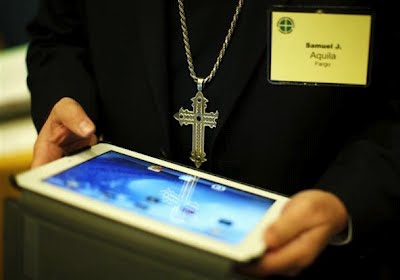
by Denver Archbishop Samuel J. Aquila | January 22, 2013
[Leer la carta en español] [Archbishop Aquila is the former Bishop of Fargo and was appointed to Denver last year.]
[view letter as PDF]
[view letter as PDF]
Dear Brothers and Sisters in Christ,
I went to college in 1968 with the idea of becoming a doctor, like my father. College campuses in the late ‘60’s and throughout the 70’s were places of turmoil. I didn’t practice my faith much in the first three years of college and I certainly never imagined that the Lord would one day make me a bishop.
I spent my first three years of college working as a hospital orderly and assisting in the emergency room, at a university student health center and in a hospital in California during summer break.
When I began the job, I hadn’t thought much about human suffering, or about human dignity.
But during my employment in hospitals, something changed. At that time, some states had approved abortion laws that I wasn’t even aware of. Because of those laws, when I was in college I witnessed the results of two abortions.
The first was in a surgical unit. I walked into an outer room and in the sink, unattended, was the body of small unborn child who had been aborted. I remember being stunned. I remember thinking that I had to baptize that child.
The second abortion was more shocking. A young woman came into the emergency room screaming. She explained that she had had an abortion already. When the doctor sent her home, he told her she would pass the remains naturally. She was bleeding as the doctor, her boyfriend, the nurse and I placed her on a table.
I held a basin as the doctor retrieved a tiny arm, a tiny leg and then the rest of the broken body of a tiny unborn child. I was shocked. I was saddened for the mother and child, for the doctor and the nurse. None of us would have participated in such a thing were it not an emergency. I witnessed a tiny human being destroyed by violence.
The memory haunts me. I will never forget that I stood witness to acts of unspeakable brutality. In the abortions I witnessed, powerful people made decisions that ended the lives of small, powerless, children. Through lies and manipulation, children were seen as objects. Women and families were convinced that ending a life would be painless, and forgettable. Experts made seemingly convincing arguments that the unborn were not people at all, that they could not feel pain, and were better off dead.
I witnessed the death of two small people who never had the chance to take a breath. I can never forget that. And I have never been the same. My faith was weak at the time. But I knew by reason, and by what I saw, that a human life was destroyed. My conscience awakened to the truth of the dignity of the human being from the moment of conception. I became pro-life and eventually returned to my faith.
I learned what human dignity was when I saw it callously disregarded. I know, without a doubt, that abortion is a violent act of murder and exploitation. And I know that our responsibility is to work and pray without ceasing for its end.
Repentance, Prayer, Renewal
At each Mass, before we receive the Eucharist, the Church instructs us to consider and confess our sinfulness. When we pray the Confiteor at Mass we proclaim the sins of “what I have done, and what I have failed to do.”
We ask the Lord for mercy. We ask one another for prayers.
At the Penitential Act, we recognize the times we have chosen sinfulness, and also the times we have chosen to do nothing in the face of the evil of this world. Our sins of omission permit evil. They permit injustice. At the Penitential Act, I sometimes think about the abortions I witnessed and my heart still experiences sadness. I beg forgiveness for the doctors, nurses, politicians, and others who so ardently support abortion and pray for their conversion.
Today we recognize the 40th anniversary of Roe vs. Wade—we recognize 40 years of sanctioned killing in our nation. Today we recognize the impact of those 40 years. Tolerating abortion for 40 years has coarsened us. We’ve learned to see people as problems and objects. In the four decades since Roe vs. Wade, our nation has found new ways to weaken the family, to marginalize the poor, the homeless, the mentally ill—we’ve found new ways to exploit and abuse.
Today we must recognize that 40 years of sanctioned killing has given the culture of death a firm footing and foundation in our nation.
We must also recognize our sinfulness. When we survey the damage abortion has caused in our culture, we must repent for our sins of omission. We Christians bear some responsibility for our national shame. Some of us have supported pro-choice positions. Many of us have failed to change minds or win hearts. We’ve failed to convince the culture that all life has dignity. In the prospect of unspeakable evil, we’ve done too little, for too long, with tragic results.
Today is a day to repent. But with repentance comes resolve to start anew. The 40th anniversary of Roe vs. Wade is a day to commit to a culture of life. Today the Lord is calling us to stand up.
When I worked in hospitals in college, I didn’t know or understand what the Church taught about human life. I learned by experience that a human life is destroyed in every abortion. But I was unprepared to defend life—unprepared to even see real human dignity, let alone proclaim it. I pray that none of you, dear brothers and sisters, will ever find yourselves in the position I was in so many years ago. I pray that you are prepared to defend the truth about human life.
Life is a Gift From God
The Church’s teaching on the dignity of human life is clear. “Human life” states the Catechism of the Catholic Church, “must be respected and protected absolutely from the moment of conception. From the first moment of his existence, a human being must be recognized as having the rights of a person—among which is the inviolable right of every innocent being to life.”[1]
The inviolable right to life is taught in Scripture, Sacred Tradition, and witnessed to in natural moral law. The Church believes that life is a God-given right, and a gift. Our very being is an expression of the love God has for us—the Lord literally loves us into existence, and his love speaks to the worth of the human person. We take the gift of life seriously because each human being is a unique creation of God the Father.
At the moment of conception we receive the gift of life, and lay claim to the right of life. “Before I formed you in the womb,” says the Lord to the prophet Jeremiah, “I knew you. Before you were born, I consecrated you.”[2]
Human dignity begins with the divine gift of life. But our dignity is enriched because Jesus Christ, the Son of God, chose to live among us as a human being. Because of the Incarnation, all humans can share not only human dignity, but divine dignity. Our human life allows us to share in God’s own life—to share the inner life of the Trinity. “Life is sacred” the Church teaches, “because… it remains forever in a special relationship with the Creator, who is its sole end.”[3]
The dignity and sacredness of human life have very clear moral implications: innocent human life is absolutely inviolable. “The direct and voluntary killing of an innocent human being,” teaches the Church, “is always gravely immoral.”[4]
“It makes no difference,” Blessed John Paul II taught in 1993, “whether one is the master of the world or the ‘poorest of the poor’ on the face of the earth. Before the demands of morality we are all absolutely equal”[5]. The Church unequivocally condemns abortion, euthanasia, embryo-destructive experimentation, and the targeting of civilians in war.
The Church takes human dignity so seriously that she even teaches that in all but “cases of absolute necessity” capital punishment is immoral.[6]
Unjust killing is a rejection of the gift of God.
Abortion is always wrong
This letter wishes to reflect particularly on the Church’s teaching regarding abortion.
In 1974, the Congregation for the Doctrine of the Faith reflected that “in the course of history, the Fathers of the Church, her Pastors and her Doctors have taught the same doctrine,” namely that abortion is an “objectively grave fault.”[7] In 1972, Pope Paul VI declared that “this doctrine has not changed and is unchangeable.”[8]
Today many Catholics seem to believe that while abortion is unfortunate, it is not always a moral evil. Secular arguments to justify abortion abound. New life often represents difficulty. When pregnancy seems to threaten health or life, or poverty, or when a child may be born with grave disabilities, abortion is often the secular solution.
But, as the Holy See noted in 1974, “none of these reasons can ever objectively confer the right to dispose of another's life, even when that life is only beginning. With regard to the future unhappiness of the child, no one, not even the father or mother, can act as its substitute… to choose in the child's name, life or death…Life is too fundamental a value to be weighed against even very serious disadvantages.”[9]
Though abortion is never a justifiable action, the response of the Church to women who have undergone abortions should be one of compassion, of solidarity, and of mercy. Abortion is a sinful act, and a tragedy. The fathers and mothers of aborted children are beloved by God, and in need of the mercy and healing of Jesus Christ. Programs like Project Rachel exist to help women who have had abortions encounter the merciful and forgiving love of God, our Father.
Just Law Protects All Life
Because life is a fundamental value, we have a duty to proclaim its goodness, and its dignity. We also have a duty to protect it in law. The Congregation for the Doctrine of the Faith observed in 1987 that “the inalienable rights of the person must be recognized and respected by civil society and the political authority. These human rights depend neither on single individuals nor on parents; nor do they represent a concession made by society and the State: they pertain to human nature and are inherent in the person by virtue of the creative act from which the person took his or her origin.”[10]
Clearly, just laws should respect the dignity of the unborn, and their right to life. Laws which fail to do so should be defeated. And it is the vocation of all Catholics, most especially lay Catholics, to work to change unjust laws which allow for the destruction of human life. The Second Vatican Council decreed that “since laity are tightly bound up in all types of temporal affairs, it is their special task to order and to throw light upon these affairs in such a way that they may come into being and then continually increase according to Christ to the praise of the Creator and the Redeemer.”[11]
Despite the clear teaching of the Church, many Catholics, and especially Catholic politicians, maintain that their personal opposition to abortion should not affect their participation in civic life. These arguments are unreasonable, and disingenuous. No one, especially a person in public office, is exempt from the duty to defend the common good. And the first and indispensable condition for the common good is respect for the right to life. Our Declaration of Independence begins with an argument that all men should protect the inalienable rights granted them by God—among them, the right to life.
At the basis of arguments which recognize abortion’s immorality, but support its legal protection, is relativism, and cowardice: a refusal to stand for basic and fundamental truth. Law does nothing more important than protect the right to life.
The fathers of the Second Vatican Council reminded Catholics, “Nor,…are they [the faithful] any less wide of the mark who think that religion consists in acts of worship alone and in the discharge of certain moral obligations, and who imagine they can plunge themselves into earthly affairs in such a way as to imply that these are altogether divorced from the religious life. This split between the faith which many profess and their daily lives deserves to be counted among the more serious errors of our age. …Therefore, let there be no false opposition between professional and social activities on the one part, and religious life on the other. The Christian who neglects his temporal duties, neglects his duties toward his neighbor and even God, and jeopardizes his eternal salvation”[12]
This statement resonates even more true today, as many Catholics have withdrawn their faith from the world and public square.
In 1987, Blessed John Paul II said to Americans that “every human person -- no matter how vulnerable or helpless, no matter how young or how old, no matter how healthy, handicapped or sick, no matter how useful or productive for society -- is a being of inestimable worth, created in the image and likeness of God. This is the dignity of America, the reason she exists, the condition for her survival -- yes the ultimate test of her greatness -- to respect every human person, especially the weakest and the most defenseless ones, those as yet unborn.” [13]
The legacy of America is respect for human dignity—most especially respect for the innocent, vulnerable, and marginalized.
Catholic political leaders who claim that they can separate the truths of faith from their political lives are choosing to separate themselves from truth, from Christ, and from the communion of the Catholic Church.
On the contrary, Catholic political leaders who truly understand the teachings of the Church and who use their creativity and initiative to develop new and creative ways to end the legal protection for abortion deserve the praise and support of the Church, and of the lay faithful. All of us must put our energy and effort into ending the legal protection for abortion. It is, and must be, the primary political objective of American Catholics—it is difficult to imagine any political issue with the same significance as the sanctioned killing of children.
Building a Culture of Life
Protecting life is our duty as Catholics, and ending legal protection for abortion is imperative. 40 years have passed and still we have not found a successful strategy to end the legally protected killing of the unborn. But we have also failed to win public opinion. Polling today suggests that 63% of Americans support legal protection for abortion.[14] This is where change must begin.
Although we must continue legal efforts, we must also recognize that law follows culture—when we live in a culture which respects the dignity of all human life, we will easily pass laws which do the same.
Our task, said Blessed John Paul II in 1995, is “to love and honor the life of every man and woman and to work with perseverance and courage so that our time, marked by all too many signs of death, may at last witness the establishment of a new culture of life, the fruit of the culture of truth and of love.”[15]
A culture of life, quite simply, is one which joyfully receives and celebrates the divine gift of life. A culture of life recognizes human dignity not as an academic or theological concept, but as an animating principle—as a measure of the activity of the family and the community. A culture of life supports most especially the life of the family. It supports and celebrates the dignity of the disabled, the unborn, and the aged. A culture of life seeks to live in gratitude for the gift of life God has given us.
If we want to build a culture of life, we need to begin with charity. Social charity, or solidarity, is the hallmark of a culture of life and a civilization of love. It allows us to see one another through the eyes of God, and therefore to see the unique and personal worth of one another. Charity allows us to treat one another with justice not because of our obligations, but because of our desire to love as God loves.
This charity must begin in the family. Our families are the first place where those who are marginalized, and whose dignity is forgotten, can be supported. To build a culture of life we must commit to strengthening our own families, and to supporting the families of our community. Strong families beget the strong ties which allow us to love those most in danger of being lost to the culture of death.
The charity of the culture of life also supports works of mercy, apostolates of social justice and support. Families impacted by the culture of death are often broken. Supporting adoption, marriage, responsible programs of social welfare and healthcare, and responsible immigration policy all speak to a culture which embraces and supports the dignity of life.
A true culture of life is infectious. The joy which comes from living in gratitude for the gift of life—and treating all life as gift—effects change. When Christians begin to live with real regard for human dignity, our nation will awaken to the tragedy of abortion, and she will begin to change.
Finally, dear brothers and sisters, I wish to remind you of the power of prayer. Our prayer and sacrifice for an end to abortion, united with Christ on the cross, will transform hearts and renew minds. In prayer we entrust our nation to Jesus Christ. In doing so, we can be assured of his victory.
Today I ask you to join me in a new resolve to build a culture which sees with the eyes of God—which sees the dignity of the unborn, of women and men, of the poor, the elderly, the mentally ill and the disabled.
Our forefathers saw with the eyes of God when they recognized in the Declaration of Independence that “we hold these truths to be self-evident, that all men are created equal, that they are endowed by their Creator with certain unalienable Rights, that among these are Life, Liberty and the pursuit of Happiness.”
I ask you, dear brothers and sisters, to join me in building a culture of life which ends the brutal killing of the unborn—the smallest and least among us. There is no greater task we can undertake. I pray that the words of Scripture may burn within our hearts, “You formed my inmost being; you knit me in my mother’s womb. I praise you, because I am wonderfully made; wonderful are your works!”[16]
Sincerely yours in Christ,
Most Reverend Samuel J. Aquila, STL
Archbishop of Denver
[1] CCC 2270
[2] Jeremiah 1:5
[3] CCC 2278
[4] Evangelium Vitae, 57.
[5] Veritatis Splendor, 97
[6] Evangelium Vitae, 56
[7] Declaration on Procured Abortion, Congregation of the Doctrine for the Faith, 1974.
[8] "Salutiamo con paterna effusione," December 9, 1972, AAS 64 (1972), p. 737.
[9] Declaration on Procured Abortion, Congregation of the Doctrine for the Faith, 1974.
[10]
Instruction on respect for human life in its origin and on the dignity
of procreation., Congregation of the Doctrine for the Faith, 1987.
[11] Lumen Gentium, 31.
[12] Gaudium et Spes, 43.
[13] John Paul II, Farewell Ceremony, Apostolic Visit to the United States and Canada, September 19, 1987
[14] Roe v. Wade at 40: Most Oppose Overturning Abortion Decision, Pew Research Center, 2013
[15] Evangelium Vitae, 77.
[16] Psalm 139: 13-14