Monday, July 17, 2006

A Meditation on "Deus Caritas Est"

.
Trying to work through a whole encyclical is often intimidating. Father Dana , the "Prairie Priest" who blogs at "White Around the Collar" in Sioux Falls created a short meditation on the Pope's recent encyclical and has posted it for sharing:

Yesterday the parish staff here made a little retreat at our diocesan retreat center. It was a wonderfully prayerful day that brought me some much needed time to reflect.

We started the evening before with a little recreation. We had wine and cheese and alot of stories and jokes. The next day we had much of the morning for free time to enjoy the outdoors. Throughout the day we had two half-hour times for quiet prayer and adortion, two-half hour talks, the stations of the cross, confessions, and of course the Holy Sacrifice of the Mass. The pastor gave a talk on the apostolate of the laity and I gave a meditation using Pope Benedict's Deus Caritas Est.

A couple of people asked to have copies of it, so I thought I would let you all read it as well. Here is the text of the meditation:

I would like to begin our meditation with a quote from Deus Caritas Est by Pope Benedict XVI. He said
We have come to believe in God's love: in these words the Christian can express the fundamental decision of his life. Being Christian is not the result of an ethical choice or a lofty idea, but the encounter with an event, a person, which gives life a new horizon and a decisive direction.


Pope Benedict points out that we as Christians express the underlying decision of our lives when we come to a point in our lives where we can say with certainty and with all our hearts what we, you and I, have come to believe in God’s love for us. This expression is not one that we can make haphazardly or flippantly. We don’t just one day wake up and say that we have come to believe in God’s love - and really mean it. This expression has a depth that goes far beyond what many of our separated brothers and sisters would call “accepting Jesus Christ as your personal Lord and Savior.” It is not something you can just do in a momentary altar call, but something that is an ongoing reality – a journey of sorts. It goes to the very heart of our lives and is not something we just say with our mouths, it is something we say by the way we live our lives in addition to saying it with our words.

This journey to fully and completely realizing that God truly loves us, as Pope Benedict puts it “is not the result of an ethical choice or a lofty idea, but the encounter with an event, a person.” My friends, this journey to knowing Gods love comes only through encounter with a person – the person of Jesus Christ. It is that moment or moments of encounter with Christ that give our life a decisive direction. We know this from experience. No doubt many of us went through much of our lives saying that God loves us, but it was not until an encounter with him in prayer, in the Sacred Liturgy, or even in the midst of pain and suffering, that we truly came to understand and to believe in the depths of our being and with all our hearts that God loves us, and that we are His children. And maybe you are not there yet, maybe you have yet to have that encounter with Jesus. Have no fear. Seek him out. Search after Him confident that He too is searching you out and that if you seek Him with a sincere heart you will meet Him and encounter love itself.

This decisive encounter with Christ is an encounter that should spur us on to seek an ongoing encounter with Christ. One that is continuous and lifelong – one through which we can truly live out what St. Paul has called us to do when he instructs us to “pray always”[2] This is not easy, and it comes only through living a life consistent with Gospel values. A life lived this way has a number of different characteristics, a few of which I will expound on today.

  1. A life lived in such a way that we are continually in the presence of God is one that has as its rock foundation an understanding that we are sons and daughters of God. St. Josemaria Escriva says that “Divine filiation (being Children of God) is a joyful truth, a consoling mystery…it shows us how to speak to God, to know and to love our Father in heaven. And it makes our interior struggle overflow with hope and gives us the trusting simplicity of little children. More than that: precisely because we are children of God, we can contemplate in love and wonder everything as coming from the hands of our Father, God the Creator. And so we become contemplatives in the middle of the world, loving the world.”[3]

This realization that we are indeed Children of God should move us to a profound trust and hope in God who is our Father. He will never abandon us, he will never leave us orphan, and he will give us what we need, when we need it. It should also move us to abandon all fear. If God is our Father, we have nothing to fear. Not even little rubber spiders in my desk drawer. As Pope Benedict reminds us, that children of God, “Immersed like everyone else in the dramatic complexity of historical events… remain unshakably certain that God is our Father and loves us, even when his silence remains incomprehensible.”[4]

  1. If God is our Father, then we, as His Children should spend time with Him in prayer. In recent times there has been a movement within Christian circles to make activism more important than prayer. There has crept into the lives and teachings of many an attitude of “our work is our prayer.” Now surely work can be prayer when it is offered to God, but it should never take the place of our time spent in private, personal prayer. Pope Benedict points out that “It is time to reaffirm the importance of prayer in the face of the activism and the growing secularism of many Christians engaged in charitable work…[The Christian] seeks an encounter with the Father of Jesus Christ, asking God to be present with the consolation of the Spirit to him and his work.”[5] For those of us involved in the apostolate of serving our brothers and sisters in parish work should be sure that our relationship with the Father in prayer is a priority. This is why we, as a staff have began to pray together weekly. That weekly prayer time is to remind us that we should be praying, not just together, but individually as well. We should daily be lifting up the people we serve to God in personal prayer.

  1. If we are to come to know that we are children of God through personal and communal prayer, then we should make the greatest prayer the Church offers the high point of our lives, not just in theory, but in practice. The Holy Sacrifice of the Mass is the perfect time to lift up those we work with and those we serve in prayer, if possible, we should be doing this every day. I think, and I am sure Fr. Morgan would agree, that it would be wonderful if everyone who worked at Holy Spirit was able to attend daily Mass. I think it would make a huge difference in how we interact with each other and with the people we serve.

The Mass is the privileged place to meet Christ and to learn, at the foot of the cross, made present there, how to better love those around us. For, as Pope Benedict says “The Eucharist draws us into Jesus' act of self-oblation.”[6] This act of self oblation, or self gift is His death on the cross “in which gives himself in order to raise man up and save him. This is love in its most radical form.”[7] This act of self gift is an action that we should imitate in our dealings with those we serve, so that we too, in cooperation with the Lord can raise up our brothers and sisters and lead them to salvation. We as human beings are called by our very nature to make a sincere gift of ourselves to those around us. This is most clearly seen in ones relationship with their spouse, but it also should be lived out in a similar way in our service to those who we encounter every day in our work. When we truly give ourselves to those we serve day in and day out we will be instruments in the hands of God; instruments that will help lead our brothers and sisters to heaven.

  1. So how do we live these things out on a practical level. How do we, as a result of being a child of God live out our calling to radical, self giving love?

    1. Pray. This was discussed earlier, but it is vitally important for us as people who seek to love as God loves in service to our brothers and sisters to have daily contact with God who is love. We will never be able to give love if we do not receive love in daily prayer, especially in the Holy Sacrifice.

    1. Be people of sacrifice in imitation of Christ. These little sacrifices do not need to be big. You don’t need to fast on bread and water three days a week, although I could probably use that. These sacrifices can be very simple. Here is one of my favorite quotes from St. Josemaria that some of you have heard before: “That joke, that witty remark held on the tip of your tongue; the cheerful smile for those who annoy you; that silence when you're unjustly accused; your friendly conversation with people whom you find boring and tactless; the daily effort to overlook one irritating detail or another in the persons who live with you... this, with perseverance, is indeed solid interior mortification.”[8]

We all know that there are many sacrifices that we can make every day as we work in the office. We can smile at those we don’t like. We can help those who annoy us instead of making an escape through the back door. We can not roll our eyes when “that person” calls again. We can hold our tongue instead of gossiping about this or that parishioner. All sacrifices. All things that will be real life manifestations of our love for God and those we serve.

In conclusion, Pope Benedict reminds us that God is Love, and that makes a difference. It makes a difference in our lives, and through us, in the lives of others. As we now move into a time of quiet prayer and meditation let us ask ourselves if God’s love truly does make a difference in our lives. Does his love flow through us to our brothers and sisters? How can I we do better as a group and as individuals? Then make a strong resolution about what we need to change in our lives to grow in holiness and lead those we serve to the same.


The Duluth School Board Proposes to Install Cameras as anti-violence measure in its three high schools

.
Randby Brown, the parent of two children who were at the Columbine High School in Colorado in 1999 when twelve students were killed and the killers ultimately committed suicide. In an opinion piece in the Duluth NewsTribune, Brown thinks that the money would be better spent for anti-bullying measures and other training and facility improvements that would discourage such events from happening.

Sharon, who blogs at Clairity's Journal lives and works in Duluth and is also experienced as the parent of a child who witnessed a school killing at Santana High School in Santee, CA, in 2001 where two were killed and 13 others were wounded by one student. Sharon has posted an op-ed piece that she has sent to the NewTribune that disagrees with Brown's position:

In a July 14th editorial, Columbine parent Randy Brown opined that security cameras would not make Duluth schools safer and that money would be better spent on “anti-bullying programs and threat-assessment models. As a “Santana parent”, I agree with Brown that cameras might give a false sense of security and don’t address the actual threat of school violence. My daughter was a freshman at Santana High School and present at the March 2001 shooting resulting in the deaths of two students.

Anti-bullying programs do not uncover the painful emotional illnesses of children who are a risk to others, but more often to themselves. As a former volunteer at a children’s residential treatment facility, I know that by far most emotionally troubled youth are not dangerous to others, but the suffering and social toll are such that it is cruel to offer no more than a kinder, gentler student population. A less toxic social environment, while desirable, is unlikely to immunize schools from deadly outbursts.

My daughter knew the lone shooter at Santana, Andy Williams. [snip] Clairity's Journal

The Bible is Patriarchal and Oppressive to Women

.
Adoro must be a very good student. She just smashes that fabrication.

Adoro, who blogs at Adoro Te Devote, attended the Called to Lead Bible Conference out in Wayzata over the weekend and appears to be on fire this morning with things she learned. You shouldda been there, too! Me, too! I thought it was just for teachers.

How many of us have heard the above claims? How many of us have looked to scripture to read it for ourselves, and have been outraged by, for example, the directives of the apostle Peter when he stated that women must be quiet and are not allowed to teach?

How accurate are these claims?

Let us look to the Bible itself for the answers. If we look at historical fact, throughout the Bible, men were the heads of families and were the leaders. Abraham, Moses, David, Solomon, Joseph. But does this mean that women are oppressed and demeaned?

Let us look to Genesis 1:26-27 "Then God said 'Let us make man in our image, after our likemess, and let them have dominion over the fish of the sea, and over the birds of the air..' "So God created man in his own image, in the image of God he created him; male and female he created them."
[snip] Read More

Minnesota novelist, Jon Hassler: The New Woman

.
Jon Hassler, retired from St John's University has another novel waiting for you at your local bookstore or library: The New Woman

W. H. Auden once remarked that readers want their favorite novelists to be faithful to them, while remaining free themselves to be as unfaithful as they please. Jon Hassler’s latest book, The New Woman, may at first glance seem unfaithful to readers devoted to his four previous novels of life in bucolic Staggerford, the fictional Minnesota town he began chronicling almost thirty years ago. In The New Woman Hassler trains his comic and ironic Midwestern vision-more generous and humane than Sinclair Lewis’s, less macabre than Sherwood Anderson’s-on the problems of the senior citizen. The novel follows Hassler’s familiar heroine, retired Staggerford teacher Agatha McGee, through a series of adventures in and around Sunset Senior Apartments, where at age eighty-seven Agatha has moved, fearing herself too old to live alone. Seeing her at Sunset, readers may ask: whatever happened to the feisty and opinionated Agatha we knew from the prior books? And what kind of compelling story will the novelist find in the everyday events of a retirement community?

Like many a Hassler novel, The New Woman begins with a mystery. Agatha cannot find a valuable gold brooch, a gift from her parents and memento of her 1927 high school graduation. She suspects another Sunset tenant of stealing it, and soon focuses on John Beezer, a retired farmer with a surly disposition and bad table manners. With other residents fearing for their possessions, Agatha’s best friend, Lillian Kite, proposes that all entrust their valuables to a shoebox. To foil any would-be thief, the shoebox is passed randomly from one resident’s room to another’s. Before long it is Agatha’s turn to safeguard this so-called “MX Shoebox” and its eclectic treasures, including a charm bracelet, a papal medal, a shaving brush, and-Lillian’s contribution-a partial roll of Tums. [snip] Read More. . . . Free Commonweal registration required

Tip O' The Hat to Amy at Open Book
who has posted her introduction to the Loyola Books edition of Hassler's "most Catholic novel", North of Hope. It is in a pdf file, but as might be expected from Amy, it is unusually easy to open and read.


Sunday, July 16, 2006

We now have "Categories"

.
If you note on the right sidebar, below the most recent ten posts, you will see a list of "Categories."

This blog has gotten to be far bigger than I ever dreamed when it was begun in March. While it is basically a "news" blog about Catholic activities in a five state area, I also include many posts relating to specific Catholic sites and activities. Many of those early posts would still be of interest to people who have just begun to visit the site. But examining the nearly 800 posts that have been made would be an impossible task for even the most diligent web surfer.

By creating "Categories", you now will be able to view all posts sorted by location or subject matter. That should be very helpful.

But coding all of those posts will take some time. It took significant portions of three days to just code the months of March and April when I was just starting out. So please bear with as I continue to code.

I will start on May tomorrow! If you have an additional Category you would like to see, please let me know and I will consider it.

I am not including scheduled events as their date has passed. But when I get caught up when there is only five or ten posts a day, it will be easy to categorize everything.

Parishioners say goodbye to churches in Clutier, Dysart

.
[snip] On Sunday, Catholic parishes in Clutier and at Dysart's St. Joseph Church will close. A final Mass will be held at 8 a.m. in Dysart and at 11 a.m. in Clutier. Receptions will follow each service. The Most Rev. Jerome Hanus, archbishop of the Archdiocese of Dubuque, is expected to attend.

A shortage of priests and declining populations in rural Iowa bring transition and change to many Catholic communities, priests and parishioners said.

"Everybody's downhearted about the closing of the church," said Marvin Dostal, 62, of Clutier. He'll miss the potluck dinners with mountains of food and especially the annual Corpus Christi feast. "Church is community," Dostal said. "We are losing our community." [snip] Waterloo-Cedar Falls Courier

Basil has a name . . . for his radio station!

.
Windy Hill Radio
.
I don't know how many hills there are in the middle of South Dakota, but good for Basil. Currently blogging at A Country Boy Writes . . . he will be moving his blog soon to their new site. But let him tell about it.

www.windyhillradio.org is alive and is ready to start its ministry.... when we get a bishop!

Check it out and let me know.

OH- the Vatican called today. Msgr. Charles Mangan informed me that His Holiness, Pope Benedict XVI is INTERESTED in what "Grandma Jazz" and I are doing with the radio idea! WOW!

And pray for a bishop soon for Sioux Falls. They have been waiting long enough!

Rave Review for "The Called to Lead" Conference

.
Adoro, who blogs at Adoro Te Devote, attended "The Called to Lead" Conference in Wayzata and came away totally impressed and wondering why more local people didn't attend.

This is completely unacceptable, and I am now demanding that all you locals put this conference on your calender for next July. Believe you me, this is a conference well worth attending and I told the pastor at my parish that he needs to send people next year. Then I gave him one of the CD's made from a talk given by Mother Assumpta on the Virtues of a Parish leader as a fine example of what to expect at this conference.

There are three different "tracks", or categories that the various talks fall into; Leadership, Scripture, or Evangelization. I attended talks in all three categories and honestly, I'm still trying to intellectually digest what I have learned, and whenever I think about it, I am set on fire. I can't wait to share this knowledge, but I want to do it in a way that will make sense. [snip] Read More

It's not too often that Catholic speakers of the caliber of Sarah Christmyer, Tim Gray, Bishop Samuel Aquila of Fargo, Father Mitch Pacwa of EWTN, Curtis Martin, Carol Locke, Mother Assumpta Long, Jeff Smith, Marcellino D'Ambrosio, MichaelAnn Martin, Tom Smith, Dr. Mary Healy, Marcus Grodi of EWTN, Jeff Cavins and Fr. Peter Laird come here. Well, those last two live here, but the rest were here for a rare opportunity for you to take advantage of their expertise.

The theme of the conference was "Tools, Techniques, and Materials for Effective Life-Changing Bible Study."
There aren't too many Catholics that can't use some help in that field.

Watch for it next year.


Saturday, July 15, 2006

Those nuns have suffered a lot over the years

.
On Bastille Day yesterday, Terry, the doppel-blogger of Leaflet Missal who has Abbey-Roads and Rome-ing Catholics, spent some time thinking about nuns in general and in particular the local order of the Sisters of St Joseph of Carondelet, who suffered during some of the excesses of the French Revolution and the debt of gratitude we owe them.

Hey! The French Revolution wasn't a good thing you know. Marie Antoinette was a very devout Catholic and nothing at all what proponets of the revolution said about her. But that is not my point here. The Sisters of St. Joseph of Corondolet had a few sisters guillotined in the revolution, along with many other nuns and priests. Martyrs all.

My last post consisted in a bit of "nun bashing" - it did a disservice to the faithful Sisters who still exist. (I'm not talking about the radical feminists among them in this post, who had aroused my anger. Nor am I talking tonight about the 'mean' ones I experienced.)

Today a lovely Sister came into the Store with her sister. I know these two well, they are parishoners at St. Louis Church in downtown St. Paul. I knew the one is a Sister, I assumed she was a Daughter of the Immaculate Heart of Mary, who, from their original foundation in France, always wore secular clothing to hide from the revolutionaries, and they continue in secular garb today, not living in community, but among the laity. I was astonished to find out she was from the Sisters of St. Joseph of Corondolet, an order to whom all Catholics in the mid-west owe an enormous debt of gratitude. If it had not been for these early 'pioneer' Sisters, we would never have had the schools and hospitals, or one local college in particular, that we grew up with and in some cases still have today. Nor would I have been properly instructed in the faith! [snip] Read More

Sweating the Really Important Stuff Today

.
Dear Communion of Saints,
Is Hell a dry heat, or is it humid too? I walked outside today and was inspired to think of this. I mean, I think I can handle the dry heat. But if it's as humid as it's been lately, I'm seriously getting my life in order. Thanks!

Sincerely,
Sweating the answers

Dear Sweating:

The Compendium to the Catechism of the Catholic Church is now available On Line

.
The 200 page shorter Compendium to the longer, 803 page, Catechism of the Catholic Church is now available online at the Vatican website.

It would be better to have your own paper copy in which you can take notes and slip holy cards, newspaper clippings and pertinent articles into, but this will be nice to have too.

The soft cover edition should be available at your local Catholic book store for about $15. If you do not have one nearby,
Leaflet Missal is all set up to help you out. Tip O' The Hat to Amy at Open Book!


Here's some interesting tidbits from the new catechism:

Who is God:

God, infinitely perfect and blessed in himself, in a plan of sheer goodness freely created man to make him share in his own blessed life. In the fullness of time, God the Father sent his Son as the Redeemer and Savior of mankind, fallen into sin, thus calling all into his Church and, through the work of the Holy Spirit, making them adopted children and heirs of his eternal happiness.

Why did God Make Me?

God in his goodness and wisdom reveals himself. With deeds and words, he reveals himself and his plan of loving goodness which he decreed from all eternity in Christ. According to this plan, all people by the grace of the Holy Spirit are to share in the divine life as adopted “sons” in the only begotten Son of God.

What must we do to get to Heaven?

Faith is the supernatural virtue which is necessary for salvation. It is a free gift of God and is accessible to all who humbly seek it. The act of faith is a human act, that is, an act of the intellect of a person - prompted by the will moved by God - who freely assents to divine truth. Faith is also certain because it is founded on the Word of God; it works “through charity” (Galatians 5:6); and it continually grows through listening to the Word of God and through prayer. It is, even now, a foretaste of the joys of heaven.

I can't believe they used the expression "free gift." When are gifts not free?

When have you ever seen less rules rather than more? It is now the "Five Precepts of the Church." One rarely hears about the "Ten Commandments" any more, but I'd bet that few under fifty recall the "Six Precepts of the Church." I won't question why they use the word "Precepts" in a book that was intended to simplify. You may, if you want.

The five precepts of the Church:

1. You shall attend Mass on Sundays and on holy days of obligation and remain free from work or activity that could impede the sanctification of such days.
2. You shall confess your sins at least once a year.
3. You shall receive the sacrament of the Eucharist at least during the Easter season.
4. You shall observe the days of fasting and abstinence established by the Church.
5. You shall help to provide for the needs of the Church.

Who can come up with the sixth "precept" that used to be included with these five?


Friday, July 14, 2006

As Western Society Secularizes, Will Africa Become the New Home of the Catholic Church?

.
John Allen, National Catholic Reporter's greatly respected "Man in the Vatican" is now their "Man of the World, writing about "All Things Catholic" on a weekly basis. John's column, available on your desktop by free weekly notice is one of the "must reads" if you want to stay on top of Catholic news. This week he has an interesting African perspective.

I sat down with Fr. John Mary Waliggo of Uganda, a widely influential African theologian and currently a member of his country's human rights commission. Waliggo is an enormously appealing figure, with a ready smile, an infectious laugh, and a salty tongue. In Padua, he led a group of Africans who decided to create a steering committee for a new society of African ethicists.

How can Africa influence the global church?
For one thing, missionary congregations today come to Africa and recruit, so they have many African members. If you really looked into it, you'd find the percentages are enormous. There are also many other Africans priests and sisters serving abroad in various places. Right now, the local church in Africa usually has no idea who these people are or what they're doing, it has no contact with them. I think a critical moment will come when these Africans begin to connect with one another, to form a network, to become aware of the voice they already have.

What will they use that voice to say to the rest of the church?
First, racism will be challenged.

Second, Africans can stimulate theological development. Theology in Europe and North America is not creative enough anymore, and so they get renewed when they read theology from India, from South Korea, from Africa. Our theology is a little bit more dynamic.

For example, we have much to say about inculturation, offering new models for theological reflection … Jesus as proto-ancestor, the idea of the dead living among us, the emphasis on active participation by all in the community. There's also African liberation theology, which includes African feminism. It's a theology that departs from injustices to Africans and by Africans. It keeps the government dancing, because they don't quite know what to do with it.

There's the theology of remembering. We Africans have our own Exodus story in the form of the slave trade, which is a story we must always remember. The past is part of us, it's a big instrument in forming our future. We also do a very historical sort of theology, such as what we should learn from the Rwandan genocide. If you forget this sort of thing, you are naïve.

Our theological style is very concerned with narrative, expressing teachings in story. Our people listen better when you give them a story. This means using local expressions and rituals, linking the gospel to their story. Everything is brought into the story, the animals, the plants, the whole environment. It's a way of doing theology that's almost dead in the West, but it's very Biblical.

As Africans move around the rest of the church, they will carry this way of thinking and teaching with them. If I'm called to Munich or somewhere else, I won't stop my way of doing things.

What else is a distinctive contribution of African Catholicism?
We have refused to leave our cultures and traditions behind. We believe that the old wine and the new wine must be mixed together. Jesus did not come to destroy, but to create. Christianity is in general something additional to what the people already believe, not its complete replacement.

What do you think when you see Catholics in the north discussing matters such as whether the correct response should be "and also with you" or "and also with your spirit?" Is it a priority for you?
Look, I was part of the fight to get rid of Idi Amin, when my country was bleeding. I went into exile for five years, but we finally got rid of him. I wrote four books on the political education of our people. I came back, and fought against [Milton] Obote, who was no better than Amin. I had to go into exile again, to Kenya, but we got rid of him too in 1986.

I then became the General Secretary for writing the new Ugandan Constitution. We went up to all the villages to consult the people, including women, people with disabilities, everybody. It took six years to do it, but in the end the constitution is full of Catholic social teaching.

I'm now a commissioner on the Human Rights Commission. I visit the jails, and if I say so, I can get somebody released within 48 hours. The idea is to be sure that people aren't just tossed in jail and never heard from again.

This isn't just me. The chair of the AIDS commission in Uganda, for example, is a Catholic bishop.

We believe that theology must be relevant. It has to contribute to the constitutions, laws, and policies of the country. We see our role as social change agents, as people who work and unite themselves with the poor who are struggling. We do theology for them, to help them to have life to the full.

What sort of question does interest you?
To me, the important questions are, 'How are your kids fed?' 'How do you get along with your Muslim neighbors?' I don't invent the questions, I find them in the community.

Is it true that Africans are more traditional on sexual morality?
Yes, it is true. There's a basic cultural value in our heritage in which sexuality is sacred and respected. We talk about it in very clear terms. Things such as homosexuality are not just seen as sins, but as perversions. They're seen as hideous, they make you an outcast from your clan and village. If a man impregnates his sister, or if he has sex with another man, this is a kind of social sin which people believe will bring misery on the entire village, so he'd better just go away. This is what the people believe, and [as a theologian] you can't isolate yourself from society.

The presence of Muslims is also very important. If you're a homosexual, they come to stone you. Those who practice traditional African religions would stone you too. The Catholics isolate you. If everyone agrees to that, who are we to reject it?

We've had too much armchair theology in the church. We want to be synthesizers and prophets of the people.

Do you think there will be a rupture in Catholicism on these issues, as in the Anglican Communion?
If it's pushed, it would be a big split. But the church generally tries to avoid sensitive issues which simply divide it, and I don't think it will come out "soft" on homosexuality.

What about abortion?
I identify with the victims of suffering, and no one is more speechless, more voiceless, more silent, than the unborn child. To me, it's like defending the blind. If I see someone attacking a blind person, I will beat him with a stick. This is my attitude to attacks on an unborn child too.

So by Western standards, your views are in some ways quite "liberal," in other ways "conservative."
I suppose you always fit 50 percent. But in the end, we remain accountable to our people. We don't want to be like our dictators, pursuing their own ideas and their own interests.

Running For The Pope: Two Americans in Rome

.
Sue, known to blogging pals as "Desparate", has the renowned DIH blog besides writing occasionally for the really renowned NRO. This little gem of a tale surfaced after diligent research during a 90+ degree day during a slow news month around here. It is well worth your time.

[snip] A guard let us in the big wooden gate. In the courtyard some black-suited Italian met us and led us inside the palace, where we were left in the hands of a tiny Vietnamese monsignor. He said something that no doubt sounded to him like “buon giorno,” and we said something that sounded like “buon giorno,” to us. Then he took off. Fast.

He scurried down the long hallways. The floors of the palace are blindingly polished marble, and as we learned within a couple seconds, extremely slippery. Now Richard in his solid leather soles was having just as much difficulty as I. Our choices seemed few and all bad: race after the little Vietnamese and fall on our rear ends in the papal palace, or lag behind and become lost in the labyrinth, miss our chance to meet the pope, and disappoint our young friend waiting for us to do our sacramental duty only to surface hours later as accused terrorists or, even more shameful, journalists.

The little monsignor made a compromise of sorts. He would race to the end of a hallway until reaching a corner at which he would pause and look back at us beseechingly. We would race after him as fast as we dared until we had just caught up. Then he would smile, stretch out his hand, and bow and say "prego," pointing for us to go ahead. We would reply "grazie," imagining we must be near our destination, and walk on in a more dignified manner. Then he would start running again, leaving us far behind. Corner. Stop. “Prego.” Point. “Grazie.” Walk in dignified manner. Run. Corner. Stop. “Prego.” Point “Grazie.” Walk in dignified manner. Run. This was repeated so many times in that old 17th-century palace that we began to get a little punch drunk, the way you feel when you've been making left turns around a parking lot too long looking for an empty space. By now the walking bit had dropped out entirely and it was more like: Run fast (little monsignor). Run slow (Vigilantes). Stop and wait. (little monsignor again). Slow and nod while passing by (us). “Prego.” Point. “Grazie.” (Us, on the fly) And run. Which is how, after chasing him down I don't know how many hallways and seeing the little priest do the prego-point one last time, we turned yet another corner, careened into the tiny chapel, and skidded to a halt just short of tripping over the pope, on his knees, deep in prayer.

We took a seat in one of the pews, carefully. [snip] You need to read all of this one!

Future Priests of the Third Millenium

.
What do you suppose a seminarian does on summer vacation? Twelve of the seminarians of the St Paul Seminary (stay tuned for really great vocation news in August) have been blogging a bit since the Spring.

Aaron: I am fortunate enough to be able to spend my summer in a parish in my home diocese, the Diocese of New Ulm, Minnesota's most rural diocese. I am living with the pastor in the rectory of the Church of Our Lady in Manannah, Minnesota. Now, I grew up on a farm north of a very small town called Seaforth. This is a town of fewer than eighty residents. Imagine my surprise when I drove into Manannah for the first time and found that this town is actually smaller than Seaforth! It's population is below forty! In fact, it is not even an incorporated city. Manannah has no mayor or other city governing body. Rather, it is a small collection of residences, a church, and a tavern called the Hilltop that is located in Manannah township. The parish itself is quite large for being located in such a small town with about 600 members.

So far in Manannah I have taken communion to parishioners in nursing homes in the area, helped build a parish float for the Manannah Daze parade, ridden on the parish float for the Manannah Daze parade, helped dig a hole in the cemetery (not for a grave, but for the concrete base of a new altar being constructed), watched trees be taken down and a large whole be dug for the gathering space now under construction, among other things. Now I am preparing to spend five days in the Boundary Waters with eight parishioners in less than two weeks. [snip]

Tyler: These last two weeks, I have had the opportunity to experience the ministry of religious siters in a new way. It happened quite accidentally. I was asked to visit a nearby parish (pictured below) to help the pastor pack and move. He has lived in the parish for twenty-five years, and he has a lot of possessions that have accumulated over that period. He also has two elderly Benedictine nuns who have lived in the parish and helped in its daily operation, as well as caring for Father who suffers from a neurological disorder that prevents him from moving about easily. These sisters have also been in the parish for decades.
It was so amazing to see them, in their habits, scurrying around the parish, “convincing” people to volunteer for various activities, and taking care of Father. They love the work they are doing, and though they are nearly bend double with old age, they don’t seem to recognize that they should be resting, enjoying their golden years. As I walked out of the rectory, I encountered one of them carrying a ladder. She, at almost ninety years old, was going to climb to the top of it to clean a closet. They will be moving back to their motherhouse soon, and an era will have ended. For more than a century, religious women have lived in that parish doing the same work that these sisters have continued in the more recent years. As I watched them going about their business, I couldn’t help but think, “This must have been what a parish was like in 1950 when there were more sisters to help carry out the work of the Church.”

A couple of days later, I had the opportunity to serve as sacristan for our annual vocation camp for girls. Dominicans staffed the camp this year. There were three characteristics about them that immediately struck me: 1) They were young. 2) They were happy. 3) They wore their habits. This was striking inasmuch as one seldom encounters a young sister in the Diocese of Rapid City these days. Indeed, these sisters had come from the Archdiocese of Chicago. The more profound realization that occurred as I listened to the sisters speak, however, was their dedication to the Church, their love for the people of God, their deep devotion to the charism of their order, and their abiding relationship with Christ. This is not to say that other religious women do not exhibit these same qualities. Rather, because sisters are mostly absent from the daily life of the parishes and schools in this diocese, I seldom have reason to be involved with them. To have the opportunity, therefore, to spend a week in their presence was a profound reminder of the role of religious women in the life of the Church, and of the essential role they play in supporting the ministry of priests. Never have I heard a more moving testimony of the absolute necessity of praying for one’s pastor, nor have I ever seen a priest reach a young female audience so effectively as the sisters did in their own testimonies. Seldom has a priest inspired me toward holiness quite so deeply as did these small women in white habits and black veils. I’ve heard it said that the diocesan vocation crisis will find at least partial resolution when women religious have remedied their own vocation crises and are more visible in the life of the Church. After all, how many sisters, through their work in parishes and schools, inspired young men to pursue the priesthood? I believe that this sentiment must be true. Resulting from the testimony of these women’s lives and actions, I find myself freshly invigorated to pursue my own vocation with renewed enthusiasm and sincerity.

Is nothing private any more?

.
Sharon, who blogs at Clairity's Journal in Duluth, explores modern relationships today and muses on why it is that we are expected to whole-heartedly accept any changes in the behavior or relationships of friends and relatives.

She didn't use the word, but I will; am I automatically a bigot if I don't approve of what you are doing, no matter what it is? Do I really need to know some things? Must I change if someone new moves in down the street? I really don't know.

If you realize you are "gay", why is it that you must tell everybody about your "coming out?" Do heterosexual couples discuss their sexual relationships in front of their friends? Wouldn't it be possible for you to live your "gay" lifestyle and not tell your family and friends about it? Or is "gayness" the only important thing about you?

I noticed the other day an activist for an ethnic group that has recently migrated to Minnesota complained that he found that Minnesotans were not very "welcoming."

Why is it that we should be welcoming? Most of us have few friends that we see regularly. And most of them are often relatives. Some of us have very few friends and don't see them much at all. Is it our responsibility that we learn the language of newcomers and invite them over for "Welcome to your new home" parties?
When our ancestors arrived here, did the locals immediately grab Polish or Finnish or German dictionaries to ease the transition for the new neighbors?


[snip] There's this trend I've noticed intensifying in our society, and I see it on many levels, although the demands of homosexuals for recognition are a prime example. The aim is for a person to make a public manifesto, primarily about their living arrangements, and to invite others to recognize and even praise it and equate it with the social institution of marriage in all its original stability.
[snip]
Sometimes friends demand of other friends that they "accept" some situation of theirs. "If you don't accept this about me, then you don't accept me." Instead it is the one who demands who puts a limit on the relationship by taking the friend's freedom captive, a freedom which includes love, forgiveness, and even judgment (not condemnation) which stays open to the friend.
[snip]
At a wedding I attended recently, the couple married longest were presented with the bride's bouquet. It was such a touching gesture, and yet for some, absurdly, perceived as a slap in the face. But why can't we honor something beautiful even if because of different kinds of sadness in the world it isn't always so. It seems we've lost the graciousness to do so. [snip] Read More

Neverborn Gets An Eviction Notice

.


.

Thursday, July 13, 2006

NY Court Decision Banning Same Sex Marriages is Good Model For MN Justices to Follow

.
Katherine Kersten, the lonely conservative columnist on the Opinion Page Staff of the Strib analizes the decision last week of the New York Court of Appeals banning same sex marriages in that state.

The proposed Marriage Amendment to the Minnesota Constitution stayed bottled up in committee during the previous legislative session. A handful of Senate DFLers kept the amendment - which would preserve marriage as the union of one man and one woman - off the ballot and out of the people's hands in this fall's election.

Not that Republicans put up much resistance. They seemed more interested in a new Twins stadium.

As a result, the way seems clear for same-sex marriage supporters to challenge Minnesota's marriage law in court as an unreasonable form of discrimination against same-sex couples. [snip] StarTribune

Here's a Summer Treat for You: The Pope at the Keyboard, Playing His Favorite, Mozart

.
.
You will appreciate it much more if you can understand the French narration!
About 2 minutes.

But it appears to be Cardinal Joseph Ratzinger, in his pre-Papal days, playing Mozart and his brother, Father George Ratzinger, being interviewed, probably in Regensburg ("Ratisbonne"), Germany, where Father Ratzinger headed the Choir for many years.

Thanks and a Great Big Tip O' The Hat to Hilary!

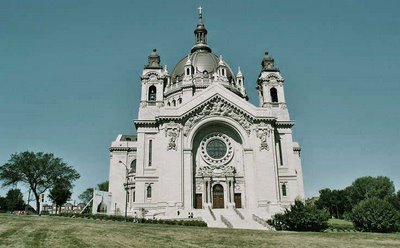
Church O' The Day: Cathedral of St Paul, St Paul

.

Winona Catholic Worker homes focus on community life

.
Sometimes all a person needs is a little friendship, especially at those frequent “down on your luck” moments.

Winona’s two Catholic Worker homes exist precisely for that reason: to provide a supportive community for people who could use a touch of a simple family life.

That’s why the homes’ volunteer staff members prefer their facilities not to be called simply “homeless shelters.” While they often use that term to facilitate easy conversations with other local assistance agencies, the homes are anything but repositories for people without shelter.
[snip]
Both homes are entirely staffed and supported by volunteers, which allows the homes to run on an annual budget of only $13,000 each. This total represents the homes’ electric, heating and water bills, and that’s it. The staff and residents eat donated food, sleep on donated beds, and congregate on donated furniture.
[snip]
Although Winona’s Catholic Worker homes are connected to the worldwide Catholic Worker movement (founded on the principles set forth by faith visionary Dorothy Day), they run a completely independent organization. Despite the title, the Catholic Worker homes are not directly connected to the Catholic Church, and receive no money from the diocese. [snip] Winona Post Tip O' The Hat to our Field Reporter in Winona


Wednesday, July 12, 2006

Report from Barb Nicolosi's "Act One" Executive Program

.
Some of you, no doubt, read books, go to movies, can write a bit, and have the passing thought that you could be writing something better than you have just read or watched on the big screen. Barbara Nicolosi, who blogs at The Church of the Masses, has been out in Hollywood for a few years, teaching writing to Christians who would love to make their mark in Hollywood by writing the next "The Robe" or "The Passion of the Christ." Barb's recently been in a reflective mood about her chosen career.

Hi all! Thanks so much to those of you who keep tuning in here watching for signs of life. Once, a friend asked Emily Dickinson if she had been writing much poetry, and Emily said she hadn't because "lately existence has over-whelmed being." I think I know what she means. Writing that is worth reading requires moments of "being." That is, time when a writer can think on experience. It's two different moments "experience" and "reflecting on experience". I am piling up stuff to reflect on - which I will do here hopefully soon. Just not right now. And, frankly, I don't trust what I would write in my current frame of mind. I'm very clipped lately....

So what's going on? Well, there are our two Act One programs - Writing and Executive - which are both in full swing. (Please keep our sixty students in your prayers.) Then, there have been my trips to Europe and DC (and soon Seattle - and, of course, every trip tends to generate more work in cleaning-up, following up and new leads.
[snip]
It probably has more to do with me not writing much lately than anything else. I'm bored. Completely, mind-paralysingly, agonizingly bored. This happens to me every ten years or so. I started realizing I was getting bored during the whole Da Vinci Code insanity. One day I woke up irritated about having to go over again why blasphemy is like pornography - not something at all that is useful or neutral especially to Christians. And I found I was triple times infinity to the tenth power of pi bored with people who want me to either not state the obvious about problems in the Church or state it is such a way that it is obscure. I know it is true that "You get more bees with honey," but what exactly do you get with two and a half parts watered down aspartame and why should I care anyway? (And please. I'm already bored with those of you who are going to tell me with umbrage that what is obvious to me may not really be obvious at all but just you know, subjectively obvious in some way, you know, to me.... Please resist.)

I'm bored with pretty much every speech I've been giving lately... before I even start. This is the pitfall of making it onto the Christian guru speaking tour circle. That is, you have to be on it. ( I really love meeting all the people! It's listening to myself repeat myself that is so awful.) [snip] Read More from Barb

Minn. Sen. Norm Coleman to vote against Senate bill expanding embryonic stem cell research

.
Sen. Norm Coleman said Wednesday he will vote against a bill that would expand funding for embryonic stem cell research, and instead back a bill encouraging stem cell research that does not involve the destruction of embryos.

Both bills are part of a legislative package expected to come up next week on the Senate floor. [snip] StarTribune

Campaign begins in S. Dakota abortion vote

.

Supporters of a South Dakota abortion ban, passed as a challenge to an established U.S. right to abortion, launched their campaign on Wednesday to uphold the state law in a November referendum.

The ballot issue is expected to make South Dakota a key battleground in a national election-year debate over abortion. Democrats are seeking to recapture the U.S. Senate and House of Representatives from President George W. Bush's Republican party, where abortion opponents are bedrock supporters.

A small-town elementary school parking lot served as the backdrop for a group called Vote Yes for Life to begin a bus tour across South Dakota with a stop in the farming community of Mitchell, stumping for money and volunteers in support of the law.

"We're all about life, helping women and helping babies," Leslie Unruh, the group's leader and a long-time anti-abortion activist, told the gathering of about 100 supporters.

The South Dakota abortion ban is considered the most restrictive in the United States, banning abortions at all stages of a pregnancy, even those that result from incest or rape or harm a woman's health. [snip] MyWay.com

Catholic Nuns Return Home after Serving Scott Co., VA for 28 Years

.


Sister Janice Koziolek and
Sister Maria Exner

Scott County, Virginia, said thank you and farewell to Sister Maria Exner and Sister Janice Koziolek July 2, after 28 years of devoted service to the people of this area. Sister Janice joined the School Sisters of Notre Dame of the Mankato Province in 1941, and Sister Maria joined the same organization in 1946. The two are members of an organization of more than 4,400 vowed women within the Catholic Church whose mission is “to promote justice and educate with the conviction that the world can be changed through the transformation of persons.”

Before coming to Scott County in 1978, Sister Janice taught in Catholic schools for 35 years, mainly in Minnesota and Iowa. Sister Maria also taught school for 30 years in Minnesota and in the state of Washington. [snip] Scott County Star

Do You Know What An Apologist Does --- No. 12

.
.
An Apologist Doesn't Apologize for the Church's Actions.


An Apologist Defends the Faith of the Catholic Church and its Interpretation of Holy Scripture!

Would You Like to Become a Good Apologist?


John Martignoni at the Bible Christian Society is an apologist and has a free newsletter that gives instructions on how to be a better apologist when you feel called upon to defend the Church when you hear someone say or write something that is incorrect.

John's instruction system makes a lot of sense. He prints a question that he has received; then he explains how a question like that should be handled; and then then he gives his answer. If you would like to be better able to speak confidently about your Catholic faith, why not visit John's web site and subscribe to his newsletter. He also has audio tapes that he will send you for free (he will accept a free will offering, though).

Here is an example of the information he sent in today's newsletter:

General Comments

Well, so far so good in regard to weekly issues. Haven't yet heard back from Jon (Issue #11), so in this issue I'll just be answering a couple of questions.

Introduction Issue No. 12


One of these questions is from a Catholic and one is from a former Catholic who is looking at returning home. The one about the 10 Commandments I hear relatively often. The other one, about Catholics and how they worship, is also fairly common. The questions are in italics.

As always, your feedback is welcomed and all of it will be read.

Challenge/Response/Strategy

Question: I was in an apologetic discussion today and could not answer why our commandments are different than the protestant version. Can you help? Thanks.

Diane

Dear Diane,

Our 10 commandments do not differ from the Protestant version, there is simply a difference in how they are organized. The Protestants first two commandments are: 1) I am the Lord thy God, thou shalt not have any false gods before me; 2) Thou shalt not make any graven images... And, their last commandment is simply: Thou shalt not covet.

The 1st two commandments, Catholic version are: 1) I am the Lord thy God...; 2) Thou shalt not take the name of the Lord thy God in vain. And, our last two commandments are: 9) Thou shalt not covet thy neighbor's wife; 10) Thou shalt not covet thy neighbor's goods.

So, the Protestants combine our #9 and #10, into their #10. While we combine the Protestants' #1 and #2, into our #1. Now, some folks say that the Catholics purposely left out the graven image thing so that we could worship our statues and all that kind of rot. Which is probably what this person you were talking to was saying, but, you can take anyone to page 496 of the Catechism of the Catholic Church and show them that we did not leave out the graven image thing. In the left hand column of that page, you will see the whole first commandment written out just like it appears in Exodus 20. You have the long version on the left, the shorter version in the middle, and the traditional version for catechesis on the right.

So, in essence, we simply don't write the whole thing out, because we know that not worshipping graven images falls under: thou shalt not have any false gods before me. Just so, the Protestants shorten the commandment about coveting. Go to page 497 of the Catechism (or go to Exodus 20) and see all the things that are included in the "thou shalt not covet" section. The Protestants don't write out all those things, they just say, "Thou shalt not covet." Did they change or leave out part of that commandment? No. It's understood that thou shalt not covet means all those things. Just like we understand that thou shalt not have any false gods before me means that we should not worship idols (false gods).

Hope that helps.

John Martignoni


Question:
Hello. I've recently found your radio program and listen in the mornings - about a week now. I have been raised in the Roman Catholic Church, but have been away from it since I was 19 yrs old (now 54 yrs old). I've been searching for a spiritual home for 15 yrs. and most recently a fundamental, bible-believing church - 3 yrs now. I am questioning where I belong and re-thinking Catholicism because of your radio show and this website. I went to mass a few weeks ago, and I can't help but feel like there is no heartfelt participation by the congregation. It feels like the worship singing is done by the "singer" up front and not very much singing from the people. I almost want to come back to my upbringing, but not sure if I can get past this stumbling block. I have seen and felt the enthusiasm in my bible church and feel like this is something I would have to give up to come back to Catholicism. Can you help me with this? More than anything, I want sincerity in my worship. Am I being too judgemental of the mass attendees? Thanks for any advice you can give me.

Sally


Dear Sally,

I know exactly what you're talking about, but my question to you is: Which is more important, the way other people react to the truth, or the truth itself? Are there Catholics who just go through the motions at Mass and who, in general, just go through the motions of being Christian? Absolutely...way too many in fact. Are there priests, and even some bishops, who don't properly instruct their people and give bland and fairly meaningless homilies? Absolutely. Are there parishes where the singing (or lack thereof) leaves a whole lot to be desired? Absolutely.

But, again, do you allow those who don't appreciate the priceless treasure they have right in front of them to keep you away from that treasure? Would you have allowed the reactions of the twelve apostles on Holy Thursday to keep you away from Christ? Afterall, one of them betrayed Him and 10 of the other 11 abandoned Him. Would you have said, "Well, if that's how those closest to Him react, then I don't want to have anything to do with Him?" Should the sincerity of worship be the determining factor in what you believe to be true? Mormons worship very sincerely, and they have some incredible singing. Muslims are very sincere in their worship...they stop, wherever they are, five times a day to hit their knees and pray. The trouble is, sincerity has nothing to do with determining truth.

Also, you need to consider that Catholics, in general, are not as emotional in their worship service as our Protestants. Why not? Because we don't need to be. Now, that's not to say that we shouldn't have good singing and more participation in the singing and things like that, but our worship service is not about making us feel good, it's about worshipping God. The God Who is physically present in the Eucharist in a way that He is not present in any other church. And, while it is possible that at any particular parish there is a lack of "heartfelt participation," it is also possible that the participation which on the surface doesn't appear to be heartfelt, is actually much more heartfelt and much more intimate than at other churches...it simply isn't expressed in song or such.

Catholics have a lot we can learn from our Protestant brothers and sisters...particularly in the areas of fellowshipping, Bible reading, youth ministry, singing, etc. That's not to say that there isn't good singing or good youth groups or Bible studies or fellowshipping in the Catholic Church, there is. But, on average, Protestant churches do such things better. However, we have something that no other church has...the fullness of the truth as given to us by Jesus Christ. We have the Eucharist. We have the other Sacraments. We have the Priesthood. We have the Pope and the Magisterium. We have the Communion of Saints. And so much more. Do we often fail to appreciate all that we have...yes, unfortunately. But, that shouldn't be enough to keep someone who knows the truth away from the truth.

I would simply say to keep attending Mass, but do some independent study on the Mass. Know what's going on and why. If you would like, I could suggest some resources. And keep praying that Christ show you the truth and ask Him to help you get past this particular stumbling block. And, don't be surprised if, once you get past this stumbling block, others get thrown in your way.

Well, I hope that helps. If I can do anything else, please let me know.

God bless!

John Martignoni


In Conclusion

Not much else to say on these...they're pretty straightforward. I'm getting ready to take off for a few days of vacation, capped off by my 30-year high school reunion. Should be fun. I hope everyone has a great week and a wonderful weekend!

One last thing, please remember to let folks know about us and about our free tapes and CDs at www.biblechristiansociety.com. By the way, we have 3 new talks at the website: 1) Which Came First, the Church or the Bible? 2) Debate: Sola Fide (Are we saved by Faith Alone? 3) Two-Minute Apologetics. Check them out if you haven't already!


If this newsletter was forwarded to you by a friend, and you would like to be added to our distribution list, all you have to do is go to www.biblechristiansociety.com and click on the "Newsletter" page to sign up. It will take you about 10 seconds.

Previous Issues

Issue No. 11 I just read one of your newsletters about salvation, and you said that it doesn't say in the Bible that public confession has to be made to be saved. That we are saved by baptism. That is not the truth. It is belief in Christ, and confessing him before others that we are saved by. The Holy Spirit will only come to those who accept Jesus as their Lord and Savior.

Issue No. 10b I am a Deacon in the Archdiocese of _____. Admittedly my strong suit is not in prophesy. I found your lecture on the "Rapture" very insightful. However I am getting some flack over the concept of "one resurection". My opponents cite Revelation 20 pointing out that it says "first resurection" which implies more than one. Plus "the rest of the dead did not come to life until the thousand years were over". Please advise.

Issue 10a I began taking a Catholic Bible Study course a few weeks ago...The teacher has degrees in Divinity and Theology...He says that the Bible cannot be taken "literally"...I understand that, am open to that and believe that...however, I was of the mind that the New Testament was true as written...he used the miracle of the loaves and fishes to challenge us as to whether we thought this "actually" happened or...if the five thousand men listening to Jesus preach were moved to share the food that they had been hoarding...I left there (and my small group of 5 others) feeling upset, confused,and a bit sad...we began to question whether the water became wine at Cana and if all other miracles can be dismissed as well...what are your thoughts on this and what should we do at our next class?


Tuesday, July 11, 2006

Calix Society -- St Paul Cathedral

.
Holds monthly breakfast meetings in the Assembly room on the 3rd Sunday of the month, following the 8:00 am Sunday Mass. Anyone who has experienced difficulties with alcoholism or chemical abuse is welcome to attend.

The Calix Society is an association of Catholic alcoholics who are maintaining their sobriety through affiliation with and participation in the Fellowship of Alcoholics Anonymous. Our first concern is to interest Catholics with an alcoholic problem in the virtue of total abstinence. Our second stated purpose is to promote the spiritual development of our membership."

"Called to Lead": National Conference for Catholic Bible Study Leaders

Tools, Techniques, and Materials for Effective,

Life-Changing Bible Study

July 13-16, Holy Name of Jesus Parish, Wayzata - Speakers:

Jeff Cavins
Sarah Christmyer
Tim Gray
Bishop Samuel Aquila
Fr. Mitch Pacwa
Curtis Martin
Carol Locke
Mother Assumpta Long
Jeff Smith

Marcellino D'Ambrosio
MichaelAnn Martin
Tom Smith
Dr. Mary Healy

Fr. Peter Laird
Marcus Grodi

"Equipping Catholic Bible Study Leaders"

Men on a Mission; Friday, July 14, 7-8 A.M. (that's in the morning!)


Embassy Suites.7901 34th ave. South Bloomington, MN 55425


Men on a Mission began five years ago with a small gathering of businessmen over breakfast to learn about Saint Paul’s Outreach. Since this humble beginning, Men on a Mission has evolved into a monthly one-hour breakfast with over three hundred men participating. They gather to learn about the evangelistic and formational work of Saint Paul’s Outreach and to embrace the same mission in their own lives as Catholic business professionals, husbands, and fathers.

Men on a Mission events include breakfast, a time of fellowship, updates on the ministry of Saint Paul’s Outreach, and a presentation by either a member of the clergy or a man who is experienced in living the Catholic faith. These presentations offer practical wisdom on how to better live out the faith, advice on parenting and family life, or training in ways to offer a more effective witness for Christ in the workplace.


My morning was not nearly as interesting as Erin's

.
Erin, chemist, engineer, and home-schooling-mom of 2.889 children who always writes well about something interesting at her bearing blog, lives a much more interesting life than I do, also.

This morning about ten-thirty I buckled my five-year-old and two-year-0ld into their car seats and started off to Melissa's house via a fairly busy north-south surface route. As I approached an intersection I saw a brown car pull partway out from the right, stop, pull a little farther, stop again. It caught my eye and as I drew closer I saw there was a young woman, barefoot, her hair unkempt, kneeling on the hood of the car. I couldn't make out what she was doing but she looked like she was shouting at the driver.

Rather than drive across the car's path, I hit my brakes. What the --- ? My hand reached into my bag and fumbled for my cell phone, but didn't find it before the car pulled out in front of me, tires squealing, turning left across me, the woman still clinging to the hood of the car, turning her head this way and that as if it see where he was driving. My windows were open. I didn't even think about it. I shouted out the window at the woman, "Hey! Are you okay?"

The car screeched to a stop, facing the opposite way. The woman came down off the hood, or maybe she fell when the car stopped, and opened the passenger door. She looked up at me for an instant; I repeated my question; she nodded and got in. Then the driver's side door opened, and the man who was driving put a foot out and turned towards me and began to yell abusive words at me, started to get out of the car. I whipped my head around and put the pedal to the floor. Behind me in the rear view mirror I saw the car making a three-point turn, and I realized he was going to follow me. I had no idea what he planned to do if he caught up with me. I didn't want to find out. My two kids were in the back seat. I'm eight months pregnant. [snip] Read what happened

St Benedict: Stability and Community

.
Today on this feast of St Benedict, patron saint of European and father of western monasticism, Sharon, photographer, poet, professor, daughter, wife, mother, grandmother and blogger from California who now blogs in Duluth at Clairity's Journal, has posted some reflections on this great saint who has inspired our Holy Father that she had posted some time ago.

If St. Anthony was the father of monasticism, leading countless young men into the desert to a life of asceticism and commitment to Christ, St. Benedict was the father of the common life. He built monasteries as the Roman Empire waned, and his institution spread throughout Europe and is singly responsible for preserving books and learning during the political and social chaos which spread through the centuries of the early middle ages. Along with his rule of obedience and conversion of life, he introduced the vow of stability which tied his monks to their monasteries. This vow was a built-in antidote to the kind of spiritual wandering that caters to personal taste. Stability meant that no man was left behind. Even when monasteries were attacked and burned to the ground, the monks rebuilt and replanted their crops and continued. Around the monastery, families settled down and built their lives again. Stability was responsible for preserving and rebuilding a new society out of the ruins of a fallen civilization. [snip] Read More

Catholic Daughters of America to meet in Minneapolis

The Fifty-first Biennial National Convention of the Catholic Daughters of the Americas will be held in Minneapolis July 16-21, 2006. Convention Headquarters will be at the Hyatt Regency on Nicollet Mall.

Catholic Daughters of the Americas engages in creative and spiritual programs which provide its members with the opportunity to develop their special God-given talents in a meaningful way to positively influence the welfare of the Church and all peoples throughout the World. The Catholic Daughters of the Americas strive to embrace the principle of faith working through love in the promotion of justice, equality, and the advancement of human rights and human dignity for all.

The Convention will provide a wonderful chance for you to share experiences with fellow Daughters from across the country and the Americas. Serious matters affecting the organization’s future will be attended to and there will be plenty of “time for a good time” as well.

Minnesota Chapter Information

Catholic Daughters of the Americas A Century in Review tells the good news of an extraordinary CDA century. This illustrated history is a remarkable volume, and is a proud addition to anyone's library. Learn more about this handsome hardcover book and how you can own your own copy here.

Monday, July 10, 2006

Mary Calls Us . . . To Become Saints

.
Among those called by her sweet voice ,
these she surely bade,
true Franciscans who hear her now,
having found the way he made.

Mary calls us all to follow her Son. She always does that. She always calls us to follow Jesus. Many misunderstand her call. She never seeks her own glory. Only the glory of God and our salvation. So,those who can accept this reality always respond to her call.

She is the advocate of all that is holy, and certainly of the mission and message of St. Francis. She supports all who seek to become Saints, and that was what St. Francis had in mind in giving us his Rules of life. That we should become Saints. The First Rule of the Third Order of St. Francis is the rule St. Francis gave us. The Rule of the Brothers and Sisters of Penance of St. Francis. The Rule on which the entire Stella Matutina movement has been based from day one.

St. Olaf Choral Musicians Invited to NYC!

.

St. Olaf choral musicians have been invited to sing for High Mass at St. Patrick’s Cathedral in NYC, and a performance at Carnegie Hall with the New England Symphony Orchestra in June, 2007! Dr. Lynn Trapp is guest conductor for the Carnegie Hall performance of Te Deum by Swedish composer Otto Olsson.

This is a magnificent opportunity for our music ministers, and they ask the parish to help support them in this endeavor. How? MARK YOUR CALENDARS to attend our parish fundraiser,


New York Deli and Cabaret
The Best of Broadway and a Salute to Frank Sinatra


With Wendy Zaro and combo
Great food! Smashing performance by Ms. Zaro, one of our fine music ministers!
And...Silent Auction!


Fleming Hall at St. Olaf
Saturday, October 28, 7:00 pm


Tickets will be sold after all Masses on these weekends:
October 1, 8, 15, 22.
Funds gathered will aid St. Olaf music ministers in their participation in the
Twin Cities Big Apple Chorus, 2007.

I Honor The Divine Within You. You Personally, On The Other Hand, Are Another Story

.
Sue from Desparate Irish Housewife has been absent from these parts for some time, gallivanting around the East Coast, partying up a storm, one hears. And as you might expect, she's brought one of those trendy coastal fads back with her, Yoga To Sweat By:


I went to my first "bikram yoga" class" last week. That' s the kind where they heat the studio to 104 degrees. Supposedly this is meant to simulate weather conditions in southern India, so yoga practitioners can get that authentic third world experience. Everyone strains through the poses, guzzles bottled water and sweats like a rain forest. It's a bonding experience.

I went to my first class while I was still back on the East Coast. Even though it was sweaty and slippery, not two of DIH's favorite conditions, it was quite exhilarating. You sweat through 90 minutes of yoga poses and you feel like you can do pretty much anything. So when I got back to Minneapolis I looked up a studio. [snip] You must read more