skip to main | skip to sidebar

Stella Borealis Catholic Roundtable

Just recently, a 6-yr-old said: “Daddy, why in the English Mass does the priest have his back to Jesus the whole time?”[Ex ore infantium… – Fr. Z]

Thursday, January 27, 2011

Catholic Spirit starts second century with a head start on reaching audience in the digital world

.

(The following is the text from Bob Zyskowski’s talk at The Catholic Spirit newspaper’s 100th anniversary party in downtown Minneapolis Jan. 6. His talk included a seven-minute video that demonstrated the new www.TheCatholicSpirit.com)

Many of you know Father John Malone. I see from the chuckles that you do.

Well, Father Malone has a brother named Jim.

Jim Malone came home from the office one day, and before he could get his coat off his wife, Kath, who worked for years in the office at Hill-Murray, said, “Jim, you gotta read this.”

She held out a copy of the Catholic Bulletin to him.

“Could I take my jacket off first,” Jim asked.

“Nope. You gotta read this.”

Turns out a column I’d written had touched Kath, and she had to share it with Jim because she knew it would touch him the same way.

That was more than a few years ago, but touching lives is something that has happened pretty regularly over the last century, thanks to the Catholic Bulletin and its successor, The Catholic Spirit. And we know that because people tell us we touch their lives.

A catechist in Hopkins let us know she uses The Catholic Spirit to prepare teenagers for Confirmation.

A teacher in Woodbury orders 25 copies each school year so that everyone in his class can keep up to date with the news of their church.

A small faith-sharing group in Maplewood — a RENEW group that still meets — uses articles from The Catholic Spirit as discussion starters.

A pastor in Roseville told me at every parish meeting he goes to somebody brings up something they read in The Catholic Spirit.

These are just some of the anecdotes that confirm in my mind a philosophy I’ve pushed our staff to live by: I don’t want The Catholic Spirit to be liberal or conservative – I want it to be useful.

It’s a philosophy that has earned The Catholic Spirit national recognition. Over the past century this newspaper has done tremendous work, but during the past six years The Catholic Spirit has become one of the very best diocesan newspapers in North America. For this medium-size archdiocese out on the prairie to have its Catholic paper named No. 1 four times – and never lower than third – in competition with New York, Chicago, Los Angeles, Boston and Baltimore — says a lot about the newspaper, but it says so much about you, our readers – about the excellence you expect from us.

What’s more important than recognition by Catholic journalism judges is that you appreciate what we do. You truly are friends of The Catholic Spirit. Your being here tonight to celebrate with our board and our staff is testament to the fact that you understand the need for our church to communicate in the best possible ways.

There are lots of friends of The Catholic Spirit. We hear from readers all the time that as soon as the paper comes in the mail they read it cover to cover.

But we also get this type of note, and

Stephanie Anderson, sent this, and it’s printed right off a computer screen.

“Being a single mother of two very active and smart kids, I don’t always have the time to read the actual paper when it comes in the mail. It’s nice to be able to read articles online through Facebook.”

While so many of us appreciate holding our reading material in our hands, a growing audience lives in the digital world, and our church must as well.

For us, the future has arrived. TheCatholicSpirit.com this year was named the best diocesan newspaper website.

But we’re not resting. Shortly after we came back from New Orleans with that award in June, our web guru, Craig Berry, told me he was dumping the old site and creating something new. By September that “best website” has been completely revised. As we take a look at it today you’ll get a peek into how The Catholic Spirit is spreading the Good News of Jesus Christ as it begins its second century.

We’ve jumped into social media so that we can touch even more lives. We push out our stories by promoting them on Facebook.

We send an e-newsletter to several thousand folks, giving them the headlines and the gist of stories and a link they can click on to send them right to that story.

And as of yesterday morning, TheCatholicSpirit had 18,540 followers on Twitter. That means that every time we post a story 18,540 people get a tweet with a link to our website.

As Catholic newspapers have for 100 years, Catholic media today – through e-mail and video and smart phones and iPads and Facebook and Twitter and whatever comes out next, as well as through printed publications – will have the same charge:

  • Spread the Gospel and the teachings of the church.
  • Form consciences and values.
  • Deepen spiritual and prayer life.
  • Challenge Catholics to live morally and justly.
  • Connect Catholics to their faith, to their parishes, to their fellow parishioners, to the archdiocese and to the wider church.
  • Report stories that affirm others’ faith and inspire even more noble acts.
  • Celebrate Catholic traditions, strengthen Catholic identity and enliven the Catholic community.

I’ll be honest. There are days when I wish I were five years older and could have retired before all this new technology entered our lives.

But most days I’m excited to be part of this great movement in Catholic journalism. God is giving us a great opportunity to reach and inspire not only those faithful readers of The Catholic Spirit but thousands more who see our work on their computer screens.

It’s a great way to start a second century, don’t you think?

Tags: Catholic Church, Catholic Press, Church, diocesan newspaper, e-newsletter, Facebook, Minneapolis, Minnesota, newspaper, St. Paul, twitter, Website

About Bob Zyskowski

As a journalist working for Catholic publications for 37 years, Bob Zyskowski has read a lot of books that have to do with faith and morals, but he loves history, too, and a good story.
View all posts by Bob Zyskowski →
Posted by Unknown at 3:47 PM No comments:
Labels: St. Paul-Minneapolis Interest

Thursday, January 20, 2011

Name change of Catholic Aid Association reflects Catholic organization’s roots, mission; Now it's Catholic United Financial

.

It's new name reflects what was known as "Catholic Aid’s" roots and mission


Mike McGovern


What’s in a name? Plenty, say people at Catholic United Financial in Arden Hills.

That’s why the fraternal life insurance company, which started in 1878, recently chose to change the name it held for more than 80 years: Catholic Aid Association.

The new name took effect Jan. 1, and the change is the result of extensive research, said president Mike Mc­Govern, who be­came a member of the organization short­ly after he was born.

The non-profit surveyed both members and non-members to help understand their perceptions of Catholic Aid Association, which offers life insurance and financial products like annuities and IRAs to members in Minnesota, North and South Dakota, Iowa and Wisconsin.

“Most non-members had no clue who we were,” McGovern said. “The biggest confusion was that most people thought we were Catholic Charities. We still, to this day, get continual calls every day [from people trying to contact Catholic Charities]. I joke that I think half my family still thinks I work for Catholic Charities.”

[And don't call us "CUF", he admonished!]

Helping the church

McGovern and others believe the word “aid” caused much of the confusion. Back in the 1920s, when the organization became Catholic Aid Association, the name was patterned after the many mutual aid societies that existed at the time.

These organizations provided mutual benefits, such as aid and/or insurance, to members. Catholic Aid reached beyond individuals to help the local Catholic Church. Today, Catholic United offers fundraisers, youth events and scholarships, and matching grant programs for Catholic parishes, schools and religious education programs.

“Over the years, we have substantially supported the St. Paul Seminary,” McGovern said. “A couple years ago, we gave them a grant for $100,000. We’ve supported NET Ministries with some significant gifts, we’ve supported St. Paul’s Outreach.

“What makes us unique is that, because we’re a nonprofit and we’ve been a nonprofit since our beginning, the money that would have gone to taxes and to the shareholders goes back to the members in the form of benefits, charity and the workings of the association, such as vocations and Catholic education.”

Important part of history

The easiest part of the name change was keeping the word “Catholic” as the first word in the new name.

The organization was founded on its Catholic identity, and McGovern said that has been at the heart of its existence since the beginning, when it was called The Mutual Life Insurance Association of the German Roman Catholic Benevolent Societies of Minnesota.

The new name marks the fourth time the organization has updated its name.

“We knew that we wanted to keep ‘Catholic’ in our new name,” McGovern said. “It’s a critical part of our history, and we were not going to waver from that in any way. But, at the same time, we needed to let people know that we are a financial institution, that we sell insurance and financial products and we are still definitely involved very closely with our church, and we are more than just aid.”

Catholic United is about to embark upon its biggest fundraiser of the year — the Catholic Schools Raffle. It runs from Jan. 24 to March 4.

The first raffle, held in 2009, raised more than $128,000 for Catholic schools in Minnesota and South Dakota. This year, the raffle has opened up to twice as many schools, with a fundraising goal of $250,000. Participating Catholic schools will receive all of the money from raffle ticket sales.

The raffle is one example of how the company has continued to grow, even in a slow economy. Originally, Catholic United had 10 councils and 485 members. Now, there are more than 74,000 members and 160 active councils.

“We grow every year,” McGovern said. “We added several new councils this year. We are starting a new one in Fargo in February.

“At the end of the first year of existence, they had somewhere in the range of $637 in assets. Today, we have $670 million in assets.”

For more information about Catholic United Financial, visit www.catholicaid.com . Catholic Spirit

Posted by Unknown at 7:57 PM No comments:
Labels: Catholicism is working, St. Paul-Minneapolis Interest

St. Benedict of New Prague closes doors, prepares for integration into St. Wenceslaus

.
  • January 19, 2011 3:46 pm

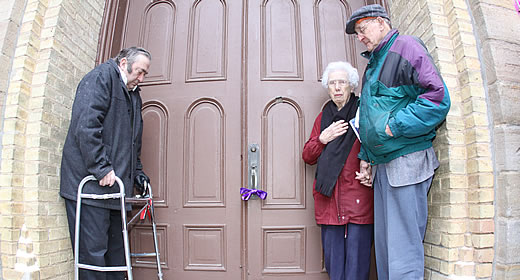
From left, Gilbert Schoenbauer and Adeline and Bernard Sobczak react moments after Adeline tied a purple ribbon on the doors of St. Benedict Church Jan. 16, which marked the closing of the church building in Scott County. Photo by Dave Hrbacek / The Catholic Spirit

Bernard, 86, and Adeline, 88, Sobczak can look out the window of their home near New Prague and see the church of St. Benedict across the street. For more than four decades, they have walked out their front door and about 100 yards to the church doors for Sunday Mass. Jan. 16, they did it for the last time.

In the predawn darkness, they made their way through snow and cold for the final Mass at the church, which closed its doors shortly after the 7:30 a.m. liturgy ended. In fact, it was Adeline who tied a small purple ribbon on the doors, which made the closing official.

With a small crowd gathered around to watch, Adeline was joined by Bernard, a parish trustee along with Gilbert Schoen­bauer, 73.

The mood was almost festive as parishioners en­gag­ed in lively conversation as they filed out of the church and gathered on the sidewalk.

Then, a hush fell over the crowd as Adeline pulled out the ribbon and slowly tied it to the door handles.

Afterward, she and the two trus­tees turned to face the crowd. There was a moment of awkward silence, then all three began to weep.

“Very sad,” said Schoenbauer, whose wife, Shirley, was the church organist. “I didn’t want to see it happen. But what can you do?

We’ve got to keep up with the times. We don’t have enough priests.

“It’s like you lost something. I don’t cry very often. I cried when my mom died, I cried when my dad died, and I cried today.”

Part of the plan

It was an exhausting weekend for Father David Barrett, who celebrated the final Mass and “taking leave ritual” at St. Thomas in St. Thomas at 5 p.m. Jan. 15.

Both St. Thomas and St. Benedict were to be part of the merger with St. Wen­ceslaus in New Prague, St. John the Evangelist in Union Hill, St. Scho­las­tica in Heidelberg and St. Joseph in Lexington as part of the archdiocesan strategic plan, an­noun­ced the weekend of Oct. 15-16. St. Thomas appealed and was allow­ed to merge with St. Anne in LeSueur because of the proximity to that church.

Diane Weckman and Jack Stasney, who served on the transition committee, talked about plans for St. Benedict.

During the week after the Mass, St. Benedict’s Stations of the Cross were to be installed at St. John, where they will be dedicated during the Jan. 23 Mass, and St. John will welcome St. Benedict parishioners with coffee and rolls.

The following week, the statue of St. Benedict is to be moved to St. Scholastica and that parish will host a dedication with coffee and rolls on Jan. 30.

“We should all be fat,” Weckman joked.

Stasney said that people will be OK with going to another building for Mass, but it’s the “fabric part of the community” that will be lost.

“Change is inevitable in our lives,” Stasney said. “Some people are having a hard time with it and they need their own time to go through a healing process and move on — and that is how it is with human beings.”

St. Benedict parishioners are still working on an itinerary of items that have been donated to the church in memory of a loved one.

Although those items can’t be given back to the donors, Weckman said they would make room for them in other churches, where they will continue to be used.

“All our cassocks are going to St. Scholastica because theirs are in need of replacement and ours are in good shape,” she said. And she plans to contact the Mankato Catholic community, which is building a new church, to see if St. Benedict has anything that could fill their needs.

“Father Elgar [Bockenfeld, OFM], for years, had been preparing us,” she said. “When he was alive, he said, ‘It’s coming, so just buck up and accept it.’”

Stasney noted that Father Bock­enfeld had run three of the rural parishes as a cluster, sharing programs and sacraments over the past four years.

“We were already merging things, so some of the stuff is not going to be brand new,” he said.

Weckman added that she appreciates all the work done by Deacon Bob Wagner, Father Barrett and Father Kevin Clinton, St. Wen­ces­laus’ pastor.

“They’ve been a lifesaver for me.”

Personally, Weckman is sad about not seeing the people at St. Benedict every Sunday, as each family chooses a church to meet their needs.

“I will have to get out there and make a phone call and stop in,” she said. “It’s our church family. I don’t see them all the time, but if I needed them, I know they’d be there.”

Weckman said there are positive aspects in the final collaboration be­tween St. Wenceslaus and the other parishes involved in the merger.

“St. Wenceslaus has so much to offer with adult studies,” she said. Although St. Benedict and St. John had a thriving religious education program with 125 children in­volv­ed, there was no Sunday school, Bible study or options for post CCD kids and that has her excited about the changes.

“It opens up more opportunities for us to grow in our faith,” she said.


Other mergers

Two additional mergers set forth in the archdiocesan strategic plan be­came official with the end of 2010 and beginning of 2011.

St. Francis de Sales and St. James in St. Paul officially merged Dec. 31, said Greg Vasterling, parish business administrator.

“Legally, yes, it’s done. But it’s business as usual to a certain extent, until we review all the different pieces of our campus and what that might mean,” he said.

The two parishes have been collaborating over the last four years, sharing a pastor, school, finance council, parish council and more.

“Under the archdiocese format, the next thing that happens is that a leadership committee is formed to review the campuses,” Vasterling said.

The first thing the parish will need to address is the urgent review of the school, he said. For now, Mass times will continue as they have been at both churches, he added.

Also merged as of Dec. 31 are: St. Andrew with Maternity of the Blessed Virgin in St. Paul. Catholic Spirit


Posted by Unknown at 7:11 PM No comments:
Labels: Archdiocesan Plan, Mergers-Clusters, St. Paul-Minneapolis Interest

National Catholic Register Acquired by EWTN from the Legionaries of Christ; no cash exchanged

.
.

The world’s largest Catholic media network is the fourth owner of the 83-year-old newspaper.

Share
by TIM DRAKE 01/19/2011 Comments (34)

BIRMINGHAM, Ala. — Eighty-three years after its debut in Denver, and 15 years after its purchase by the Legionaries of Christ, the National Catholic Register is being acquired by the world’s largest religious media network, the Eternal Word Television Network (EWTN). The acquisition, finalized at the end of January, marks the third time in the newspaper’s history that a new owner has stepped forward to preserve and expand the newspaper’s service to the Church.

Under the terms of the transaction, no cash will be exchanged between the parties. EWTN will take over the ongoing operational expenses of the Register and will assume the paper’s future subscription liabilities.

“I am very pleased and excited that the Register will now be a part of the EWTN family,” said Michael Warsaw, the network’s president and chief executive officer. “All of us at EWTN have great respect for the Register and the role it has played throughout its history. It’s a tremendous legacy that deserves to not only be preserved, but also to grow and to flourish. I believe that EWTN will be able to provide the stability that the Register needs at this time as well as to give it a platform for its growth in the years ahead. We’re proud to be able to step in and carry on both the Register’s name and its tradition of faithful Catholic reporting on the issues of the day.”

The need for the providential intervention by EWTN was precipitated by what Legionary Father Owen Kearns, the Register’s publisher and editor in chief, described as a “perfect storm.” That storm, not dissimilar to what has hit most print publications, was intensified by rising publishing and mailing costs, and the negative impact on Register donations from the downturn in the economy, all of which overwhelmed the Legion’s ability to continue to subsidize the costs of producing the newspaper and managing its website.

As of Feb. 1, EWTN will take full control and ownership of the Register.

Recent management changes at the Register had resulted in cost reductions exceeding $1 million annually. Senior Register staff said that this, coupled with continued donor support, a new marketing and advertising team, and additional changes have resulted in a recovery that promises to be timely and beneficial to the change in ownership.

Due in part to the fallout from revelations regarding the congregation’s founder, the Legion of Christ did not have the resources to bring the previous turnaround efforts to fruition, said the Register spokesman.

EWTN and the Register began exploring the possibility of an acquisition in November. A meeting, which was held in early December, was described by the spokesman as “open and enthusiastic.” Details of the transfer were worked out after that.

The acquisition of the Register is the latest in EWTN’s efforts to expand their operation in the global Catholic digital and multimedia market. At the start of 2010, the Irondale, Ala.-based organization entered into a partnership with Catholic News Agency (CNA). CNA is a Denver-based independent Catholic news media outlet with bureaus in North and South America and Europe. Under that agreement, EWTN and CNA are sharing news resources and have created a joint news service found at EWTNNews.com. That arrangement was recently expanded to include a new original Spanish-language news service, EWTN Noticias, launched in January 2011.

EWTN Global Catholic Network provides multimedia services to more than 140 countries and territories. The network transmits nine separate television channels in several languages to audiences around the world. It also operates multiple radio services including a network of hundreds of AM and FM stations, a Sirius satellite radio channel, and a global shortwave radio service. EWTN’s main website draws more than 20 million unique visitors annually.

Register’s History

EWTN will become the Register’s fourth owner. The National Catholic Register grew out of the Archdiocese of Denver’s Register, which began in 1924 and whose first national edition appeared on Nov. 8, 1927. Under the leadership of Msgr. Matthew Smith, the Register System of Newspapers was developed, eventually producing 35 diocesan editions, reaching its highpoint in the 1950s with a combined national and diocesan circulation of more than 700,000.

In 1970, California businessman Patrick Frawley purchased the declining newspaper and later moved it to Los Angeles. Its emphasis shifted to in-depth commentary on religion and culture. Throughout the 1970s and 1980s it attracted young, promising writers such as George Weigel, who went on to author Pope John Paul II’s biography, William McGurn, who went on to The Wall Street Journal, Robert Moynihan, who publishes Inside the Vatican, Phil Lawler, director of Catholic Culture, and Greg Erlandson, publisher of Our Sunday Visitor.

In 1995, a group of investors, along with the Legionaries of Christ, saved the newspaper from imminent closure and moved it to Connecticut, where it remained until late last year.

“When the Legion took it over, they did things with resources and personnel that we couldn’t do,” said Fran Maier, the Register’s editor between 1979 and 1993, and now chancellor of the Archdiocese of Denver. “During its affiliation with the Legion, it played an important role in Catholic journalism.”

Under the Legion’s direction, the paper restored the emphasis on the news, made the print edition more colorful and greatly expanded it, adding numerous features such as the Vatican page and the family-friendly Culture of Life section.

When rising costs forced a reduction in frequency from weekly to biweekly, the Register expanded its Web presence with NCRegister.com, with daily breaking news, exclusive online content and free commentary by popular Catholic bloggers. In November, in a further effort to cut costs, the editorial offices were relocated from Connecticut to the Legionaries’ Center for Higher Studies in Thornwood, N.Y.

“The Register is a perfect addition to our teaching apostolate,” noted Warsaw. “We live in an age where there is so much distortion and misrepresentation of the Church’s teaching by forces who oppose her message, particularly in the secular news media. Being sure that the Church’s voice is heard clearly and accurately has always been the core of EWTN’s mission,” he said. “Continuing the tradition of the Register gives us another means to carry out our mission of service to the Church.”

“The service and the history of the paper are too important to simply abandon,” said Archbishop Charles Chaput of Denver, where the newspaper originated. “The Church needs more tools of faithful communication, not fewer.”

Archbishop Chaput said that he doesn’t feel that the Register’s basic mission of “reporting the news and analyzing trends that are important for Catholics, from a Catholic perspective,” will change. “The means of accomplishing that mission may change quite a lot over time, but the Register’s fidelity to the Church will not.”

Father Kearns described the acquisition by EWTN as “a natural and a happy fit.” “EWTN has earned a reputation of fidelity to the magisterium, which has always characterized the Register,” he said. “This represents a continuity of fidelity to the Church and support of the bishops. The Register’s mission is to equip its readers to engage the secular culture with competence and confidence, and EWTN intends to continue, strengthen and develop that mission.” National Catholic Register

Posted by Unknown at 6:52 PM No comments:
Labels: Catholicism is working, Clerical and Religious Interest, Education

Before W-K school there was Kosciusko (01/19/2011)

.
By Frances Edstrom

Submitted photo
Kosciusko school


February will be a big month at Washington-Koscuisko elementary school, affectionately called W-K. On February 4, the school will celebrate the birthday of Thaddeus Kosciusko, one of the men after whom the school is named. And then at the end of the month comes Presidents’ Day, when we honor George Washington, the other man the school’s name reflects, and whose birthday is February 22. Both men are heroes of the Revolutionary War.

When W-K was built on Mankato Ave. and opened in 1935, it replaced three schools — Washington, Kosciusko, and Sugar Loaf. Sugar Loaf started as a country school, and didn’t become part of the Winona school system until 1891. Washington was built as the fledgling town was growing, and by 1888 the schools were so crowded that night classes were being held, and the age of starting school was raised from 5 to 6. Even in 1937, there were more than 100 country schools open in Winona County.

The Fourth Ward schools became more and more crowded, so in 1889, the Polish Stock Company Hall was converted to a school. By 1891, that school was called the Mankato Ave. School, unlike the others in town not a U.S. president’s name, reflecting the school board’s hope that it would be a temporary building. (Jefferson, Madison and also a Jackson School were on the West End.)

After a lot of wrangling, in 1892 the school board knew they couldn’t accommodate the growing population in their present schools, so voted to build an East End school at Sanborn and California streets. (That is according to the 1913 History of Winona County, but that was either a misprint, or the name of the street was changed later to Chatfield.) The school cost $25,000 to build, including the lot, and was dedicated in 1894, after the city was redistricted.

It was about that time that the school board installed a telephone in each school. Perhaps the wires were burning up with talk of the argument over what the name of the new East End school should be. Finally, with Benard Stoltman and Joseph Winczewski as Fourth Ward representatives on the board, Kosciusko was chosen over Columbia.

The school population continued to grow, and the school board continued to talk about building more schools or adding on to existing schools. But some warned that when the Catholic parishes built their own elementary schools, as they were talking of doing, there wouldn’t be a need for a Kosciusko school if St. Stanislaus parish built a school. In fact, when the parishes did open their own schools around 1913, the public school population fell by 1,000 students.

Thaddeus Kosciusko

Kosciusko (pronounced Kos-chew-skoe, according to Paul Libera, quoted in a newspaper article in 1973) was born son of a nobleman in 1746 in Poland, where he attended at the King’s Corps of Cadets, with military studies as well as the liberal arts. He then studied for five years in Paris. When he returned home, there was no post for him in the greatly reduced Polish army, as the country had been divided up by the Russians, Prussians and Austrians. He left Poland in 1775, and in Paris heard about the American Revolution. He came to America, served as a volunteer in the new army, and in 1776 was named a Colonel of Engineers in the Continental Army. He went to work building forts to protect the army from the British. It was Kosciusko who designed West Point, at the behest of George Washington (Benedict Arnold tried to give the plans to the British). He then traveled south to join forces there, and for the first time encountered chattel slavery, which he grew to abhor (he gave his army salary to Thomas Jefferson, and instructed him to buy slaves with the money, free them and educate them. He freed his own serfs in Poland before his death.)

After seven years of distinguished service to the American Revolution, Kosciusko was promoted by Congress to the rank of brigadier general. He also received American citizenship. He returned to Poland to fight against the Russians, who had invaded. But the Polish army was woefully out manned, and Kosciusko surrendered to the Russians. He then fled Poland, and joined a group planning the ouster of Russia from Poland. But the cause failed, and Kosciusko was captured by the Russians and imprisoned. It wasn’t until 1796 that Kosciusko was freed. He declined to fight with the Napoleon-allied Polish Army, and rebuffed overtures from the Russians to build a Kingdom of Poland, a small and ineffectual plan that Kosciusko called a joke. He died in Switzerland in 1817 of typhoid. He is a national hero in Poland, Lithuania, Belarus and the United States. Winona Post

Posted by Unknown at 6:06 PM No comments:
Labels: Education, Winona

Tuesday, January 11, 2011

Vianney News, Fall 2010, St. John Vianney College Seminary

.
Men in Christ.
Men of the Church.
Men for Others.

Are you willing to invest in the young men
who are the future of the church?

The Seminarians of Saint John Vianney ask for your prayers and support. Please pray for them.

Read their stories and consider a gift to the seminary to help secure the future with new, vibrant young priests.


Rector's Update

Vistas of Hope and Opportunity

As Rector of Saint John Vianney College Seminary, I feel it one of my joyful duties to open up vistas of hope and opportunity for our young seminarians. Many come here with no habit of daily prayer, and only a vague sense that God might be calling them to the priesthood. The first vista which opens up to them is a marvelous experience of our personal God, Who is real, beautiful, beyond description and beckoning. This occurs through the avenue of our daily Holy
Hour (6:15 a.m.) and Mass (7:15 a.m.). When these young men catch a first sight of God, for them it is something awe inspiring, like a first view of the ocean, or majestic mountains, yet supernaturally far surpassing. The experience gives them
tremendous conviction about what is true, good, real. It is the commencement of a spiritual adventure. It is a vista of hope and opportunity.

In today’s culture there are many souls who live in bondage to their passionate nature. Pope Benedict says, “We are moving toward a dictatorship of relativism which does not recognize anything as definitive and has as its highest value one’s
own ego and one’s own desires.” Sadly a number of seminarians come to SJV each year with wounds of pornography, grief of families torn in two, addiction to technology (with its violent games and impersonal operation). We offer these seminarians a true remedy: the grace of God and the power of the Holy Spirit, which are given through the Sacraments, the proclamation of the Gospel, retreats, spiritual direction, study of philosophy and theology, and fraternal groups. Our seminarians are rapidly convinced of the supreme endeavor, “Be perfect, therefore, as your heavenly Father is perfect” (Matthew 5:48). Thereafter, the real work begins, and they must enter the pathway of sanctification, an arduous and at times painful transformation. In time, by God’s grace, they come to know the liberty and joy of self-possession, the purity of our Mother Mary, the justice of St. Joseph, the wisdom of St. Thomas Aquinas, the faith of St. Abraham. This is the life of infused virtue, a vista of hope and opportunity.

Once or twice a week throughout the year, we invite 3rd and 4th year seminarians to publicly share either their vocation testimony or a ‘priest-hero’ story. In the life of the seminary, this is one of our most edifying moments. Our hearts are set
ablaze, like holy priests of old, who possessed zeal for souls, courage to proclaim the Gospel in season and out, love for Mother Church, and a yearning for the heights of mystical union with the Divine. Every vocation is a leap of faith. Jesus
said, “If you have faith the size of a mustard seed, you will say to this mountain, ‘Move from here to there,’ and it will move” (Matthew 17:20). As Rector, I would rather have faith the size of a mountain, to see possibilities hidden within a mustard seed . . . which is sometimes the seed of a priestly vocation. For those called, the priesthood becomes a vista of hope and
opportunity.

Experience of the indwelling Trinity, the life of infused virtue, a call to the priesthood . . . these are vistas of hope and opportunity found at Saint John Vianney College Seminary.

Fr. Michael Becker
Rector

Apostolic Outreach at Saint John Vianney College Seminary

Saint John Vianney College Seminarians participate in an Apostolic Outreach program each year they are in the seminary. Over the course of four years, each will provide service to parishes and social service agencies throughout the Archdiocese of Saint Paul and Minneapolis. The Seminarians teach religious education, lead confirmation groups, tutor underprivileged children, and offer a ministry of presence to children who have emotional issues. They also minister to the elderly by socializing, reading aloud and sharing meals, as well as work with adults possessing
mental and cognitive disabilities.

Fr. Baer’s Farewell

On May 12, 2010 friends and benefactors of Saint John Vianney College Seminary gathered to bid farewell to Fr. William Baer. After eleven years as Rector of Saint John Vianney, Fr. Baer has returned to parish life at Transfiguration in Oakdale, MN.

Fr. Baer leaves quite a legacy at Saint John Vianney. In his years as Rector, Fr. Baer instituted the Seminarians’ pledge and prayer – “Men in Christ. Men of the Church. Men for Others”. A total of 475 seminarians took the pledge and studied at Saint John Vianney under his guidance. Enrollment more than doubled
during his tenure as Rector.

Fr. Baer will also be remembered for starting the “Last Chance Mass” at the University of St. Thomas, a Sunday evening tradition, where over 300 students and neighbors attend Mass in the Saint John Vianney Chapel.

Fr. Baer’s final gift to the seminary is a lasting one – a scholarship fund which was created in his honor to provide financial assistance to transfer students who join the seminary. Transfer students make up a third of each class of New Men, and traditional scholarship assistance for transfer students is very limited. An envelope is enclosed if you would like to donate to the scholarship fund, or make an unrestricted gift to the seminary.


You can read the entire Vianney News newsletter, with photos of Father Becker, Fr. Baer and the seminarians, HERE.


Posted by Unknown at 7:40 AM No comments:
Labels: Clerical and Religious Interest, Religious Formation, St. Paul-Minneapolis Interest

Monday, January 10, 2011

Top 10 enemies the pro-abortion Left fears

.

Now that conservatives are gaining some power in Washington, the battle over abortion is being reignited. Pro-lifers could do very little to stop the pro-choice forces while so-called liberals controlled nearly every level of government. But times have changed. And that means those who fight for the unborn are even more dangerous to the pro-abortion Left. Here are a list of their top ten enemies.

It is important to note that this list is meant to be for today and not all time. It is a look at the current top ten enemies of the pro-abortion Left. There are other huge leaders in the history of the pro-life movement that won’t be found here. (For a list of 30 leaders in the first 30 years of pro-life movement go here.) Our list is a revelation of those most likely found right now on the dart boards of groups like Planned Parenthood and NARAL.

Depending on your familiarity with the pro-lifers, the names may be enlightening. One thing that might surprise you about this top ten is that there are only three men included. Usually when the Pro-Abortion left argues their case to the American people, they present the battle as men versus women. The spin is that evil men are keeping women from their reproductive rights. But in reality the top enemies of the pro-choice groups are primarily women. And that is because, with some exceptions, women are the key leaders of the pro-life movement.

And now the top ten enemies the pro-abortion Left fears:


10. Jill Stanek

Jill Stanek is a leader in the pro-life movement today and a very popular speaker. However, she used to be a nurse at Christ Hospital in the Chicago suburb of Oak Lawn. In 1999 Stanek realized her hospital was not only involved in abortion, but they were leaving babies that survived induced labor abortion in a utility room to die. In other words, these weren’t just abortions, the hospital was involved with infanticide.

Stanek first unsuccessfully worked to get things changed from the inside as a nurse, but eventually had to quit and try to use the courts and legislation. She helped get some laws in Illinois changed and later, President Bush would sign the Born-Alive Infants Protection Act into law. At the signing Bush publicly recognized Stanek for her contribution.

Stanek gained even more notoriety in 2008 as a leading pro-life voice against Barack Obama’s run for President. Stanek went public to reveal that Obama had voted against an Illinois Born-Alive act multiple times. Obama had basically supported infanticide and Stanek wasn’t going to let that go unnoticed. Of course this made her a top enemy of the Left.

Besides being a popular speaker, Jill now writes for World Net Daily and has her own blog which is the top ranking pro-life blog in the United States. She has become the internet voice of the pro-life movement. The Left recognized that on June 4, 2009 when Keith Olbermann named her the worst person in the world that day and called her readers “crazy people”. He even said that if this were “a just world” then Stanek would “be put in jail for the rest of (her) life”. . . .

For being the leading voice for Life on the internet, and central in some political battles, Jill Stanek finds herself as the tenth biggest enemy of the pro-abortion Left.


9. Father Frank Pavone

The role of the Roman Catholic Church in the battle over abortion cannot be overstated. The RCC was the first and remains the strongest advocate and defender of the unborn. Long before there was even such a thing as a social conservative, Catholics were speaking up for innocence in the womb. While there are countless liberal Catholics who are pro-choice (especially in politics), the Church itself remains staunchly pro-life. And in America, the Priest who leads the anti-abortion charge is Father Frank Pavone.

Frank Pavone is the national director of Priests for Life. Priests for Life exists to inform the clergy and the people of the RCC how to fight the culture of death. The organization speaks out strongly against both abortion and euthanasia. Priests for Life supplies literature for activism and is also known for providing pictures of aborted babies as a way to show just how horrid the practice of abortion is. They believe strongly that “America will not reject abortion until America sees abortion.”

Father Pavone was a major player in the Terry Schiavo case. He is also a member of Dr. James Dobson’s Focus on the Family Institute which is one of the leading Protestant organizations against abortion. Father Pavone’s influence stretches wide. Even Norma McCorvey, “Jane Roe”, called Fr. Frank “the catalyst that brought me into the Catholic Church.”

Pavone believes strongly in Priests standing for life and not being afraid of politics. He vehemently attempts to convince Catholics to stop voting for pro-choice candidates. Also, if he can get Priests to be bold in promoting a culture of life then possibly the number of pro-choice Catholics will begin to decrease and that could really damage the pro-abortion Left.

The Catholic Church is the biggest fighter against abortion, Father Pavone is a leader on that issue, and therefore he will continue to be a top enemy of the pro-abortion Left.


8. Jay Sekulow


Jay Sekulow is one of the top dogs in the Christian Right. And Sekulow is, without a doubt, the head lawyer of the Christian Right. While Sekulow battles many issues that are related to Christianity and religious freedom, he has long been a major player on the issue of abortion. Considering the Christian Right is probably the most hated group to the Left, it shouldn’t surprise anyone that Sekulow made this list.

Sekulow is an attorney but also a media figure for the right, hosting his own radio and television programs. He is both a frequent guest on many news programs and a major player in Supreme Court battles. Some of those court cases were vital battle grounds in the fight over the womb. And Sekulow is now the Chief Counsel for the American Center for Law and Justice (ACLJ). The ACLJ was founded by Pat Robertson to be the Christian Right’s answer to the ACLU.

The pro-abortion Left has a lot of reasons to both hate and fear Jay Sekulow. Not only is he a smart legal mind that often beats them in court. Not only does he represent so much of what the Left despises. But Sekulow is a friend to Justice Antoni Scalia, and Sekulow is rumored to have been a key figure in getting Chief Justice John Roberts into the Supreme Court. . . .

The Left knows it faces more future losses in the abortions wars. And many of those losses will be connected to Jay Sekulow.


7. John Boehner

There are a lot of pro-life politicians that the pro-abortion organizations hate. But politicians are largely ineffective in pushing pro-life legislation (and sometimes they stab life advocates in the back i.e. Bart Stupak). So no politicians made the top ten list except John Boehner. Why?

Boehner is especially feared by the Left because of his new found power as Speaker of the House. Boehner is now third in power in all of American government. He is Republican, conservative, passionate, and pro-life. And to make matters worse for the abortionists, Boehner had declared the abortion industry is one of his targets.

Boehner recenently told Charmaine Yoest of Americans United for Life that he is determined to be the most “pro-life speaker in history”. This has the abortion industry so upset they are spending big money to go against him. NARAL just announced a new campaign to stop Boehner and his pro-life agenda.

Nancy Keenan, president of NARAL, said that Boehner is set to the launch the “fiercest attacks” on abortion “in decades.”

“Americans did not give Boehner and his cronies a mandate to interfere in our personal, private decisions. We will turn the Boehner Bait and Switch into the Boehner Backlash, as the new speaker learns that his anti-choice agenda is out of step with our country’s values and priorities.” – Keenan

One of the top priorities of the Pro-Abortion Left is to stop Boehner from pushing pro-life legislation. They even created a website to gain support against him. It promotes taking an oath against Boehner’s agenda.

Boehner is clearly a primary target of the Pro-Abortion Left. They understand the laws of the land are going to be greatly shaped by what the Speaker pushes the next couple of years.


6. Dr. Charmaine Yoest

Dr. Charmaine Yoest is President and CEO of Americans United for Life (AUL). The AUL is the first national pro-life organization in America. They are mostly a team of legal strategists who have been involved with every case on abortion that has gone before the Supreme Court since Roe v. Wade. Their focus is helping the pro-life cause in court rooms, helping politicians with legislation, and educating the public. Their work is vital to the abortion battle in courts, congress, and living rooms. That makes them a top enemy of pro-Abortion group and that makes their leader, Charmaine Yoest, a top ten target.

The AUL is the right hand man for any pro-life politician. They provide them models of legislation and educate them on the issues. The are the brains behind the work of those in politics who want to protect the unborn. The AUL is also typically the #1 resource for those doing battle in the courts over abortion. And the AUL is often sought out by the press as a voice to represent the pro-life side of hot debates, and Yoest is the face of the organization.

Dr. Yoest worked in the Regan administration, worked in Universities, was VP of the Family Research Council, and was a major adviser to Mike Huckabee in his 2008 bid for President. She has spoken before congress and on countless news shows. AUL is the legal arm of the pro-life movement and Yoest is their leader and spokesman. This fact was seen clearly during the debate over both Kagan and Sotomayer as new Supreme Court justices. . . .

To put it simply, any time abortion groups are in a battle, if you look across the table at their opposition you will usually see Charmaine Yoest and AUL.


5. Marjorie Dannenfelsor

Last November the American people elected 72 new pro-life members of the House, new pro-life senators, and gave Boehner the largest pro-life majority in the House since Roe v. Wade. One of the groups who should get a lot of credit for those results is the Susan B. Anthony List. And their President and Chairman of the Board is Marjorie Dannenfelser.

Dannenfelser helped start the SBA-List as a way of getting pro-life leaders, especially women, into office. Dannenfelser got frustrated in the early 90s watching so many of the women going into politics being pro-choice. She made it her goal to change that situation. Now when you look at conservatives in politics, the most exciting names are usually women.

Under Dannenfelser’s leadership, the SBA-List has spent millions promoting pro-life candidates. Since 1996 they have outspent the pro-choice National Organization for Women in every election. The organization’s success rate has had its best results the last couple of years. When you think of names like Sarah Palin, Michelle Bachmann, and Nikki Hailey; realize that SBA-List played a big role in their success. Politico even reported that Sarah Palin will only endorse candidates who support the Tea Party and have the support of the SBA-List.

The Left has attempted to silence Marjorie Dannenfelser on many occasions. She and her group have become the most effective organization in getting passionately pro-life people into office. In the political battle for abortion, Dannenfelser is extremely dangerous to the pro-choice power hold in Washington.


4. Lila Rose

For years Planned Parenthood has been presented as a positive and helpful place for women to go for reproductive health issues. The organization has been able to get government money and receives funding from regional offices of beloved groups like United Way and Susan G. Komen. However, pro-lifers have long believed the organization to be harmful to women, unethical, and maybe even involved in illegal activity. Yet it was hard to prove Planned Parenthood was shady until Lila Rose showed up.

Lila Rose is head of the pro-life activist group Live Action. Rose has gained notoriety in the abortion battle over the last year by releasing sting videos on their YouTube page. The young looking 20 year old was able to easily pass herself off at Planned Parenthoods in multiple states as a pregnant thirteen to fifteen year old. Rose would use hidden video cameras that often revealed counselors trying to help Rose cover up statutory rape and break parental consent laws.

Live Action’s videos have garnered Rose and her cause a lot of media attention. She is a master of utilizing new media and will most likely remain a major player in the abortion battle for years to come.

Rose’s work has been damning and damaging to Planned Parenthood. The organization has had to fire long time employees and defend itself against ongoing investigations in multiple states. Rose is not simply a pebble in the show of America’s largest abortion provider. She may just bring them down.


3. Crisis Pregnancy Centers

The number 3 enemy of the pro-abortion Left differs in that can’t be represented by a single person. In fact, it can’t even be represented by one single organization. Crisis Pregnancy Centers are pregnancy resource centers all over the world. They are run by many different groups, but the major ones are Care Net, Heartbeat International, National Institute of Family and Life Advocates (NIFLA), and Birthright International.

CPCs are typically run by pro-life Christian volunteers. Their goal is to give free care to women with crisis or unplanned pregnancies and provide them alternatives to abortion. The centers often offer counseling, literature, free ultrasounds, adoption information, and many of them will help young mothers and dads with education and supplies for caring for their new babies. Some CPCs even offer counseling for women who have had abortions and are struggling with and regretting their decision.

Why does the pro-abortion Left hate a group that is actually helping women? The simple answer is money. Abortion is a lucrative industry. Clinics like Planned Parenthood make millions and millions of dollars convincing women to let them abort their babies. CPCs take a lot of that business away by showing women how they can have their babies and get help. There are over 4,000 CPCs in the United States but only around 750 abortion clinics. The abortion mills will do whatever they can to turn those numbers around.

A lot of money has been spent by groups like Planned Parenthood and NARAL to try to shut down or silence CPCs. Leftist politicians in New York, California, Texas, Maryland, New Jersey and other states are constantly trying to pass laws censoring Crisis Pregnancy Centers. Many politicians receive campaign funds from abortion groups and then are encouraged to pursue ways to get rid of CPCs. One example can be seen here.

With all the money spent to attack CPCs, the organizations are clearly a major enemy of the pro-abortion Left.


2. Alveda King

It would be fair to consider Alveda King the number one enemy of pro-choicers. She is greatly feared for many reasons, most of them center around the fact that the woman is such a powerful symbol as the niece of Martin Luther King Jr.

The Left loves to portray the ‘anti-abortionists’ as white, angry, men. King can get angry at times I’m sure, but she destroys the image being pushed by the pro-abortion crowd. She is a strong black woman with a past that included having two abortions and being a staunch Democrat, even once holding office as a Congresswoman in Georgia’s 28th district from 1979 to 1981.

At some point in her life, King became a strong advocate for the unborn. She believes that it is babies in the womb who most need civil rights now. They deserve the right to life. And now King is one of the most well known pro-life advocates.

Alveda King makes the Left ring their hands in anger. They know she gives legitimacy to groups and people they despise. For example,the so-called liberals reacted with horror when King spoke at Glenn Beck’s “Restoring Honor” rally last August. (Read the Huffington Post’s angry blog on the topic.)

Another reason the Left fears Alveda King is because she points out how the abortion industry specifically seems to target and harm the black community. King has worked with Priests for Life to point out:

“Planned Parenthood is the largest abortion provider in America. 78% of their clinics are in minority communities. Blacks make up 12% of the population, but 35% of the abortions in America. Are we being targeted? Isn’t that genocide? We are the only minority in America that is on the decline in population. If the current trend continues, by 2038 the black vote will be insignificant.”

If Alveda King had remained a pro-choice Democrat she would be a hero and champion of the Left. But because of her work for the unborn, she remains a top enemy.


1. Abby Johnson

Many of those most hated by the abortion industry are despised because they are former members of the abortion industry. When people wake up to the horrors and dangers of abortion in America, they often become strong pro-life advocates and leaders. That makes them major targets of the Left. The last thing they want is people giving credibility to former pro-choice advocates.

In the past the pro-life movement has been blessed with many converts. Norma McCorvey, the original Roe in Roe v. Wade became an advocate for the unborn in 1995. Bernard Nathanson co-founded NARAL but completely changed his views around 1979. Today’s most feared convert to the abortion industry is also the number 1 overall enemy of the pro-abortion Left: Abby Johnson.

Lila Rose was featured on this list for revealing so much of the unethical and apparent illegal behavior of Planned Parenthood. But Abby Johnson is feared because she has revealed much about Planned Parenthood and will soon reveal much more, moreover she has the credentials to do it.

Johnson was a volunteer or employee for Planned Parenthood for eight years and even became the director of a clinic in Texas. On October 6, 2009 she suddenly quit her job. Why? In September of that year Johson was assisting in an ultrasound guided abortion on a 13 week old baby in the womb. It was the first time she ever saw an abortion take place from an ultrasound. She watched in horror as the little baby tried to avoid the probe inserted into the womb to destroy the baby. The unborn child died and Johnson fled the industry. She saw some people praying for life outside of the clinic and knew that is who she needed to turn to.

Almost immediately Planned Parenthood sought to put Johnson under a gag order to keep her from revealing damaging information. The full “restraining order of disclosure” only held until it was put before a judge in November of 2009 who recognized it as bogus. The next day Johnson was on Bill O’Reilly and has been a sought after speaker ever since. Her main argument is that Planned Parenthood has aggressively sought to promote abortions to raise profits, and she has been sharing her story to all who will listen.

On January 11th of this year, Johnson’s book revealing her Planned Parenthood experience will be released. The Left is quaking in fear and is hoping for dismal sales. And so at this very moment, Abby Johnson is the top enemy of the pro-abortion Left.

Hopefully all of these champions for life will continue to get the word out on the truths of abortion and the industry behind it. Even those who aren’t pro-life advocates should support the freedom of speech of these warriors for those without a voice. As the abortion battle heats up with this new congress, leaders like these need a chance to speak to the American people.

________________________________

Paul Cooper is a husband and father above all else. With a wife and 2 daughters he could use a dog, but sadly he only owns a cat – a female cat no less. Paul is also a pastor, blogger, and business owner. Find him on Twitter.

NewsReal Blog is the team blog of the David Horowitz Freedom Center.


Posted by Unknown at 6:51 PM No comments:
Labels: Abortion and Life Issues, Education

Sunday, January 9, 2011

The story behind a Communion host

.
American Sisters have come a long way from baking Communion dough with tongs over an open fire

Originally posted 1/22/10

When Mother Mary Anselma Felber assigned Sister Mary Agnes to bake the first altar bread for her fledgling Benedictine community, she began a 100-plus year tradition that would one day become her abbey’s major source of income.

Sister Mary Agnes cooked the hosts in small batches, the dough pressed inside a cast-iron mold and baked over an open fire. In those days, Sister made only enough for herself and the four others who had come to America in 1874 to found the Sisters of Perpetual Adoration in Clyde, Missouri.

Over the years, the method would change, and the community would grow. And in 1910, the Sisters began producing quantities of their altar bread to sell to parishes. Later this year, when the community — now 65 strong — welcomes guests and dignitaries, they will be celebrating the 100 years since their first host was sold.

The event at the monastery, located among rolling hills and fields of corn and soybeans, promises to be poignant and prayerful. Honored guests will include the bishop from Kansas City, Benedictine monks from a nearby abbey, various diocesan priests, former lay employees of the monastery, and neighbors. There will be refreshments and (mostly) joyful recollections. “There will also be laughter,” says Sister Rita.

“One thing we’ll do is look over our archived photos,” she said. “We’ll recall how the bread was baked 50 and 20 years ago and we’ll wonder, How did we do it?”

In the early days, the Sisters baked the dough at the end of tongs over an open fire, or cooked it between two heated iron molds, similar to a waffle iron. Today, the bread is baked using automated equipment that produces more than 2 million hosts a week.

Over the course of a century, the monastery has become the nation’s largest Religious producer of altar bread, serving parishes in the United States and Canada as well as Mexico, Haiti, Ireland, Russia, Japan, New Zealand, and Australia.

The Sisters have a high-tech baking operation in a turn-of-the-20th-century brick building surrounded by maples and oaks and located about 200 feet from the monastery proper. It’s a job that begins at 5 a.m., “when a gentleman comes in to mix the batter and start the oven,” says Sister Rita. Nearly 20 nuns and lay employees are involved.

As busy as the enterprise is, Sister Rita says the Sisters do not consider the work a business. “It is our way of life,” she says, mentioning that St. Benedict, founder of the Benedictine Order, taught that work, reverently and contemplatively done, can be a form of prayer.

St. Benedict’s Rule aside, making altar bread seems to invite special care, if not veneration, no matter where it’s done.

A century ago, before mass transportation and ordering over the Internet, altar bread was made locally, usually by the nuns of the parish or sometimes the laywomen from the church altar society. Making hosts this way was a time-honored tradition, but the tradition began breaking down in the years after World War II, as many convents and monasteries found they couldn’t keep up with the demand. While 60 years ago there were hundreds of Communion host makers in the country, today just a handful remain. Best guess from existing producers: two or three dozen.

The nation’s biggest producer is the Cavanagh Company of Smithfield, Rhode Island. Located in the rural northwestern part of the Ocean State in the area of pick-your-own apple orchards, the company, with 35 employees who work round-the-clock shifts, pumps out 25 million hosts a week. The family-run business estimates it serves 80 percent of the U.S. and Canadian market. It sells its hosts to religious supply centers, convents, and monasteries, which in turn resell them to local parishes for profit.

According to company literature, the Cavanagh Company got its start in 1943, when a Jesuit priest approached John Cavanagh, an inventor, and his son John Jr., and mentioned problems some of the parish nuns of Rhode Island were having with their antiquated bread-making equipment. The Cavanaghs helped with repairs, and three years later John Jr. and his brother Paul started manufacturing and selling new and improved host-making equipment.

But even with the larger baking sheets John Sr. designed, parish nuns were unable to keep up with the demand, which only increased as World War II servicemen began returning home and starting families. The Cavanaghs petitioned the local bishop for permission to begin baking their own bread, and by the early 1950s they were operating from a new 10,000-square-foot plant.

Packaging low-gluten altar breads

Some monasteries that buy Cavanagh altar bread also make their own. The Passionist Nuns in Ellisville, Missouri, make their bread once or twice a week with only a two-Sister work team. “We’re talking small operation here,” says Sister Veronica. The Sisters say they are too busy to take on new orders.

As do all the Sisters who make altar bread, the Passionists consider their work a form of devotion. Sister Veronica says she experiences joy and enthusiasm when she realizes “that when someone consumes each Host, he will be blessed by taking Jesus into himself.” She says when she cuts the altar bread by hand, she sometimes wonders who might receive a particular host, and then says a prayer for that person.

Whether made in Missouri or Rhode Island, altar bread must be produced in accordance with Church specifications: The bread for celebrating the Eucharist must be made only from wheat, must be recently baked, and, according to the ancient tradition of the Latin Church, must be unleavened.

The Church establishes a standard for making Communion bread but will allow exceptions. After Vatican II in the mid-1960s, for example, the Church allowed use of a darker, thicker host with a more familiar bread-like taste and texture. Prior to Vatican II hosts were pure white and thinner.

A few years back, the Sisters in Clyde sought and received permission from the U.S. Conference of Catholic of Bishops to make a host extremely low in gluten. The wheat protein, when consumed, exacerbates celiac disease, a condition affecting the small intestine (see related story on page 94). The ailment had kept many sufferers from receiving the Eucharist. The Sisters report that since they began making the hosts about five years ago, more than 4,500 people with the disease have been receiving them at Communion.

Some parishes make their own Communion hosts, an endeavor that harks back to the days when altar bread was made locally by the Sisters and women of a parish. For the past 15 years, a group of women (and now one man) at St. Timothy Church in Norwood, Massachusetts, have been baking hosts in their home kitchens, says Colleen Campion, the church’s director of liturgy. The quarter-inch thick, brownish host is offered at two of four Masses on Sundays. Campion says the bakers occasionally hear complaints — and compliments — about the bread, and that the bakers meet to discuss how to tweak procedures when warranted.

“This bread appears real and tangible, so it gives a richer sense of what the Last Supper celebration was like for Jesus,” says Campion.

“This is a wonderful ministry,” she adds, saying the baking is a welcome option for a church volunteer “who might not feel comfortable in front of (a crowd of) people but who does feel comfortable in a kitchen.” Catholic Digest

How the communion wafer arrived in the capitalist marketplace.
2011
Posted by Unknown at 2:09 PM No comments:
Labels: Clerical and Religious Interest

Saturday, January 8, 2011

Haven't made a New Years Resolution yet? It's time to learn your faith better

.
Posted by Unknown at 7:43 PM No comments:
Labels: Education, Video

Thursday, January 6, 2011

Bishop Salvatore Cordileone of Oakland has been appointed chairman of the USCCB's Ad Hoc Committee for the Defense of Marriage.

.

Bishop Cordileone: Perfect Man for the Job


His Excellency was quoted in CNA:

'Marriage and the family are the essential coordinates for society. How well we as a society protect and promote marriage and the family is the measure of how well we stand for the inviolable dignity and good of every individual in our society, without exception'....

During his time as the Bishop of Oakland he has worked to preserve the traditional definition of marriage. His work has been high profile because of the adoption of Proposition 8—the successful ballot initiative that defined marriage as being between one man and one woman—and subsequent legal efforts to overturn it.

'The consequences for our future – especially that of our nation’s children – cannot be greater and must not be ignored.'”


What a great shepherd! Here is His Excellency in the "Marriage Matters to Kids" video:

Posted by Unknown at 8:19 PM No comments:
Labels: Marriage and Family, Video

Wednesday, January 5, 2011

.
Nineteen Sixty-four is a research blog for the Center for Applied Research in the Apostolate (CARA) at Georgetown University edited by Mark M. Gray. CARA is a non-profit research center that conducts social scientific studies about the Catholic Church. Founded in 1964, CARA has three major dimensions to its mission: to increase the Catholic Church's self understanding; to serve the applied research needs of Church decision-makers; and to advance scholarly research on religion, particularly Catholicism. Follow CARA on Twitter at: caracatholic.
2010 Review
Here are some statistical nuggets from this year in case you missed them:

  • The U.S. Catholic population continues to grow and is projected to exceed 100 million by 2050.
  • At the same time, the number of infant baptisms and marriages in the U.S. Catholic Church has declined in number each year since 2001. In 2009, there were 12.7 infant baptisms and 2.7 marriages in the Church per 1,000 Catholics. Although nearly all Catholic parents continue to baptize their children in the Church (as the birthrate declines) many Catholics are choosing to get married in non-Catholic houses of worship or secular settings.
  • Yet even as the recent trend in infant baptisms is down slightly, there are still enough people joining the Catholic Church each year to sustain the population. In 2009, The Official Catholic Directory reported 857,410 infant baptisms, 43,279 adult baptisms, and 75,724 receptions into full communion in U.S. dioceses. This totals 976,413 in one year. To put that in context, the number of new Catholics in 2009 would make this one-year cohort of new Catholics approximately the 26th largest membership Christian church in the United States.
  • The likelihood that a Catholic will marry a non-Catholic is strongly and directly related to the likelihood that a Catholic will be in close proximity to other Catholics. In dioceses where Catholics make up only 10% of the total population, the average percentage of interfaith marriages celebrated in parishes is 41%. By comparison, this average is only 16% where 40% or more of the total population in a diocese is Catholic.
  • On the institutional side, if the current trend in parish closures were to continue and current priest projections bear out, there will likely be only 12,520 active diocesan priests and 14,825 parishes in the United States by 2035 (also in OSV).
  • There has been no measurable decline or increase in Mass attendance percentages nationally in the last decade. Just under one in four Catholics attends Mass every week. About a third of Catholics attend in any given week and more than two-thirds attend Mass at Christmas, Easter, and on Ash Wednesday. More than four in ten self-identified adult Catholics attend Mass at least once a month.
  • A majority, 54%, of the adults of the Catholic Millennial Generation (those ages 18-28 in 2010) in the United States self-identify as Hispanic/Latino(a). In the late-2030s there will likely be more Catholics who self-identify as Hispanic/Latino overall than those who do not.
  • A minority of Americans of Irish ancestry self-identify their religion as Catholic. At the same time, the size of the Irish Catholic population has been stable in recent decades as Catholics of Italian, German, and Polish ancestry have declined a bit. The number of Catholics noting Mexican ancestry increased dramatically in the 2000s.
  • About 3.5 million U.S. residents self-identify their race as Black, African American, Afro-Caribbean, or African and their religion as Catholic. Of these Black Catholics, 42% also self-identified their ethnicity as Hispanic.
  • The number of Catholic senators declined from 25 to 22 (or is it 21?).
  • 57% of adult Catholics did not vote in the 2010 elections.
  • The average tuition for the first child of Catholic parents attending a parish Catholic primary school for 2008-2009 was $3,383. For that same child the per-pupil cost of education for 2008-2009 was $5,436. This means that only 63% of this child’s per-pupil cost was covered by their tuition.
  • In the 20 years since Ex Corde Ecclesia, Catholic colleges and universities have seen an increase in student enrollment of 24%.
  • Many Catholic colleges are providing a “return on investment” for the tuitions paid. Yet there are mixed short-term effects for changes in Catholic beliefs and practice among those attending Catholic colleges with more consistently positive long-term effects evident as well.
  • 13% of active Bishops in the United States were born outside of the U.S.
  • 49.4% of the global Catholic population resides in the Western Hemisphere. Yet, in 2011 only 28.9% of the cardinal electors will be from this area of the world.
  • Note during the papal visit… there are more weekly church-going Catholics in Great Britain than there are weekly church-going Anglicans.
  • A majority of U.S. Protestants express a belief in the Real Presence and those who believe the Bible is to be taken literally word for word are most likely to do so.
  • 22% of Nones in America (those without any religious affiliation) were raised Catholic. ["Nones" are those who responded to poll questions who claimed that they are "nothing in particular."]


2011 Preview
Coming next year… initial results from the first phase of the most comprehensive study of parish life in the United States in the last two decades are in. The study, conducted by CARA for the Emerging Models of Pastoral Leadership Project, has just completed its first phase of research—a single informant, random sample survey of pastors and other parish leaders in the United States. The second and third phases are underway.

One of the first results from the initial phase mirrors the effects of trends noted in other recent posts. With the combined net effects of a reduction in the number of parishes of -6.6% in the last decade and +8.4% growth in the Catholic population, the “mega-parish” is becoming more common. The number of U.S. parishes with more than 1,200 registered households has increased from 25% in 2000 to 33% of all parishes in 2010. The current average number of registered households in U.S. parishes is 1,167 (compared to 855 in 2000). Are these larger parishes the future? Are we super-sizing the Church?

class="separator">


The number of Masses per parish is on the rise as well, with parishes celebrating four or more Saturday Vigil or Sunday Masses increasing from 44% in 2000 to a majority, 51%, in 2010.

Some Recent Comments from the Gallery
Finally, it appears the recent posts on Catholic population growth and parish closures have inspired some reactions. One kindly suggest I might be being a bit of a cheerleader for the Church while another goes further and says he believes I am just “wrong-headed” and “pretending and minimizing.”
  • “[T]here are other views that see the statistics very differently and argue that the number of Catholics is about steady and even slightly growing. The Center for Applied Research in the Apostolate (CARA) has a blog edited by Mark Gray which presents a more sanguine view of the situation,” said Msgr. Charles Pope from blog.adw.org
  • “Two of … [his] recent posts strike me as wrong-headed,” said Anthony Ruff, OSB from www.praytellblog.com. “My aim is to face up to the truth, no matter what it is, without pretending or minimizing.”
First, let me say CARA is an independent, non-profit, academic research center. This is my personal research blog as a CARA researcher. The data presented here often come from multiple and reliable sources outside of CARA and the Church in general. Previously as a journalist and now as a professor I take research, science, and objectivity very, very seriously. The data can speak for themselves. I have nothing to gain or lose based on how the results come out. I am Catholic but whether there are more or fewer Catholics or parishes in the United States next year or ten years from now will not alter my faith. I have no motivation to spin anything, and even if I had, I would not do so as a professional, committed, ethical scientist. I am not paid by any special interest and I am not a member of any organizations with a stake in the results (my only memberships to anything are to the American Political Science Association and my parish). I do not personally take part in any advocacy campaigns or activities. I am not registered to vote, make no contributions to anything other than church and charity, and have no affiliations with any political party or social movement (again… as you can see I take detached objectivity as a political scientist very seriously!).

I understand that sometimes the data reveal a reality that does not comfortably conform to our existing opinions and views. For example, I teach a social science research methods class at Georgetown. In the first meeting each semester I always ask the class if they believe we live in a more or less dangerous America now than say a decade ago or even three or four decades ago (and this is just the first of several similar examples like this used in the class…). Specifically I ask them if they believe Americans are at a greater risk of being a victim of a violent crime now than in the early 1970s. Invariably students agree that violent crime is much more likely now. We talk about the “good old days” when you could leave your door unlocked and your kids could walk to school safely. Then I show them this. That is the data, the reality, (multiple sources and multiple methods of collection) and it certainly bucks “conventional wisdom” (which unfortunately is too often not very “wise”). As a class we discuss why there is a perception of a greater threat and often news coverage and the level of violence seen in the media (mostly fictional violence in movies or video games) are put forth as important culprits in the creation of this specific “unreality.”

There are measurable doses of “unreality” in Church discourse these days. Much of it fashioned around anecdotes and agendas. My promise now and in the year ahead to readers of this blog is that you’ll find none of this unreality here.
Posted by Unknown at 7:51 AM No comments:
Labels: Catholicism is working, Clerical and Religious Interest, Commentary

Tuesday, January 4, 2011

Fr. David Hennen of Buffalo's St. Francis Xavier to be new State Senate Chaplain

.
The Rev. David Hennen, a Catholic priest from St. Francis Xavier parish in Buffalo, will be the new state Senate chaplain.

He'll be formally nominated Tuesday by Senate Majority Leader Amy Koch, who is from Buffalo. The Senate chaplain traditionally comes from the majority leader's place of worship.

A bio from Senate Republican caucus says:

A native of Watkins, Minnesota, Father Hennen was raised on a family farm and later graduated from Eden Valley-Watkins High School. He received his Bachelor’s Degree in Computer Science from the University of St. Thomas and worked as a software developer for a variety of corporations in the Twin Cities metro area.

Father Hennen attended St. Paul Seminary at the University of St. Thomas where he studied to become a Catholic priest. In May of 2005, he was ordained to the priesthood for the Archdiocese of St. Paul and Minneapolis. After ordination, Father Hennen was assigned to Epiphany Catholic Church in Coon Rapids as an Associate Pastor. In June of 2008, he was then assigned as Pastor of St. Francis Xavier Catholic Church in Buffalo, where he currently resides.

The Rev. Kevin McDonough, another Catholic priest, had been Senate chaplain since 2007 while Sen.Larry Pogemiller was majority leader. MinnPost

Posted by Unknown at 3:59 PM No comments:
Labels: Minnesota, St. Paul-Minneapolis Interest

Sunday, January 2, 2011

Fr. Steve Biegler fills in for bishop in Diocese of Rapid City

.

The Rev. Steve Biegler has been running the Diocese of Rapid City in the absence of a bishop. Biegler is one of the Rapid City Journal's 11 in 2011. (Ryan Soderlin/Journal staff)

He does not get to wear a mitre or carry a crosier, but as the diocesan administrator for the Diocese of Rapid City, the Rev. Steve Biegler has most of the authority of a bishop.

“The hat and the stick? No … the crosier and mitre don’t go with the job,” said Biegler, describing the temporary position that has him leading the diocese in the absence of its bishop.

Western South Dakota Catholics have been without a bishop since September, when Bishop Blase Cupich left for the Diocese of Spokane. Biegler, 51, was chosen to manage the daily affairs of the diocese until a new bishop is appointed, which could happen as early as May or June, he predicts, or might take a year or longer.

Biegler can, however, perform confirmations, preside at diocesan-wide celebrations, admit seminarians and vote as a member of the U.S. Conference of Catholic Bishops — which he did at the conference’s most recent meeting in Baltimore.

The 51-year-old Catholic cleric, who grew up on a Timber Lake cattle ranch in a family of 13 children, didn’t go to seminary until he was 27. Educated in Rome and fluent in Italian, Biegler also was tapped by the diocese to oversee its Terra Sancta project, an ambitious $10 million-plus renovation that will convert the former St. Martin Monastery property into a spiritual retreat center and Catholic elementary school.

Like most big remodeling projects, Terra Sancta is complicated, especially since it is essentially two projects sharing one fundraising budget.

“It’s exciting. Is it a headache some days? Sure, but it’s exciting,” he said.

Doing double duty as diocesan administrator and a construction project manager is exhilarating, not exhausting, Biegler says.

But no matter how efficiently a diocese operates without a bishop in place, its people are anxious for a spiritual shepherd, Biegler said.

“Without a bishop, there’s something missing in the diocese,” he said. Rapid City Journal

Posted by Unknown at 2:56 PM No comments:
Labels: Clerical and Religious Interest, South Dakota
Newer Posts Older Posts Home
Subscribe to: Posts (Atom)

Pages

  • Home

Followers

Blog Archive

  • ▼  2013 (20)
    • ▼  June (2)
      • Remembering Chaplain Vincent Capodanno: R.S.V.P. S...
      • Abstinence Education Downplayed as Method of Comba...
    • ►  May (7)
    • ►  April (3)
    • ►  March (3)
    • ►  February (3)
    • ►  January (2)
  • ►  2012 (44)
    • ►  October (1)
    • ►  September (8)
    • ►  July (6)
    • ►  June (1)
    • ►  May (13)
    • ►  April (6)
    • ►  February (3)
    • ►  January (6)
  • ►  2011 (230)
    • ►  December (13)
    • ►  November (6)
    • ►  October (24)
    • ►  September (10)
    • ►  August (31)
    • ►  July (22)
    • ►  June (20)
    • ►  May (37)
    • ►  April (9)
    • ►  March (26)
    • ►  February (14)
    • ►  January (18)
  • ►  2010 (462)
    • ►  December (25)
    • ►  November (61)
    • ►  October (98)
    • ►  September (29)
    • ►  August (41)
    • ►  July (32)
    • ►  June (44)
    • ►  May (11)
    • ►  April (23)
    • ►  March (34)
    • ►  February (23)
    • ►  January (41)
  • ►  2009 (707)
    • ►  December (65)
    • ►  November (52)
    • ►  October (52)
    • ►  September (53)
    • ►  August (86)
    • ►  July (61)
    • ►  June (71)
    • ►  May (81)
    • ►  April (56)
    • ►  March (37)
    • ►  February (43)
    • ►  January (50)
  • ►  2008 (650)
    • ►  December (50)
    • ►  November (65)
    • ►  October (67)
    • ►  September (50)
    • ►  August (63)
    • ►  July (50)
    • ►  June (48)
    • ►  May (64)
    • ►  April (94)
    • ►  March (34)
    • ►  February (41)
    • ►  January (24)
  • ►  2007 (858)
    • ►  December (43)
    • ►  November (66)
    • ►  October (89)
    • ►  September (55)
    • ►  August (58)
    • ►  July (40)
    • ►  June (62)
    • ►  May (75)
    • ►  April (95)
    • ►  March (81)
    • ►  February (109)
    • ►  January (85)
  • ►  2006 (1465)
    • ►  December (77)
    • ►  November (89)
    • ►  October (129)
    • ►  September (142)
    • ►  August (180)
    • ►  July (173)
    • ►  June (217)
    • ►  May (203)
    • ►  April (207)
    • ►  March (48)

About Me

Unknown
View my complete profile