Showing posts with label Archdiocesan Plan. Show all posts

Tuesday, December 27, 2011

Catholic school realignment leaves winners, losers in St. Paul, Dakota County

.

A plan by the Archdiocese of St. Paul and Minneapolis to consolidate Catholic schools on St. Paul's West Side and in northern Dakota County keeps changing, with the latest twist leaving members of one parish proclaiming a "Christmas miracle" and members of another crying foul.

Holy Trinity in South St. Paul is the latest school to escape being absorbed into a new regional school that the archdiocese is planning to combat falling enrollment, financial stress and aging facilities at five parish schools. The decision was announced to parishioners at a recent Christmas event.

"I can't tell you how many people have described this as a Christmas miracle," said the Rev. John Echert, who appealed the decision to close the school on behalf of parents and church leaders. "That's how strongly they felt about this."

But the move has upset some members of St. Matthew's School on St. Paul's West Side who say the entire "realignment" plan has been convoluted and lacked a clear vision from the start.

The confusion has made it hard for members of St. Matthew's to see how they will fit into a regional school without losing their neighborhood ties.

"The whole realignment is a joke," said Brian Osborne, a longtime member of St. Matthew's. "They don't know what they are doing. How can a billion-dollar company be so dysfunctional?"

The initial plans that were announced had five schools - St. Joseph's, St. Michael's, St. Matthew's, Holy Trinity and St. John Vianney merging into two regional campuses.

St. Joseph's in West St. Paul quickly won an appeal to remain a parish school, and now with Holy Trinity staying open, the remaining three parish schools will form one regional campus at St. Michael's in West St. Paul.

Dennis McGrath, spokesman for the archdiocese, said that after the initial plans were announced, members of Holy Trinity and St. Joseph felt their schools were still "viable" on their own. Any appearance of confusion was unintended.

"Organizations change direction all the time, if there is reason for it," McGrath said. "We are not a dictatorship."

McGrath acknowledged the emotions involved in consolidating schools with long-standing community ties. Changing population demographics and enrollments make it necessary to consolidate schools such as St. Michael, St. Matthew and St. John Vianney.

"It makes sense and they will be a stronger school going forward," McGrath said, noting the age and repairs needed at locations such as St. Matthew. "It would be irresponsible to keep a school like that going."

There currently are 361 students at the three parish schools to be consolidated. If the students won't all fit at St. Michael's, the archdiocese will find a way to accommodate them, McGrath said.

The archdiocese said in October that the "common sense plan" was recommended by a task force made up of pastors, principals and stakeholders and came after six months of "intensive discussion."

But Glenn Burke, who served on the task force, said the discussion was heavy on local demographics, governance of the new regional school board and administrative costs. It lacked talk about facilities.

"As far as I was concerned, we missed the bigger issues about facilities and finance," he said. "I did not feel that we came to a good, solid decision and made a real recommendation to the archbishop."

He called the recommendation "premature."

"I didn't feel like there was a real good recommendation that came out of the committee to the archbishop," he said. "I understood Holy Trinity and St. John Vianney were going to be consolidated together - that was my feeling - but the question was which was the best facility?"

Burke said St. John Vianney in South St. Paul has fewer classrooms than Holy Trinity but is more up to date with a newer gymnasium and cafeteria and an expanded church lobby.

Holy Trinity has 133 students in kindergarten through eighth grade. St. John Vianney, a K-6 school, has 100 students.

Echert said the initial plan generated "a very passionate response" from Holy Trinity parents and parishioners, many of whom voiced their displeasure at a November meeting attended by the archdiocesan superintendent of schools.

"Over 80 percent of the parents signed a respectful statement to the archbishop which they presented him, indicating that they did not have confidence in the plan as it was proposed," Echert said.

Echert said that he requested that Archbishop John C. Nienstedt reconsider the decision and that the archbishop then directed a formal independent assessment of the Holy Trinity and St. John Vianney buildings.

Burke, who serves on Holy Trinity's school board and has a son enrolled at the school, said he understands the uncertainty that parents and parishioners at St. John Vianney and St. Matthew's are facing.

"We got the bad news a month and a half ago," he said. "It's tough."

Meanwhile, the archdiocese is planning a contest in the three parishes to name the new regional school, McGrath said.

Osborne worries that the regional school will wind up split between St. Michael's and St. John Vianney, leaving St. Matthew's as the only school being closed.

"There are too many unanswered questions," Osborne said. "Too many people just want to know what is going on."

2011 ENROLLMENT

Holy Trinity (South St. Paul) - 133

St. John Vianney (South St. Paul) - 100

St. Joseph's (West St. Paul) - 572

St. Matthew's (St. Paul) - 169

St. Michael's (West St. Paul) - 92

Pioneer Press

Saturday, August 13, 2011

Archdiocese repeats what it said last Fall (but some didn't listen): Holy Cross to retain Polish heritage

.

Archdiocese says Holy Cross to retain Polish heritage


Holy Cross protest

Dave Berger of Our Lady of Victory in Minneapolis joined about 50 others to express their concerns about parish mergers during a rally held at the Cathedral of St. Paul Aug. 6. Most of the protestors are members and/or supporters of Holy Cross in Minneapolis who said they fear the Polish-ethnic nature of the parish would be lost in a merger. A statement issued by the archdiocese attempted to alleviate those fears.

While some 50 people protested the merger of northeast Minneapolis parishes Aug. 6 at the Cathedral of St. Paul and the archdiocesan chancery across St. Paul’s Summit Avenue, the Archdiocese of St. Paul and Minneapolis responded by attempting to straighten out the facts and alleviate parishioners’ fears.

Under the archdiocesan strategic plan announced in October, St. Anthony of Padua is the receiving parish for three other parishes in northeast Minneapolis — Holy Cross, St. Clement and St. Hedwig.

Archbishop John Nienstedt later confirmed his original decision with some modifications, including that the combined parish community would be named Holy Cross and the effective date of the merger would take place upon the retirement of St. Clement’s pastor by July 2013. The archbishop also reaffirmed the Polish nature of the combined parish community, including the continued offering of Mass in Polish.

During the rally, homemade signs pointed out the concern that the Polish heritage of Holy Cross would be lost in any merger.

Barb Maciejny of Holy Cross, who attended the rally with her husband, Anatol, said, “We are asking [Archbishop John Nienstedt] to do a new decree — not merging…. He should leave us just as we are.” She said she has written letters protesting the merger both to the Vatican and to Archbishop Nienstedt.

The archdiocese released the following statement in response to the concerns of those who attended the rally: “Holy Cross Catholic Church will continue as a proud and strong center of the Catholic faith and the Polish culture of Northeast Minneapolis as it has been for more than 125 years. Mass will continue to be offered in English and in Polish at Holy Cross Church. Polish programs such as Polish Sunday school will also continue. Any rumors to the contrary are unfounded. Holy Cross’ pastor and lay leadership are fully supportive in all these matters.”

Other mergers underway

In addition, the archdiocese clarified that as of July 1, 2011, nine parishes have merged with six neighboring parishes under changes announced in the strategic plan.

Another merger between two Minneapolis parishes [St. Philip and Ascension], which happened outside of the planning process for financial reasons, is under appeal with the Vatican.

Five of the remaining nine mergers have been appealed to the Holy See. Holy Cross and St. Austin, both in Minneapolis; St. Columbkill in Belle Creek; St. Mary in Bellechester; and St. John in St. Paul remain in the hands of the Holy See.

The mergers of St. Thomas of St. Thomas with St Anne of LeSueur; St. Andrew with Maternity of Mary both in St. Paul; St Francis de Sales with St James, both also in St. Paul; and the merger of St. Benedict, St. John the Evangelist, St. Joseph and St. Scholastica with St. Wenceslaus, all in the New Prague area, were made official Jan. 1, 2011. The mergers of St. Augustine with Holy Trinity in South St. Paul and St. Thomas the Apostle with Blessed Sacrament in St. Paul took effect on July 1, 2011.

Plan adjustments already made

Along with holding listening sessions across the 12-county archdiocese and meetings with priests and ministry leaders before any of the strategic plan was proposed to Archbishop Nienstedt, the archbishop has accepted some ideas for adjusting the plan since it was first released last October.

In November 2010, in response to information received from parishioners in their petitions to reconsider parish merger decisions, Archbishop Nienstedt modified two of the original 14 mergers, namely the one involving Holy Cross, St Anthony of Padua, St Clement and St Hedwig in northeast Minneapolis and the one involving St. Thomas of St. Thomas.

A merger decision does not necessarily mean that the merging parish’s church building will close. Decisions regarding the church buildings of the newly combined parish community will be made by local leaders in consultation with the archbishop and Presbyteral Council, a representative body of priests. Catholic Spirit


Archbishop Nienstedt: Archdiocesan Plan Also Calls for Strengthening Catholic Schools

.

My staff likes to make sure that I have plenty to do while away for vacation, so this year they presented me with the report and recommendations of the Catholic Schools Commission, which I convened last December as part of our Archdiocesan Strategic Plan.

The document was the size of a small phone directory, full of important data and research. I am grateful to the 17 members who made up the commission for the thoroughness and professionalism of their work as well as their wide ranging consultative process.

Call to holiness

The church’s mission is to communicate the love of God to all men and women, drawing them into a relationship with God and with their fellow believers. The “Dogmatic Constitution of the Church,” from the Second Vatican Council, calls the church a “sacrament — a sign and instrument of communion with God and of unity among all men” (par. 1).

The same council states in its “Constitution on the Liturgy” that all the church’s activities are directed toward the sanctification of human beings and the glorification of God. This is our call to holiness, given to us in baptism and developed throughout the rest of our lives.

Holiness means living in, with and through Christ. It is a dynamic relationship that is nurtured and strengthened by the church’s teaching, her sacramental celebration, her apostolic outreach and her ecclesial communion.

One of the means that the church uses to accomplish her mission is her Catholic schools. These have been an effective instrument for doing so in this archdiocese for the past 160 years.

Changing times

Today, more than 30,000 students attend our 95 Catholic elementary and high schools. This is quite a contrast to the situation here in 1965 when we had nearly 90,000 students in 180 Catholic schools within the archdiocese.

Much has changed in those intervening years: Society has moved from close-knit, urban neighborhoods to spread-out suburban communities, leaving urban areas in a state of decay. Our classrooms, once filled with students of Irish, German, Italian or Polish immigrants, now reflect more mainstream middle- or upper-class backgrounds as well as minorities and new immigrants who are a gift to our church, our schools and our community.

Teaching staffs were then made up of religious sisters in habits, who have now been by and large replaced by lay men and women. Technology has advanced, replacing blackboards with smart boards and computers.

And, of course, the price of Catholic education has also changed. Today the approximate average cost for Catholic elementary school education is $5,237, while the average tuition charged per pupil is $3,377.

Thus, parishes and school administrations are faced collectively with bridging the elementary education gap of more than $30 million through parish subsidies, grants, gifts, endowments, local fundraising and archdiocesan support through the Catholic Services Appeal.

Making recommendations

Faced with the challenges offered by this changed reality, the Strategic Plan asked all schools to review their sustainability.

The Catholic Schools Commission complemented this work and has recommended criteria for long-term viability with the goal of making a high quality Catholic school education available to every family that desires it. They did so by focusing on the areas of Catholic identity, governance, educational excellence, advancement and funding models/financial management.

The first recommendation was to establish an Archdiocesan Catholic Schools Advisory Council, made up of visible and supportive leaders for our Catholic schools. This council’s focus will be primarily to continue the strategic planning in the five areas mentioned above, assisting me and my staff to implement the recommendations made by the Catholic Schools Commission.

I look forward to the work of the Archdiocesan Catholic Schools Advisory Council beginning in September. In time, we also hope to have an advisory council with clear roles and responsibilities in each of our parish schools, engaging lay leadership in the mission of those schools.

It is clear to me that these steps have the potential of giving our Catholic schools the direction and resources that they need and deserve.

It is also clear to me that these schools benefit all of us, whether our home parish has a school or not. Educating the next generation in our Catholic faith, forming them to live holy lives in Christ, and preparing them to be virtuous leaders in the church and society as a whole are fundamental to what we do as church.

We simply must succeed at fulfilling that mission. Catholic Spirit


Friday, August 5, 2011

St. John's Parish, Hugo: Community Cornerstone for 110 Years

.
The Parish of St. John the Baptist Catholic Church in Hugo will hold its 110th birthday celebration this weekend, and parishioners are planning a community party. The public is invited to attend an old-fashioned country picnic on Sunday, Aug. 7, from 11 a.m. to 3 p.m. as church members and local dignitaries mark the occasion.

A Look Back at Parish History

A church’s history is interwoven with the history of its parishioners and the births, baptisms, and wedding and funeral Masses that mark their lives.

For the Parish of St. John the Baptist, that history really began in Centerville more than 150 years ago. There the Parish of St. Genevieve of Paris was founded in 1854, three years before the Township of Centerville was established. Now it seems that things have come full circle: St. John’s parish looks to the future, when it will merge with the Parish of St. Genevieve under a strategic plan announced last October by Archbishop John C. Nienstedt of the Archdiocese of St. Paul and Minneapolis.

Though the two parishes share a common heritage, the proposed merger has not necessarily been easy to accept: objections were filed with the archdiocese by members of both parishes. The merger continues to be a work in progress. Prior to the construction of St. John the Baptist in Hugo—known then as Centerville Station—area residents of the Catholic faith made the weekly journey to Mass at St. Genevieve by traveling three miles west on the corduroy road.

The Parish of St. John the Baptist was formally established on Feb. 27, 1901 and the church cornerstone was laid Sept. 29 seven months later. The church was completed in 1902, and area residents along the St. Paul & Duluth Railroad tracks finally had their own church home. In fact, for more than three generations, St. John the Baptist was the only church located in the small village—and the only church in 36-square-mile Oneka Township, which surrounded the town.

The village buzzed on Sundays as parishioners attended Mass and then spent the remainder of the day socializing and completing their shopping errands before the work week began once more.

For many township residents, it was their one weekly trip in to visit area merchants, and they made it count. Buggies were tied up to hitching posts along dusty Main Street, the main road from St. Paul to Duluth, which would not be paved for another 25 years.

In 1902, parishioners John and Julie LaValle presented a deed for three acres of land to the church for use as a cemetery. Until the time of Fr. Laventure’s death in 1941, preaching was conducted regularly in French as well as in English, for at least one Mass each week.

In 1947, the church was destroyed by a three-alarm fire, which was reported to have started in the entrance of the church. It quickly moved up the belfry and engaged the roof. According to historian Gits, the limitations of the local fire truck—which could only haul 300 gallons of water at a time—and the lack of long ladders spelled the end of the 45-year-old building.

Largely financed by the pledges of the parish’s 175 families, the church was rebuilt on its original foundation. Newly appointed pastor Fr. Lloyd J. Fortin took on a special project during the reconstruction of the church: he spent many hours learning how to make the stained glass windows that still adorn the sanctuary.

Parishioners stepped up to help with reconstruction. One family donated wood from forest stands on their farm, another fashioned a new handrail, still another constructed a new tabernacle.

Vestments and silk hangings were sewn by careful seamstresses, a blacksmith crat ed ornamental wrought iron railings and grilles, and teams of area cooks prepared huge Sunday night meals for sale at the church in order to help pay of the debt. “I still can’t look a meat loaf in the face today,” historian Gits quoted one parishioner as saying. The new church was dedicated April 25, 1948.

Three years later, in September 1951, more than 600 people helped celebrate the 50th birthday of the parish with a chicken dinner: according to Gits, the number of guests was as great as the populations of the Village of Hugo and City of Centerville combined.

The cemetery’s shrines also hint at the church’s history: when visitors enter, the Shrine of Our Lady of Fatima can be seen to the right. Father Fortin created a scene that included several children and sheep gazing at a statue of the Virgin Mary; a rosary of cement and stones surrounds the shrine. Some of the heavier stones came from the Francis Lutz farm in what was then Oneka Township and is now the City of Hugo.

Located farther within the cemetery is the Shrine to the Sacred Heart of Jesus, built of fieldstone—a common byproduct of farming in an area formerly overlain by glaciers. The altar itself is the threshold of the original church building, retrieved from the ashes of the church after it was destroyed in 1947. The slab at the base of the altar was from the base of the old sacristy.

In the same vein, under the planned merger, parish families will continue to build on what has gone before. A firm date for the merger has not yet been set—it could possibly happen in 2012 if St. Genevieve’s Fr. Tom Fitzgerald retires next year—but it will occur no later than July 1, 2013, archdiocese representatives have said.

Fr. Jon Shelley told parishioners earlier this year, “Our work together today begins with a shared understanding that every member of our community (Centerville/Hugo) will play a part in our future shared ministry.” “By combining our resources and not duplicating efforts,” he said, “we can really take on the challenges of what it means to be a Catholic parish.” The Citizen

Saturday, June 11, 2011

No real identity crisis in time of parish transition

.

Father Paul Jarvis poses with parishioners following his installation Mass at Guardian Angels in Chaska in January 2008.

The French must have an expression for the awkward feeling of being known primarily by some association. Not by name or accomplishment, but through some relative: “Hey, you’re so-and-so’s brother, aren’t you?” Or known simply through some institution.

Believe me, I know the humbling feeling of being known largely by the parish I am assigned to. Just to make things easier for folks, I should refer to myself as “Guardian Angels’ pastor.”

Wherever I go around Carver County or the archdiocese, I know that following my introduction I’ll hear something like, “Oh, you’re from Guardian Angels Church. I’ve heard about that church. Lots of exciting things happening there! Doubled in size, I hear. You must feel privileged being assigned there, Father Pat.”

(My name’s Father Paul.) “Yes, I do.”

They typically smile. And then mention the annual basketball tournament at GA, or the AngelFest block party they danced at, or the beef and sausage dinner they came from miles away for, or the SayHey5K race they’re running in around Mayberry-like downtown Chaska on June 25 (register at http://www.GAchaska.org).

Those familiar with parochial schools will remember Guardian Angels School having two educators nationally recognized in the past seven years. And if they don’t know about them, they certainly know about GA School’s groundbreaking intercultural class linked with a school in Chile, thanks to Skype.

Nearly all mention the incredibly beautiful interior of the 1885 church — once referred to as the “Cathedral of the Valley” by German settlers. Southwest metro residents usually enthuse over a tour they went on in the Old Friary, one of the state’s oldest landmarks and a vestige of the century-plus Franciscan ministry in the Minnesota River Valley.

As they reveal what they know, I nod my head. And smile. It’s a well-practiced habit.

Valuable lesson

I’ll be frank. This being known by association reminds me of how I went through high school as “Mark’s younger brother” or “Anne’s older brother.”

To be honest, it’s been good for me as a continuing lesson in humility — a lesson started several years back with my mentor, friend and former rectorymate, Father Bob Cassidy, former pastor of Our Lady of Grace in Edina, and now of happy memory.

In my first year of priesthood, during a time when I think I was particularly full of myself for some minor parish project I’d overseen, Father Cassidy sat me down and set me straight.

“Let me give you some advice that’ll keep you sane, Paul,” he matter-of-factly intoned. “No matter where you’re assigned, or how well regarded you might become someday, you will be largely forgotten by parishioners within five years of reassignment or retirement. No doubt about it.”

I countered that he was still very much well-known and respected from his last assignment, to which he deadpanned: “It hasn’t been five years yet.”

Keeping focus

Being assigned to a super-engaged parish like Guardian Angels in Chaska is especially humbling as I ponder my re-assignment on July 1 to St. Joseph in Rosemount. Over the next few weeks, Guardian Angels parishioners are no doubt going to say pleasant and polite things about my pastoral experience at GA. There will be very nice cards given to me and a tribute or two.

But, truth be told, each and every one of them will know, not so deep down, that their parish’s incredible growth, welcoming hospitality, ministry success and collaborative spirit are really parishioners’ accomplishments, not any pastor’s.

As the years go by, and the parish grows from 1,000 to 1,500 households, veteran GA parishioners will remember me as: “You know, that guy who came before Father Doug Ebert. That bald guy — um, Father Bill.”

And in archdiocesan gatherings, I’ll hear: “You’re that priest who used to be at Guardian Angels. What are they up to now?”

Which is the way it really should be. Not just because it is true. Not just because it keeps a priest humble (someone who doesn’t have a wife or kids to straighten him out). Not just because it prevents the blurring of the line between a pastor’s and a parish’s identity (a surefire recipe for emotional confusion).

As Father Cassidy understood, it simply keeps the focus on who a parish is, and always has been, about: God. And parishioners.

There’s no telling how far God and parishioners will go when there’s no parish or pastor identity crisis.

Father Paul Jarvis is the soon-to-be former pastor of Guardian Angels in Chaska. Catholic Spirit

Ascension welcomes merging St. Philip parishioners

.

St. Philip parishioners walk toward the Church of Ascension in Minneapolis following the last Mass at St. Philip June 5.

Parish sign on June 5: Church of St. Philip 1906-2011 105 years of blessings

It was fitting that Father Dale Korogi presided at the last Mass to be celebrated in St. Philip Church in Minneapolis on June 5, after the parish officially merged June 1 with Ascen­sion Church, just eight blocks away.

The merger of the 250-household parish with Ascension’s 650 households was first announced by the archdiocese April 30.

“These people helped raise me,” said Father Korogi, pastor of Christ the King in Min­nea­polis. “My mother grew up in this parish and I grew up in this parish.”

In recent years, many members of the once tight-knit Polish community, however, have dispersed to other parishes, cities and states.

“I’ve learned in my 50-some years that every death has a new life,” Father Korogi said. Although the closing of the church ends an era of Catholic life on that corner, he added, “What was built there won’t go away.”

Since his arrival at St. Philip several years ago, Father Jules Omba Omalanga has ministered to a growing community of fellow immigrants from French-speaking African countries who traveled to St. Philip from across the Twin Cities.

Dick Picquet has attended Mass at St. Philip for about three years. In addition to serving on the parish’s financial committee and parish council, he also has been the custodian for the church building, he said.

“It’s a neat church with a neat background,” Picquet said. “But the financial sustainability wasn’t there . . . for about 10 years.”

A parishioner from Ascension welcomes the St. Philip community June 5 as they arrive for a reception.

When the parish had a number of financial challenges earlier this year, parish leaders went to talk with the archdiocese, he said.

New plan for St. Philip

Father Peter Laird, archdiocesan vicar general, said St. Philip was not designated for structural change as part of the archdiocesan Strategic Plan announced last October, but soon after it came “on our radar screen as a parish that might also need to be merged.”

The strategic plan accounted for many needs and transitions taking place in the local church, “but we couldn’t see every eventuality,” he said. “It’s important to note that just a little more than a half-mile away is Ascension and a little more than one and one-half miles away is St. Bridget.”

The Catholic Church has always tried to respond to the distinctiveness of various communities of faith in ways that can be sustainable, Father Laird said. The Parish Services Team is currently working with the French-speaking African community, who gathered around Father Omba Omalan­ga at St. Leonard of Port Maurice and then at St. Philip, to set up a chaplaincy to serve them at St. William in Fridley.

If St. William becomes their worship site, the “Franco­phone” community would gather there for Sunday liturgies, much like the Filipino community that meets at Guardian Angels in Oakdale for a Mass in Tagalog.

“Father Jules will be half-time chaplain at North Memorial and half-time chaplain for this new chaplaincy for the French-speaking African community,” Father Laird said.

Father Michael O’Connell, Ascension pastor, blesses sacred items from St. Philip Church that were carried by parishioners during the procession to Ascension.

“But it will take some time for this to materialize.”

Committed to inner cities

The Catholic Church has always made a strong commitment to the inner cities of St. Paul and Min­nea­polis. In fact, there remain five Catholic parishes in north Minneapolis alone. However, in some areas, the “number and concentration of church buildings were really designed for another era and careful evaluation indicates in some cases the number of buildings may not be optimal for ministry today,” Father Laird said.

“Rather than duplicating weaknesses, we want to build on strengths,” Father Laird said. “The excellent work that Ascension is doing in that community is now enhanced by the gift of the St. Philip’s community who will choose to come and worship at Ascension.”

Patty Stromen, parish administrator at Ascension, said Father Michael O’Connell, pastor, wrote in a Sunday bulletin: “If we have one overarching message, it is welcome, welcome, welcome.”

Besides the reception Ascension hosted after the final St. Philip Mass, the parish will incorporate several of its neighbor’s ministries, such as the Kids Club summer program and the parish’s food shelf. Parishioners also are invited to take part in Ascen­sion’s liturgical ministry, garden ministry and tutoring at the school, Stromen said.

Space is also being sought at Ascension for St. Philip parishioners to reverence the large icon of Our Lady of Czestochowa that will be moved from the church.

“We are honoring the grief and loss of the parishioners of St. Philip, while welcoming them into the life of Church of the Ascension and the shared commitment to the neighborhood in which both churches exist,” Stromen said. Catholic Spirit

Monday, June 6, 2011

Closing time for St. Philip's in North Minneapolis; and St. Andrew's in St. Paul

.
St. Philip in north Minneapolis is among the congregations forced by demographics and finances to close down and merge.


After the Rev. Dale Korogi, left, declared St. Philip closed, members Cece Ryan, with the crucifix, and others marched to Ascension Church.


.


Comforting each other with hugs as they wiped away tears, parishioners at north Minneapolis' Church of St. Philip, founded 100 years ago for Polish immigrants, celebrated their final mass Sunday "I just can't stop crying. It hurts so much," said Sharon Glover, who was among the 250 parishioners who stood outside the Roman Catholic church and watched its doors shuttered for good, their moods standing in sharp contrast to the bright, sunny day.

"I declare the church of St. Philip closed," the Rev. Dale Korogi said as congregants wept. The priest then led the group six blocks along Bryant Avenue N. to Church of the Ascension, with which St. Philip is merging because its congregation has shrunk so much that church leaders can't afford to keep it open. The solemn march was a foretaste of more goodbyes to come as the Archdiocese of St. Paul and Minneapolis reorganizes amid tight budgets, shifting demographics and a projected shortage of priests.

Next to close will be St. Andrew in St. Paul, which will celebrate its final mass June 12 and merge with nearby Maternity of Mary. In all, 21 parishes are slated to fold into 14 "receiving" parishes as part of the reorganization plan. Of the 21, four parishes have appealed to the Vatican and await word on their fates.

Even for those not fighting mergers, they are painful. People become attached to their priest's preaching style, to the hymns they sing, to celebrating church feast days a certain way, even to their favorite pews. Dinners and other social events have been held to acclimate St. Andrew's parishioners to their new reality, said the Rev. Peter Williams, pastor for the merged parishes.

"There was a lot of raw emotion, a lot of grieving," he said. "There can be an awkward human quality to it because, remember ... the way this works in the Catholic Church is, they didn't, like, submit it to a vote -- 'do you want your church to close?'

"We're not necessarily happy about this. And that's OK. I've tried to respect that. People grieve in different ways and on different timetables."

The Rev. George Welzbacher is priest at the Church of St. John of St. Paul, where some congregants are appealing their merger with St. Pascal Baylon. "We do have a beautiful church, and in the merger, there would be very little if any use of our church building," he said. "I think people just feel sad. This beautiful building has many memories clinging to every part of it. They just felt, if there's anything we can do to delay it, let's do it."

Archdiocese pleased so far

Despite these challenges, archdiocese officials say they've been pleased with the reorganization. So far, at least one church, St. Benedict in New Prague, has closed. Four parish mergers were officially sanctioned by the archdiocese Jan. 1, with more expected in July. Barring successful appeals to the Vatican, all the mergers are projected to be complete by 2013, said Andrew Eisenzimmer, legal counsel for the archdiocese. Across the country, many dioceses are going through similar reorganizations, in some cases pushing parishioners to take drastic steps to keep their churches from closing. When the Boston archdiocese reorganized several years ago, some parishioners held 24-hour sit-ins in churches.

"From our standpoint, it's been a far smoother process than we anticipated," Eisenzimmer said. "When you saw what happened in other dioceses ... we certainly haven't seen that kind of action."

The next steps for St. Philip and St. Andrew involve working with real estate company Northmarq. Although neither church is on the market, Williams said there has been interest in St. Andrew's building from groups who want to use it for worship services. The archdiocese would have to approve any sale or lease and won't allow deals that would have churches end up as bars or the like.

Of the 21 churches slated to merge, six are in St. Paul and five in Minneapolis. The rest are in suburbs, exurbs or small towns. While the archdiocese has grown to nearly 800,000 members in the past decade, officials say a number of parishes and school buildings are grouped in areas where the population can no longer sustain more than one parish or school. The archdiocese also expects to have fewer priests eligible to serve by 2020.

The reorganization plan also looked at the viability of the archdiocese's schools; four are scheduled to close at the end of this school year. Beginning next fall, there will be 94 Catholic schools within the archdiocese with close to 30,000 students.

A decade of financial struggle

St. Philip's parish was not among the 21 parishes on the merger list, but the church told archdiocese officials last year that it couldn't financially sustain itself. Its congregation has dwindled to about 250 registered households. Because the church offered community outreach programs -- such as an after-school program and a monthly food shelf initiative -- the archdiocese wanted St. Philip to hang on as long as it could, said Nancy Meyer, the parish's finance committee chairwoman.

"It's been a decade of financial duress this community has struggled with," she said. "It's in a really impoverished neighborhood. There's a small group of people who attend church who live in the area. But most people are commuting from suburbs to attend the church."

Established in 1906, the church served Polish immigrants until the 1950s and now is home to mostly French-speaking immigrants from the Congo, Cameroon and Nigeria. That diversity is what kept Meyer, her husband and her daughter, 9, attending the past three years. For her, losing that is the hardest part.

"It's tragic, really tragic, because out of all the communities, this was the one that's really important to our future, embracing all people for who they are," Meyer said, breaking down in tears. "We're just a real eclectic group, and that's hard to find in Minnesota."

After St. Philip's procession, parishioners were welcomed by Ascension church leaders and congregants, who hosted an outdoor reception for them.

"The process of leave-taking is a difficult one, filled with grief," said Patty Stromen, parish administrator at Ascension. "It is so important that we honor and draw a fitting close to the rich legacy of St. Philip parish while at the same time looking forward to a future full of hope."

StarTribune


Tuesday, May 31, 2011

New assignments affect more than one-third of parishes in St. Cloud Diocese

.
The end of June will mark new beginnings for numerous pastors and parishes in the St. Cloud Diocese.

Forty-seven parishes will see changes in leadership or clustering arrangements, 24 priests will begin new parish assignments, three pastors will retire, nine new clusters will form and one parish will be served by a pastor from another diocese.

Sharing with New Ulm Diocese
St. Anthony Parish in Browns Valley will be served by Father David Breu of the Diocese of New Ulm as of July 1. The parish will be clustered with St. Mary in Beardsley and Holy Rosary in Graceville. Even though St. Anthony’s will be served by a pastor from the New Ulm Diocese, the parish will still be considered part of the St. Cloud Diocese.

“This provides pastoral staffing for all of our parishes. There were not enough available pastors and this freed up a priest for us,” said Jane Marrin, director of the diocesan Planning Office.

Marrin said there has been a history of sharing pastoral responsibilities along the border between the Diocese of St. Cloud and the Diocese of New Ulm, and conversations about sharing pastoral responsibilities with other parishes along the border will continue.

Six parishes that were previously stand-alone parishes will be clustered with other parishes. They are St. Edward in Henning, St. Marcus in Clear Lake, St. John in Foley, St. Wendelin in Luxemburg, St. Mary in Melrose and SS. Peter and Paul in Richmond.

However, two parishes — Our Lady of Victory in Fergus Falls and Assumption in Morris — that were previously clustered with other parishes will become stand-alone parishes.

New clusters formed on June 30 will be:
• Ave Maria in Wheaton and St. Mary in Chokio.
• Holy Cross in Pearl Lake, Mary of the Immaculate Conception in Rockville and St. Wendelin in Luxemburg.
• Holy Rosary in Graceville, St. Anthony in Browns Valley and St. Mary in Beardsley (July1).
• Our Lady of the Lake in Battle Lake, St. Edward in Henning and St. James in Maine Township.
• St. Andrew in Greenwald, St. John the Baptist in Meire Grove, St. Mary in Melrose and St. Michael in Spring Hill.
• St. Charles in Herman, St. Gall in Tintah and St. Olaf in Elbow Lake.
• St. John in Foley and St. Patrick in Minden Township.
• St. Lawrence in Duelm and St. Marcus in Clear Lake.
• St. Martin in St. Martin and SS. Peter and Paul in Richmond.

Assuming more responsibility
Some of the priests will take on bigger roles in this grouping of new assignments. Father Peter VanderWeyst will get his first experience as pastor as he assumes leadership for Christ the King in Browerville, St. Joseph in Bertha and St. Joseph in Clarissa. Father VanderWeyst currently serves as a parochial vicar for three parishes in Stevens County.

Vincentian Father Jimmy Joseph will become a parochial administrator of Sacred Heart in Flensburg, St. James in Randall and St. Stanislaus in Sobieski. He is currently a parochial vicar for three parishes in St. Cloud.

Soon-to-be ordained priests, Deacons Matthew Crane and John Knopik, will begin their first priestly assignments this June. Father Crane will serve as parochial vicar of Holy Spirit, St. Anthony and St. John Cantius, all in St. Cloud. Father Knopik will become a parochial vicar for St. Andrew in Elk River. The Visitor

Friday, May 27, 2011

St. Andrew parishioners soon to meld into Maternity of Mary; St. Phillips into Ascension

.
St. Andrew parishioners soon to meld into Maternity of Mary

For Kate Konkol, the most difficult aspect of St. Andrew in St. Paul closing is her concern for those who have been parishioners for 50 years and more.

The last Mass at St. Andrew, which will merge into Maternity of Mary in St. Paul, is set for 10 a.m. Sunday, June 12.

“My husband and I bought our home just up the street from St. Andrew just because of the parish,” said Konkol, who has served as co-chair with Dick Forliti of Maternity of Mary on the parishes’ Tran­si­tional Leader­ship Coordina­ting Committee (TLCC). The archdiocesan Stra­te­gic Plan calls for the formation of such committees at merging parishes.

“We’re very attached to these folks. It’s a small parish and you get to know people really well,” Konkol said. “I understand these are difficult decisions and I appreciate that the archdiocese had to make these decisions . . . but I worry about what’s lost.”

When the archdiocese announced its Strategic Plan Oct. 18, 2010, news of the merger of St. Andrew and its 250-plus families with Maternity of Mary and its 950-family parish was published in the secular media before the pastors were able to talk with parishioners, Konkol said.

“That just made our job with the TLCC harder,” she said. “I think everyone can, in their head, understand, but sometimes it’s a little hard on the heart.”

Konkol said the merger an­nouncement was made more difficult by the planned reassignments of both St. Andrew’s pastor, Father Mark Juettner, and Mater­nity of Mary’s pastor, Father Peter Williams.

“We were fortunate that [the archdiocese] realized that [reassigning Father Williams] was not the best solution,” she said. “Father Williams is loved at Maternity and he has become loved by the St. Andrew’s parishioners. The man has worked tirelessly to bridge the two parishes,” which he now pastors.

Father Williams praised the TLCC members for representing both parishes.

The Maternity of Mary campus was the “natural choice” in terms of parking and seating capacity, Father Williams said. But he acknowledged the physical and emotional adjustments for St. Andrew parishioners, many of whom are elderly. So, over the past six months, he spent more time with the people at St. Andrew.

Making gradual changes

“I felt it was hard for them to come into a new church that’s much bigger, has a different feel, the altar is farther back. Now they don’t know where to sit,” he said. “If there is a personal connection with the people and the pastor, that can go a long way.”

The TLCC members — four from Maternity of Mary and five from St. Andrew — planned a variety of events, such as a mission, soup suppers and senior breakfasts, at St. Andrew at the same time it gradually discontinued all except the 10 a.m. Mass at the site.

“I think the gradual change was good,” said Forliti, who attended St. Andrew parish with his parents, who were members for 70 years, and his four brothers, including Father John Forliti, who will join Bishop Lee Piché and other former pastors for the last Mass.

“The last Mass is not going to be happy by any means,” he said. “I will be sad that it is closing.”

Forliti, a parishioner at Mater­nity for more than 35 years, credits Father Williams with keeping people in both parishes informed with bulletin inserts and included in decision-making.

Looking toward the future

“I’ve tried to respect the people and do it in a way that is transparent and, hopefully, to keep as many people from St. Andrew’s on board into the future as we can,” said Father Will­iams. “I’ve had people come to me and say, ‘Father, I am coming to Mater­nity of Mary, but I’m going to keep going to St. Andrew until the last Mass.’”

Yet to be determined after the church closes are what artifacts will be incorporated into Maternity of Mary Church.

Certain things must be removed, such as the altar, tabernacle, sacred vessels and Sta­tions of the Cross, Father Williams said. They also will take the St. Andrew statue and some stained-glass windows, including the Last Supper, which appears on this year’s vocation poster. Father Wil­liams was the archdiocesan vocation dir­ector when the poster was created.

Although merging the two parishes has been challenging, Father Williams said he has grown through the process.

“It’s also been a privilege,” he said. “I really see the Lord at work in all this.”


Last Masses

St. Andrew finalé

The final Mass at St. Andrew will be celebrated at 10 a.m. Sunday, June 12, at 1051 Como Ave., St. Paul, before the parish merges into Maternity of Mary in St. Paul. Immediately after the Mass, a reception will take place at Maternity of Mary, 1414 Dale St. All former and current parishioners are encouraged to attend the Mass and reception.

Welcoming St. Philip

The final Mass at St. Philip in Minneapolis will be celebrated at noon Sunday, June 5, at 2507 Bryant Ave. N., before the parish merges with nearby Ascen­sion parish. After the Mass, parishioners will process to Ascension Church, 1723 Bryant Ave. N., for a welcoming reception and celebration of the feast of the Ascension. All former and current parishioners are encouraged to attend the Mass and reception.

Catholic Spirit

Sunday, May 1, 2011

St. Philip Parish in Minneapolis to close and merge with Ascension

.
I wonder how many know that Mass is offered in French in Minneapolis!

St. Philip Parish in Minneapolis to close and merge with Ascension

French chaplaincy to be created in Ascension and St. William's in Fridley

St Paul, MN, April 30, 2011 - Members of St. Philip in Minneapolis are being welcomed at other parish communities, after parish leaders determined the current community of 250 registered households is not sustainable for the long term. On June 1, 2011, St. Philip will merge with Ascension parish, whose church is a little over a half mile down the street from the St. Philip building.

Earlier this year, the pastor, parish trustees and members of the pastoral and finance councils at St. Philip reported to the Archdiocese that the challenges of growing costs and changing demographics had become insurmountable. Parishioners at St. Philip have been engaged and remain informed of the challenges facing their parish.

On March 31st, parish leaders sent a letter to Archbishop John C. Nienstedt, noting that there were no feasible alternatives to the merger of St. Philip with another parish. Archbishop John C. Nienstedt concurred with the local leaders’ assessment of the situation at their parish. “When the Archdiocese launched its strategic planning process a little more than two years ago, it was our hope that St. Philip could stabilize financially and would be able to remain open,” said Archbishop Nienstedt. “Unfortunately, over the past several months, it has become clear that this is simply not possible. I offer my condolences and prayerful support to all those who are impacted by this decision.”

Ascension parish is ready to warmly welcome families from St. Philip into all aspects of parish life. Welcoming events are being planned now. Ascension pastor, Reverend Michael O’Connell says, “Ascension Parish welcomes parishioners from St. Philip's as together we look toward a future full of hope.”

Since his arrival at St. Philip several years ago, Rev. Omalanga has ministered to a growing community of immigrants from French-speaking African countries. It is very important to note that while St. Philip is merging with Ascension, ministry to these members of the French-speaking African community will continue to be offered through a chaplaincy being established for this purpose. After the merger on June 1, Fr. Omalanga will be assigned to this French-speaking chaplaincy which will be based at St. William in Fridley. The pastor at St. William, Reverend Joseph Whalen says the members of St. William are excited about the arrival of this community. “The Saint William family is very happy to open our arms to these French-speaking African Catholics,” said Father Whalen. “We are excited about the opportunity to learn from and share with one another.”

Because of urgent financial pressures, it has been determined that the St. Philip church building should close. Parish leaders are working to determine if the St. Phillip’s community outreach programs can continue.

On April 29, 2011, a formal decree of parish merger was issued, in keeping with Catholic Church law. Parishioners affected by this merger, who believe they are negatively impacted by the decision, have until May 11, 2011 to request in writing that the Archbishop reconsider the decision. More information about the appeal of a parish merger may be found in Appendix A to the Strategic Plan (pdf). Archdiocese of StP-M

Friday, April 15, 2011

New St.Paul-Mpls center offers accounting services to churches, schools

.

The newly opened Parish Accounting Service Center at the Archdiocese of St. Paul and Minneapolis is helping to relieve some of the burden on pastors and parish leaders while providing a level of financial expertise many par­ishes cannot afford on their own.

A result of the archdiocesan Strategic Plan, the center offers participating parishes and schools comprehensive accounting and bookkeeping services, including bill paying, record keeping and financial reports. Participation is voluntary.

“If you’ve got any questions about the accuracy, the usefulness or the timeliness of your reporting, or if you’ve got better things for your [staff] to do than to be bookkeepers, we can take that burden off,” said John Bierbaum, archdiocesan chief financial officer.

Applying best practices

Bierbaum said the PASC applies best business practices to the church, a goal of the Strategic Plan.

“I was involved as the CFO of a multi-division public company, and that’s what we did there — create a centralized accounting system to accomplish exactly the same things: . . . drive some costs out of the system by essentially creating economies of scale,” Bierbaum said.

“[The PASC] enables us to assure some transparency in the numbers and some consistency between parishes as to how they report the numbers,” he added.

PASC employees all have accounting degrees and parish experience, said Mary Jo Jungwirth, PASC project manager. “I wanted to make sure [the employees] . . . really understand the environment in which they’re working,” she said.

After a parish contacts the PASC, whose offices are at the Chancery in St. Paul, employees visit the parish and work with key leadership to assess current operations, Jungwirth said.

“We do a lot of listening, then come back with a business plan based on how they operate and the funds that they’re bringing in,” she said. “Next, we talk through the business plan and come to an agreement. Then an accountant works with them to transition the parish to the service center.”

PASC employees work with parish leadership on an ongoing basis, offering reports they think might be helpful. However, the parish maintains full control of its financial decisions.

“Accounting is what we’re actually doing; that’s the product,” Jungwirth said. “But it’s about a systemized process of doing financial accounting and data collection and management. So it’s looking at the archdiocesan parish and the parish operations in a holistic way.”

Rates are determined based on parish size, and participating parishes are required to use the Logos Management Software System. The center will help parishes convert to Logos if they are not already using the software.

A ‘cost-effective’ solution

Business administrator Jon Jakoblich’s parish, Transfiguration in Oakdale, was one of the first to use the PASC’s serv­-ices.

“It’s certainly reduced a labor burden,” he said. “Now they’re generating monthly reports, like a balance sheet, a statement of activities and also cash flow projections. That’s the big one, . . . those cash flow projections. . . .

“Another way that they’ve helped us,” he said, “is by thoroughly analyzing all of our business practices, our internal controls, making sure all those are in place and they’re sound, quality practices.”

Jakoblich said he would recommend the PASC’s services to any parish.

“I think it’s a very cost-effective solution for what they’re able to provide us, which is a lot more financial analysis than I, as a very busy business administrator, could do on my own,” he said. “It’s an opportunity to partner with someone with some additional expertise and a lot more time on their hands to sit down and create these reports, analyze these things, and then hash things over with me. . . .

“It’s going to provide us with a much higher level of financial reporting and give us better information that’s going to enable us to make decisions — the right decisions — to keep our finances on track.” Catholic Spirit

Friday, March 4, 2011

Three priests appointed as regional vicars

.

Another to serve as vicar for Latino ministry

Three priests of the Archdiocese of St. Paul and Minneapolis have been ap­pointed by Arch­bishop John Nien­stedt as regional vicars to help foster communication be­tween parishes, clergy and the archbishop.

In addition, the archbishop has ap­point­ed a vicar for Latino ministry.

The regional vicars are:

» Father Michael Skluzacek, pastor of St. John the Baptist, New Brighton, for Region 1 (Northeast);

» Father Charles Lachowitzer, pastor of St. John Neu­mann, Eagan, for Region 2 (South); and

» Father Robert Schwartz, pastor of Our Lady of Grace, Edina, for Region 3 (Northwest).

» Father Kevin Kenney, pastor of Our Lady of Guadalupe in St. Paul, will serve as vicar for Latino ministry.

The vicars will exercise several delegated canonical and administrative responsibilities, including conducting regular parish visitations and serving on the Archbishop’s Council. The vicars will continue as pastors of their parishes.

The Strategic Plan an­nounced last Octo­ber for the archdiocese’s parishes and schools included the creation of the re­gion­al vicariate structure. “I think better communication, with the priests in par­ticular, is one of the big things I see as a value in the vicariate system,” Archbishop Nienstedt said at the time.

The vicariate structure will serve as a complement to the already existing deanery structure. The role of the Presbyteral Council — a body of priests that serves in a consultative role to the archbishop — remains unchanged.

The archdiocese previously had a regional vicariate structure from the mid-1980s until 1999 in which auxiliary bishops served as vicars. The system was disbanded when the deanery system was reorganized, according to a 2001 Cath­olic Spirit article.

Father Skluzacek was ordained in 1980 and served at the Cathedral of St. Paul, St. John the Baptist in Savage and St. Michael and St. Mary, both in Stillwater. He also served on the faculty at St. John Vianney Se­mi­nary in St. Paul and as spiritual formation director at American College in Louvain, Belgium.

[In response to a question, Fr. Skluzacek described his projected duties and time constraints: I have 78 parishes in my region, and the expectation is to visit a parish once every 3 years – so 26 per year. So, I’m figuring about 4-6 hours extra work every other week. ]

Father Lachowitzer has served at St. Michael in Stillwater and Pre­sen­ta­tion of the Blessed Virgin Mary in Maplewood. He was ordained in 1990.

Father Schwartz, who was or­dain­ed in 1967, has served at St. Peter in North St. Paul, Christ the King in Min­nea­polis, St. Mary of the Lake in Plymouth and St. John Neumann in Eagan.

He completed studies at North American College in Rome and served at the St. Paul Seminary School of Divinity in St. Paul as director of continuing education for priests and on the faculty.

Father Kenney, who was ordained in 1994, previously served at St. Olaf and at Our Lady of Peace, both in Minneapolis.
Catholic Spirit


Thursday, January 20, 2011

St. Benedict of New Prague closes doors, prepares for integration into St. Wenceslaus

.

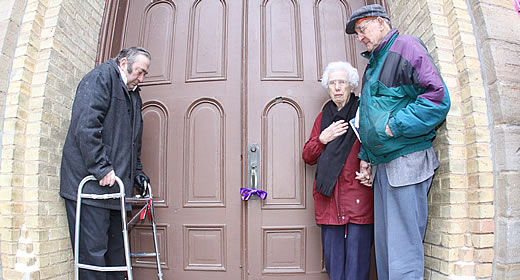
From left, Gilbert Schoenbauer and Adeline and Bernard Sobczak react moments after Adeline tied a purple ribbon on the doors of St. Benedict Church Jan. 16, which marked the closing of the church building in Scott County. Photo by Dave Hrbacek / The Catholic Spirit

Bernard, 86, and Adeline, 88, Sobczak can look out the window of their home near New Prague and see the church of St. Benedict across the street. For more than four decades, they have walked out their front door and about 100 yards to the church doors for Sunday Mass. Jan. 16, they did it for the last time.

In the predawn darkness, they made their way through snow and cold for the final Mass at the church, which closed its doors shortly after the 7:30 a.m. liturgy ended. In fact, it was Adeline who tied a small purple ribbon on the doors, which made the closing official.

With a small crowd gathered around to watch, Adeline was joined by Bernard, a parish trustee along with Gilbert Schoen­bauer, 73.

The mood was almost festive as parishioners en­gag­ed in lively conversation as they filed out of the church and gathered on the sidewalk.

Then, a hush fell over the crowd as Adeline pulled out the ribbon and slowly tied it to the door handles.

Afterward, she and the two trus­tees turned to face the crowd. There was a moment of awkward silence, then all three began to weep.

“Very sad,” said Schoenbauer, whose wife, Shirley, was the church organist. “I didn’t want to see it happen. But what can you do?

We’ve got to keep up with the times. We don’t have enough priests.

“It’s like you lost something. I don’t cry very often. I cried when my mom died, I cried when my dad died, and I cried today.”

Part of the plan

It was an exhausting weekend for Father David Barrett, who celebrated the final Mass and “taking leave ritual” at St. Thomas in St. Thomas at 5 p.m. Jan. 15.

Both St. Thomas and St. Benedict were to be part of the merger with St. Wen­ceslaus in New Prague, St. John the Evangelist in Union Hill, St. Scho­las­tica in Heidelberg and St. Joseph in Lexington as part of the archdiocesan strategic plan, an­noun­ced the weekend of Oct. 15-16. St. Thomas appealed and was allow­ed to merge with St. Anne in LeSueur because of the proximity to that church.

Diane Weckman and Jack Stasney, who served on the transition committee, talked about plans for St. Benedict.

During the week after the Mass, St. Benedict’s Stations of the Cross were to be installed at St. John, where they will be dedicated during the Jan. 23 Mass, and St. John will welcome St. Benedict parishioners with coffee and rolls.

The following week, the statue of St. Benedict is to be moved to St. Scholastica and that parish will host a dedication with coffee and rolls on Jan. 30.

“We should all be fat,” Weckman joked.

Stasney said that people will be OK with going to another building for Mass, but it’s the “fabric part of the community” that will be lost.

“Change is inevitable in our lives,” Stasney said. “Some people are having a hard time with it and they need their own time to go through a healing process and move on — and that is how it is with human beings.”

St. Benedict parishioners are still working on an itinerary of items that have been donated to the church in memory of a loved one.

Although those items can’t be given back to the donors, Weckman said they would make room for them in other churches, where they will continue to be used.

“All our cassocks are going to St. Scholastica because theirs are in need of replacement and ours are in good shape,” she said. And she plans to contact the Mankato Catholic community, which is building a new church, to see if St. Benedict has anything that could fill their needs.

“Father Elgar [Bockenfeld, OFM], for years, had been preparing us,” she said. “When he was alive, he said, ‘It’s coming, so just buck up and accept it.’”

Stasney noted that Father Bock­enfeld had run three of the rural parishes as a cluster, sharing programs and sacraments over the past four years.

“We were already merging things, so some of the stuff is not going to be brand new,” he said.

Weckman added that she appreciates all the work done by Deacon Bob Wagner, Father Barrett and Father Kevin Clinton, St. Wen­ces­laus’ pastor.

“They’ve been a lifesaver for me.”

Personally, Weckman is sad about not seeing the people at St. Benedict every Sunday, as each family chooses a church to meet their needs.

“I will have to get out there and make a phone call and stop in,” she said. “It’s our church family. I don’t see them all the time, but if I needed them, I know they’d be there.”

Weckman said there are positive aspects in the final collaboration be­tween St. Wenceslaus and the other parishes involved in the merger.

“St. Wenceslaus has so much to offer with adult studies,” she said. Although St. Benedict and St. John had a thriving religious education program with 125 children in­volv­ed, there was no Sunday school, Bible study or options for post CCD kids and that has her excited about the changes.

“It opens up more opportunities for us to grow in our faith,” she said.


Other mergers

Two additional mergers set forth in the archdiocesan strategic plan be­came official with the end of 2010 and beginning of 2011.

St. Francis de Sales and St. James in St. Paul officially merged Dec. 31, said Greg Vasterling, parish business administrator.

“Legally, yes, it’s done. But it’s business as usual to a certain extent, until we review all the different pieces of our campus and what that might mean,” he said.

The two parishes have been collaborating over the last four years, sharing a pastor, school, finance council, parish council and more.

“Under the archdiocese format, the next thing that happens is that a leadership committee is formed to review the campuses,” Vasterling said.

The first thing the parish will need to address is the urgent review of the school, he said. For now, Mass times will continue as they have been at both churches, he added.

Also merged as of Dec. 31 are: St. Andrew with Maternity of the Blessed Virgin in St. Paul. Catholic Spirit


Saturday, December 4, 2010

'Urgent review' coming for Archdiocesan Catholic schools

.
As part of its reorganization, the Twin Cities archdiocese is evaluating 10 schools "most on the edge'' and wants them to make their case to stay open.

At least 10 Catholic schools in the Archdiocese of St. Paul and Minneapolis are under "urgent review" by church officials as part of the archdiocese's historic reorganization efforts. Not all of the schools are expected to close, but some may.

The schools have until the middle of this month to present their case to the archdiocese in support of remaining open. Archbishop John Nienstedt will consider the recommendations and make a decision in January.

"They [10 schools] are the ones that are most on the edge in terms of their enrollment and financial viability," said archdiocese spokesman Dennis McGrath. "But no decisions have been made. Obviously if a school is deemed to be not viable because of enrollment and financial potential, then some action will have to be taken."

The archdiocese declined to name all the schools, but confirmed that three include St. Francis-St. James United in St. Paul, as well as Our Lady of the Prairie in Belle Plaine and St. Bernard's in Cologne.

The archdiocese currently has 98 schools with a total enrollment of nearly 34,000 students. About 3,800 full-time employees work in the archdiocese, the majority of them in schools. McGrath said it has not been determined if there will be any layoffs at the schools.

The school changes are part of the largest reorganization in the archdiocese's nearly 160-year history, which is aimed at dealing with a projected priest shortage, tighter budgets and shifting demographics.

In October, the archdiocese released a plan calling for 21 parishes to merge into other parishes. Another 33 parishes will join new cluster configurations in which one pastor will lead two or more parishes. After the mergers are completed, there will be a total of 192 parishes. Archdiocesan officials say structural changes won't begin before January and will take place over several years.

Gail Rappe, principal at St. Francis-St. James United in St. Paul, said she believes the K-8 school will be able to show it's viable because it has a balanced budget and enrollment is up from 72 students last year to 87 this year.

She expects enrollment to continue to go up, in part driven by the increasing number of Hispanics joining the Twin Cities archdiocese.

"I was not surprised we were put on this list," Rappe said. "We are a changing neighborhood. People aren't having as many children as they did before. But we'll be fine. Personally, I would find that [school closing] hard to believe."

The archdiocese is looking to reorganize schools, partly because nearly 20 percent of them receive subsidies from the archdiocese, and there are approximately 20 percent more seats than students.

"While local school leaders and the Archdiocese recognize the urgent review process may cause stress for parents, staff, and other school community members, the process is vital to strengthening Catholic schools as a whole in this Archdiocese," the archdiocese said in a statement released on Friday.

Earlier this week, Nienstedt announced more changes in the archdiocese as a result of the economic downturn. The pension plan for archdiocesan employees will be frozen on Jan. 31, 2011, which means employees' pension retirement benefits will be calculated based on eligible years of service and salary history as of that date.

In a letter to pension plan participants, Nienstedt said the pension plan has lost value in the economic downturn, creating a funding shortfall. Star Tribune

Wednesday, December 1, 2010

New Prague pastor relieved by changes to merger

.


Father Kevin Clinton, pastor of St. Wenceslaus in New Prague, said he is feeling a bit less pressure since Archbishop John Nienstedt modified the merger plan among six parishes in the area.

The new decree for the New Prague area merger removed St. Thomas in St. Thomas from merging with St. Wenceslaus in New Prague and merges it instead with St. Anne in LeSueur as the receiving parish.

The rest of the merger remains the same, with St. Benedict, St. John the Evangelist, St. Joseph and St. Scholastica merging into St. Wenceslaus on Jan. 1. The St. John, St. Scholastica and St. Wenceslaus buildings will remain open.

The changes affecting the New Prague area merger are one of two mergers modified by Archbishop Nienstedt in response to information received from parishioners in petitions to reconsider merger decisions announced last October by the archdiocese.

The other modification involved a merger of parishes in northeast Minneapolis. The original decisions in the remaining 12 mergers were confirmed.

Decisions still to be made

In the New Prague area, “It’s a win-win situation,” Father Clinton said. The parishioners at St. Thomas are not only geographically closer to LeSueur, but they also have closer relationships to the parishioners at St. Anne, he said.

It also decreases — from six to five — the number of parishes for which the pastor is now responsible to blend into one parish that worships at three sites.

One of the greatest challenges will be where and what time to celebrate six Masses at three sites, after the last Mass is celebrated at St. Benedict, he said. Mass has not been celebrated at St. Joseph for the past two years.

Many decisions are yet to be made by the transitional leadership coordination committee, made up of two representatives from each of the five parishes, along with Father Clinton, Deacon Bob Wagner and Father Dave Barrett, the regional associate pastor.

“The facts are that even with two priests serving five sites, the five sites were not sustainable,” he said. One of the sites had 14 households. Another site had just 50 to 75 people attending the one weekend Mass offered.

“People are grieving,” Father Clinton said. It is like a death within the faith community.

However, he said, the creation of the new parish won’t change much in the way people worship. That is just a “legal modification,” he said. What is more important is the relationship of the people, who have the power to create something new and life-giving for the future.

Father Clinton said he is getting a lot of support and advice from the archdiocese and meetings with other pastors of merging parishes.

“Archbishop Nienstedt spent a few years in the New Ulm diocese where he learned a lot about rural faith communities,” he said. “So, that is to our advantage. He is not unfamiliar with the dynamics that do evolve and can evolve.”

The pastor also is grateful that there are no staff reductions with the merger, since the parishes outside of New Prague did not have any staff besides the priest and volunteers.

Throughout the merger process, Father Clinton is keeping people updated through the parish bulletins, announcements from the pulpit and through lay leaders reporting to the entire parish community.

“As much as we can, we are trying to take the best from each community and bring it into the new environment,” he said.

Changes in Minneapolis

In another merger in Minneapolis, Archbishop Nienstedt confirmed his original decision, with some modifications, to merge Holy Cross, St. Anthony of Padua, St. Clement and St. Hedwig.

Modifications include that the combined parish community will be named Holy Cross, and the effective date of the merger will take place upon the retirement of Father Earl Simonson as pastor of St. Clement, which will take place by July 1, 2013.

The archbishop also reaffirmed the Polish nature of the combined parish community, including the continued offering of Mass in Polish, and he stated that Mass will continue to be offered onsite to residents of Catholic Eldercare facilities adjacent to the church buildings of St. Anthony of Padua and St. Hedwig.

Father Glen Jenson, Holy Cross pastor, was unable to comment on the changes in the merger before this issue of The Catholic Spirit went to press.

Parishioners involved in the two revised mergers — in the New Prague area and northeast Minneapolis — have until Nov. 29 to appeal the changes to Archbishop Nienstedt.

Parishioners in parishes where the mergers remain unchanged have until Dec. 3 to appeal the archbishop’s decision to the Vatican if they choose to do so.

Archdiocesan staff members are working with pastors, lay leaders and parishioners at affected parishes during this time of transition, according to a news release from the archdiocese. Pending appeals, the first round of mergers go into effect on Jan. 1. Changes will roll out over the following months and years; they will not all happen at the same time.

According to the archdiocese, 21 parishes are scheduled to merge into 15 receiving parishes, which will lead to a reduction in the number of parishes from 213 to 192. Catholic Spirit

Saturday, November 20, 2010

Two merging archdiocesan parishes win some changes on appeal

.
Sixteen others will proceed with the reorganization as the archdiocese planned and now can appeal to the Vatican.

Two of the 18 Catholic parishes appealing their mergers with other parishes were granted some changes, Archdiocese of St. Paul and Minneapolis officials announced Friday. The other 16 mergers will proceed as planned.

The announcement paves the way for the largest reorganization in the archdiocese's nearly 160-year history, barring any successful appeals to the Vatican.

The two parishes that appealed successfully will still merge, but in a more palatable way.

St. Thomas Church in the south metro community of St. Thomas was initially set to merge with St. Wenceslaus in New Prague as part of the reorganization plan. The archdiocese granted its request to merge with St. Anne of Le Sueur instead.

At Holy Cross in northeast Minneapolis, Archbishop John Nienstedt confirmed the initial decision, with significant differences. Holy Cross will merge with St. Anthony of Padua, St. Clement and St. Hedwig. But the name of the combined parish community will be Holy Cross, and the merger will take place after the retirement of the Rev. Earl Simonson as pastor of St. Clement, which will happen by July 1, 2013.

Considering another appeal

Nienstedt's decision to affirm the 16 other mergers was greeted with dismay.

"We're disappointed," said Gene Mach, a church trustee with St. Canice in Kilkenny, which is set to merge with Most Holy Redeemer in Montgomery. Mach said St. Canice preferred to remain in a "cluster" with Most Holy Redeemer, which means the two parishes share a priest.

"We're still talking about preparing something to appeal it further," Mach said. "We just have to exercise our options. We probably won't make a decision until at least after the weekend masses so everyone is notified. I was hopeful we could have remained in a cluster instead of merging. We still would have had our own identity, our own parish."

The Rev. Kevin Clinton, pastor at St. Thomas church and other nearby parishes, applauded the archbishop for allowing St. Thomas to merge with St. Anne of LeSueur instead of St. Wenceslaus in New Prague. He said St. Anne is geographically closer to St. Thomas and "socially [St. Thomas parishioners] are more tied to LeSueur than New Prague. They shop in LeSueur, and they have more friends and connections to that community."

Stay strong, archbishop asks

As in other metro areas across the country, the Twin Cities archdiocese is facing a projected priest shortage, tighter budgets and shifting demographics. The reorganization plan was released last month, after more than a year of study. In addition to the mergers, 33 parishes will join new cluster configurations in which one pastor will lead two or more parishes. Nearly 25 percent of the archdiocese's current 213 parishes already share a pastor.

With the revisions announced Friday, 21 parishes are now scheduled to merge into 15 receiving parishes. After the mergers are implemented, there will be a total of 192 parishes. Archdiocesan officials say structural changes won't begin before January and will take place over several years.

"Despite the challenges involved, especially for those affected by the mergers proposed, I ask our Catholic faithful to remain strong in the practice of their faith and equally strong in their resolve to continue building the new parish communities that will begin to unfold," Nienstedt said in a released statement.

Parishioners affected by the Holy Cross and St. Thomas changes have until Nov. 29 to file a written appeal to the archbishop. Parishioners affected by the mergers confirmed by the archbishop may appeal to the Vatican.

Just how many church buildings may close as a result of the mergers remains unclear. Archdiocese officials say those decisions will be made by local leaders in consultation with the archbishop and a representative body of priests.

Even though St. Thomas' appeal succeeded, there's still pain involved in giving up a parish built in the 1880s.

"People at St. Thomas are generally understanding of what's happened," Clinton said. "But there are some very strong feelings here. They're having to say goodbye to something that's been in their own personal lives and in the lives of their parents and grandparents. We're talking about feelings connected to three generations of people." Star Tribune


Friday, November 19, 2010

.

Archbishop modifies two of 14 original mergers

As result of petitions, combined parish community in northeast Minneapolis to be named Holy Cross; St. Thomas to merge with St. Anne in LeSueur

In response to petitions sent by parishioners to reconsider parish merger decisions, Archbishop Nienstedt modified the merger of Holy Cross, St. Anthony of Padua, St. Clement and St. Hedwig in Minneapolis.

A new decree of merger for the four parishes includes making the name of the combined parish Holy Cross.

Second, the effective date of the merger will take place upon the retirement of Father Earl Simonson as pastor of St. Clement parish, no later than July 1, 2013.

Third, the archbishop reaffirmed the Polish nature of the combined parish community, including the continued offering of Mass in Polish. He added that Mass will continue to be offered onsite to residents of Catholic Eldercare facilities, which are adjacent to the church buildings of St. Anthony of Padua and St. Hedwig.

In the New Prague area merger involving St. Benedict, St. John the Evangelist, St. Joseph, St. Scholastica, St. Thomas and St. Wenceslaus, St. Thomas is removed from the merger and will, instead, merge with St. Anne in LeSueur. The other details of the St. Wenceslaus merger remain the same: the remaining four parishes will merge into St. Wenceslaus, and the St. John the Evangelist, St. Scholastica, and St. Wenceslaus buildings are identified to remain open. New decrees for the New Prague area merger and the new merger of St. Thomas and St. Anne were issued.

With these revisions to parish mergers, 21 parishes are scheduled to merge into 15 receiving parishes, bringing the total number of parishes to 192, compared to the current 213 parishes.

A merger does not necessarily mean that the merging parish’s church building will close. Decisions regarding the church buildings of the newly combined parish community will be made by local leaders in consultation with Archbishop Nienstedt and the presbyteral council, a representative body of priests.

Parishioners at parishes affected by the new decrees of merger who believe they are negatively impacted by a decision have until Monday, Nov. 29, to request in writing that the archbishop reconsider the decision.

Parishioners affected by the 12 mergers confirmed by the archbishop may appeal the archbishop’s appeal response to the Vatican.

More information about the appeal of a parish merger may be found at http://planning.archspm.org/wp-content/uploads/Appendix-A.pdf

Pending appeals, the first round of mergers will go into effect on Jan. 1, 2011, with further changes continuing over the following months and years.

The archdiocesan strategic plan is the result of 20 months of study and consultation, which includes the input of pastors and other clergy, parish and Catholic school leaders and staff, parishioners and Catholic school families.

The entire strategic plan is available at http://planning.archspm.org. Catholic Spirit

Archbishop modifies two of 14 original mergers

.
As result of petitions, combined parish community in northeast Minneapolis to be named Holy Cross; St. Thomas to merge with St. Anne in LeSueur

In response to petitions sent by parishioners to reconsider parish merger decisions, Archbishop Nienstedt modified the merger of Holy Cross, St. Anthony of Padua, St. Clement and St. Hedwig in Minneapolis.

A new decree of merger for the four parishes includes making the name of the combined parish Holy Cross.

Second, the effective date of the merger will take place upon the retirement of Father Earl Simonson as pastor of St. Clement parish, no later than July 1, 2013.

Third, the archbishop reaffirmed the Polish nature of the combined parish community, including the continued offering of Mass in Polish. He added that Mass will continue to be offered onsite to residents of Catholic Eldercare facilities, which are adjacent to the church buildings of St. Anthony of Padua and St. Hedwig.

In the New Prague area merger involving St. Benedict, St. John the Evangelist, St. Joseph, St. Scholastica, St. Thomas and St. Wenceslaus, St. Thomas is removed from the merger and will, instead, merge with St. Anne in LeSueur. The other details of the St. Wenceslaus merger remain the same: the remaining four parishes will merge into St. Wenceslaus, and the St. John the Evangelist, St. Scholastica, and St. Wenceslaus buildings are identified to remain open. New decrees for the New Prague area merger and the new merger of St. Thomas and St. Anne were issued.

With these revisions to parish mergers, 21 parishes are scheduled to merge into 15 receiving parishes, bringing the total number of parishes to 192, compared to the current 213 parishes.

A merger does not necessarily mean that the merging parish’s church building will close. Decisions regarding the church buildings of the newly combined parish community will be made by local leaders in consultation with Archbishop Nienstedt and the presbyteral council, a representative body of priests.

Parishioners at parishes affected by the new decrees of merger who believe they are negatively impacted by a decision have until Monday, Nov. 29, to request in writing that the archbishop reconsider the decision.

Parishioners affected by the 12 mergers confirmed by the archbishop may appeal the archbishop’s appeal response to the Vatican.

More information about the appeal of a parish merger may be found Here

Pending appeals, the first round of mergers will go into effect on Jan. 1, 2011, with further changes continuing over the following months and years.

The archdiocesan strategic plan is the result of 20 months of study and consultation, which includes the input of pastors and other clergy, parish and Catholic school leaders and staff, parishioners and Catholic school families.

The entire strategic plan is available Here
Catholic Spirit

John Allen: The press and the sex abuse crisis of 2010

.
John Allen [Nat'l Catholic Reporter] and George Weigel consider the Vatican's response to sex abuse charges in Europe

Under the best of circumstances, the Vatican and the secular media struggle to understand each other, and the first half of 2010 was hardly the best of times. As a new wave of the sexual abuse crisis swept across Europe and raised critical questions about Pope Benedict XVI, Vatican officials accused the press of bias, while news reports and editorial pages blasted the Vatican for dishonesty and denial.

Now that the dust has begun to settle, thoughtful figures on both sides realize the need to take a dispassionate look back. Many in the news business want to know if they got the story right, and at least some in Rome — not to mention frustrated Catholics elsewhere — wonder if the Vatican's crisis management strategy, such as it was, backfired.

On Monday, I was in Miami Beach for a gathering of journalists from mainstream secular outlets, sponsored by the "Faith Angle" project of the Washington, D.C.-based Ethics and Public Policy Center. Papal biographer George Weigel and I were asked to lead a discussion of coverage of the crisis, especially its most recent wave.

Among the 20 or so reporters on hand was Laurie Goodstein of the New York Times, whose pieces digging into Benedict's record have been both widely read and controversial. Critics include American Cardinal William Levada, Prefect of the Congregation for the Doctrine of the Faith, who called a March 24 story by Goodstein on the Vatican's handling of the case of a Wisconsin priest accused of molesting deaf children "deficient by any reasonable standards of fairness."

The conversation in Miami didn't produce an artificial consensus — and it wasn't designed to — but it did have a lot to say about where things stand vis-à-vis the church and the fourth estate.

* * *

Weigel said that in his view, coverage of the American sexual abuse crisis of 2002 largely got the story right, forcing the church to confront a reality that had been "ignored or downplayed" for too long. By way of contrast, he argued, the coverage in 2010, which focused more on the Vatican and the pope, was marred by "errors in reporting and editorial bias."

Weigel laid out what he called seven "flawed assumptions" which, in his view, ran through much of the 2010 coverage.

Assumption One: The "Omni-Competence of the Papacy"

Weigel said the pope is often styled as an absolute monarch, wielding total control over Catholic life. That's not true either in theory or practice, Weigel insisted. In theory, a pope's power is limited by all sorts of things: church tradition, the Code of Canon Law, the sacramental system, even the rules of logic.

In reality, Weigel said, a pope's influence is also limited by factors such as the competence of his aides and his own shrewdness in diagnosing situations and making appointments. He added that the latter point is part of the dynamic of the papacy of Benedict XVI — this "world-class theological mind," Weigel said, doesn't always seem to have an aptitude for picking subordinates.

Assumption Two: The "World-Class Competence of the Roman Curia"

Weigel said people often succumb to the notion that Vatican officials must be the cream of the Catholic crop, including the notion that they operate "the world's best intelligence service." In reality, Weigel said, the quality of heads of Vatican offices is not notably higher than other systems with which he's familiar — say, the governments of the United States or the United Kingdom — and in some cases it's "much lower."

As an illustration, Weigel claimed that Pope John Paul II was four months behind the news when the sexual abuse crisis broke out in the United States during spring 2002, because of the poor quality of information reaching him through Vatican channels. In general, Weigel argued, the small circle of senior Vatican officials who wield real power, probably no more than 20, do not live in the same "24/7 media universe" as the rest of us.

Assumption Three: A "General Hermeneutic of Suspicion"

Outsiders sometimes conclude, Weigel said, that "there is a will to deceive at the highest levels" of the Vatican. In reality, he said, much of what looks like deception is actually bungling — bred by naiveté, misinformation, or just plain being in over one's head.

A hermeneutic of suspicion, Weigel argued, breeds contorted conspiracy theories, thereby missing "the simplest and truest explanation, which is that these guys were blindsided and scrambled to respond."

Assumption Four: "Institutionalized Hypocrisy"

Many people already don't like the sexual teachings of the Catholic church, Weigel argued, and when violations of that teaching by clergy are not immediately met by draconian penalties, it fuels "gotcha" reporting.

When hypocrisy is presumed to be the root of everything, he said, important bits of context are overlooked. Weigel offered three examples:

  • A 1983 revision of the Code of Canon Law was designed to protect priests from arbitrary abuses of power by bishops, but it also made it harder for bishops to discipline abuser priests.

  • In debates over laicization (popularly known as "defrocking"), some experts caution against it on the grounds that once the church cuts ties with a priest, it loses any ability to monitor and control him.

  • Weigel also criticized attempts to link the crisis to priestly celibacy, asserting that 50 to 60 percent of the sexual abuse of children occurs in the family — and is therefore committed by people who have never taken vows of celibacy.

Assumption Five: Sex abuse is "a distinctively Catholic problem, and an institutional Catholic problem."

That may be true of Ireland, Weigel said, but it's not in the United States, where data suggests the incidence of abuse among Catholic priests is no higher than among comparable professional groups such as public school teachers — even though sex abuse in other environments doesn't draw anything like the same saturation coverage.

In 2010, Weigel argued, "the Catholic church is arguably the safest environment for young people and adolescents in the country," but there remain other "non-safe environments" that will not be exposed so long as public perceptions treat the sexual exploitation of children as a "Catholic problem."

Assumption Six: "A lack of skill in reading church statements and documents"

The inability of some observers to adequately decode Vatican-speak, Weigel said, sometimes leads to "missing the real stories." He cited Pope Benedict's letter to the Catholics of Ireland, which Weigel said, for the first time begins to "dig into real problems of ecclesiastical culture" underneath the crisis. That point was missed, he said, amid sensational but often ill-informed commentary from the likes of Sinead O'Connor.

Assumption Seven: Confusion about who's a reliable source

Weigel complained that in some news coverage, critics of Benedict XVI have been presented as seemingly neutral "experts." He complained, for example, that victims' attorney Jeffrey Anderson is routinely cited without mention of his "direct financial interest" in sex abuse litigation. He also offered the example of Italian Catholic writer and scholar Alberto Melloni, an exponent of a school of interpretation of the Second Vatican Council (1962-65) rejected by Benedict XVI. To present Melloni as an objective source, Weigel argued, is a distortion.

More broadly, Weigel warned against relying too much on alleged Roman insiders — who, he said, are often "low-level munchkins who have no idea what's going on, but are happy to talk over a free cappuccino or a Campari and soda."

* * *

All of that, Weigel argued, illustrates the need for "serious reform in press coverage of the Catholic church."

On the church's side of the ledger, Weigel argued that two chronic problems have to be addressed: 1) What he called "the Vatican's communications debacle," and 2) the lack of "a mechanism for dealing with manifest incompetence, or worse, from bishops." Weigel said that many "serious Catholics," including regular church-goers and big-time donors, have deep reservations these days about the competence of some local bishops. He called the inability to get rid of problem bishops in a timely fashion the church's "single biggest management problem."

Both issues, he said, will have to be faced the next time the cardinals gather in a conclave to elect a pope, because it's not realistic to expect they will be resolved under Benedict XVI.

* * *

In my [John Allen] comments, I raised what has long struck me as the central puzzle about the crisis of 2010: How is it that Pope Benedict XVI, whom insiders regard as the great reformer on the sex abuse issue, somehow became the global symbol of the problem?

I laid out my reading of Benedict's record, which is that then-Cardinal Joseph Ratzinger underwent a sort of conversion experience around 2001, when the sex abuse crisis was dumped in his lap by John Paul II. His willingness to face what he once memorably called the "filth in the church" was fueled by studying case files from all over the world, including the testimony of victims, and by listening to his deputies who met with victims. The story as I know it boils down to this: before 2001, Ratzinger was essentially another cardinal in denial; afterwards, he became the leading force inside the Vatican for a more aggressive response.

Measured not against the sweeping programs for reform that some critics of the church have advanced, but against what was realistically possible, Ratzinger moved the ball farther and faster than most people anticipated, often against strong internal opposition.

If that's so, then why did a handful of cases from decades ago, which came to light earlier this year, cause such an earthquake in public perceptions?

In addition to the flawed assumptions flagged by Weigel, I suggested two other factors — both of which, I think, impeded the Vatican from making a more effective case on the pope's behalf.

First, I argued, the Vatican drew a bad hand, in that the first case to come to light was also the most serious. It involved Peter Hullermann, a German priest who came into the Munich archdiocese for therapy, while facing charges of abuse, when then-Cardinal Joseph Ratzinger was in charge. Hullermann ended up in a Munich parish where he committed other acts of abuse, for which he was eventually convicted criminally.

When the story broke in early March, the immediate response in church circles, both in Munich and in Rome, was to try to insulate Benedict from blame — insisting that the decision to assign Hullermann to a parish was made at lower levels, without the future pope's knowledge. Whether true or not, that response rang hollow for many people, because a bishop still has to take responsibility for decisions made in his name.

Benedict could have said something like, "I'm heartsick over what happened, and with the benefit of hindsight it's clear I should have been more vigilant. I intend to reach out to Hullermann's victims to apologize, and this terrible tragedy illustrates the importance of the reforms we've put into place." Had that been the tone, outsiders might have been more inclined to listen to a defense of the pope on other cases — especially because in the handful of other instances which have drawn coverage, his role was often minor and after-the-fact. Instead, an impression of blanket denial was created, which became the prism for everything else.

More deeply, I also speculated that the Vatican has been hampered in defending Benedict's record because it would imply indicting other senior Vatican officials, and perhaps ultimately tainting the memory of Pope John Paul II. That's a psychological and cultural bridge, I said, that many in the Vatican aren't ready to cross.

Weigel was asked to comment on whether the crisis indeed represents a stain on John Paul's legacy. He conceded the crisis wasn't handled well, especially towards the end when John Paul was already in decline. At the same time, Weigel argued, that breakdown has to be seen in the context of John Paul's broader renewal of the priesthood. Both John Paul and Benedict XVI, Weigel said, have inspired a new generation committed to a "heroic ideal of the priesthood," which, he said, suggests there will be few incidents of abuse down the line.

* * *

Understandably, Goodstein wanted to join the conversation. She said that when she began reporting on the latest wave of the crisis, she largely accepted the claim of "Ratzinger the Reformer," based partly on things that I and others had written.

Yet, she said, the 2010 stories upended that narrative, which placed the responsibility entirely on bishops for the failure to report and remove abusers. This year we learned of one case after another, she said, in which bishops were pleading urgently with the Congregation for the Doctrine of the Faith under Ratzinger to laicize a known molester, and the CDF rejected those requests. And, she added, we were always told that the CDF had nothing to do with these cases until 2001, but that turned out to be false also. In fact, they were handling them all along.

As a footnote, Goodstein said that much of the reporting was based on documents — though she didn't add this herself, usually documents obtained from victims' lawyers. Those documents, she said, are the most revelatory evidence we have. The documents come from attorneys, she said, because the church sure is not handing them over.

Goodstein's question thus was: Didn't the reporting of 2010 add something to what we thought we knew?

I said that for me, the reporting fleshed out the picture, but didn't fundamentally alter it.

First, it's still true that pre-2001, most sex abuse cases never reached Rome because bishops relied on informal remedies rather than laicization (which requires Vatican approval, and was seen by many bishops as a cumbersome, expensive, and uncertain process). We already knew that before 2001, Ratzinger's approach to the few cases which reached his desk wasn't notably different from other senior Vatican personnel. Thus to produce a 1985 letter in which he urges caution in laicizing Stephen Kiesle of Oakland, for example, is certainly interesting, but not a paradigm-changer.

That go-slow approach in the 1980s and 1990s, I argued, still has to be balanced against expedited handling of hundreds of cases beginning in 2003, when Ratzinger obtained "special faculties" from John Paul II allowing him to waive a canonical trial and to remove an abuser from the priesthood more efficiently.

One can certainly argue that his awakening came late, and that not enough has yet been done — perhaps especially in terms of matching the new accountability for priests with similar accountability for bishops. The fact remains, however, that the Vatican is today more committed to a "zero tolerance" policy because of Ratzinger's impact, both before and after his election.

If that point sometimes got lost earlier this year, it's probably one part a media failure to keep the whole picture in focus, and one part the Vatican's inability to project a different narrative.

Weigel threw in a couple of interesting footnotes. In terms of the response to the crisis under John Paul II, Weigel said that during the late pope's long illness, there was effectively no one in charge — on sex abuse or almost anything else. The then-Secretary of State, Italian Cardinal Angelo Sodano, was either "unprepared or unwilling," Weigel said, "to become a sort of prime minister as the king was dying."

Weigel also asserted that another element in understanding Vatican culture vis-à-vis the crisis is "the odd influence of the Latin American mind," which he described as "riddled with conspiracy theories." He was likely referring to suggestions from a few Latin American cardinals that media reporting on the crisis, especially in the United States, was calculated to stifle the church's advocacy on issues such as support for a Palestinian homeland.

* * *

We spent a fair bit of time in Miami doing some basic exercises in Vaticanology, which prompts a warning about relations between the Vatican and the media.

Several people, for instance, asked why there never seem to be consequences when somebody in Rome obviously screws up. To take one example, Sodano explosively compared criticism of the pope on the crisis to "petty gossip" during the 2010 Easter Sunday Mass, and yet he continues merrily along as dean of the College of Cardinals. (When Cardinal Christoph Schönborn of Vienna, Austria, later criticized Sodano, he actually got his knuckles rapped.)

I explained that in the culture of the Vatican, the way they typically signal disapproval of a statement from someone at Sodano's level isn't by overtly repudiating it, but rather by not repeating it. Insiders know that silence speaks volumes, although the outside world usually concludes that the guy got away scot free.

Two reactions from reporters are worth recording.

One said that while such insider scoop is interesting, it's of limited journalistic value. Editors won't tolerate sticking in four paragraphs of "Vatican context" into stories to explain every statement or decision that comes down the pike, this reporter said, because it smacks too much of apologetics — i.e., trying to get the Vatican off the hook.

Another reporter made the point that when it comes to the crisis, media outlets have a limited appetite for nuance, because of the stark moral nature of the underlying issue — the sexual exploitation of vulnerable children. In that regard, this reporter said, the media can be as "unchanging and relentless as the church."

The take-away seemed to be that unless the Vatican wants a perpetual war with the press, it needs to become more adept at translating its internal culture for the outside world.