Tuesday, July 24, 2012

MN Marriage Minute #29: Negative Consequences of Redefining Marriage in Massachusetts

.

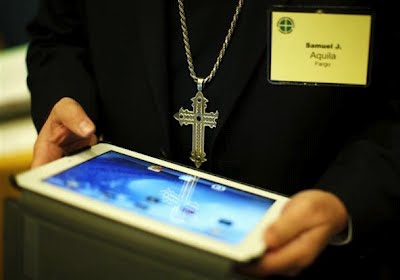
Samuel Aquila's Denver Return Marred by Tragedy

.
The new archbishop of Denver is dealing with the aftermath of the Aurora theater tragedy just two days after his installation.

07/24/2012 

Archbishop Samuel Aquila was installed July 18 as the fifth archbishop of the Archdiocese of Denver. The appointment brings Archbishop Aquila home to the archdiocese where he was first ordained 36 years ago.

His first week has been a difficult one, given the tragedy at the Century Aurora 16 theater just two days after his installation. He spoke July 24 with Register senior writer Tim Drake about his installation and the Aurora tragedy.


How is the Church responding to the Aurora tragedy?
The Church has reached out to the victims and the wounded. The priests and deacons in Aurora have visited the hospitals and been present to the families who were impacted in different ways.
On Friday afternoon, I celebrated Mass at Queen of Peace Catholic Church in Aurora. There were well over 1,000 people there. One young girl had been in the theater, and another had five friends who were injured. The Church has continued to reach out amidst the sadness, the tragedy and the evil of it.
There will be three Catholic funerals. We’re visiting with the families and trying to respect everything they are going through. Catholic Charities has made counseling available for those who desire it.
There has been a real outreach to the families who have lost loved ones and those who have been wounded. There’s been great compassion and charity shown toward them in carrying out the corporal works of mercy to those who have been impacted by this.
Anytime where there is such a violent act that is so unexpected there is the shock and horror and questioning that goes on. We’re trying to help people with those questions and help them to bring it all to the Lord, whether they are experiencing vengeance, anger, emptiness.
There’s a tremendous hole when one loses a spouse, a child, a friend. That unique individual will never be replaced on this earth. There’s a tremendous sense of loss there.
In addition, dying a violent death is quite different from an accident. All those who went to the movie theater went to enjoy a film. Suddenly, that’s been shattered by the power of evil and sin, and it’s so unexpected.
In some of the conversations I’ve had with some of the people impacted, I’ve tried to help them to see how they can bring their suffering to the cross and see how the Father permitted his only Son to suffer a violent death — and to remember that that death and the evil that was present did not conquer the love of God.
Rather, God conquered death and evil with the Resurrection and the gift of eternal life. I let them know that they stand at the cross with Mary and John. They experienced the death of Jesus Christ, and so Mary and John intercede and are with them.
The questions they are asking are likely the same questions Mary and John asked. So, I encourage them to remember their humanity in it all and their deep faith and love to stand with the Lord.
The Church is very much in solidarity with those who have been wounded and hurt and lost their lives.


Is there any indication of how many of the victims were Catholic?
Of those who were killed, we know of three. I’ve met with one of the families and will be meeting with the other two.  Bishop [James] Conley or I will be present for the funerals. I would ask all people of good will to continue to pray for those impacted.
What many of these people experienced will take time to heal. After the funerals will be the greatest part of the adjustment, when they need our continued prayer.


This tragedy has occurred just days after your installation. You were ordained a priest here. Does it feel like you’ve come home?
In many ways, it does. I served as a priest here for 25 years, so I know a lot of the people. Even though I was away for almost 11 years, there were a lot of friends and contacts that I had here.
In that way, it is very much like a homecoming. There’s been a lot that has changed. When I looked out at the clergy, there were a number of younger men who have been ordained over the last seven or eight years who I did not recognize. Archbishop [Charles] Chaput also brought in some new religious communities.
I look forward to reconnecting with people and look forward to meeting the new clergy and all those in seminary, the staff at the pastoral center and the diocese.


What was the highlight of your installation?
The installation Mass itself was filled with meaning and tremendous joy. Never in your imagination do you think you’ll ever be in the diocese where you were ordained a priest. As we celebrated Mass, there were a flood of memories of being ordained at the cathedral. I was in residence at the cathedral for almost eight years and celebrated Mass there.
There were also memories from World Youth Day in 1993 and being an assistant emcee for Pope John Paul II. There is a stained-glass window of the Council of Ephesus that has always spoken to me of Mary’s love and protection, and that was very much present. There was also the strong face of the people and the reception I was given as I entered into the cathedral. To see so many of the clergy present who I hadn’t seen for 11 years and so many of the faithful — my heart was filled with a great love for the Father for his providential love for me.


In what ways is the Archdiocese of Denver different or similar to the Diocese of Fargo, N.D.?
They are very, very different. The Diocese of Fargo is a rural diocese. It has 130 parishes, and about half of those have about 75 households or less. It’s a much smaller community.
Denver is a huge metro area, and there are more than 550,000 Catholics there. In Fargo, there were about 75,000 Catholics and about 100 priests. Here, there are over 380 priests. The differences are quite great, in terms of size and territory. The Archdiocese of Denver is about 40,000 square miles. Eastern North Dakota was about 35,000 square miles.


What are the major challenges that you face in Denver?
I think, certainly, part of it is the size of the diocese. It’s much more complex than Fargo. Denver is much more secular, in terms of belief and in terms of political views than Fargo, and in that way it will be a new challenge, because the people of North Dakota were primarily a people of faith.
About 90% of the people of North Dakota had some type of faith. Here, in Colorado, they told me, it’s about 30%. That itself will be a challenge.
How do you keep God in the public square and engage in conversation with society to promote the common good?


You made the restoration of the order of the sacraments of initiation a primary focus during your time in Fargo. Do you anticipate looking at that issue in the Archdiocese of Denver?
It has already surfaced, and it’s certainly something we’ll look at, especially after the encouragement I received from Pope Benedict XVI during the ad limina visit. He encouraged me to continue in that direction.
I will continue to speak to that and reflect on it with the priests and lay faithful of the archdiocese.


Denver is home to a rich diversity of apostolic efforts. I understand there are a couple of new efforts under way (Lighthouse Crisis Pregnancy Center and Christ in the City). What can you tell me about those?
Lighthouse is certainly something I’ve been aware of. The founders came up to see what we had put together in Fargo. They visited the St. Gianna Maternity Home and First Choice Clinic, an ecumenical response to crisis pregnancies and helping women choose life.
Given my own work in the pro-life movement and concerns in that area, I’m very supportive of it and look forward to meeting those involved. It falls under the auspices of Catholic Charities, so will now be a part of the ministry of the archdiocese.
Christ in the City is a movement of young people in the inner city bringing Christ to those who are homeless and poor and in need. Christ in the City combines solid Catholic intellectual and spiritual formation with service to the poor. I encourage young people to look into it.


What do you see as Denver’s greatest strengths?
It’s a young, vibrant, zealous Church. I think it’s a Church that has taken the New Evangelization seriously.
When I see things like the Augustine Institute, Focus [Fellowship of Catholic University Students], the Catholic Biblical School, movements like the Neocatechumenal Way and Communion and Liberation and the Oblates of the Virgin Mary, and the seminaries, they are tremendous signs of light in the archdiocese.
There is a tremendous amount of life and proclaiming the Gospel of Christ and carrying out the mission of Christ in the archdiocese.


What kinds of things do you enjoy doing when you’re not “on duty?”
I enjoy golf, fishing, and I enjoy sitting quietly in prayer, reflection or reading. I also enjoy going out and being out and about.
When I lived here, I would go out and hike on trails in the mountains. I used to ski, but gave that up. My knees are not what they used to be.


Do you have a favorite saint?
There are a lot that I go to. There are two that stand out the most.
Our Lady of Guadalupe: I have a deep devotion to her, just in terms of her deep desire to share her Son with the world and give us the gift of the tilma. I’ll never forget the first time I saw the tilma and realized it was almost 500 years old. What a great gift it is.
Also, St. Joseph, in terms of his fatherhood, his manhood and his deep love for Jesus and Mary — in protecting them and being the one who formed the humanity of Jesus as a father.
It demonstrates the great confidence of God the Father to trust to Joseph the care of Mary and Jesus. I seek his intercession often for being a spiritual father to the faithful and seek his help in that.
When we talk about the saints, something I’ve discovered throughout the years in my own walk of faith is that they are really our friends. The more I read them, the more I see their sanctity and their cooperation with God. They are each unique, and all of us are called to be saints.
Each one of us has a particular relationship with the Father, Jesus and the Holy Spirit, and we’re called to live that out in the life of the Church.

Thursday, July 5, 2012

Wyoming Cowboy Carmelites

Wyoming Cowboy Carmelites
Rollin', rollin', rollin', Though the streams are swollen, Keep them dogies rollin'
Rawhide!
Move 'em on, head 'em up, Head 'em up, move 'em out, Move 'em on, head 'em out Rawhide!
http://is.gd/PB3cBF  


The Diocese's Shepherd visits his motorized shepherds


Wednesday, July 4, 2012

Happy Fourth, Americans!


Meet one of the world's most amazing priests

According to one of the world's most amazing  Catholic newspapers, the Catholic Herald of the United Kingdom!

5. Fr George Grafsky
Fr George Grafsky is the parish priest of St Anne in Le Sueur, a suburb of Minneapolis, Minnesota. It is a bitterly cold, frosty spot. Fr George has a cheerful expression and a relaxed, child-like face, which is not what one expects from a priest who meets many challenges in the most frenzied and panicked of situations.
As well as being chaplain to the Le Sueur County Sheriff’s Department, he also works side-by-side with the police and is often one of the first people they call when they have harrowing tasks to perform. Fr George is unflappable. A police sergeant, Dave Struckman, was alone at the scene of an accident when he had to pull two dead bodies from a car. None of his colleagues were available and so he called Fr Grafsky to help him, and together they pulled the bodies from the wreckage.
Fr George is not indifferent to the pain caused by sudden death, and he has a special way of guiding families through their grief after they have lost a loved one to an accident or fire. Some tragedies do unsettle Fr George’s serenity. One concerned a boy who drowned a mere day after making his First Communion. While he was saddened, Fr George did not shirk from accompanying the mother as she watched her son’s body being fished from the water.

Tuesday, June 12, 2012

Bishop Kinney preps for the next chapter: Retirement

.

Church law requires resignation be submitted to pope at the age of 75 [St. Cloud Times]


Past bishops of the Diocese of St. Cloud
Rupert Seidenbusch, O.S.B. (Feb. 12, 1875, Appointed — Oct. 19, 1888, Resigned)
John Joseph Frederick Otto Zardetti (Oct. 3, 1889, Appointed — March 6, 1894, Appointed, Archbishop of Bucarest
 • Martin Marty, O.S.B. (Jan, 21, 1895, Appointed — Sept. 19, 1896, Died)
 • James Trobec (July 5, 1897, Appointed — April 15, 1914, Retired)
 • Joseph Francis Busch (Jan. 19, 1915, Appointed — May 31, 1953, Died)
 • Peter William Bartholome (May 31, 1953, Succeeded — Jan. 31, 1968, Retired)
 • George Henry Speltz (Jan. 31, 1968, Succeeded — Jan. 13, 1987, Retired)
 • Jerome George Hanus, O.S.B. (July 6, 1987, Appointed — Aug, 23, 1994, Appointed, Coadjutor Archbishop of Dubuque, Iowa)
 • John Francis Kinney (May 9, 1995, Appointed — )

How bishops are appointed Stage 1: Bishops' Recommendations

Every bishop may submit names of priests he thinks would make good bishops to his archbishop. After a discussion among the bishops of the province, which includes an archdiocese and one or more dioceses, the group votes on who to recommend.

Stage 2: The Apostolic Nuncio

The apostolic nuncio gathers information about potential candidates, and interprets it for the Congregation. If the appointment is a replacement for a diocesan bishop or archbishop about to retire, the incumbent’s recommendations are considered. Broad consultation is encouraged with regard to the needs of the diocese, but not the names of candidates. Past and present bishops of the diocese, and the president and vice president of the United States Conference of Catholic Bishops are consulted. Three candidates are listed with the nuncio’s preference noted, but all materials are forwarded to the Congregation for Bishops in Rome.

Stage 3: Congregation for Bishops

Once documentation from the nuncio is in order, and the Congregation of Bishops’ prefect approves, a cardinal relator is chosen to summarize and report to the full congregation, which generally meets twice a month on Thursdays. After hearing the report, the congregation discusses and then votes on the appointment.

Stage 4: The Pope Decides

At a private audience with the pope, usually on a Saturday, the prefect presents the recommendations . A few days later, the pope informs the congregation of his decision. The congregation notifies the nuncio, who contacts the candidate. If the candidate accepts, the Vatican is notified and a date is set for the announcement.

Bishop John F. Kinney celebrated his birthday today by declaring his intent to step down as the spiritual leader of the Diocese of St. Cloud. The 75-year-old’s letter to Pope Benedict XVI announcing his intention to retire does not come as a surprise; Kinney is the age at which bishops are required by church law to submit their resignation to the pope.

“We’re very appreciative of Bishop Kinney’s service to this local church, which began with his ordination to the priesthood in 1963 and continued with his ordination as a bishop in 1976,” said Jim Accurso, Archdiocese of St. Paul and Minneapolis media and external relations manager.

Kinney has indicated he will send his letter today by way of the apostolic nuncio, Archbishop Carlo Maria Vigano, Pope Benedict XVI’s diplomatic representative in America.

“The nuncio conducts his own investigation and then the process begins from there,” Accurso said of the replacement process, which often takes eight months or more to complete.

Selection process

The process for selecting candidates for the episcopacy normally begins at the diocesan level and works its way through a series of consultations until it reaches Rome. “He’s not moving out at any point soon,” said Rebecca Kurowski, director of communications for the Diocese of St. Cloud. “We would be shocked if, three months from now, they said, ‘OK, here’s the new guy.’ ”

It is a process bound by strict confidentiality and involves a number of important players – the most influential being the apostolic nuncio, the Congregation for Bishops, and the pope. “They will not be accepting his resignation until they have someone lined up to take his spot,” Kurowski said.

The late Archbishop Pietro Sambi, who died almost a year ago, preceded Archbishop Carlo Maria Vigano as the apostolic nuncio. “It took six months to fill his (Sambi’s) spot and so it created this huge backlog because he’s the liaison directly to the pope for the United States,” Kurowski said.

Diocesan bishop

Kinney was first ordained an auxiliary bishop of St. Paul and Minneapolis in 1977. He served as bishop of Bismarck, N.D., from 1982 to 1995 before his appointment to St. Cloud.

Wednesday, May 30, 2012

5 Questions Before You Leave the Catholic Church

.

5 Questions Before You Leave the Catholic Church


National Catholic Register 
Author Anna Quindlen has been in the news lately, promoting a new book called Lots of Candles, Plenty of Cake. She recently spoke with NPR's Terry Gross about a wide range of topics she covers in the book, including her recent decision to leave the Catholic Church. She summarized this decision by telling Gross:
The pedophilia scandals, the church's reaction to them, and their constant obsession with gynecology -- taken together at a certain point, it was probably two or three years ago, I said, 'Enough.' Every time I sit in the pew I ratify this behavior, and I'm not going to ratify it anymore.
I'm sure that Quindlen's words resonated with many. She's a gifted writer, and has undoubtedly put words to what others have thought when they make the decision to leave the Catholic Church. Like Quindlen, many people who abandon their Catholic faith still believe in God and still strive to be good, moral people; they choose to leave because they think that they will find these things they desire -- God, freedom, equality -- outside the walls of the Church. Such a move certainly fits in with popular cultural beliefs. Common wisdom states that the Catholic Church is a corrupt organization that places oppressive, unnecessary rules on its members. The way to find freedom, the thinking goes, is to ditch the institution and create a spirituality and moral code that works for you.
To modern ears, this all sounds right. But is it true?

As someone whose faith journey has gone in the opposite direction, I would encourage Quindlen, as well anyone else who has followed her path or is thinking of following it, to consider the following five questions before abandoning the Catholic faith:

1. Are you sure members of the Church hierarchy are worse than anyone else?

When people cite the pedophilia scandals as a key reason for abandoning the Church, I worry that they're setting themselves up for deep disappointment. The fact that priests abused children is an idea so horrific that one can hardly bear to think about it, and the fact that some bishops didn't take action to stop it is almost worse. But the chilling fact -- perhaps so chilling that we don't can't accept it -- is that this is not a problem with Catholic priests and bishops; it's a problem with human nature. A priest is no more likely to abuse a child than a male schoolteacher, and a bishop is no more likely to cover it up than a school administrator.
The problems may have seemed worse within the Church because it is a single, worldwide organization, so it's easy to link all the bad occurrences under one umbrella. But if, for example, all the nondenominational churches on the earth were part of a cohesive worldwide system, you would almost certainly see the same issues at the same rates. Instead of each instance being lost in the anonymity of disconnected communities, when they were all considered together it would seem epidemic.
Other organizations are no more safe for children than the Church -- in fact, based on personal experience, I believe they are now less safe. Thanks to the pervasive stereotypes about Catholicism, people are lured into a false sense of security when dealing with other organizations, and end up adopting the dangerous mentality that "it couldn't happen here."

2. Are you sure your faith life would be better outside of the Church?

Keep in mind that leaving the Catholic Church means leaving the sacraments -- sacraments with real power, which are not available outside of the Church that Jesus founded. If it brings you joy to commune with Jesus spiritually, how much better is it to commune with him physically as well? And how lucky are we to have the sacrament of confession, where you can unload all your burdens, hear the words "you are forgiven," and receive special grace to help you to be the morally upright person you strive to be?
Now, those who are considering leaving the Church may struggle with believing in the supernatural power of the sacraments (in which case I'd recommend checking out these resources). But even if that's the case, within the two-thousand-year-old Church is an unfathomable treasure chest of spiritual wisdom. We have the Rosary as well as all the other time-tested prayers of the Church. Then there are the lives of the saints, countless stories that offer an inexhaustible supply of information and inspiration about how to have a rich spiritual life. And of course we have a worldwide network of monasteries and convents, and all the great religious orders. I suppose it's possible to utilize some of these spiritual resources without being a practicing Catholic, but if you believe that they're good and helpful, why sever them from the source of their wisdom?

3. Are you sure the Church's teachings are wrong?

There is a pervasive sense in modern culture that whatever spiritual tradition places the fewest moral restrictions on its adherents is most likely to be right. This idea might feel good since it appeals to our natural desire for autonomy, and certainly it is accepted as an immutable fact by modern society. And so if a person follows the path of least resistance carved out by our culture, it would be easy to drift away from all these "oppressive" teachings of the Church, without ever pausing to ask:
But are they true?
Let's take just one example: The Church's crazy-unpopular prohibition against contraception. The Church says that it's neither good for individuals nor for society for couples to use artificial birth control. It's understandable that someone's first reaction upon hearing that would be to reject this wildly counter-cultural teaching. I know that when I first heard it, I thought it was one of the most backwards, bizarre ideas I'd ever heard. But when I took a closer look, I was shocked by the wisdom behind this thinking: I realized that contraception doesn't solve the problems its proponents claim it will solve. I discovered that it makes women lose control over their bodies. I thought of the women I've known who have had abortions, and realized that almost every single one of them were using contraception when they conceived. They had been told that it would be just fine to engage in the act that creates babies, even if they were sure they couldn't have a baby. Then, when they saw the two lines on the pregnancy tests, they felt trapped and scared, believing that they had no choices outside of the walls of the local abortion facility.
Living without artificial contraception has its challenges, but it's the only system that gives women real freedom. As with so many other Catholic teachings that seemed crazy at first glance, once I took the time to understand the details of this view, I saw that there was a wealth of wisdom behind it beyond anything I could have imagined. It had seemed crazy simply because our culture has it so wrong, and the Church is the last institution left that's willing to proclaim what's right.

4. Are you sure the Church's doctrines aren't divinely inspired?

In my own conversion to Catholicism I faced serious challenges, including the fact that I was diagnosed with a Deep Vein Thrombosis (blood clot in a major vein) which was caused by a genetic clotting disorder that's exacerbated by pregnancy. My doctors told me I absolutely had to use contraception. It threw me into a crisis where I had to discern how serious I was about this religion, and how much I was really willing to risk to follow it.
Thanks to some wise advice, I realized that the situation was really quite simple: Is this Church guided by God in its teachings or not? If it's not, then there's no reason to listen to anything it says; if it is, then to say that I knew better than the Church was to say that I knew better than God.
When I looked at the unfathomable body of wisdom contained in this organization, considered that it has stood strong while empire after empire has fallen away around it, and saw that it has been unwavering in its core doctrines despite the imperfections of its hierarchy, I simply didn't think that humans could pull this off on their own. Then, when I began to transform my life according to these teachings, I was completely convinced. Following the "rules" of the Church brought an explosion of grace and peace and love into my life, and into my family's lives as well. I became convinced that these teachings are not human-made, but come from Someone who knows us better than we know ourselves.

5. Are you sure we don't need the Church?

At the end of the NPR interview, Quindlen says, "I've never really gotten past that quote from Anne Frank in her diary, where she says that people are really good at heart." I too have always been touched by that quote, and I think it's worth putting some serious thought into. Because if it's true that people are ultimately good at heart...then that means that the staff who worked at Auschwitz and Bergen-Belsen, lining up children in front of the gas chambers, overseeing Anne Frank and her family in slave labor, were good at heart too. How on earth, then, could normal, good people participate in something so evil?
The answer is chillingly simple: Through the power of human rationalization.
To look at the smiling faces of the employees in these pictures of an on-site staff retreat at Auschwitz is to understand that they had all rationalized their behavior. Nobody ever wakes up and says, "I'm going to do something evil today!", not even the staffers at Auschwitz. The only way evil ever works through us is when we convince ourselves that what we're doing is actually good. The most dangerous force in the world is the human capacity for rationalization.
I think that some folks reject the concept of the Church's divinely-inspired moral code because they don't see why it would even be necessary. Why would God even care to institute something like that? Why can't each person just get in touch with the spiritual realm and find what's good and true for him- or herself? The answer to that question can be found in the smiles on the Auschwitz's employees faces.
Though the individual members of the Catholic Church have made plenty of mistakes, sometimes gravely serious ones, its doctrines have always been a bulwark that protects human life. To a healthy American adult this may seem like an insignificant concept, since the only life that is devalued in our time and place is that of the severely disabled, the unborn, and others who literally do not have a voice. But that could change. The zeitgeist could shift, just as it did in Europe in the 1930s, and new groups of people may suddenly be seen as inconvenient and expendable. And one day the life that the Catholic Church stands up for may be your own.

Tuesday, May 29, 2012

Duluth’s Irish connections shaped its history

.Diocese of Duluth

The story of missionary priests coming from Ireland to serve in the United States and other countries is a rich part of church history. The Diocese of Duluth has been blessed by this phenomenon. The first bishop of the diocese, James McGolrick, was from Ireland.

In the Duluth diocese, it ended up being a family affair. At least four Irish priests who came to the diocese in the early 20th century were followed here by nephews ordained decades later.


Archival photo

Msgr. Michael Boland (with trophy) poses with students from St. John School in Duluth.
Msgr. Michael Boland, ordained a priest for the diocese in 1912, was followed by his nephew Father Eamonn Boland, pastor of Holy Angels in Moose Lake, who was ordained in 1969. Father Patrick Flynn, ordained in 1925, was followed by Father Charles Flynn, pastor of Resurrection Church in Eveleth and St. Joseph in Gilbert, who was ordained in 1969. Msgr. Thomas Scott, ordained in 1926, was followed by Father Michael Lyons, pastor of Holy Spirit in Two Harbors and St. Mary in Silver Bay, who was ordained in 1970. And Father Henry Spain, ordained in 1918, was followed by Father Seamus Walsh, pastor of St. John in Grand Marais and Holy Rosary in Grand Portage, who was ordained in 1966.

Each uncle and nephew came from the same county in Ireland. Each uncle spent more than 40 years as a priest in the diocese. All four nephews have also served more than 40 years, bringing combined family totals sometimes more than a century.


Fathers Boland

Msgr. Michael Boland, from County Tipperary, was born in 1886 and died in 1971 in Superior, Wis. He built St. John the Evangelist Church in Duluth, where he was pastor for 46 years, and directed the adjacent St. James Children’s Home for 45 years. He also served the Cathedral of the Sacred Heart and St. Michael’s in Duluth, building the basement and offering the first Mass at the latter parish in 1915.

He was vicar general under three bishops — Bishops James McGolrick, John McNicholas and Thomas Welch — holding the post from 1922 until 1957 with only a brief interruption while he served as diocesan administrator between 1925 and 1926. He was named a prothonotary apostolic, the highest of the three grades of the honorary title monsignor, in 1922, and as he marked his golden jubilee in 1962 was considered to have held the title longer than any other priest in the United States.

Father Eamonn Boland, 67, has served at parishes in Grand Rapids, Duluth, Deer River, Hibbing, Cloquet, Carlton, Hoyt Lakes, Eveleth and Moose Lake, where he is approaching a decade as pastor. He has also served as a diocesan consultor.

He said his uncle’s work at the orphanage stands out. “I think that was the great love of his life,” Father Boland said. “He loved that ministry.”

His uncle was influenced to come to Duluth by Bishop McGolrick and in turn was an influence on his own decision, especially when his uncle would come home and mention happenings in the diocese, Father Boland said. “That influenced me quite a bit.”

His time in the diocese overlapped with his uncle’s only briefly, and he said Msgr. Boland’s “mind was going a little bit” by that time, but he would go up to St. John’s and talk to him frequently. “We come from a big family, so we had lots of relatives to talk about.”


Fathers Flynn

Father Patrick Flynn was born in 1900 in County Leitrim and died in 1970 in Two Harbors. He served parishes in Duluth, Virginia, Hill City, Aurora, Biwabik, Pine River and Two Harbors. He also served a mission in Pequot Lakes and founded St. Christopher Church there. He was a diocesan consultor.

Father Charles Flynn, 66, has served parishes in Grand Rapids, Cloquet, Longville, Hibbing, Nisswa, Pequot Lakes and Duluth in addition to his current parishes in Eveleth and Gilbert. His additional service has included being a consultor, serving on the diocesan Pastoral Council and Executive Council, chairing the Priests’ Senate and serving as dean of the Duluth deanery.

Father Charles Flynn said he remembers his uncle coming home when he was a little boy. “He came every three years, and he’d stay with us three months.” On the years he didn’t come home, they would have other missionary priests visit.

His time in the diocese overlapped with his uncle’s service by about a year and a half. “It was fine; I’d go up and visit him and stuff like that,” he said, and his uncle would give him Pabst Blue Ribbon and let him take the four cans left over home with him.

“He drove a great big car. It was a Buick Wildcat. It was like a tank,” he said.

Father Flynn said his uncle was happy about the decision to come to Duluth but that he had already made the decision independently, drawn in part by the Catholic American president John F. Kennedy.


Father Lyons and Msgr. Scott

Msgr. Thomas Scott was born in 1899 in County Mayo and died in 1968. He served parishes in Duluth, Hibbing, Hill City, Floodwood and Brainerd. He was named a monsignor and invested in 1961. He also served as Brainerd dean and as a diocesan consultor.

Father Michael Lyons, 68, served as a deacon in Brainerd and as a priest in parishes in Hibbing, Duluth and Pine City in addition to his current parishes in Two Harbors and Silver Bay. He also served in the Archdiocese of St. Paul and Minneapolis and the Archdiocese of Tuam in Ireland in the 1970s and for the Duluth diocese has directed the planning office and the office of communications and served on the diocesan Presbyteral Council.

Father Lyons said in an email that his only personal experiences of his uncle are from his teenage years while Msgr. Scott was on an extended vacation in Ireland. “During that time I enjoyed his many stories about Minnesota that he shared with family members and neighbors,” Father Lyons said.

He said the visit left a deep impression on him. Those experiences and his uncle’s “iconic stature” were important to his eventual decision to serve as a priest in the Duluth diocese, and he also got a “persuasive letter” from Msgr. Scott when he entered All Hallows Seminary.

“He spoke highly of the life of the church here, the deep faith and support of parishioners for their priests, as well as the potential support and friendship of many other Irish-born priests already serving here,” Father Lyons said. “He never mentioned the Minnesota winters, however!”

Many other letters passed between them during seminary, and he was looking forward to an ongoing friendship, but just six months before he was to begin his internship as a deacon in Brainerd, Msgr. Scott died suddenly. “Had he lived, I’m sure I would have enjoyed his familial support and his ever-ready counsel,” Father Lyons said.


Fathers Walsh and Spain

Father Henry Spain was born in 1893 in County Tipperary and died in Duluth in 1978. He served parishes in Virginia, Chisholm, Pine River, Walker, Bovey, Coleraine, Nashwauk and Eveleth before retiring in 1968.

Father Seamus Walsh, 70, has served parishes in Duluth, Marble, Crosby, Cloquet, Pequot Lakes, Nisswa, Brainerd, Pine Beach and Fort Ripley as well as his current parishes in Grand Marais and Grand Portage. His other service includes being chaplain to St. James Children’s Home, being a diocesan consultor, doing campus ministry at the University of Minnesota Duluth, serving on the diocesan Personnel Board and Presbyteral Council and serving as a National Guard chaplain.

Father Walsh’s time in the diocese overlapped with his uncle for about two years while Father Spain was still a pastor and for several years after his retirement. “There was something special about it, a family connection, both immigrants to the country,” he said.

Father Spain came to Duluth because of Bishop McGolrick. Father Walsh came to the diocese because he wasn’t needed in his home diocese and because of his uncle. “Had he not been here, I would never have heard of such a place as Duluth,” he said.

“I’m amazed that I asked so few questions about what it was like,” he said. For instance, he never knew anything about the winters.

Fathers Walsh and Spain attended the same seminary but 50 years apart. With Father Spain’s 60 years as a priest in the Duluth diocese (10 retired) and Father Walsh’s nearly 46, that’s almost 106 years between them.

The Fathers Boland have combined for almost 105 years.

The Fathers Flynn have combined for nearly 88 years, and Father Lyons and Msgr. Scott have combined for nearly 84.

Duluth's Bishop Paul Sirba Visits the Pope!

The Northern Cross - Fiat Voluntas Tua

First ad limina visit to Rome a memorable experience

I continue to ponder the meaning of my first “ad limina” visit. I am sure I will do so for years to come. “To the threshold of the Apostles” — part pilgrimage, part meeting, all done in communion with the bishops of the United States and the Duluth's Bishop Paul Sirba Visits the Pope and the Vicar of Christ, Pope Benedict XVI.


Bishop Paul D. Sirba
Fiat Voluntas Tua
On the day of the audience, Archbishop John Nienstedt led the delegation of bishops from Minnesota. He greeted the Holy Father, followed by Bishop Lee Piché, the auxiliary bishop of the Archdiocese of St. Paul and Minneapolis. We then proceeded in alphabetical order by diocese, Bishop Michael Hoeppner from the Diocese of Crookston; yours truly; Bishop John LeVoir from the Diocese of New Ulm; Bishop John Kinney from the Diocese of St. Cloud; and Bishop John Quinn from the Diocese of Winona, with retired Bishop Bernard Harrington.

I was able to bring along one of our seminarians from the North American College, Elias Gieske, to accompany me.

I took off my zucchetto, bent down on one knee, and reverenced the Holy Father’s ring. I then looked into the kind and deep eyes of Pope Benedict XVI and introduced myself as the bishop of Duluth from northeastern Minnesota. I assured the Holy Father of the love and prayers of the faithful of our diocese. I said: “Thank you, Holy Father, for leading us to Jesus!”

The Vatican photographer quickly snapped a number of photographs. He captured the moment for a visual memory. I introduced Elias Gieske as one of our seminarians to be ordained a deacon on June 21. “A deacon in June,” the Holy Father said. I took it as a papal pronouncement. Eli got his photo op, and then the two of us looked on as the Holy Father blessed the holy cards I will distribute to the confirmation candidates around the diocese this year.

After all the bishops, priests and seminarians had greeted the pope, the bishops took their seats on either side of the Holy Father’s chair, the priests and seminarians left, and we had our audience with the Successor of St. Peter.

He greeted us warmly. He spoke of the importance of our meeting, our communion with the office of St. Peter, and his desire to hear from us about matters of importance that the church is experiencing in our part of the Lord’s vineyard.

Beginning with Archbishop Nienstedt, each of the bishops presented briefly on topics of importance for our local church. We had sent ahead of us our Quinquennial Reports detailing matters we were now presenting.

The bishops spoke about marriage, the blessings and challenges, our efforts in Minnesota to pass an amendment to our state constitution defining marriage between one man and one woman. We spoke to the sometimes negative responses we have encountered and the conviction and unity of the bishops to defend marriage.

We thanked His Holiness for the third edition of the Roman Missal. We reflected on our ecumenical efforts, and Bishop Piché greeted our Holy Father on behalf of the Lutheran bishops of Minnesota.

We addressed the need for priests and the hope of more vocations. We spoke about the signs of hope in the quality of the men and women considering vocations to the priesthood, religious life and permanent diaconate. Our seminaries, the St. Paul Seminary and St. John Vianney Seminary, are full.

I had the honor of mentioning our work with the youth. The night before the audience, I accompanied Archbishop Nienstedt and Bishop Piché to visit the Catholic Studies students from the University of St. Thomas’ Bernardi campus. Two of our seminarians, Deacon Daniel Weiske and Nicholas Nelson, serve as chaplains at the campus. One of the students, Ann Thompson, is from St. Joseph’s in Crosby. What a great example of what a Catholic Studies program can be!

I told the 30-plus students I would have the opportunity to speak to the Holy Father tomorrow about the youth in our region and asked them what they might say if they had the chance. One student said, with such beautiful conviction: “Tell the Holy Father how much we love him!” He is to them a spiritual father leading them in word and witness to Jesus. I expressed the sentiments to His Holiness. He was grateful. I thanked him for World Youth Day and Youcat and for introducing our young people to silence as a place to encounter God.

The bishops spoke about the importance of Catholic identity and the need to form a new generation of leaders who embrace the church’s teaching in love, are willing to be counter-cultural, and lead our institutions.

Echoing the comments of bishops across the United States, we spoke about the attacks against our religious liberty and the challenges ahead. And we thanked the Holy Father for his leadership and strong response in the face of clergy sexual abuse, especially his meeting with victims of abuse on his journeys. His example gives direction and brings healing.

The next day we had the privilege of meeting a second time in audience with Pope Benedict XVI. He delivered a discourse, the third of five to be given to the bishops of the United States. The full text is printed in this issue of The Northern Cross.

In this talk, our Holy Father spoke to the serious issue the bishops have been raising in our “ad limina” visits, namely, the contemporary crisis of marriage and the family, and, more generally, of the Christian vision of human sexuality.

As you can see, the Holy Father is close to us. As a good Shepherd, he is concerned for the Lord’s flock. He is with us in the challenges we face and continually encourages us and points us to Jesus as our loving Redeemer and our source of hope.

“To all of you I willingly impart my Apostolic Blessing as a pledge of wisdom, strength and peace in the Lord,” he said.

Bishop Samuel Aqula of Fargo to Become Next Archbishop of Denver

It was only a matter of time for Bishop Samuel Aquila to move to a larger diocese than Fargo. Many thought he would have become the Archbishop of St. Paul-Minneapolis when Archbishop Harry Flynn retired. But that wasn't to be.
Archbishop Aquila will have big shoes to fill when he moves to the Mile High city, those of Archbishop Charles Chaput, O.F.M.-Cap., himself a former Bishop of Rapid City, now the Archbishop of Philadelphia, most probably soon to be a Cardinal, making the Dakotas a wonderful incubator of Good Shepherds for the Catholic Church.

Archbishop Aquila is returning "home", after a fashon, having attended Denver's St. Thomas seminary on his way to ordination as a priest of the Archdiocese of Denver..
But Archbishp Aquila has been no slouch from the viewpoint of his Shepherd's See at the top of North America (except Alaska, of course):
Bishop Samuel J. Aquila
Born: 1950, Burbank, California
Education: B.A., Psychology, University of Colorado, Boulder, CO, 1972; M.A., Theology-Dogma, St. Thomas Seminary, Denver, CO, 1976; Licentiate of Sacramental Theology, San Anselmo University, Rome, 1990.
Vocation: Ordained to the priesthood in 1976; Bishop, The Catholic Diocese of Fargo since 2001
On Success: “When people tell me that I have been an instrument of God and have helped to bring them to encounter Jesus Christ.” “Being a spiritual father to seminarians.”
On leadership: “A leader needs to be a person of honesty, integrity, who desires truth, is compassionate and a listener.”
“One who has to make the difficult decisions that are grounded in The Truth.”
Do whatever He tells you” (John 2:5). Mary’s instruction to the waiters at the wedding feast in Cana reminds Bishop Aquila to be a servant of Christ and the Church and to trust Jesus to guide him.
As he visits parishes, teaches through his homilies and speaking to Catholics and non-Catholics throughout the Diocese of Fargo, Bishop Aquila hopes to inspire all of us to give ourselves fully to our Lord, to live our lives according to our faith, and do whatever Jesus calls us to do. Bishop Aquila started his spiritual journey as a parish priest in the 70s and served in parish ministry for 11 years.
“Every priest has it in their heart to serve people,” he reminds us, and he has served the people well. Over the last 30 years, he has accepted positions of increasing responsibility in the church and has earned the honor of being named a Prelate of Honor by Pope John Paul II, receiving the honorary title of Monsignor in 2000.
Ordained a bishop in 2001, Bishop Aquila now oversees 139 parishes, 86 active priests, a number of retired priests, the Cardinal Meunch Seminary and 13 schools located in eastern North Dakota, which covers approximately 36,000 square miles. Bishop Aquila serves on the Bishops’ Advisory Council for the Institute for Priestly Formation.
He is also a member of several United States Conference of Catholic Bishops committees. His responsibilities include teaching though preaching, writing pastoral letters and visiting with priests and parishes. He also oversees the sacramental life and governance of the Church in all churches in the diocese and he attends many monthly and quarterly meetings that are devoted to running the diocese.
Twice a year, Bishop Aquila meets with lay people and priests, who are members of the Diocesan Pastoral Council, about their concerns and pastoral outreach. A typical day also includes an hour in prayer before the Eucharist, and praying five times daily for the church and the diocese.
The admonition from John 2:5, “Do whatever He tells you,” also adds direction to Bishop Aquila’s daily life. Bishop Aquila says he was inspired by the late John Paul II’s ability to teach, preach, and visit with people. He said that John Paul II had a deep goodness about him, living The Faith, enjoying people, and engaging in banter back and forth in conversation with them. He has also worked diligently to meet controversy head-on and to stand for The Truth—especially pertaining to the dignity of human life.
He admires, remembers and applies a quote that John Paul II used often: “Be not afraid.” Much like a corporate CEO, Bishop Aquila manages a large team of people and faces the same challenges. He points out that he relies on a talented staff that does a wonderful job with the day-to-day duties of running the diocese.
Bishop Aquila has learned to set very clear expectations for his staff and to give people the freedom to do their job, allowing them to be accountable for their areas of responsibility. Bishop Aquila says that, over the years, he has learned to trust his gut feeling or intuitiveness more when dealing with staff and daily issues. Bishop Aquila stressed that his primary focus and love is the spiritual side of his calling.
His future goals include continuing to evangelize the truth of Jesus Christ and of the Catholic Church. The Bishop would like Catholics to be more familiar with the Catechism so they can truly understand the real teachings of the church and develop a deeper love of the Eucharist. All in all, Bishop Aquila is striving for them to know The Word, to develop a more contemplative heart and to be silent in order to listen to the Lord. Bishop Aquila believes that, in this day and age, silence can be uncomfortable for people. He said that we are constantly bombarded with noise and activity from Ipods to cell phones to constantly running between activities.
By pursuing regular silence in our lives, he notes, we can hear God’s plan for each one of us and enter in to a deeper relationship with Him. As for time spent in prayerful silence, Bishop Aquila said one of the most profound experiences he has experienced was a 30-day silent directed retreat. He adds that time spent in silence and prayer can offer a real renewal in our family life — the place where stability starts for children.
In addition to prayer, Bishop Aquila believes in the importance of reading and learning. He reads books of the Church Fathers from the early 600s, theological books, as well as biographies and autobiographies of the saints. Reading and reflection helps him see that conversion is an ongoing experience for all of us.
Bishop Aquila has enjoyed all of the many different ministries that he has been involved in over the years and has found real grace in all situations. However, he has enjoyed serving as a parish pastor and seminary rector the most.
This servant of God also enjoys traveling, the water, boating, playing pinochle and began golfing a few years ago. He recently played in a pinochle tournament in Napoleon, ND and commented, “It was a blast!”
I found Bishop Aquila to be a warm and approachable person with a delightful sense of humor. When you talk with him, you have his undivided attention and you can feel his deep commitment to the church and above all, to God.
As he puts it, “I believe that, in Christ Jesus are all of the words and instructions that mankind needs to live life in peace and harmony and to gain eternal salvation.” The priest said to them,”Go in peace. The journey on which you go is under the eye of the Lord.” - Judges 18:6 KFGO Faith (Fargo-Moorhead)


--------------
 The Eagle Returns:  Fargo's Aquila Headed Home to Denver 

(The report below was formally announced by the Vatican at Roman Noon on Tuesday, May 29th.)

Much as the shop was planning to hold for Roman Noon, after a late leak to the Mile High City's ABC affiliate, we can proceed.

Earlier tonight, three Whispers sources confirmed that Pope Benedict is to name Bishop Samuel Aquila, 61 -- the Denver-bred head of North Dakota's Fargo diocese since 2001 -- as his hometown's fifth archbishop at Roman Noon (4am Mountain time) today.

As noted below, the putative appointee -- born in California to a family that emigrated West from South Philly -- is slated to appear at the traditional 10am press conference before leading an evening Mass in the Cathedral-Basilica of the Immaculate Conception, located in the shadow of the Colorado Capitol. By virtue of his appointment alone, the archbishop-elect would be expected to receive the pallium from the Pope's hands in Rome a month from today on the feast of Saints Peter and Paul, alongside the world's other new metropolitans named over the last year.

According to credible reports, Aquila's installation has already been scheduled for Wednesday, July 18th -- 365 days since his predecessor-to-be, Archbishop Charles Chaput OFM Cap., was transferred to Philadelphia, in a move widely seen in church circles as the most challenging assignment an American prelate has been given in at least the last half-century.

A sacramental theologian trained at Rome's Benedictine-run Athaneum of Sant'Anselmo, as director of Denver's Liturgy Office, Aquila served as Master of Ceremonies at Chaput's installation as Colorado's fourth archbishop in April 1997. At the Capuchin's appointment, two years later Aquila took office as founding rector of St John Vianney -- the Denver seminary reconstituted from scratch which, within a decade of its establishment, has become the largest American formation house west of Mundelein. (Just last fall, the archdiocese received 20 first-year seminarians.)

During his ad limina visit with the bishops of the upper Midwest in early March (above), Aquila was praised by the Pope for his push to restore the traditional order of the sacraments of initiation in the 90,000-member North Dakota church, where Confirmation has preceded First Communion since 2005.

* * *
The first and lone US city to host World Youth Day, in August 1993 -- an event termed the "second founding" of the Mile High church -- Denver is viewed by no shortage of key churchfolk both at home and abroad as the de facto seat of the New Evangelization on these shores, a distinction born from the encouragement given to and success experienced by creative apostolates ranging from the celebrated NewAdvent web portal and rapidly-growing college missionary effort FOCUS to the archdiocese's lay-led Augustine Institute and ENDOW, a mission to affirm and amplify the charisms of women in the church. Demographically speaking, meanwhile, a mass influx of Hispanic immigration coupled with the community's birth-rates over the last two decades has now given Latinos a slight but growing majority share of the archdiocese's Catholic population.

The Denver church stretches across some 40,000 square miles of Colorado's Northern third from the Mile High City to the state's Western Slope.

Notably, the last two Denver archbishops have subsequently been named to positions traditionally held by cardinals. While Chaput's Philadelphia predecessors have been given the red hat for the last century, Aquila's predecessor-to-be was returned to the Rockies (where Chaput had already spent a decade as a parish priest and Capuchin provincial) after the 1996 appointment of then-Archbishop J. Francis Stafford to Rome as president of the Pontifical Council for the Laity. Stafford's transfer ostensibly owed itself to the unexpected success of WYD Denver, which was felt in Rome to have "redefined" the concept and scope of the triennial event.

Elevated to the "Pope's Senate" in 1998, Stafford -- still a member of several Vatican offices, including the Congregation for Bishops -- is expected to retire in Denver on reaching his 80th birthday in late July, at which point his Curial memberships cease. Much as the Baltimore-born cardinal has maintained a vigor far younger than his years, the scholar-prince has reportedly kept his wish to be buried with the archdiocese's prior heads in the Bishops' Mausoleum at the local Mount Olivet Cemetery.

On 16 August, the Denver church marks the 125th anniversary of its founding as a diocese under the leadership of Joseph Projectus Machebeuf, the French-born cleric who would lay the groundwork for a sprawling, pioneering and evangelical Colorado Catholicism over the following three decades.

As ever, more to come.

Sunday, May 27, 2012

Archbishop John Vlazny's ad limina visit to Rome

An Uplifting and Challenging Experience

Archbishop Vlazny, currently the archbishop of Portland, OR, is the former Bishop of Winona.

Last week in the print issue of the Sentinel I wrote about the ad limina visit of us bishop here in the Pacific Northwest to Rome at the end of April. Our newly ordained brother from eastern Oregon, Bishop Liam Cary, was able to accompany all of us on that visit. He found it to be an excellent preparation for his new duties as Bishop of Baker. As always, I found the experience uplifting and challenging, a great reminder of the universality and the complexity of the church. It all began on that first Pentecost when the Holy Spirit came upon the apostles. I sensed that the same Holy Spirit was coming upon his successors from the Pacific Northwest during our days in Rome. On our first full day in Rome, Monday, April 23rd, we visited the Pontifical Council for the Family. The challenges to family life, the increase of divorces, the defense of marriage as a sacred union of husband and wife, and family problems dominated our conversation. My visit prodded me to think about the ways we as a local church might more effectively support marriage and family life. I confess that archdiocesan support has been minimal ever since our bankruptcy experience, but, thanks be to God, many parishes and many religious communities have picked up the slack ever since those tragic years. This is an area that calls for improvement in the coming years. Tuesday was our busiest day. We went to visit the Congregation for Bishops, whence these ad limina visits are scheduled and coordinated, the Congregation for the Doctrine of the Faith, headed by our former Archbishop, Cardinal William Levada, the Congregation for Divine Worship, where the number two man is Archbishop Augustine DiNoia, OP, presently the titular archbishop of Oregon City, and the Congregation for Institutes of Consecrated Life. All four of these meetings dealt with issues that are pertinent to us in our life as teachers of the faith and shepherds of the flock. We acknowledged our gratitude for the recent appointment of the new Bishop of Baker, a priest of this archdiocese. We discussed some possible programs for the coming Year of Faith, reviewed the implementation of the new Roman Missal in our dioceses and discussed some of the serious questions that have been raised recently about religious life in the United States. We stressed how invaluable men and women who have embraced the consecrated life have been for us in carrying out our evangelizing mission. Wednesday began with an early morning Mass at the Tomb of St. Peter. Praying there is always a very special privilege, a reminder of all the church history that takes its origins on that Vatican hill. We later visited the Congregation for Clergy and the Pontifical Council for the Laity. That evening we had an opportunity to meet with the United States priests who are working in Rome and live at the Villa Stritch, a residence established by the American bishops back in the late 1960’s. Our own Msgr. John Cihak is one of the residents and, with his fellow residents, graciously welcomed us for some refreshments and conversation. Thursday, in addition to seeing the Holy Father, we celebrated Mass at the Basilica of St. John Lateran, the Pope’s cathedral, and then visited the Pontifical Council for Promoting Christian Unity. I was especially impressed with the conversations there. The new Prefect, Cardinal Kurt Koch, a native of Switzerland and former Bishop of Basel, was especially helpful. As challenging as ecumenical dialogue may be at times, the importance of relationships with the other Christian churches is so critical that our struggles need to be endured, not set aside. His second in command, Archbishop Brian Farrell, was especially instructive in some of our conversations about the ecumenical dialogue involving Anglicans and Catholics, as well as the recent welcome that has been extended to some Episcopalian priests and the establishment of a special ordinariate for former Episcopalians who have asked to become members of the Catholic Church. That evening we were hosted by Ambassador Miguel Diaz and his wife Marianne, at a reception in the Villa Richardson, the residence of the United States Ambassador to the Holy See. I have known Marianne and her family from my days as Bishop in Winona. Finally on the last day of our visit, we celebrated Mass again in St. Peter’s at the Altar of Blessed John Paul II and visited the Congregation for Catholic Education and the Pontifical Council for Promoting New Evangelization. The Prefect at the Congregation for Catholic Education spoke to us at length about seminaries, Catholic universities and Catholic schools. He prodded us to be persistent in our efforts to seek assistance from the government for the ministry of our Catholic schools. He pointed out how this is quite common in other nations and surprisingly unacceptable by so many in the United States. The last visit, at the Council for Promoting New Evangelization, gave us an opportunity to meet with Archbishop Rino Fisichella. The archbishop at one time taught a course at Mount Angel Seminary. He is an enthusiastic proponent of the new evangelization. We discussed some opportunities and strategies that might strengthen the life of our church during the coming Year of Faith. With the celebration of Pentecost on this coming Sunday, the Easter season will come to an end. We return to Ordinary Time, but, with the help and guidance of the Holy Spirit, hopefully we shall be able to accomplish some extraordinary things in the months ahead. Certainly the ordination of ten new priests on June 9th will be a highlight. It will be my special prayer this Pentecost that the Holy Spirit will guide our efforts to protect religious liberty here in the United States. We need to pray especially for our Catholic leaders in government who are sorely tempted these days to do what is seemingly expedient and “politically correct” in our current secular milieu. Pray too for all our bishops and pastors that they will be faithful shepherds of the flock, and not run for cover when under attack. God bless us all.

Pope Benedict's Explanation to Jimmy Akin on the Meaning of the Book of Revelation

One of the most difficult books to understand in the Bible is the book of Revelation, also known as the Apocalypse.
Here we offer an "interview" with Pope Benedict (taken from his writings) to learn from his wisdom on this book.


#1

Your Holiness, the book of Revelation is often attributed to one of Jesus' first disciples: John, the son of Zebedee. He is also the traditional author of the Gospel of John and the three epistles of John. Interestingly, none of those works expressly say that they were written by a man named John, but Revelation does--four times! (1:1, 4, 9, 22:8). Was it written by this John--the son of Zebedee--or by another?
The Gospel never directly identifies [its author/the beloved disciple] by name. In connection with the calling of Peter, as well as of other disciples, it points toward John, the son of Zebedee, but it never explicitly identifies the two figures. The intention is evidently to leave the matter shrouded in mystery.
The Book of Revelation does, admittedly, specify John as its author (cf. Rev 1:1, 4), but despite the close connection between this book and the Gospel and Letters of John, it remains an open question whether the author is one and the same person.
It is obvious, on the one hand, that the author had no reason not to mention his own name, and on the other, that he knew his first readers would be able to precisely identify him.
We know, moreover, that in the third century, scholars were already disputing the true, factual identity of John of the "Apocalypse".
For the sake of convenience we could also call him "the Seer of Patmos" because he is linked to the name of this island in the Aegean See where, according to his own autobiographical account, he was, as it were, deported "on account of the word of God and the testimony of Jesus" (Rv 1: 9).

#2

Many in our own day have seen the book of Revelation as a vision almost exclusively concerned with the future. How should we understand it?
The Book should be understood against the backdrop of the dramatic experiences of the seven Churches of Asia (Ephesus, Smyrna, Pergamum, Thyatira, Sardis, Philadelphia, Laodicea) which had to face serious difficulties at the end of the first century - persecutions and also inner tensions--in their witness to Christ.
John addresses them, showing acute pastoral sensitivity to the persecuted Christians, whom he exhorts to be steadfast in the faith and not to identify with the pagan world.
His purpose is constituted once and for all by the revelation, starting with the death and Resurrection of Christ, of the meaning of human history.

#3

There are many compelling images in the book of Revelation, but if you had to boil it down to just one, central symbol, what would it be?
The first and fundamental vision of John, in fact, concerns the figure of the Lamb who is slain yet standing (cf. Rv 5: 6), and is placed before the throne on which God himself is already seated.
By saying this, John wants first of all to tell us two things: the first is that although Jesus was killed with an act of violence, instead of falling heavily to the ground, he paradoxically stands very firmly on his own feet because, with the Resurrection, he overcame death once and for all.
The other thing is that Jesus himself, precisely because he died and was raised, henceforth fully shares in the kingship and saving power of the Father. This is the fundamental vision.
On this earth, Jesus, the Son of God, is a defenceless, wounded and dead Lamb. Yet he stands up straight, on his feet, before God's throne and shares in the divine power. He has the history of the world in his hands.
Thus, the Seer wants to tell us: trust in Jesus, do not be afraid of the opposing powers, of persecution! The wounded and dead Lamb is victorious!
Follow the Lamb Jesus, entrust yourselves to Jesus, take his path! Even if in this world he is only a Lamb who appears weak, it is he who triumphs!

4

One of the most mysterious images in the book is that of a scroll which the Lamb--Jesus--opens in heaven. How can we understand this image?
The subject of one of the most important visions of the Book of Revelation is this Lamb in the act of opening a scroll, previously closed with seven seals that no one had been able to break open.
John is even shown in tears, for he finds no one worthy of opening the scroll or reading it (cf. Rv 5: 4).
History remains indecipherable, incomprehensible. No one can read it. Perhaps John's weeping before the mystery of a history so obscure expresses the Asian Churches' dismay at God's silence in the face of the persecutions to which they were exposed at that time.
It is a dismay that can clearly mirror our consternation in the face of the serious difficulties, misunderstandings and hostility that the Church also suffers today in various parts of the world.
These are trials that the Church does not of course deserve, just as Jesus himself did not deserve his torture.
However, they reveal both the wickedness of man, when he abandons himself to the promptings of evil, and also the superior ordering of events on God's part.
Well then, only the sacrificed Lamb can open the sealed scroll and reveal its content, give meaning to this history that so often seems senseless.
He alone can draw from it instructions and teachings for the life of Christians, to whom his victory over death brings the message and guarantee of victory that they too will undoubtedly obtain.
The whole of the vividly imaginative language that John uses aims to offer this consolation.

#5

Another compelling image is that of the Woman in chapter 12, who is clothed with the sun, who stands on the moon, and who has twelve stars as a crown on her head--imagery that is based on Joseph's dream in the Old Testament (Gen. 37:9-10). Many understand this Woman as Mary, but others see her as an image of the Church. What is the truth?
This Woman represents Mary, the Mother of the Redeemer, but at the same time she also represents the whole Church, the People of God of all times, the Church which in all ages, with great suffering, brings forth Christ ever anew. And she is always threatened by the dragon's power. She appears defenceless and weak.
But while she is threatened, persecuted by the dragon, she is also protected by God's comfort. And in the end this Woman wins. The dragon does not win.
This is the great prophecy of this Book that inspires confidence in us!
The Woman who suffers in history, the Church which is persecuted, appears in the end as the radiant Bride, the figure of the new Jerusalem where there will be no more mourning or weeping, an image of the world transformed, of the new world whose light is God himself, whose lamp is the Lamb.
In the vision of the Book of Revelation there is a further detail: upon the head of the woman clothed with the sun there is "a crown of twelve stars". This sign symbolizes the 12 tribes of Israel and means that the Virgin Mary is at the center of the People of God, of the entire communion of saints.
And thus this image of the crown of 12 stars ushers us into the second great interpretation of the heavenly portent of the "woman clothed with the sun": as well as representing Our Lady, this sign personifies the Church, the Christian community of all time.
She is with child, in the sense that she is carrying Christ in her womb and must give birth to him in the world.
This is the travail of the pilgrim Church on earth which, amidst the consolations of God and the persecution of the world, must bring Jesus to men and women.

#6

After the woman gives birth, she is persecuted by the dragon. What does this mean?
This dragon sought in vain to devour Jesus--the "male child", destined to rule all the nations" (12:5)--because Jesus, through his death and resurrection, ascended to God and is seated on his throne.
Therefore the dragon, defeated once and for all in Heaven, directly attacks the woman--the Church--in the wilderness of the world.
However in every epoch the Church is sustained by the light and strength of God who nourishes her in the desert with the bread of his Word and of the Holy Eucharist.
And so it is that in every tribulation, in all the trials she meets over time and in the different parts of the world the Church suffers persecution but turns out to be victorious.
And in this very way the Christian community is her presence, the guarantee of God's love against all the ideologies of hatred and selfishness.

#1

Many people feel frightened reading the book of Revelation. Should they be?
Although John's Book of Revelation is pervaded by continuous references to suffering, tribulation and tears--the dark face of history--it is likewise permeated by frequent songs of praise that symbolize, as it were, the luminous face of history.
So it is, for example, that we read in it of a great multitude that is singing, almost shouting: "Alleluia! For the Lord our God the Almighty reigns. Let us rejoice and exult and give him the glory, for the marriage of the Lamb has come, and his Bride has made herself ready" (Rv 19: 6-7).
Here we face the typical Christian paradox, according to which suffering is never seen as the last word but rather, as a transition towards happiness; indeed, suffering itself is already mysteriously mingled with the joy that flows from hope.
For this very reason John, the Seer of Patmos, can close his Book with a final aspiration, trembling with fearful expectation. He invokes the definitive coming of the Lord: "Come, Lord Jesus!" (Rv 22: 20).
This was one of the central prayers of the nascent Christianity, also translated by St Paul into its Aramaic form: "Marana tha". And this prayer, "Our Lord, come!" (I Cor 16: 22) has many dimensions.
It is, naturally, first and foremost an expectation of the definitive victory of the Lord, of the new Jerusalem, of the Lord who comes and transforms the world. But at the same time, it is also a Eucharistic prayer: "Come Jesus, now!". And Jesus comes; he anticipates his definitive coming.
So it is that we say joyfully at the same time: "Come now and come for ever!".
This prayer also has a third meaning: "You have already come, Lord! We are sure of your presence among us. It is our joyous experience. But come definitively!".
And thus, let us too pray with St Paul, with the Seer of Patmos, with the newborn Christianity: "Come, Jesus! Come and transform the world! Come today already and may peace triumph!". Amen!
Thank you, Your Holiness.
If you've found this interview helpful, don't forget to share it with friends so that they can benefit from it, too!

To learn more of Pope Benedict's wisdom, read the resources from which the above "interview" was taken:
Your pal,
Jimmy Akin, Secret Info Club Poobah