Showing posts sorted by relevance for query solanus. Sort by date Show all posts

Thursday, June 18, 2009

St. Solanus Casey?

.

David Nantais has a nice article in America about Venerable Solanus Casey, the American Capuchin whose canonization cause is currently under consideration:

The Solanus Casey Center is an urban oasis on Detroit’s east side, situated among signs of death and decay. Much of the surrounding neighborhood is a distressing collection of crumbling homes and vacant lots, stark reminders of the 1967 summer riots when Detroit burned. To the west is Mt. Elliot Cemetery, one of the largest Christian burial grounds in the city. As desolate as it is, this setting is an ideal location for a memorial to Venerable Solanus Casey, a Capuchin Franciscan who devoted his life to serving the city’s poor, sick, outcast and suffering people. Father Solanus had an ability to see potential and beauty in people and situations where others saw only human refuse and devastation. The city of Detroit itself is much in need of realizing the potential it holds beneath its grimy exterior, and Father Solanus would make an especially appropriate patron saint.

Bernard Francis Casey, known as Barney, was born in Prescott, Wis., on Nov. 25, 1870, to an Irish immigrant family. As a young man, he had a momentary experience of the brutality of the world that radically shifted his concept of life. While at work as a trolley conductor in Superior, Wis., he once saw a drunken sailor standing over a woman lying on the tracks; the sailor held a knife in his hand and yelled at the woman, threatening her life. Casey realized that this incident was not an isolated one—that the world was full of such violence. He also realized he wanted to make things better. He prayed for the sailor and his victim, and a few days later told his pastor that he wanted to become a priest.

At St. Francis De Sales diocesan seminary in Milwaukee, Casey floundered academically in courses taught in Latin and in German. After four years there he was advised to enter a religious order instead. He entered the Capuchins at St. Bonaventure’s Monastery in Detroit on Christmas Eve 1896. He received the habit and took the name Francis Solanus, by which he would be known for the rest of his life.


Solanus’s superiors believed that his struggles with academic work during formation would prove an impediment to full priestly status, so they ordained him a “simplex” priest, one who could neither preach nor hear confessions officially. He performed rudimentary duties like serving as porter at the monastery. Yet Solanus fully embraced his mission and greeted each person with such joy and respect that it evolved into a ministry of hospitality and spiritual counsel. Because of his gentle nature, which put people at ease and encouraged even the despairing to hope, Solanus earned the nickname “the holy priest.”

Father Solanus’s caring presence and reputation for listening intently to each person also drew thousands to the monastery. “Do we appreciate the little faith we have?” Solanus once asked a friend. “Do we ever beg God for more?” Solanus counseled his visitors to do both. He welcomed alcoholics and the homeless in the same way he welcomed local dignitaries like Mayor Frank Murphy. By looking beyond the superficial—a person’s drunkenness, addiction, poverty, grief or uncouth behavior—Solanus showed people their reflection as “beloved” in God’s eyes.
One person who made the short pilgrimage across town to St. Bonaventure’s was my grandmother’s sister, Mary Louise. She brought my aunt Debby as an infant to Father Solanus because the child suffered from a painful skin condition, and home remedies had proved inadequate. Soon after the visit to Father Solanus, Debby’s skin cleared up. When I recently heard my Great-aunt Mary Louise recount this story, I was amazed not only by the outcome, but by her faith in the humble Solanus, whom she still reveres.

During the Great Depression, unemployed men lined up outside St. Bonaventure’s asking for food; Solanus helped to provide soup and sandwiches. Soon the few dozen men the Capuchins fed each day grew to hundreds. Father Solanus worked at the soup kitchen, recruited volunteers and elsewhere begged for food and funds to keep the kitchen open. One day food supplies ran short and the staff became concerned that a riot might break out. Solanus assured them that God would provide and invited the men in the line to join in praying the Our Father. Within minutes a bakery truck pulled up, full of donations for the soup kitchen. “Nobody will starve as long as you put your confidence in God,” said Solanus.


Today the spirit of Solanus Casey is alive at the Capuchin soup kitchen, which has found new ways—like the Earthworks project—to peel back the surface of blight and expose the richness and potential within. One of the first of its kind, the Earthworks project grows hundreds of pounds of food each season on 1.5 acres of urban garden, some of it to feed the homeless and some to sell for revenue. Earthworks is not only an agricultural endeavor but also a community development project like dozens of others sprouting up around the city. Neighbors cooperate to clear vacant land (some formerly occupied by a crack house) and recruit local kids to lend a hand and make connections with the earth. To gaze upon soil permeated with pollution (the E.P.A. calls them brownfields) and see possibility—that is the spirit of Father Solanus.

Solanus long practiced his ministry of presence, listening and praying. He never turned people away; in fact, he wanted to see them as soon as they arrived, even at the expense of his own plans. But the ministry exhausted him. Sometimes he would fall asleep while praying in the monastery chapel and startle his fellow Capuchins when he awoke and sat upright in the pew.
When Father Solanus passed away on July 31, 1957, people lined up for two straight days to view his body before burial. Detroit had lost a saint.

It was inevitable that the cause for Solanus’s canonization would be introduced, considering how much he was loved and the thousands of people he had helped. A petition to begin the process was filed under Cardinal John Dearden in 1981. Six years later, Solanus’s body was exhumed and found to be intact. It was transferred to a new coffin and reinterred in a tomb beneath the floor of St. Bonaventure’s, in what is now part of the Father Solanus Casey Center. Each year hundreds of people visit, leaving their requests for prayers and favors on folded pieces of paper above Solanus’s tomb. In 1995 Pope John Paul II declared Father Solanus “venerable.”

His cause for beatification, according to Richard Merling, O.F.M.Cap, director of the Father Solanus Guild, requires one medically verified healing miracle. A number of documented miracles have been sent to Rome, and the guild is awaiting approval. If Solanus is canonized soon, he could become the first U.S.-born male saint.

Detroit has suffered for a long time, and recent financial problems, a crumbling urban infrastructure and a corrupt former mayor have deflated the spirits of many residents. If Father Solanus were alive, he would be saddened, I think, but he would not stand idle. No, he would encourage people to search for the budding grace of God, present among them like a lone flower in bloom among the weeds and trash of an abandoned city lot.

Friday, July 31, 2009

Venerable Solanus "Barney" Casey 1870-1957

.
Today marks the death of Father Solanus Casey, and the following is taken from SolanusCasey.org:

Fr. Solanus Casey, Capuchin Franciscan, was born Bernard Francis Casey on November 25, 1870 on a farm near Oak Grove, Wisconsin. He was the sixth child in a family of ten boys and six girls born to Irish immigrant parents. Bernard left the farm to work throughout Wisconsin and Minnesota as a logger, hospital orderly, street car operator, and prison guard.

At the age of 21 Bernard entered St. Francis High School Seminary in Milwaukee to study for the diocesan priesthood. Five years later he contemplated a religious order. Invested in the Capuchin Order at Detroit in 1897, he received the religious name of Solanus. After his ordination in 1904, Fr. Solanus spent 20 years in New York, Harlem, and Yonkers. In 1924 he was assigned to St. Bonaventure Monastery in Detroit where he worked for 20 years.

Fr. Solanus spent his life in the service of people. At the monastery door as porter he met thousands of people from every age and walk of life and earned recognition as "The Doorkeeper." He was always ready to listen to anyone at any time, day or night. During his final illness, he remarked, "I'm offering my suffering that all might be one. If only I could see the conversion of the whole world." His last conscious act was sitting up in bed and saying, "I give my soul to Jesus Christ." He died at the age of 86 on July 31, 1957 at the same day and hour of his First Holy Mass 53 years earlier. McNamara's Blog

For other articles on the Venerable Solanus from Stella Borealis, click HERE.

Friday, October 23, 2009

Priest provides edifying portrait of simple, saintly man, the "Servant of God", Father Solanus Casey

.
“Thank God Ahead of Time: The Life and Spirituality of Solanus Casey” by Michael H. Crosby, OFM Cap. St. Anthony Messenger Press (Cincinnati, 2009). 282 pp., $16.95.

Franciscan Father Michael Crosby is uniquely qualified to write about the life and spirituality of Father Solanus Casey (1870-1957). A fellow Capuchin, he wrote Father Casey’s official biography in 1982 and was the “external collaborator to the relator” for the investigation by the Congregation for Saints’ Causes that concluded, in 1995, that “the servant of God, Francis Solanus Casey, was an authentic master through his word and example.”

In declaring him venerable (the first major step leading to canonization) the Vatican extolled Father Casey’s “life of heroic virtue.”

“Thank God Ahead of Time” draws on this intimate and respectful knowledge. Father Crosby rightly eschews sentimentality and instead persuades the reader of Father Casey’s virtue through rich anecdotes, illustrative excerpts from letters and spiritual reflections, and wonderful photographs of a man who knew the happiness, peace and confidence of conformity to God’s will.

Wisconsin native

Solanus Casey was the sixth of 16 children of Irish immigrant parents. He was born on a farm near Oak Grove, Wis., and as a young man worked as a logger, a motorman and a prison guard before entering the Capuchins at age 26.

His seminary education was hindered by his lack of fluency in German and Latin and a tendency to “skim the surface. If he did not grasp something immediately he tended to give up. To himself and others this indicated a lack of sufficient intelligence; to observers today he might be considered more intuitive or intellectually lazy.”

Thus, when he was ordained in 1904 it was as a “simplex priest,” one who is unable to hear confessions or preach dogmatic sermons. Father Casey’s resignation to the will of his religious superiors was evident in the fidelity and gratitude with which he carried out the most humble tasks in the monastery.

Two years after his ordination, while serving in Yonkers, N.Y., Father Casey was assigned to be the friary’s porter, or doorkeeper, a ministry he would carry out for the rest of his life.

Father Crosby shows us how, in Solanus Casey, grace built on nature. The man’s natural gentleness, ap­proach­ability and genuine concern for people were the scaffolding for his “unique giftedness: his keen insight into people’s needs and how they fit into God’s plans. These days at Yonkers found the seeds being sown which would flourish in his future ministry of healing and prophecy.”

In 1923 his superiors told him to keep a record of “special cases,” a rich compilation of the spiritual blessings that flowed through the decades of 18-hour days.

Almost more remarkable than example after example of miraculous healing and conversion is the evidence of Father Casey’s humility, reverence, simplicity and lack of self-importance.

He was, one Capuchin explained, “constantly God-centered, on fire with love for God, and constantly God-conscious, seeming always to have his eyes on God. He seemed to see everything as flowing from God and leading back to God.”

Father Casey, as Father Crosby reminds us, was a man of his time and culture, but he also exhibited a remarkable freedom that al­lowed him to move beyond racial, economic and religious divisions.

He believed that “religion is the science of our happy relationship with God and our neighbor” and that widespread anxiety and alienation were the result of “humanity’s sad weakness,” the “lack of faith and, consequently, want of confidence in God.”

Total dependence on God


The book’s concluding chapter offers an excellent overview of the theological and spiritual influences and religious practices that sustained Father Casey in his life of expansive and expensive charity, a life of ongoing conversion, renunciation and total dependence on God.

“Thank God Ahead of Time” is an example of the best kind of contemporary hagiography, combining as it does the spiritual nourishment of an edifying portrait of Father Casey and the intellectual pleasure of Father Crosby’s masterful theological reflection. It is a fitting tribute to this humble and holy man and a gift to its readers. Catholic Spirit

See Here for other Stella Borealis articles on Solanus Casey

Tuesday, August 7, 2007

Solanus Casey: The First American Male Saint? And from Prescott, WI

.

.
One of my favorite people in the category of Not-Yet-Officially-A-Saint is Solanus Casey (others on my list would include Dorothy Day, Oscar Romero and Charles de Foucauld).

Fr. Casey was a simple Capuchin friar from Detroit and New York City who never received the full faculties of the priesthood, but was a powerful and prayerful presence in the lives of countless people.

Now, a Milwaukee woman is adding her story to the list of possible miracles that can be attributed to this holy man:
The details are a bit fuzzy in Mary Cherubini’s mind, but that’s understandable as it’s been some 60 years since she met the man she calls “her saint.”

One thing that’s clear in 84-year-old Cherubini’s mind is the belief that the blessing she received in Detroit in the early 1940s from Capuchin friar Solanus Casey is a key reason she can see today, in spite of a genetic eye ailment that threatened her vision.

Wearing thick glasses, and noting that she’s had two corneal transplants, one as recently as last fall, Cherubini told your Catholic Herald about the blessing that altered her life.

Shortly after she graduated from Denby High School in Detroit, she began having vision problems. At the suggestion of a neighbor who also had a daughter with vision troubles, she went to St. Bonaventure on Mt. Elliott where a simple Capuchin friar was gaining a reputation for prophecy and healing.

The friar, Fr. Solanus Casey, has strong ties to Wisconsin. He was born Nov. 25, 1870, on a farm in Prescott along the banks of the Mississippi River, the sixth child in a family of 10 boys and six girls. The family moved to Superior where he spent his youth. After working as a logger, streetcar motorman and federal prison guard, he enrolled at Saint Francis Seminary in St. Francis in 1892, intending to become a priest. He struggled, however, with the seminary’s German language curriculum and seminary administrators suggested he join the Capuchin Order. In 1904, at age 33, he was ordained a priest by Archbishop Sebastian Messmer at St. Francis Church, Milwaukee, but because his German was still weak, he was barred from preaching or hearing confessions.

Fr. Casey spent the next 20 years in New York, before arriving at St. Bonaventure Friary in Detroit in 1924 where, as porter at the monastery door, he greeted thousands of people. He may have fallen short academically, but Fr. Casey’s reputation grew as a man who listened and connected with people. His deep faith drew people to him and Cherubini, a member of Three Holy Women Parish, Milwaukee, recalls waiting in a long line at the monastery for her chance to be blessed by the simple priest.

While she recalls few other details about the blessing, Cherubini said after she met Fr. Casey her vision was good enough that she was able to work as a stenographer for years.

“After that blessing, I just felt, I’m going to be OK. I was able to work for many, many years with that blessing,” she said, adding, “I think it was a special thing.”
This year marks the 50th anniversary of Solanus Casey's death. To read more about him, visit this website. Offer a prayer, or whisper a petition. You never know what miracles might come. The Deacon's Bench


Stella Borealis Posts on Servant of God, Solanus Casey

Tuesday, March 17, 2009

“People’s Priest” may become first U.S. male saint

.
Father Solanus Casey, according to all who knew him, was a kind and gentle priest whose story is one of devotion to God and selfless service to others. The son of Irish immigrants, Casey was born in 1870 on a Wisconsin farm. Now, he appears poised on the cusp of becoming the first American-born male to attain sainthood in the Catholic Church.

His remarkable life is documented in a 60-minute film titled The Healing Prophet: Solanus Casey. Interestingly enough, he didn’t take the conventional route to priesthood. Rather, he pursued a number of secular occupations and interests before dedicating his life to others.

At age 21, he was one of the first streetcar operators in the Midwest. Another job found him working in a stone quarry. In his job at Stillwater State Prison in Minnesota, Casey crossed paths with none other than members of the Jesse James outlaw gang. As a young man, he fell in love and proposed, but never married.

Casey’s parents afforded him and his 15 siblings little material wealth, but they were faithful to bring them up in the church. Even as a teenager, Casey was sensitive to others, Solanus Casey documentaryespecially to his family and their needs. He quit school in eighth grade to work and help support the family.
Two of his siblings died during a diphtheria epidemic, and the young Casey turned to God for strength and guidance. Another tragedy – a fatal stabbing, which he witnessed – was a determining factor in his decision to pursue the priesthood.

Religious education was not an easy road, but he was eventually ordained a Simplex Priest, unable to hear confessions or preach sermons. Instead, he was assigned the duty of monastery porter, a title that implies what the job entailed -- that of doorkeeper. Some believe this humble position was central to his growing sensitivity to the needs of others because it brought him in frequent contact with people from all walks of life -- including the poor, the desperate, the hungry, the sick.

As porter of St. Bonaventure in Detroit in the 1920s, Fr. Solanus earned a reputation as the “People’s Priest.” During the Great Depression, his concerns for the poor led to the first soup kitchen established by the Detroit Capuchins. Eventually, many deemed his spiritual gifts to include the ability to heal the sick and to prophesy the future. Countless miracles are attributed to his prayers.

Fr. Solanus died in 1957 at age 86. Fr. Michael Crosby, Casey’s biographer, says the Vatican is looking for “people from the U.S. who can model what it means to be holy.” Fr. Solanus Casey seems to fit the bill, and there are countless faithful who are praying and working toward his canonization.

Sainthood or not, producers Audrey Geyer and Kevin Lindenmuth at Audrey Geyer Productions (audreygeyer@aol.com) have done a great service to chronicle this remarkable man’s life and ministry. The 60-minute film, available for home video purchase (www.afastore.net), features interviews with Fr. Michael Crosby and others who know Casey’s life well. It is a celebration of a life well-lived. OneNewsNow

Friday, December 15, 2006

"The Healing Prophet", Film About the Venerable Father Solanus Casey To Air on Public Television

.
The Venerable Father Solanus Casey, a deceased Capuchin friar who may soon become the first American-born male Catholic saint, will become more familiar to Southeast Michigan residents, thanks to a new documentary created by a couple from the Brighton area.

Documentary producers Kevin Lindenmuth and Audrey Geyer run GL Productions from their home in Genoa Township. Their documentary, "The Healing Prophet,'' makes its debut on Saturday at the Solanus Casey Center in Detroit and its broadcast debut on Wednesday on WTVS, Detroit Public Television.

"We wanted to present him more as a human and show what he believed and what he did for people,'' says Lindenmuth. "People came to him and would tell him that a parent was sick, and Solanus would say that he or she would be fine in a few days, and they were. This happened to thousands of people, and that's what we wanted to present in this documentary.''

Lindenmuth and Geyer learned about Casey while watching an episode of "Unsolved Mysteries'' 12 years ago. Solanus was born in near Prescott, Wisconsin, worked in Stillwater, Minnesota and Superior, Wisconsin, lived in New York, and spent the last 40 years of his life in Detroit at the St. Bonaventure Capuchin Monastery. He died in 1957 at the age of 86 and his tomb is at St. Bonaventure, adjacent to the Solanus Casey Center, which was built in 2002. Lindenmuth and Geyer visited the center and said the Capuchin brothers who run it were receptive to a documentary. [...Snip] Ann Arbor News

Tuesday, October 16, 2007

.
Michael Dubruiel, Mr. Amy Welborn to some, posted that the necessary miracle required for Venerable Solanus Casey to be named a "Blessed" of the Church may have been found.

When Bro. Leo Wollenweber, OFM Cap., [flew] to Rome Sunday, Oct. 14, he may [have been] carrying with him details of the miracle that finally advances the Ven. Solanus Casey the next step on the way to being declared a saint.

“I have three cases that look promising, for which I have some medical records,” said Bro. Wollenweber, vice postulator for the sainthood cause of the famous Capuchin who served as porter at St. Bonaventure Monastery in Detroit.

He will deliver the reports on the three remarkable healings to Fr. Florio Tessari, OFM Cap., postulator general for all Capuchin sainthood causes.

“We’ll need people’s prayers so that we’ll have good success with this,” Bro. Wollenweber said.


Solanus Casey: The First American Male Saint? And from Prescott, WI

"The Healing Prophet", Film About the Venerable Father Solanus Casey To Air on Public Television

Monday we should remember our area's first "Venerable", Father Solanus Casey

Sunday, July 30, 2006

Monday we should remember our area's first "Venerable", Father Solanus Casey

.
Monday is the day Fr. Solanus (Bernard "Barney" Casey died, July 31, 1957. When he is canonized I'm sure his feastday would not supplant that of St. Ignatius of Loyola (whose feast is July 31) and therefore his would be celebrated on July 30th. He is declared Venerable, therefore we may be assured he is in heaven and may ask his intercession.
[snip]
This humble priest was the instrument for countless miracles and graces in his lifetime, obtained for the average working person whom he counseled as his role as porter for the monastery. He himself had worked hard before entering the monastery. He was a guard at Stillwater State Prison not far from the Twin Cities. A street car conductor in Superior, Wisconsin. He worked as a hospital orderly and for a while as a logger- that's really hard work. Born in 1870, he grew up near Prescott Wisconsin on a farm. At twenty one he entered the Capuchin Franciscans, finding studies for the priesthood extremely difficult. (The classes were in German and Latin, language was not his forte.) When ordained he was designated a "simplex priest", meaning he could celebrate Mass, but neither preach or hear confessions, except in case of emergencies. His life was lived pretty much as a lay-brother. He was transferred throughout the Province, in part because of the large crowds who came to see him at all hours, asking for prayer and advice; but most of all due to his poor health. Fr. Solanus died at the friary in Detroit, July 31, 1957, fifty three years to the day of his ordination.
[snip] Read More from Terry at "Rome-ing Catholics"

Thursday, November 1, 2007

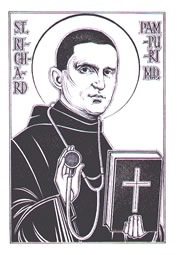
It's not just All Saints Day today; it's also the Feast Day of St. Riccardo Pampuri who is Minnesota's only saint, so far!

.
On this date in 1989, St. Riccardo Pampuri was canonized by Pope John Paul II (the Great).

St. Riccardo,
born August 12, 1897 in Trivolzio (Lombardy), Italy, was a physician who was employed for some time at the Mayo Clinic in Rochester. He died 1 May 1930 in Milan, Italy. Apparently there is a statue of him in St John the Evangelist parish in Rochester. More research is needed.

St Blog's favorite search engine, Google, has provided us with a little more on our new Saint, including a translation from the Italian,
Here.

Cripta with the Body of Saint Riccardo Pampuri Saint Riccardo Pampuri The Church of TrivolzioSaint Riccardo Pampuri

The Vatican on St Riccardo Pampuri, O.H. (1897 - 1930)


Hospitaller Brothers of Saint John of God

Canonized 1 November, 1989, only the fourth physician ever


The presence of Riccardo in our church is a beautiful gift of memory as together we beg for the grace of healing in the name of Jesus. Our many visitors come as beggars with hearts longing and asking for strength in the face of suffering and medical needs.

We are prayerfully mindful of everyone who serves at the Mayo and Olmsted Medical Community and all of the sick. We pray through the intercession of San Riccardo that all our sisters and brothers know the comfort of trusting the presence of Christ who gives purpose and meaning to sacrifice.
San Riccardo, pray for us.

Church of St John the Evangelist, Rochester, MN


San Riccardo Pampuri - Wood
The statue of San Riccardo is a gift from Msgr. Luigi Giussani
founder of Communion and Liberation, Milan, Italy


Google Directory: St. Riccardo Pampuri


In addition to St. Riccardo, the cause for the canonization of another Italian, Dr. Giancarlo Rastelli, who also served at the Mayo Clinic as a pioneer pediatric heart surgeon until his death in 1969 from Hodgkin's Disease, has been opened in Italy.

And of course, the Servant of God, Solanus Casey, born in Prescott, WI, across the river from Hastings, MN, has been pending for some time. Just last month it was reported that the second miracle need for him to be declared "Blessed" has been found and sent to Rome. If Solanus is canonized, he would become the first American born male saint.

Wednesday, October 3, 2007

Diocese embraces new bishop like a son

..
The dancers from St. Francis Solanus School on the Lac Courte Oreilles Reservation wanted to be photographed with Bishop Peter F. Christensen at the reception in the cathedral school gymnasium following the installation ceremony. From left they are James Martin, Joshua Martin, Simone Stevens, Jeffrey Taylor, Alayna Benitez, Cody Wilson, Billie Jean Chosa and in front wearing a single feather, Georgia Rose Bogat. (Catholic Herald photo by A.M. Kelley)


SUPERIOR -- Bishop Peter F. Christensen was installed as the 10th bishop of Superior on Sept. 23. But the crowd who packed the Cathedral of Christ the King on this auspicious day made the celebration seem like a homecoming, greeting and embracing him as a son.

It was the kind of day that people in the north are so fond of: sunny and warm--but not too warm--breezy, but not enough to warrant protection. And everyone who planned and anticipated the event was certain that it was not going to rain. It just would not happen.

Rain would have made the rite difficult as it began outside on the plaza. The visiting bishops, diocesan priests and deacons lined up with an honor guard of more than 50 Knights of Columbus.

Two children, American Indian drummers from St. Francis Solanus School on the Lac Courte Oreilles Reservation under the care of their teacher Sr. Felissa Zander, SSSF, signaled the start of the procession and 10 dancers led the new bishop from the rectory to the massive doors of the cathedral.

There he knocked three times. He was asking to be admitted. During his ordination ceremony a week earlier in St. Paul, Minn., a 13-year-old student at Christensen's former parish school, Nativity of Our Lord, said that he had explained this part of the unique liturgy during a visit to her classroom.

"He's worried," she said. "Will they open the door for him?"

Yes, it was opened and later during Christensen's first homily in his new home parish, he introduced himself simply: "It's good to be here."

About 900 people filled the cathedral and another 100 were seated in front of a video screen downstairs. At a reception afterwards many waited in line in the cathedral school gymnasium to personally greet their new bishop and introduce themselves.

The prioress of St. Scholastica Monastery in Duluth, Minn., Sr. Lois Eckes, OSB, told Christensen that the sisters would like him to be their guest at the monastery when he is "settled" in his new job.

Rice Lake residents Deacon Ron and Karen Novotny presented the former Minnesota resident with their (well-intentioned) idea of a welcome-to-Wisconsin basket of goodies: a Packer cap and paraphernalia.

"The Vikings lost today," Christensen said, a little redundantly. (For the record, Green Bay won.)

Many in the crowd, like Superior resident Char Bachlund, were excited to witness the installation of the new bishop.

"It's so wonderful to be a Catholic," Bachlund said. "That's how (the ceremony) made me feel. It was almost like being in Rome."

She has never been to Rome but imagines that ceremonies there could not be any grander than this one at the cathedral where she received her first Communion, was confirmed and married her husband Ramon.

"I enjoyed the service," she said. "We're so lucky to have him.

Douglas County district attorney Dan Blank felt the same way.

"This reminds you how great it is to be Catholic," he said. "The ritual, the assembled priests, the vestments. This just really takes it back to our traditions."

Blank was able to share a few words with Christensen about his particular concern: the diocesan schools.

"I told him that the parents of all the Catholic students are praying for you," Blank said. "The schools are hurting. Enrollments are declining."

Sr. Jeanne Wiest, OP, the pastoral associate at St. Peter the Fisherman in Eagle River said she felt "hopeful" and cathedral parishioner Terry Mikel said, "he's wonderful and I thought the last bishop was wonderful."

Christensen's interaction with Bishop Raphael M. Fliss during the ceremony was the "most touching" moment of the day for Sr. Virginia Schwartz, OSM. She is the parish director of St. Ann Parish in Cable and thought that the new bishop showed himself to be "caring and sensitive" in thanking Fliss and then embracing him. It was a small action that meant a lot.

Schwartz also said she liked Christensen's easy handling of some minor blips during the liturgy: dealing with annoying feedback in the sound system and then later forgetting to pick up his crosier.

"I'm still so new at this," he said.

Most of the attendees were meeting Christensen for the first time, but some at the installation held long histories with him.

A number of Nativity parishioners were in Superior to see their pastor off, among them were, Lucy and Jerry Alfveby. However, they didn't have tickets, which were distributed equally to all parishes in the diocese to manage the limited number of seats.

"I asked Fr. Peter about it," Alfveby said. He told the couple not to worry. "'You're family,' he said."

Another couple not meeting Christensen for the first time on Sunday were Patrick and Diane Ricci.

"We met Bishop Peter 17 years ago in our home when he came to interview Andy for the seminary," Patrick said.

"Andy" is Fr. Andrew Ricci, their son who is now the pastor of St. Francis de Sales and also the director of vocations for the diocese.

The installation drew at least one couple that thinks the naming of a new bishop will close a difficult chapter in the life of the diocese.

Allan Jirele and his wife Mary, members of Sacred Hearts of Jesus and Mary, Crescent Lake, felt that the Pope Benedict XVI's choice of Christensen heralds significant changes for the diocese and a separation from past abuse scandals.

"This new bishop will put a renewed face on Catholicism," he said.

While Jirele welcomes moving forward he also hopes Christensen will take the diocese somewhat back to what once was.

"We are students of our faith, Mary and I," Jirele said. "The cathechesis was lost between Vatican II and today. The church has realized that we have an adult population who does not know its faith."

Then alluding to Christensen's background as the rector of Saint John Vianney College Seminary, Jirele talked about his hope for more seminarians in the future.

"We've got a huge priest shortage," he said. "(Christensen's) gift to the church will be (more) vocations."

Deacon Joseph Wesley from St. Francis de Sales in Spooner stood in line with his wife Ruth to greet and welcome their new bishop. Smiling afterwards he summed up the feelings of many present.

"He's one of us," Wesley said, "one of the people." Superior Catholic Herald

Monday, March 20, 2006

Calendar of Events March 21 - 25

Thanks to The Catholic Spirit

Tuesday, March 21:

Rally for marriage at the state Capitol: 11:30 a.m. to 12:30 p.m. at the state Capitol, St. Paul. Demonstrate support for the Minnesota Marriage Amendment. For information, call (651) 291-4488, or visit www.archspm.org/family.


Wednesday, March 22:

Organ recital series at Good Shepherd: 11:30 a.m. at Good Shepherd, 145 Jersey Ave. N., Golden Valley. (763) 544-0416, ext. 853.

Thursday, March 23:

Grief support group: 4 to 6 p.m. at Holy Name of Jesus, 155 County Road 24, Wayzata.Topic is “Moving On.” Sponsored by the West Suburban Grief Support Coalition. (612) 801-2491.

High school and college tuition planning seminar: 7 p.m. at St. Charles Borromeo School, 2727 Stinson Blvd. N.E., St. Anthony. For more information, call Education Resource Partners at (651) 246-1497.


Friday, March 24:

Lenten speaker series at Holy Family: 7 p.m. at Holy Family, 5900 W. Lake St., St. Louis Park. Stations of the Cross, followed by Dr. Stephen Najarian, who will speak on medical ethics for the end of life based on Catholic teaching.

‘Food for Folk’ dinner at St. Mark: 6 p.m. at St. Mark, 1983 Dayton Ave., St. Paul. Fundraiser for the Food for Folk project includes a salmon dinner, speaker and live music. Cost is $25 at the door. For tickets, call (612) 330-1624.

Speaker series at St. Helena: 7:30 to 9 p.m. at St. Helena, 3204 E. 43rd St., Minneapolis. John Boyle will speak on “St. Thomas More: A Model of Holiness for the Modern World.” (612) 729-7321.


Saturday, March 25:

X Committee presentation at Transfiguration: 3 p.m. at Transfiguration, 6133 15th St. N., Oakdale. The X Committee is a group of people who have experienced homelessness. Hosted by the Transfiguration Social Justice Ministry. (651) 738-2646.

Mirror of True Womanhood spring conference: 8:30 a.m. to 4 p.m. at Providence Academy, 15100 Schmidt Lake Road, Plymouth. Cost is $55. For information, visit www.MirrorOfTrueWomanhood.org, or call (651) 714-9085.

‘Solanus’ at St. Mark: 7 p.m. — Saturday and 2 p.m. Sunday at St. Mark, 1956 Marshall Ave., St. Paul. A drama about the life and times of Father Solanus Casey. Tickets are $10 for adults, $5 for children and children under 5 are free. (651) 645-5717.

Antique and collectibles sale at Immaculate Heart of Mary: 8:30 a.m. to 3 p.m. Saturday and noon to 3 p.m. Sunday at Immaculate Heart of Mary, 1550 Summit Ave., St. Paul. Proceeds to support Habitat for Humanity. (651) 698-4782.

Rummage sale at Corpus Christi: 8:30 a.m. to 3 p.m. at Corpus Christi, 2131 Fairview Ave. N., Roseville. Proceeds benefit the retirement fund for the School Sisters of Notre Dame of Mankato. (651) 486-4823


Don't Miss:

“An Evening Affirming Human Life and the Family”
will be held March 25 at St. Helena, 3201 E. 43rd St., Minneapolis.

The event begins with social hour at 5 p.m., dinner at 6 p.m. followed by entertainment an a talk by Arthur Hippler, director of the Office of Justice and Peace for the Diocese of La Crosse, Wis.

Tickets are $25 per person and must be purchased by Thursday, March 23. Complimentary tickets are available by calling (612) 729-7321.

Friday, August 3, 2007

The Life and Death of Religious Life

.

.
from First Things Magazine
(June/July 2007)

Note: This article has been significantly shortened.

It was a truism—universally accepted until the last decades of the twentieth century—that, wherever the Catholic Church was present, there would be representatives of the religious life: communities of vowed men and women living a frugal common life, praying and working together in Christian service, and offering a witness to the kingdom of God. They belonged to congregations that explicitly took on the responsibility of answering the gospel’s call to leave family, lands, and ownership to follow Jesus Christ.

Similar religious communities existed in smaller numbers in the Orthodox churches. Even today, many older people were taught, guided, and cared for by an impressive army of religious sisters, brothers, and priests. They numbered at least three hundred thousand in the United States on the eve of the Second Vatican Council, and their ranks were swelling. From Trappists to Jesuits, from cloistered Carmelites to Sisters of Charity, the religious could be found everywhere, celebrating the liturgy and common prayer, and frequently serving those with personal needs, especially the poor and the sick.

Most of these communities are now in a state of collapse, with the average age of members in the upper seventies, and no recruits in sight. My own experience offers a sad example. In 1951 I entered the Capuchin province of Detroit, which had almost seven hundred friars. The Capuchins were the fourth-largest religious order of men in the Church. They had produced such examples of sanctity in our time as Padre Pio of Pietrelcina, now declared a saint, and the Venerable Solanus Casey, who may soon be beatified. There were almost 150 friars in formation in the Detroit province when I joined. Today the province has fewer than a dozen men in formation.

Against that decline, one has to set the number of new communities that have appeared in recent years—made up of deeply dedicated men and women who are part of what has come to be known as the John Paul II generation. I belong now to a reform movement, founded by eight Capuchins and known as the Franciscan Friars of the Renewal. We currently have 115 friars and some twenty-five sisters. Because I was the first servant, or superior, of our community, many people ask me, “What are you doing to thrive in a wasteland?” Occasionally someone inquires, “What can we do to see religious life return?” I have thought much about these questions.
[...Snip]
The collapse of the large religious orders of men and women in the Church can be attributed to a variety of factors that coalesced at the same time. The disaster has been well described by the well-known anthropologist Fr. Gerald Arbuckle, S.M., in two important books: Strategies for Growth in Religious Life and Out of Chaos: Reforming Religious Congregations. Religious life, Arbuckle argues, was drawn into the same cultural revolution that undermined family life and higher education in the late 1960s. Unfortunately, the Catholic religious, who had been taught not to think for themselves, followed like sheep. Many of the most strident voices, which demanded the removal of the foundations of religious life, departed after eviscerating the life and constitutions of their communities. Those who sincerely attempted to lead a spiritual life found themselves with little effective leadership.

I once heard a well-meaning and well-educated sister of a respected teaching order tearfully observe at a seminar, “We did what we were told to do.” The obvious question “Who told you?” must be asked. Christian religious are called without exception to lead a gospel life and follow the Scriptures and the traditions of the Fathers, the Church, and the saints. These sources, which were always there, were almost completely ignored. Instead, many shaky theories of psychology, most of them now gone over the waterfall of time, were substituted for the gospel and sacred teaching. Alien and awkward things were introduced into the spiritual life, some of them borrowed from totally misunderstood Asian traditions. We have only to look at the offerings of retreat houses run by some religious congregations to discover how silly people intending to be serious can sometimes become.

Along with this came the impact of psychotherapy, which as a result of the discoveries of Sigmund Freud focused almost entirely on undoing what were seen as repressive mechanisms in the personality. Contemporary positive psychology has rejected the general intellectual and emotional bankruptcy of this position. Although some people did get to feel better, they did not necessarily do better or come closer to their eternal goal. As one founder of positive psychology, Aaron Beck, has pointed out, there was an almost complete lack of common sense in psychotherapy from the 1940s to the 1980s.

The necessity of grace for the spiritual life was also ignored. Semipelagianism, or even full-blown pelagianism, practically denying the necessity of grace, was observable on all sides. Thus, for example, the widespread popularity of the therapy and pelagian assumptions of Carl Rogers, one of the creators of client-centered therapy, practically wiped out a large and respected congregation in California in a single summer.

On top of this, the two major underpinnings of Catholic religious life were seriously weakened in their presentation. The first was the credibility of Sacred Scripture. The rules of many religious orders say explicitly that they are founded on the gospel. As a result of skeptical and rationalistic criticism of the New Testament, the scriptural foundation of religious life was undercut. The rule of life of the Franciscan order, for example, is to observe the gospel—but if the popular scholars are telling us that Jesus didn’t do this, didn’t say that, didn’t mean the other thing, what are we to do?

There was also what Pope Benedict XVI has referred to as the “collapse” of liturgical life. The intellectually and spiritually impressive liturgical movement that was growing in the United States after the Second World War—a movement founded on insights cultivated in the Benedictine abbeys—gave way to a misunderstanding of the liturgy as primarily entertainment. The goal was to get everybody involved, but the question remains: Involved in what? In religious communities and parishes across America, liturgical committees were suddenly filled with people who had never studied anything of substance about the Church’s liturgy. Eminent liturgical writers such as Romano Guardini and Louis Bouyer deplored this popular and often well-intentioned debasing of the liturgy.

In addition, a general theological confusion prevailed in the 1970s and 1980s, undisciplined and unrestrained in nature, which deeply penetrated religious communities and seminaries. I am well aware of it because I was thrown out of four seminaries during those years for the offense of being a Catholic, even though I was only teaching pastoral counseling. This period of theological confusion has largely come to an end and is roundly rejected by today’s young candidates for religious life or the priesthood.

Finally, strange as it may seem, the ideas of Marxism, a philosophy that did untold damage to the lives of hundreds of millions of people, suddenly began to appear in religious communities during this era. I spoke to someone a few years ago who had attended the more avant-garde meetings of religious sisters. I asked what the main topic of conversation was. I was flabbergasted when I was told that it was the teachings of Friedrich Engels. (Poor Engels never thought that the last people to take him seriously would be Catholic nuns who had gone off the rails.)
[...Snip]
A surprising and welcome development at the present time is the emergence of a whole wave of young men and women interested in authentic religious life. They provide proof of the ongoing presence of God’s grace—as well as the validity of the anthropological theory of liminality. These young people surprise us by their willingness to join even communities beset by obvious theological confusion and little observance of their traditional rule. If they manage to survive for twenty years, the appearance of the sinking communities may change. In some communities there is an absurd phenomenon similar to a theological sandwich: The youngest and the oldest, who are in agreement, are like slices of bread. The age group in the middle reminds us of mayonnaise.

Something in human nature has been calling people to religious life for thousands of years—and gospel teaching and church tradition have aimed this human hunger at a strong form of Christian dedication. We should have learned by the disastrous experience of the twentieth century that we cannot afford the luxury of frivolous attempts at silly spirituality and self-seeking. We cannot continue to be misled by untested and unscientific sociological and psychological theories.

There hardly seems a mistake that religious orders did not make. Corruptio optimi pessimum, the old Latin proverb runs: Corruption of the best becomes the worst. We have seen it for forty years. The generation formed since John Paul II became pope is clamoring for something better. Read it all at Roman Catholic Vocations

Wednesday, December 9, 2009

Remembering Fulton Sheen

.
If the Twin Cities were located in Italy, we'd probably have a couple dozen patron saints to whom we could pray for our special intentions. Alas, we have none, yet. And we have to expand our boundaries a bit to become inclusive. The Venerable Solanus Casey, born and raised in Prescott, Wisc., across from Hastings, is about as close as we can get so far. Many, including Father Benedict Groeschel of EWTN and the Franciscan Friars in New York are praying for his canonication.

Rochester has a couple of Italian doctors who have been canonized. They served for a time at the Mayo Clinic. St. John's University has the relics of an old Roman, St. Peregrine.

But in time, we might have a real connection if the canonization process of Archbishop Fulton Sheen who graduated from the St. Paul Seminary in 1919 and was ordained in Peoria, Ill. succeeds. Pray for that. Abp. Sheen's career as a priest, a bishop, a preacher, an apologist, a television and radio personality made him known to millions, of all faiths.


Today is the thirtieth anniversary of the death of Archbishop Fulton Sheen, who was revered by millions of Americans because of his great gifts in preaching and writing about the truths of the Catholic faith – and about the great heresies of the twentieth century.

Fulton John Sheen was born over his father’s hardware store in El Paso, Illinois, on May 8, 1895. An outstanding student, Sheen attended St. Victor’s College in Bourbonnais, Illinois, and later, realizing he had a religious vocation, entered Saint Paul Seminary in Minnesota.

Ordained a priest on September 25, 1919, he was not assigned a parish, but was sent to The Catholic University of America for graduate studies. Upon earning his Master of Arts degree, he traveled to Europe for additional education. After earning a doctorate of philosophy from the University of Louvain and a doctorate in sacred theology from the Angelicum in Rome, Sheen was offered teaching positions at Oxford and at Columbia University. Sheen sent a letter to his bishop asking, “Which offer should I accept?” The answer was, “Come home.”

In the summer of 1926, Father Sheen was summoned to the bishop’s office, who informed him, “Three years ago I promised you to Bishop Shahan of The Catholic University as a member of the faculty.” Sheen asked, “Why did you not let me go there when I returned from Europe?” “Because of the success you had on the other side, I just wanted to see if you would be obedient. So run along now, you have my blessing.”

Sheen was to teach for twenty-five years. During this period, his reputation as a preacher and Catholic apologist grew, and invitations to speak and preach throughout the nation poured in. In 1930 the American bishops invited him to represent the Church on NBC’s nationally broadcast show “The Catholic Hour,” and he appeared on that show until 1951, when he switched from radio to television.

Many believed Sheen had the ability to become the greatest Catholic philosopher of the twentieth century. His duties at The Catholic University, however, became minimal; he eventually taught only one graduate course a year. The chairman of the philosophy department, Father Ignatius Smith, explained, “I was often criticized for not giving him more work, but I felt he was doing more good on the outside.”

Sheen accomplished much on the outside. He produced at least one book a year, wrote two weekly newspaper columns, became national director of the Society for the Propagation of the Faith, and edited two magazines. Also, he was instrumental in numerous conversions, including Clare Booth Luce, Henry Ford II, Communists Louis Budenz and Elizabeth Bentley, and violinist Fritz Kreisler.

Sheen had the rare ability to take complex philosophical and theological concepts and translate them into language the person on the street could understand. Witness this from 1933:

Never before in the history of the world was there so much knowledge; and never before so little coming to the knowledge of the Truth. Never before so much straining for life; never before so many unhappy lives. Never before so much science; never before was it used so for the destruction of human life.
Or this from 1944:

In religious matters, the modern world believes in indifference. Very simply, this means it has no great loves and no great hates; no causes worth living for and no causes worth dying for. It counts its virtues by the vices from which it abstains, asks that religion be easy and pleasant, sneers the term “mystic” at those who are spiritually inclined, dislikes enthusiasm and loves benevolence, makes elegance the test of virtue and hygiene the test of morality, believes that one may be too religious but never too refined. It holds that no one ever loses his soul, except for some great and foul crime such as murder. Briefly, the indifference of the world includes no true fear of God, no fervent zeal for His honor, no deep hatred of sin, and no great concern for eternal salvation.

His insights went beyond strictly religious questions. The books – e.g., Liberty, Equality and Fraternity (1928), Freedom Under God (1940), Whence Come Wars (1940), For God and Country (1941), A Declaration of Dependence (1941), God and War (1942), and Communion and the Conscience of the West (1948) – educated Americans on the evils of Nazism, fascism, and communism.

In 1951, now Bishop Sheen appeared at Manhattan’s Adelphi Theatre and said to America, “Thank you for allowing me into your home.” It was the beginning of his award-winning television show, “Life Is Worth Living.” He was the first (and possibly only) religious leader with a show sponsored by a major corporation.

“Life Is Worth Living” was up against “The Milton Berle Show.” Every week America asked, “Shall we watch Uncle Miltie or Uncle Fultie?” Sheen’s ratings skyrocketed, and Mr. Television was knocked off the top of the ratings chart.

The show continued until 1957 and had an estimated audience of 30 million. The bishop, who covered various subjects from psychology to Irish humor to Stalin, received 8-10,000 letters a day. In 1964 Sheen appeared on a weekly show entitled “Quo Vadis America,” and in 1966, “The Bishop Sheen Show.”

On October 2, 1979, seven days after celebrating the sixtieth anniversary of his priesthood, in St. Patrick’s Cathedral in New York, Pope John Paul II embraced Archbishop Sheen and told him, “You have written and spoken well of the Lord Jesus. You are a loyal son of the Church.”

On December 9, 1979, Archbishop Fulton Sheen died in the Lord. He was buried beneath the main altar at St. Patrick’s Cathedral, where he had preached for many years. In a nation that still harbored anti-Catholic sentiments, Sheen gave Catholicism a public face that made the Church and its teachings acceptable to millions of Americans.

Archbishop Fulton Sheen, God love you – and pray for us. The Catholic Thing

George J. Marlin is an editor of The Quotable Fulton Sheen (Doubleday Image).

Wednesday, October 3, 2007

Superior's Tenth Bishop Installed at Christ the King Cathedral - Peter F. Christensen

.


.
The Cathedral of Christ the King was filled to overflowing Sept. 23, for the installation of Bishop Peter F. Christensen as the 10th bishop of the Diocese of Superior. Christensen was ordained a bishop Friday, Sept. 14, at the St. Paul Cathedral in St. Paul, Minn. Christensen has been pastor of Nativity of the Lord Parish in St. Paul.

The installation began with a group of American Indian dancers from St. Francis Solanus Parish in Reserve leading Christensen to the doors of the cathedral. Christiansen knocked three times on the cathedral door and was welcomed by Fr. Daniel Dahlberg, rector of the cathedral. After crossing the threshold, he reverenced a crucifix with a kiss and proceeded to the baptismal font, where he blessed himself and everyone attending the Mass.

The procession into the cathedral included a Knights of Columbus Honor Guard, priests and deacons, Christensen, who was the celebrant of the Mass, Bishop Emeritus Raphael M. Fliss, and visiting bishops, including Archbishop Timothy M. Dolan of Milwaukee, who was the installing bishop and Archbishop Pietro Sambi, apostolic nuncio to the United States.

Fliss said a few words of welcome. "It's with great delight that I welcome all of you here on this beautiful autumn day in northern Wisconsin. I welcome you to this cathedral church, in the see city of Superior, which takes its name from the great lake, which the native people called Gitchee Gumee." He added that Lake Superior inspired both awe and dread in the early missionaries who traveled the area by canoe and snowshoes.

Fliss welcomed Sambi and Dolan, as well as all the other bishops and archbishops in attendance. "But, most of all," he said, "I joyfully welcome you, Bishop Christensen." He added that for two years the diocese had waited and hoped and prayed and "speculated with abandon" about his successor. "Today all this comes to fulfillment. É and so, as my final act as apostolic administrator, I entrust to you, Bishop Christensen, the church of Superior--the many people and priests who have endeared themselves to me these 28 years. I trust you will be as inspired by their lives and enriched by their faith as I have been. Welcome, Peter, and God bless you."

Following the welcome, the apostolic letter from Pope Benedict XVI, appointing Christensen bishop of Superior, was shown to Sr. Eileen Lang, chancellor of the diocese; the college of consultors, which is made up of some priests of the diocese; and the assembly.

The chancellor then announced, "Let it be known that, in accord with the provisions of canon law, the college of consultors has duly examined the apostolic letter of His Holiness Pope Benedict XVI by which the Most Rev. Peter F. Christensen is appointed the 10th bishop of the Diocese of Superior."

The apostolic nuncio then read the letter aloud. Applause signified the assembly's consent.

To formally acknowledge Christensen's position as bishop, Dolan led him to the cathedra (bishop's chair) and presented him with the symbol the office of bishop, his crosier.

As they were each introduced by Lang, FSPA, representatives from the presbyterate, the diaconate, religious congregations, the local ecumenical community, local civic officials, the laity, the American Indian community, the diocesan pastoral and education departments, Catholic Charities and the chancery staff came forward to greet their new bishop.

One of the lighthearted moments came when Lang introduced "Mrs. Patricia Wildenberg, your secretary." That got a laugh from the bishop and all of those assembled.

The newly installed bishop delivered the homily, which was interrupted with applause several times. He began with, "It's good to be here. What a beautiful cathedral, a magnificent symbol of our Catholic faith, filled with good, faithful people. It's good to be here."

He thanked the various individuals and groups involved in planning and participating in the installation liturgy. Of Fliss, the retiring bishop, Christensen said, "You are known for your kindness, gentleness and your gracious service to the people here."

Christensen talked about his motto. He said he chose "You are the Christ, son of the living God," when he was ordained to the priesthood, but the meaning has never been more evident that the past three months since he learned of his appointment.

He told the story of the call he received from Sambi, telling him he had been appointed bishop of Superior. He said he was so surprised that he didn't say anything and there was a long pause. Sambi asked, "This is Nativity Parish -- You are Fr. Peter Christensen?"

Christensen said Sambi introduced the call with a beautiful Scripture passage where Jesus and the Apostles are out on the Sea of Galilee. Jesus approaches on the water and says, "Come to me, Peter. Come to me. Do not be afraid. The archbishop said to me, 'Do not be afraid.'"

Christensen also talked about the proclamation of faith and oath of obedience he had to make before his ordination. Included was a pledge to be faithful in carrying out the ministry that has been entrusted to him and to ensure that the truths and teachings of the church are handed down pure. He added that he delights in these promises.

Part of his mission as a bishop, Christensen said, will be to show particular affection to all priests and deacons, to all men and women religious. "I will likewise take great care to promote spiritual vocations."

He will also recognize and promote ministries of lay people and especially promote the work of evangelization and will encourage family life. "I will stand with you to build strong families in faith," he said.

"I would encourage all of us, including myself, to remain faithful to prayer. That's where the dialogue takes place."

He held up a small volume of St. Augustine's "Confessions." One of his parishioners at Nativity Parish in St. Paul had given the 1686 edition of the book to Christensen as a going away gift. St. Augustine of Hippo is the patron saint of the Diocese of Superior.

He said the parishioner pointed out that when that volume was printed, missionaries were just beginning to preach Christianity in what would become the Diocese of Superior.

Christensen quoted Augustine's prayer about his coming late to the faith, "Late have I loved thee, O beauty, so ancient and so new," and said his feelings for the diocese echo Augustine's words. Christensen is getting to know the diocese "late" at the age of 54.

After a few remarks by Dahlberg, welcoming Christensen as bishop and as pastor of the cathedral, the installation Mass ended. Superior Catholic Herald

Wednesday, August 16, 2006

Hey, We've Got Ourselves Our Very Own Saint to Pray To

.
It looks like the Venerable Solanus Casey, Servant of God, born near Prescott, WI, employed in Stillwater, MN and Superior, WI, later to become a Capuchin priest in Detroit, might have to cede his postion as the probable first Saint from our area. [How foolish our dearth of saints must look to Italians who probably have a couple in every village]!

Susan from St Mary's U in Winona (although I don't believe she lives there), informs us that St Riccardo Pampuri, born August 12, 1897 in Trivolzio (Lombardy), Italy, was a physician who was employed for some time at the Mayo Clinic in Rochester. He died 1 May 1930 in Milan, Italy. Apparently there is a statue of him in St John the Evangelist parish in Rochester. More research is needed.

St Blog's favorite search engine, Google, has provided us with a little more on our new Saint, including a translation from the Italian,
Here.

posted by Ray from MN @ 1:38 PM -Permalink 1 comments links to this post

Thursday, March 11, 2010

Another possible Upper Midwest Saint we might claim? Bishop Frederick Baraga

.
There just doesn't seem to be much evidence that Minnesota has been the home for any significant period of time of a Saint of the Church. Oh, we have a few Saints and "almost Saints" who visited or worked here, one even Roman saint who is buried here. But nobody we can pray to as "our Saint."

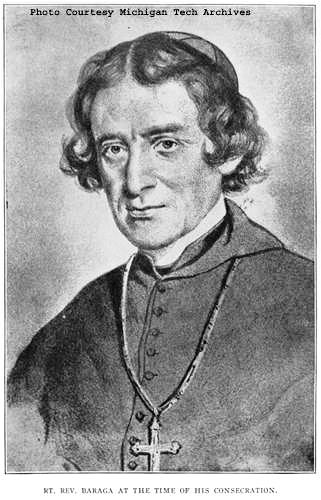
Here, courtesy of "Father Z", is an article on another visitor who might be a Saint some day. 19th century Slovenian missionary, Bishop Frederic Baraga, bishop of the mission territory that was comprised of the region around Lake Superior, apparently is in the early stage of the long process of canonization. Bishop Baraga's large diocese was headquartered in Marquette, Michigan. Many Minnesota residents had the bishop as their ordinary when they first worked in the iron ore and copper mines of the Upper Peninsula of Michigan before they moved to one of Minnesota's three iron ranges.


A miracle through Bishop Baraga?

[Father Z] I believe my friend, now Bishop of Marquette, H.E. Most Rev. Alexander Sample was once the postulator for the cause of Bishop Baraga, but that would have been many years ago. The cause has moved along. I believe the positio super virtutibus was already dealt with at the Congregation, but Bp. of Baraga, Servant of God, is not yet "Venerable".

There is now news from Marquette about a possible miracle.

this is from CNA:

Michigan diocese investigates miracle attributed to former bishop

Marquette, Mich., Mar 11, 2010 / 08:26 am (CNA/EWTN News).- The Diocese of Marquette is investigating an possible miracle attributed to Servant of God, Bishop Frederic Baraga. The official inquiry will move the cause for Bishop Baraga’s canonization forward, which was opened for the prelate in 1952.

In press conference on Wednesday, the current Bishop of Marquette, Alexander K. Sample, announced the recent development, saying, “Since my first days as a seminarian studying for the priesthood, I have had great devotion to Bishop Baraga.”

“As his eleventh successor, I am thrilled at the prospect of a miracle that will advance his cause. With all the priests, deacons, religious and lay faithful of the diocese, I give thanks to God for his, holy, priestly, example,” he added.

Father Ronald Browne, who has been appointed to lead the work of the canonical tribunal, explained the story behind the alleged miracle. “We have a case involving what was thought to be a tumor on a patient’s liver that showed up on various tests, including a CT scan and an ultrasound. However, when exploratory surgery was done, there was no tumor to be found,” Fr. Browne said.

The Diocese of Marquette reported that while in the Upper Peninsula, the patient and the patient’s family invoked the intercession of Bishop Baraga and placed his stole on the sick person’s abdomen. Following the prayers, the patient said that the pain in the abdominal area went away.

The diocese explained that in order for the event to be considered as a miracle, it needs to be affirmed as something that science cannot explain and be attributable to the intercession of the candidate for sainthood.

Once the tribunal has investigated the event – the process is scheduled to begin on March 12 – two physicians must testify regarding the physical condition of the patient before and after the event. After the alleged miracle has been verified, documentation will be sent to the Congregation for the Causes of Saints in the Vatican, who will then submit the cause to Pope Benedict XVI. The Holy Father will then determine whether or not Bishop Baraga will be beatified.

If the miracle is recognized as authentic, the diocese will need to verify one more miracle in order for the Michigan bishop to be declared a saint.

Bishop Baraga was born in 1797 in Slovenia, and come to the United States as a missionary to the upper Great Lakes region in 1830. Ministering to the Odawa and Ojibwa Native American tribes, the bishop is said to have traveled throughout the 80,000 square mile territory by means of boat, canoe, horse, dog sled and even snowshoe. Often called the “Snowshoe Priest,” he was consecrated a bishop in 1853 and served until his death in 1868. Bishop Baraga is credited with writing a Ojibwa/English dictionary which is still in use today.

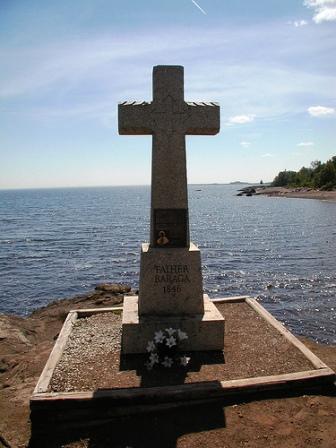
Bishop Baraga also has ties to my native Minnesota. On the North Shore of Lake Superior you can visit "Baraga’s Cross".

Father Baraga's cross

Where the Snowshoe Priest outlasted Lake Superior.

Father Baraga's Cross on the North Shore.


Only tough guys lasted for long around Lake Superior, and Father Frederic Baraga was one of them. The Slovenian priest arrived in 1831 and spent a long and frenetic life canoeing and snowshoeing between Ojibwe settlements in Sault Ste. Marie in Michigan; Grand Portage on the northeastern tip of Minnesota; and La Pointe on Wisconsin's Madeline Island.

One day in 1846, Father Baraga, learning of a possible epidemic among the Ojibwe in Grand Portage, set out from Madeline Island in a small boat with an Ojibwe guide. A terrible storm arose, but they were blown over a sandbar and into the quiet mouth of the Cross River, where the town of Schroeder is today. In thanksgiving, they erected a small wooden cross at the site, later replaced by a granite one.

The Snowshoe Priest, who compiled an Ojibwe dictionary in his spare time, became the first bishop of Upper Michigan and lived until 1868. He's buried in the 1890 Romanesque cathedral of Marquette, where efforts are under way to canonize him.

The Cross River is at Mile Marker 78, or 78 miles from Duluth's Canal Park. It's five miles south of Tofte.


Here are links to Saints and "Almost-Saints" who have a Minnesota connection: Archbishop Fulton Sheen; St. Peregrine; Father Darin Didier; Venerable Solanus Casey; Saint Nino; Dr. Giancarlo Rastelli; and St. Riccardo Pampuri. Search on Stella Borealis in the box in the upper left to find articles about these people.

Wikipedia Article on Bishop Baraga

Sunday, April 22, 2007

The Saints Meme

.
According to my pals at Google without whom I would be lost, the Catholic Church acknowledges over 10,000 official saints, about 9,300 of whom are in Terry Nelson's Rolodex. I never knew a guy who knew so many saints. Now he's tagged me with the Saint Meme where I have to let you know who my favorites are.

Those tagged for this meme will list their four favorite saints, their one favorite blessed, and one person they think should have been a saint.

I was born and bred Catholic and put in my 12 years in the Catholic schools system, taught by good Benedictine nuns and a few priests. Not very many laypeople in those days.

And considering that over those twelve years, putting in over 2,000 hours of class time with Catechism and Religion teachers, I don't recall that we spent a lot of time on the saints. Probably 1,950 hours on the Catechism and other "rules."

Now I was a member of Saint Anthony of Padua parish in Duluth but I don't recall that we ever had any particular devotions to this Portuguese Saint named after an Italian town and nicknamed "Hammer of the Heretics." If I had known his nickname, I'm sure I'd have been quite a bit more interested in having him intercede for me.

We didn't have a lot of statues in our working class, mixed ethnic parish. Your basic Blessed Mother, St Joseph, the Sacred Heart and St Anthony up front, and smaller ones of the Little Flower and somebody else in the rear of the church. St Don Bosco??? But no Feast Days were celebrated except for the ten or twenty for the Blessed Mother in the old calendar. With Nuns in charge, we were always celebrating something or another relating to the Blessed Mother.

My birthnames, of course, would have been a good source for a good patron saint. With Raymond, I had two choices. Raymond of Penafort and Raymond of Nonnatus, both Spaniards. One of them had the gift of "bi-location" which I've often thought would be neat. And the other sailed across some unruly sea on his cloak to perform some healing or other miracle. That would be fun to do on Lake Superior. There were some other "Raymonds", but I didn't have easy access to the Catholic Encyclopedia in those days. My middle name is Edward and St Edward the Confessor, a King of England, while a good and holy choice, he wasn't known for fighting battles and winning wars. Not very appealing.

I did choose Peter for my Confirmation name. I'm not quite sure why. In college I was accused of having a "power complex" and I think that is still true. But I don't believe until quite recently I have ever even asked St Peter for help.

Another source of possible "fave" Saints that I might chosen would have been the Saints upon whose feast days the various members of my family held their birthday celebrations. I got stuck with St Bede the Venerable who with a name like that didn't appeal much to a young lad. I did wonder at the time if in the process of becoming a Saint, he was initially called Venerable Bede the Venerable. What do you suppose he did to make that "Venerable" appellation stick to him.

One brother had the "Conversion of St Paul", but he'd be kinda busy I think; a sister St Polycarp (he may have been great, a pal of St John the Evangelist to be sure, but what a name! Ugh!); another brother had St Romuald (double ugh); and the other sister had her birthday on May 30 which didn't have a saint in the old missal, but being that it was a national holiday, Memorial Day, she was pleased, until they took that away from her. Now she has to work on her birthdays).

Mom had St John the Baptist who might have been pretty cool, but again just with all the churches named for him, I'd think he'd be very busy. But my one "saintly" connection probably was Dad who was born on the feast of St Stephen, the first martyr, who was stoned to death. That was all I knew about him, surprising my teachers that I even knew that, but knowing that was enough to win for me a citywide Catechism contest sponsored by the Knights of Columbus, the prize being a trip to Grand Rapids, MN, for the diocesan finals where I got whompped (by some future bishop, no doubt). But I never expressed any gratitude to St Stephen for helping me win that contest. Thanks, Steve-erino!

You want to talk about your "dry" periods? Mine was from 1960 to 1981. And to tell the truth, it's not particularly damp right now. I'm still working on it. I wasn't disenchanted with the Church. I was disenchanted with getting up for Mass on Sundays.

So I missed out on all the excitement of Vatican II that might have gotten me interested in the Saints as they threw them off the official calendar. I remember two in particular going, St Christopher, of course, whose medal I wore during Basic Training in the Army so I wouldn't get shot by some idiot who would later become an Army cook; and St Philomene (my 9th grade Civics teacher must have been devastated). I still have my St Christopher Medal, but I don't wear it any more.

Now, where was I? Oh yes, Terry wants me to do the Saints Meme. List four saints, a blessed, and someone who should have been a saint.


1. Saint Anne de Beaupre, the Blessed Virgin Mary's Mom. I posted on this one once before, but briefly, there have been a couple of miracles in my family due to her and I have no doubt but that my Mom's prayers to her are responsible for me being back in the Church. I pray to her to intercede for other members of my family.

2. and 3. After I began my reversion, as I mentioned, still a "work in progress", I decided that I should get a couple of Saints to intercede for me. I had lots of things to "fix" and I really needed help. But I figured guys like St Francis of Assisi, St Benedict and St Michael the Archangel would be too "busy" for some basket case like me. So, not being current with what was happening in the Church, I chose a couple of Polish "Blesseds" who I figured few would know about about and they would be sitting in heaven, just waiting for people to ask them for intercession. Blessed Faustina Kowalska, the Apostle of Divine Mercy and Blessed Maximilian Kolbe, Auschwitz martyr and founder of the Militia Immaculata (the Army of Mary). By the way, Max's birth name is Raymond! I think they are a lot more busy now than they were fifteen years or more ago as Maximilian was canonized in 1982 and Faustina was canonized as the first Saint of the Third Millenium in 2000. Well, at least I got in line early!

4. and 5. My Confessor, Father J., has been implying that I'm not humble enough. Hmmmmm. Maybe I should get a new Confessor? No, he's right. I have worked my way through St Therese of Lisieux's "Story of a Soul" three times and I'm beginning to see what she's talking about, but I cannot even begin to conceive that I could be even remotely like that. St Faustina in her diary that I read excerpts of daily, also speaks of humility. Father J recently has been suggesting that I call on my Guardian Angel for help with my "humility gap." Do you still remember that old prayer?

"Angel of God, my guardian dear,
To whom God's love does keep me here,
Ever this day be at my side,
To light and guard, to rule and guide."

It helps!

My favorite "Venerable" is Solanus Casey, Capuchin priest, born near Prescott, WI across the river from Hastings, MN, employed in Stillwater, MN (where I worked for a time) and Superior, WI (across from Duluth where I was born).

It's good to have local connections. I'm sure that had I been born in Italy or Spain, where everyone probably has a choice of a half dozen Saints just from their neighborhood alone, it would have been easier to select a favorite Saint. I suspect kids' gangs gathered around saints and their traditions. In Pamplona where they have the annual "Running of the Bulls", in Duluth they would have held the annual "Running of the Smelt" with processions, not Lester River fish fries and beer busts.


Who do I think should be a saint? Time Magazine, for their 2006 Person of the Year Award, printed a mirror on the front page of their magazine. You, dear ones, should be a Saint. Get working on it. You pray for me and I will pray for you.

I think that Georgette of India (she sounds like a Saint already), Jayne from "So Many Devotions", Sanctus Belle of Our Lady's Tears, the Ironic Catholic and Mitchell, Grand Sachem of the Hadleybloggers at Our Word should let us know who their fave Saints are.