Showing posts sorted by relevance for query chaput. Sort by date Show all posts

Friday, September 26, 2008

Politics and Catholics with Archbishop Charles Chaput of Denver

.
The National Review Online has a TV outlet (video) titled "Uncommon Knowledge" and this week they are interviewing Archbishop Charles Chaput O.F.M. Cap. (born in Kansas, former Bishop of Rapid City and Archbishop of Denver since 1997. He also is partly of Native American heritage). The interview is in five parts. The interviewer is Peter Robinson.


Part One -- Archbishop Charles Chaput corrects House Speaker Nancy Pelosi, who has said the Catholic Church’s teachings on abortion aren’t clear. On the contrary, Chaput says the Church has long held that abortion is always and in all circumstances wrong. He also says Sen. Joe Biden’s position on abortion — that people should not impose their beliefs on the subject on others — is highly flawed.

Part Two -- Archbishop Chaput describes Vatican II as the “primary grace of God to the Catholic Church in the 20th century.” And yet, since Vatican II, the Catholic Church in America has suffered greatly. In particular, the numbers of Catholic seminarians, priests, and nuns have plummeted. Chaput explains why this is, and is not, a dilemma.

Part Three -- The Relationship Between Jesus and Caesar, or between Catholics and the state: First, Jesus acknowledged his responsibilities to Caesar. Second, Jesus demoted Caesar, making clear that “God is God and Caesar is not.” Third, Jesus remained silent about what belongs to Caesar and what belongs to God, allowing for individual determinations on the duties of citizens.

Part Four --
Archbishop Chaput has written that “The logic behind abortion makes all human rights politically contingent.” For example, Chaput explains that if our leaders can decide when life begins, they also can make determinations about when life should end. Overall, Chaput describes what is a coarsening of the value of life in the Western world.

Part Five --
Archbishop Chaput says Catholic Democrats have an obligation to change their party’s platform on abortion, just as Catholic Republicans are responsible for keeping their party pro-life. Moreover, he says the Catholic position on abortion need not be just a Catholic position, but an American position.

Thursday, August 14, 2008

How to Conduct Politics as Catholics. Abp. Chaput's Denver Memorandum

.
A book by American archbishop Chaput is making a stir ahead of the presidential elections, against those who want to water down the faith or remove it from the public sphere. Chaput's book has also elicited strong interest in Rome.

The Archbishop of Denver is one of the premier leaders not only of the Church in America but in the world. His fidelity to the faith, clarity of conviction and inspired leadership have made the Denver Archdiocese one of the premier Sees in America. His latest book book is a blueprint for the exercise of Faithful Catholic citizenship.
ROMA (Chiesa) - A few days ago, a book was released in the United States that will be widely discussed, especially in the run-up to the presidential elections. The author is Charles J. Chaput, archbishop of Denver.

Chaput, 64, born to a farming family in Kansas, is a member of the Native American tribe of the Prairie Band Potawatomi. He is a Franciscan, of the Capuchin order. Before going to Denver, he was bishop of Rapid City in South Dakota. He is among the candidates for two top-level archdioceses waiting for new archbishops: New York and Chicago.

The title of the book itself gives a hint to its contents: "Render Unto Caesar. Serving the Nation by Living Our Catholic Beliefs in Political Life." It is right to give Caesar what belongs to him. But one serves the nation by living out one's own Catholic faith in political life.

Chaput moves decisively against the prevailing cultural tide in the media, in the universities, among political activists, a tide that wants to thrust the faith from the public stage.

But he is also issuing a challenge to the American Catholic community. There are 69 million Catholics in the United States, one fourth of the population. More than 150 congressmen say they are Catholic. In the Senate, the Catholics are one out of four. They are the majority on the Supreme Court. But, the author of the book asks, what difference do they make?

Among the American bishops, Chaput is one of the most decisive in taking clear positions on abortion, the death penalty, immigration. In the controversy over giving communion to "pro-choice" Catholic politicians, he maintains that those who ignore the Church's teaching on abortion are no longer in communion with the faith. They separate themselves from the community of the faithful. And therefore, if they take Eucharistic communion, they commit an act of dishonesty.

In the United States, this controversy remains highly charged. The latest flare-up was set off last April, when during the Masses with the pope on his visits to Washington and New York, the "pro-choice" Catholics Nancy Pelosi, John Kerry, Ted Kennedy, and Rudolph Giuliani received communion.

But Chaput's book goes much deeper. It urges Catholics to live their faith to the full, without compromise. If American Catholics are going through a crisis of faith, of mission, and of leadership – he writes – the task of overcoming this belongs to all, to the faithful as to the bishops.

And this task has repercussions for the entire world. American Catholics cannot tolerate it if the United States exports violence, greed, and disdain for human life. They must work actively to bring their nation back to being a beacon of civilization, of religious harmony, of freedom, of respect for the person.

Chaput's book has also elicited strong interest in Rome. The same day on which it came out in the bookstores, August 12, "L'Osservatore Romano" dedicated an extensive review to it, written by Robert Imbelli, a priest of the archdiocese of New York and a professor of theology at Boston College. Chiesa- Sandro Magister

Magister, acknowledged as one of Italy's most informed lay experts on the Vatican and its doings, usually has his facts together. He mentions Archbishop Chaput as being a possible replacement for one of two cardinals. Cardinal George of Chicago is only 71. Cardinal Egan of New York is already 76 and waiting for a replacement so he can retire. One wonders if Cardinal George has recurring health problems. He suffered from bladder cancer in 2006. Does Magister know something that we here in the U.S. are not aware of?

Monday, March 7, 2011

Archbishop Chaput: Lukewarm Christianity Is A Convient Form Of Paganism!

.
The idols of sex, technology, and the state are particularly prevalent in our day.

Archbishop Charles Chaput of Denver warns on the growing crisis of faith, and the many different forms of idolatry which have choked the life out of Christians and the Church as a whole. The Archbishop warns explicitly on the idols of sex, technology, and the state as being particularly prevalent in our day.

Addressing a gathering of European church officials on March 4, Archbishop Charles J. Chaput of Denver warned that many contemporary Christians have reduced their faith to a convenient “form of paganism,” which cannot compete with the widespread “idolatry” of modern consumer culture.

Archbishop Chaput offered his observations at a conference in Paris honoring the late Cardinal Archbishop Jean-Marie Lustiger, a Jewish convert to Catholicism who was the Archbishop of Paris from 1981 to 2005.

The Denver archbishop described Cardinal Lustiger as “an unsentimental realist” who dared to speak about disturbing trends in the Church and society – including a lack of faith among professed Christians, leaving a vacuum that would be filled by other “gods” such as sex and money.


“Lustiger named lukewarm Christians and superficial Christianity for what they are: a congenial form of paganism,” said Archbishop Chaput. “The Church needs a great deal more of his medicine.”

Many Christians Have Reduced God To An Idol

He recalled Cardinal Lustiger’s prophetic warnings against “creating alibis and escaping the implications of our faith.” In a passage cited by Archbishop Chaput, the cardinal wrote that “many Christians,” through evasions and misunderstandings, had “reduced the God of the Covenant to a mere idol.”

“The main crisis of modern Christianity is not one of resources, or personnel, or marketing,” Archbishop Chaput asserted. “It is a crisis of faith. Millions of people claim to be Christian, but they don’t really believe.”

“They don’t study Scripture. They don’t love the Church as a mother and teacher. And they settle for an inoffensive, vanilla Christianity that amounts to a system of decent social ethics.”

The Worst Kind Of Phony Christianity!

“This is self-delusion,” he warned, “the worst kind of phony Christianity that has no power to create hope out of suffering, to resist persecution, or to lead anyone else to God.”

Archbishop Chaput said that these weakened forms of Christian faith would not be able to compete with the many modern cults of instant gratification and success.

Cardinal Lustiger, he recalled, had “warned that one of the deepest and oldest instincts of man is idolatry.” The Denver archbishop said he sees that instinct taking on several forms today.

“There are no real atheists in America – quite the opposite,” he said. “We have a thriving free market of little gods to worship. Sex and technology have very large congregations.”

The Modern State Is A Great Idol!

“I was especially struck,” he noted, “by Lustiger’s description of the modern state ‘as one of the strongest forms of idolatry that exists; it has become the most absolute substitute for God that men have been able to give themselves . . . and it is a tyrant god, feeding itself on its victims.’”

But the Archbishop of Denver said that these human tendencies, leading to the worship of objects and of oneself, could not be driven out by the mere exercise of authority.

To Purge Christianity Of These Great Idols Demands Total Conversion Of Individuals

“The Christian remedy to these idolatries,” he explained, “can never simply be coerced from the outside, by stronger statements from stronger bishops.” He quoted Cardinal Lustiger’s insight that these forms of idolatry “must be exorcised from the inside … To uproot them, we must be converted in depth.”

He also indicated that Cardinal Lustiger’s unique perspective was just as important for U.S. Catholics today as it was for European Catholics during his lifetime. The cardinal’s work, Archbishop Chaput noted, “continues to influence our seminary formation” at Denver’s St. John Vianney seminary.

“He is a Jew who discovers Jesus Christ … His mother is murdered at Auschwitz. He survives the most horrific war in history, but he refuses to hate and despair. Instead, he turns to God more deeply and gives himself to the priesthood.”

“Most of the young men I meet hunger for examples of manliness, confidence, courage and faith,” Archbishop Chaput noted. “Cardinal Lustiger’s personal story is itself a catechesis – an invitation to pursue God heroically.” Courageous Priest.com

Saturday, August 9, 2008

Archbishop Chaput Recalls "Progressive" Nuns to Obedience

.
(LifeSiteNews.com) - At a meeting of leaders of US Catholic religious orders, Denver's Archbishop Charles J. Chaput, O.F.M. Cap., has urged members to return to the principle of "holy obedience" to the teaching and authority of the Church. The meeting, held this year in Denver, was for the Leadership Conference of Women Religious (LCWR), a group notorious among faithful Catholics for their disregard for Catholic teaching on moral and doctrinal issues, especially sexual morality.

Citing the example of saints and founders of religious orders, Archbishop Chaput called obedience the "yardstick of love," especially for people who have taken the three religious vows of poverty, chastity and obedience.

"Christian discipleship," including the religious life, he said, "demand more than a polite relationship with Jesus and His Church." "He is our Lord and God...What he deserves is our love - a love that is expressed in our worship, in our service to others and in our obedience to the Church."

In his brief welcoming address, Chaput spoke to about 800 members of LCWR and the Conference of Major Superiors of Men (CMSM), at the annual meeting that in 2004 unapologetically hosted Mary Robinson, the former Irish President and United Nations Human Rights Commissioner noted for her international abortion crusading.

Chaput's message was of a radically different kind than is usually heard at the LCWR/CMSM meetings. "The kind of radical love expressed in obedience - an obedience that can make our hearts ache and bruise our vanity - is the seed of renewal in every age of the Church," he said. Conceding that obedience to religious authority can be difficult, Chaput said, "I entered religious life because I wanted to be one of those seeds, because I knew my own happiness depended on it. I am sure you want to be those seeds of renewal too. . . ." [Snip]

Fr. Richard John Neuhaus, the editor of the Catholic periodical First Things, wrote that the LCWR took a prominent role in the 1960s and '70s in "getting women religious to follow the lead of progressive theologians in 'renewing' themselves into virtual oblivion."

"Among [communities] associated with the LCWR," Neuhaus wrote, "many of the active remnant are among the most aggressively disaffected groups in the Church, and some publicly declare that the vocation of their community is to go out of business".

Archbishop Chaput, himself a member of the Franciscan religious order, said, "The Church belongs to Christ, the Church is His spouse and we find His peace through love and obedience to His Church, which is finally not an institution or corporation or bureaucracy, but our mother and teacher."

Chaput's comments about religious obedience have been proved in many of the newer and more faithful communities being founded and developed in the US Church. The Sisters of Life in New York, the Dominican Sisters of St. Cecelia in Nashville and Mother Theresa's Missionaries of Charity, have experienced a steady influx of young vocations, and are all examples of his principle that obedience to and love of the authority of the Catholic Church are the "seeds of renewal."

Meanwhile, LCWR continues to focus its activities on its usual leftist "social justice" issues such as anti-war protests, environmentalism, and anti-poverty political work based on heavily left-leaning economic theories. While the organisation does not officially concern itself with abortion, position papers emphasize immigration, "empowerment of women", wetlands and water resources, "climate change", opposition to the death penalty and "Incorporating the Principles of the Earth Charter."

Earlier this year, Pope Benedict XVI, made a similar appeal as Archbishop Chaput to a group of women religious, saying they were undergoing "a difficult crisis due to the aging of members, a more or less accentuated fall in vocations and, sometimes, a spiritual and charismatic weariness."

The Pope reminded them of their fundamental duty, in accordance with Canon Law, of "keeping the harmony with the magisterium, which avoids creating confusion and bewilderment among the people of God.

Thursday, September 3, 2009

Archbishop Charles Chaput: A Man for Our Season [Pat Madrid]

.
To be a courageous Catholic, the kind which Archbishop Charles exemplifies, requires an unswerving commitment to always and everywhere 'speak the truth in love.'

My first conversation with Archbishop Charles J. Chaput happened over dinner at a mom-and-pop Chinese restaurant in South Dakota in early 1991. He was the bishop of Rapid City; I was working for Catholic Answers and had been invited to conduct a weekend apologetics conference there. From that first meeting, I could tell immediately that I was in the presence of a truly excellent bishop.

"Bishop Charles," as all the Catholics I met that weekend called him with proud affection, personified "down to earth." He was not merely being polite; he clearly was interested and engaged with those around him, listening thoughtfully and offering insights, advice, and the occasional funny anecdote with an easy joviality that put people at ease, while always maintaining the dignity of his role as shepherd of the flock.

I was impressed with Bishop Charles's humility; his palpable love for Christ and the Church; his quiet, understated wisdom; and his obvious pastoral dedication to the spiritual and physical wellbeing of his flock. I've met many bishops over the years, and I knew from that very first conversation with him that I was in the presence of not just a good bishop, but a great man.

A few years later, Bishop Charles become Archbishop Charles Chaput when, on March 18, 1997, he was appointed the new archbishop of Denver. I can recall the profound disappointment among my Catholic friends in South Dakota, all of whom were truly sad to be losing their beloved bishop; and yet, at the same time, they were joyful for the Catholics of Denver, knowing what a great gift they were receiving.

As the years passed, I have watched Archbishop Chaput's pastoral ministry with great interest. My intuitive perception of him in 1991 -- that he is a good bishop and a great man -- was continuously reaffirmed, especially by his courageous, outspoken leadership on critical life and family issues that form the front lines of today's culture wars.

But although Archbishop Chaput is an adroit and effective leader in the cause of proclaiming and upholding Truth, he always manages to engage his opponents with charity and respect, never talking down to people nor becoming rancorous with them, even when they do not respond in kind. His love for Jesus Christ shines through his words and actions as genuine charity for all those around him, including those who oppose the teachings of the Church.

In a recent interview, when asked if he ever became frustrated by the current cultural landscape and the public's seeming indifference to society's collapse, he responded in his usual forthright and courageous manner:

"It seems human history has been a series of times of us not taking the warning signs seriously. I think the reading for the first Sunday of Lent this year is the story of Noah and the flood. They were eating and drinking and carrying on and the flood came. They just weren't willing to take the warnings that God sends us and I think it is true about our time that we are not taking the situation concerning the Church and the world seriously now. . . . I don't know what we can do about it except to be persistent in our preaching and in our continuing to give the warning and that God bring fruit from that if He chooses. We shouldn't give up".

More recently, as a way to further his commitment to preaching the truth to a world that is not inclined to listen, Archbishop Chaput authored the best-selling book Render Unto Caesar, in which he lays out a masterful blueprint for "serving the nation by living our Catholic beliefs in political life."

In one chapter, titled "Men without Chests," he offers this sobering insight into our cultural predicament, the result of the widespread tendency to ignore God's laws in favor of secularism:

"A truly secularized United States would be a country without a soul; a nation with a hole in its chest. Such a state could not stand above tribalism in public affairs. It would become a tool of the strongest tribe. American belief in the sanctity of individual rights depends on a God who guarantees those rights and to whom the state is subordinate and responsible. And this view is not an opinion. It is the historical fact that provided the foundation for the rest of our public life".

"Secularism," he continues, "is a cult -- the kind of rigid separationism where the state treats religion as a scary and unstable guest -- hollows out the core of what it means to be human. It treats the most important part of life, the moral and religious, as a private quirk. It starves a nation's spirit. And it has never been a natural step toward democratic maturity. The rise of American secularism did not occur by chance. It didn't happen inevitably as a result of modern progress. As . . . scholars have chronicled, it came about through the intentional political struggle of secularizing activists in education, science, the media, and the law.Of course, turnabout is fair play. Believers can push back."

Here we see the beauty of Archbishop Chaput's strategy for "serving the nation by living our Catholic beliefs in political life": He shows us how to "push back" without being pushy; how to engage the political process while avoiding the extremes of politicizing our religious beliefs and turning our politics into a religion. In short, as the title of his book quotes Our Lord's teaching, we must render unto Caesar what is Caesar's and render unto God what is God's.

St. Paul echoes this theme in Romans 13:7: "Pay all of them their dues, taxes to whom taxes are due, revenue to whom revenue is due, respect to whom respect is due, honor to whom honor is due."

As everyone who takes his Faith seriously knows, being a faithful Catholic these days, amidst the tumult and temptations in the modern world, is challenging enough. But to be a courageous Catholic, the kind which Archbishop Charles exemplifies so vividly, requires an unswerving commitment to always and everywhere "speak the truth in love.¨ I thank the Lord with all my heart for this good bishop's good example.
Catholic OnLine

Other posts featuring Archbishop Chaput that have appeared on Stella Borealis

Thursday, August 14, 2008

Archbishop Charles Chaput: "Serious Catholicism for a serious election"

.
by George Weigel

Full disclosure, up front: Archbishop Charles Chaput of Denver is an old friend; the Archdiocese of Denver syndicates this column to Catholic papers throughout the country; I played a (very) minor role in introducing Archbishop Chaput to my friends at Doubleday. So I’m not exactly a disinterested party in the matter of the archbishop’s new book, Render Unto Caesar: Serving the Nation by Living Our Catholic Beliefs in Political Life. I trust that doesn’t preclude my suggesting that it’s essential reading for serious Catholics in an election year fraught with consequence for core Catholic issues in 21st century America.

Archbishop Chaput is a pastor, first and foremost; his book is a pastor’s book. It’s informed by scholarship, and by the archbishop’s extensive experience in wrestling with issues at the intersection of morality and public policy. At the same time it’s a book for ordinary Catholics who want to be faithful to the Church and faithful to the first principles of justice in their civic lives. Here’s the argument, concentrated into nine key points.

1. Schizophrenic Catholicism is neither Catholic, nor responsible, nor patriotic. “We have obligations as believers,” the archbishop writes. “We have duties as citizens. We need to honor both, or we honor neither.”

2. Postmodern secularist skepticism about the truth of anything is soul-withering; in C.S. Lewis’s phrase, it makes “men without chests.” The current social, political, and demographic malaise of aggressively secularist Europe is an object lesson, and a warning, for America: “A public life that excludes God does not enrich the human spirit. It kills it.”

3. The new anti-Catholicism in the U.S. is not built around antipathy to the papacy, the sacraments, consecrated religious life, or the other bugaboos of those who once ranted about the “Whore of Babylon.” Rather, it’s an assault on religiously informed public moral argument of any sort, an attack against “...any faithful Christian social engagement.” So we can’t rest easy with the fact that the Catholic Church plays a considerable role in American society. There are forces in the land that would banish Catholicism, and indeed classic biblical morality, from a place at the table of democratic deliberation.

4. Because the Catholic Church’s defense of the first principles of justice—principles that can be known by reason—has specific policy implications for public life, the Church’s teaching has political “side-effects.” Anyone who considers this partisan meddling is simply mistaken. The most powerful “political” statement Catholics and other Christians make is to acknowledge the sovereignty of Christ as the first sovereignty in our lives. This confession of faith in fact helps make democracy possible, by erecting a barrier against the modern state’s tendency to fill every nook and cranny of social space.

5. America was founded on the convictions that there are moral truths that we can know by reason, and that the state has no business doing theology. The result was the vibrant, religiously informed public moral culture that amazed Alexis de Toqcueville in the 19th century. That distinctive American experience later shaped Vatican II’s teaching on religious freedom and the limited, constitutional state.

6. Work for social progress, however noble, is no substitute for ongoing personal conversion to Jesus Christ. True conversion will almost inevitably extract costs in politics. Catholic politicians who seek to avoid these dilemmas by hiding in the underbrush of a public square stripped of religious and moral reference points should reflect on the lives of Thomas More and Martin Luther King.

7. There is a bottom line in all this: the life issues are “foundational … because the act of dehumanizing and killing the unborn child attacks human dignity in a uniquely grave way.”

9. Responsible citizenship means making choices, not simply voting the way our grandparents did. Citizenship is an exercise in moral judgment, not in tribal loyalty.

10. Nothing in politics is perfect, including candidates. Yet unless we fight for the truth, “we become what the Word of God has such disgust for: salt that has lost its flavor.”

Good stuff. Buy one yourself; buy another for a friend. Denver Catholic Register


Monday, August 25, 2008

Nancy Pelosi v. Roman Catholic Church

.
I am pretty new at following the activities of the Church. Frankly, I ignored them for most of my life. And I accept full responsibility for any ill effect that that negligence may have had upon the fate of the Church these past fifty years or so.

Frankly, I have been very depressed about it. Sometimes, the Church just doesn't seem to take any action when its enemies fire their blunderbusses.

Today, we started to fire back.

Nancy Pelosi, the imperious Speaker of the do-nothing House of Representatives in the 100th Congress, was interviewed on Meet the Press on Sunday and stated that as an "ardent practicing Catholic" she knew that the Church really had no knowledge or opinion of when life begins. What can you expect from a "catholic" who depends upon abortionists, pornographers, sodomites, and the like for her support as a representative from San Francisco.

This morning, swashbuckling raider, the Church's first line of defense, Bill Donohue of New York's Catholic League for Religious and Civil Rights fired his opening salvo, accusing Pelosi of denying what her religion teaches. Obama, Pelosi's candidate for President of the United States, was shifty enough to confess that he wasn't paid to know those things. Pelosi just lied, or demonstrated that she was a bad student. Read it here.

Donohue generally finds himself to be virtually the lone warrior when taking on opponents of the Church. That was not the case today. My morale was greatly raised to read the opinions of the following supporters of the concept of life beginning at conception.

Archbishop Charles Chaput O.S.F. Cap. of Denver, the site of the Democratic Convention taking place right now, blasted Pelosi for her Meet the Press statement in his statement entitled "On the Separation of Sense and State." Father John Zuhlsdorf (Father "Z") comments on the Catholic News Agency's reporting on it here.

Abp. Chaput, challenged Pelosi's wishful historical view of abortion with names, dates and sources: "Even during the many centuries when Church penal and penitential practice was based on the theory of delayed animation, the condemnation of abortion was never affected by it. Whatever one would want to hold about the time of animation, or when the fetus became a human being in the strict sense of the term, abortion from the time of conception was considered wrong, and the time of animation was never looked on as a moral dividing line between permissible and impermissible abortion.”

"Ardent, practicing Catholics [Pelosi's description of herself]
will quickly learn from the historical record that from apostolic times, the Christian tradition overwhelmingly held that abortion was grievously evil."

We now know with biological certainty
exactly when human life begins. Thus, today’s religious alibis for abortion and a so-called ‘right to choose’ are nothing more than that – alibis that break radically with historic Christian and Catholic belief.”


Kathryn Jean Lopez, editor of the National Review Online, published her thoughts on Pelosi's Meet the Press appearance, supporting Archbishop Chaput and pointing out that while Pelosi seems to doubt the dogma of transubstantion, whereby the substance of the bread and wine in the Holy Sacrifice of the Mass indeed become the Body and Blood of Our Lord Jesus Christ and her personal catechism would make the Roe v. Wade Supreme Court abortion decision a sacred doctrine, to be treated as a dogma. Father "Z" comments on Lopez' column here.

Radio talk show host, Rush Limbaugh spent an hour going over Pelosi's appearance. Spluttering in an attempt to describe Pelosi's statement, he said he has "often wondered, is she genuinely this uneducated, uninformed, silly, stupid, whatever—and I’ve concluded there isn’t a word to describe the status of her brain."


Columnist Peggy Noonan of the Wall Street Journal wrote on Barack Obama's "pay grade" obfuscation when asked about when life begins. Her comments are still echoing around the battlefield of Archbishop Chaput, Donohue, Lopez and Limbaugh, firing off not a few zingers.

"How about "Let the baby live?. . . We know when life begins. Everyone who ever bought a pack of condoms knows when life begins. To put it another way, with conception something begins. What do you think it is? A car? A 1948 Buick? If you want to argue whether legal abortion is morally defensible, have at it and go to it, but Mr. Obama's answers here seemed to me strange and disturbing."


Cardinal Justin Rigali of Philadelphia and Bishop William Lori of Bridgeport, speaking for the U.S. Council of Catholic Bishops also quickly released a statement, that, among other things, contained this:

"The Church has always taught that human life deserves respect from its very beginning and that procured abortion is a grave moral evil. In the Middle Ages, uninformed and inadequate theories about embryology led some theologians to speculate that specifically human life capable of receiving an immortal soul may not exist until a few weeks into pregnancy. While in canon law these theories led to a distinction in penalties between very early and later abortions, the Church’s moral teaching never justified or permitted abortion at any stage of development. These mistaken biological theories became obsolete over 150 years ago when scientists discovered that a new human individual comes into being from the union of sperm and egg at fertilization." Rocco Palmo

Archbishop Donald Wuerl of Washington, D.C., released the following statement:

The Catechism of the Catholic Church is clear: the current teaching of the Catholic Church on human life and abortion is the same teaching as it was 2,000 years ago. The Catechism reads:

“Human life must be respected and protected absolutely from the moment of conception…Since the first century the Church has affirmed the moral evil of every procured abortion. This teaching has not changed and remains unchangeable. Direct abortion, that is to say, abortion willed either as an end or a means, is gravely contrary to the moral law.” (Catechism, 2270-2271)
Rocco Palmo


I'm feeling much better about the Church in its role as combattant tonight! How about you?


Tuesday, May 29, 2012

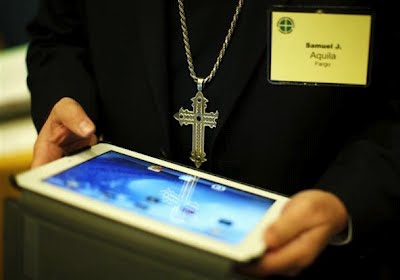
Bishop Samuel Aqula of Fargo to Become Next Archbishop of Denver

It was only a matter of time for Bishop Samuel Aquila to move to a larger diocese than Fargo. Many thought he would have become the Archbishop of St. Paul-Minneapolis when Archbishop Harry Flynn retired. But that wasn't to be.
Archbishop Aquila will have big shoes to fill when he moves to the Mile High city, those of Archbishop Charles Chaput, O.F.M.-Cap., himself a former Bishop of Rapid City, now the Archbishop of Philadelphia, most probably soon to be a Cardinal, making the Dakotas a wonderful incubator of Good Shepherds for the Catholic Church.

Archbishop Aquila is returning "home", after a fashon, having attended Denver's St. Thomas seminary on his way to ordination as a priest of the Archdiocese of Denver..
But Archbishp Aquila has been no slouch from the viewpoint of his Shepherd's See at the top of North America (except Alaska, of course):
Bishop Samuel J. Aquila
Born: 1950, Burbank, California
Education: B.A., Psychology, University of Colorado, Boulder, CO, 1972; M.A., Theology-Dogma, St. Thomas Seminary, Denver, CO, 1976; Licentiate of Sacramental Theology, San Anselmo University, Rome, 1990.
Vocation: Ordained to the priesthood in 1976; Bishop, The Catholic Diocese of Fargo since 2001
On Success: “When people tell me that I have been an instrument of God and have helped to bring them to encounter Jesus Christ.” “Being a spiritual father to seminarians.”
On leadership: “A leader needs to be a person of honesty, integrity, who desires truth, is compassionate and a listener.”
“One who has to make the difficult decisions that are grounded in The Truth.”
Do whatever He tells you” (John 2:5). Mary’s instruction to the waiters at the wedding feast in Cana reminds Bishop Aquila to be a servant of Christ and the Church and to trust Jesus to guide him.
As he visits parishes, teaches through his homilies and speaking to Catholics and non-Catholics throughout the Diocese of Fargo, Bishop Aquila hopes to inspire all of us to give ourselves fully to our Lord, to live our lives according to our faith, and do whatever Jesus calls us to do. Bishop Aquila started his spiritual journey as a parish priest in the 70s and served in parish ministry for 11 years.
“Every priest has it in their heart to serve people,” he reminds us, and he has served the people well. Over the last 30 years, he has accepted positions of increasing responsibility in the church and has earned the honor of being named a Prelate of Honor by Pope John Paul II, receiving the honorary title of Monsignor in 2000.
Ordained a bishop in 2001, Bishop Aquila now oversees 139 parishes, 86 active priests, a number of retired priests, the Cardinal Meunch Seminary and 13 schools located in eastern North Dakota, which covers approximately 36,000 square miles. Bishop Aquila serves on the Bishops’ Advisory Council for the Institute for Priestly Formation.
He is also a member of several United States Conference of Catholic Bishops committees. His responsibilities include teaching though preaching, writing pastoral letters and visiting with priests and parishes. He also oversees the sacramental life and governance of the Church in all churches in the diocese and he attends many monthly and quarterly meetings that are devoted to running the diocese.
Twice a year, Bishop Aquila meets with lay people and priests, who are members of the Diocesan Pastoral Council, about their concerns and pastoral outreach. A typical day also includes an hour in prayer before the Eucharist, and praying five times daily for the church and the diocese.
The admonition from John 2:5, “Do whatever He tells you,” also adds direction to Bishop Aquila’s daily life. Bishop Aquila says he was inspired by the late John Paul II’s ability to teach, preach, and visit with people. He said that John Paul II had a deep goodness about him, living The Faith, enjoying people, and engaging in banter back and forth in conversation with them. He has also worked diligently to meet controversy head-on and to stand for The Truth—especially pertaining to the dignity of human life.
He admires, remembers and applies a quote that John Paul II used often: “Be not afraid.” Much like a corporate CEO, Bishop Aquila manages a large team of people and faces the same challenges. He points out that he relies on a talented staff that does a wonderful job with the day-to-day duties of running the diocese.
Bishop Aquila has learned to set very clear expectations for his staff and to give people the freedom to do their job, allowing them to be accountable for their areas of responsibility. Bishop Aquila says that, over the years, he has learned to trust his gut feeling or intuitiveness more when dealing with staff and daily issues. Bishop Aquila stressed that his primary focus and love is the spiritual side of his calling.
His future goals include continuing to evangelize the truth of Jesus Christ and of the Catholic Church. The Bishop would like Catholics to be more familiar with the Catechism so they can truly understand the real teachings of the church and develop a deeper love of the Eucharist. All in all, Bishop Aquila is striving for them to know The Word, to develop a more contemplative heart and to be silent in order to listen to the Lord. Bishop Aquila believes that, in this day and age, silence can be uncomfortable for people. He said that we are constantly bombarded with noise and activity from Ipods to cell phones to constantly running between activities.
By pursuing regular silence in our lives, he notes, we can hear God’s plan for each one of us and enter in to a deeper relationship with Him. As for time spent in prayerful silence, Bishop Aquila said one of the most profound experiences he has experienced was a 30-day silent directed retreat. He adds that time spent in silence and prayer can offer a real renewal in our family life — the place where stability starts for children.
In addition to prayer, Bishop Aquila believes in the importance of reading and learning. He reads books of the Church Fathers from the early 600s, theological books, as well as biographies and autobiographies of the saints. Reading and reflection helps him see that conversion is an ongoing experience for all of us.
Bishop Aquila has enjoyed all of the many different ministries that he has been involved in over the years and has found real grace in all situations. However, he has enjoyed serving as a parish pastor and seminary rector the most.
This servant of God also enjoys traveling, the water, boating, playing pinochle and began golfing a few years ago. He recently played in a pinochle tournament in Napoleon, ND and commented, “It was a blast!”
I found Bishop Aquila to be a warm and approachable person with a delightful sense of humor. When you talk with him, you have his undivided attention and you can feel his deep commitment to the church and above all, to God.
As he puts it, “I believe that, in Christ Jesus are all of the words and instructions that mankind needs to live life in peace and harmony and to gain eternal salvation.” The priest said to them,”Go in peace. The journey on which you go is under the eye of the Lord.” - Judges 18:6 KFGO Faith (Fargo-Moorhead)


--------------
 The Eagle Returns:  Fargo's Aquila Headed Home to Denver 

(The report below was formally announced by the Vatican at Roman Noon on Tuesday, May 29th.)

Much as the shop was planning to hold for Roman Noon, after a late leak to the Mile High City's ABC affiliate, we can proceed.

Earlier tonight, three Whispers sources confirmed that Pope Benedict is to name Bishop Samuel Aquila, 61 -- the Denver-bred head of North Dakota's Fargo diocese since 2001 -- as his hometown's fifth archbishop at Roman Noon (4am Mountain time) today.

As noted below, the putative appointee -- born in California to a family that emigrated West from South Philly -- is slated to appear at the traditional 10am press conference before leading an evening Mass in the Cathedral-Basilica of the Immaculate Conception, located in the shadow of the Colorado Capitol. By virtue of his appointment alone, the archbishop-elect would be expected to receive the pallium from the Pope's hands in Rome a month from today on the feast of Saints Peter and Paul, alongside the world's other new metropolitans named over the last year.

According to credible reports, Aquila's installation has already been scheduled for Wednesday, July 18th -- 365 days since his predecessor-to-be, Archbishop Charles Chaput OFM Cap., was transferred to Philadelphia, in a move widely seen in church circles as the most challenging assignment an American prelate has been given in at least the last half-century.

A sacramental theologian trained at Rome's Benedictine-run Athaneum of Sant'Anselmo, as director of Denver's Liturgy Office, Aquila served as Master of Ceremonies at Chaput's installation as Colorado's fourth archbishop in April 1997. At the Capuchin's appointment, two years later Aquila took office as founding rector of St John Vianney -- the Denver seminary reconstituted from scratch which, within a decade of its establishment, has become the largest American formation house west of Mundelein. (Just last fall, the archdiocese received 20 first-year seminarians.)

During his ad limina visit with the bishops of the upper Midwest in early March (above), Aquila was praised by the Pope for his push to restore the traditional order of the sacraments of initiation in the 90,000-member North Dakota church, where Confirmation has preceded First Communion since 2005.

* * *
The first and lone US city to host World Youth Day, in August 1993 -- an event termed the "second founding" of the Mile High church -- Denver is viewed by no shortage of key churchfolk both at home and abroad as the de facto seat of the New Evangelization on these shores, a distinction born from the encouragement given to and success experienced by creative apostolates ranging from the celebrated NewAdvent web portal and rapidly-growing college missionary effort FOCUS to the archdiocese's lay-led Augustine Institute and ENDOW, a mission to affirm and amplify the charisms of women in the church. Demographically speaking, meanwhile, a mass influx of Hispanic immigration coupled with the community's birth-rates over the last two decades has now given Latinos a slight but growing majority share of the archdiocese's Catholic population.

The Denver church stretches across some 40,000 square miles of Colorado's Northern third from the Mile High City to the state's Western Slope.

Notably, the last two Denver archbishops have subsequently been named to positions traditionally held by cardinals. While Chaput's Philadelphia predecessors have been given the red hat for the last century, Aquila's predecessor-to-be was returned to the Rockies (where Chaput had already spent a decade as a parish priest and Capuchin provincial) after the 1996 appointment of then-Archbishop J. Francis Stafford to Rome as president of the Pontifical Council for the Laity. Stafford's transfer ostensibly owed itself to the unexpected success of WYD Denver, which was felt in Rome to have "redefined" the concept and scope of the triennial event.

Elevated to the "Pope's Senate" in 1998, Stafford -- still a member of several Vatican offices, including the Congregation for Bishops -- is expected to retire in Denver on reaching his 80th birthday in late July, at which point his Curial memberships cease. Much as the Baltimore-born cardinal has maintained a vigor far younger than his years, the scholar-prince has reportedly kept his wish to be buried with the archdiocese's prior heads in the Bishops' Mausoleum at the local Mount Olivet Cemetery.

On 16 August, the Denver church marks the 125th anniversary of its founding as a diocese under the leadership of Joseph Projectus Machebeuf, the French-born cleric who would lay the groundwork for a sprawling, pioneering and evangelical Colorado Catholicism over the following three decades.

As ever, more to come.

Friday, May 27, 2011

Archbishop Chaput on Hellfire and Brimstone

.
. . .The focus of Christian life is God, not the devil. Paying too much attention to the demonic is just as dangerous as denying its existence altogether. Nonetheless, Jesus clearly believed in the reality of Satan; so did every great saint; and so does the Church down to our own day.

For Catholics, the devil is not a legend or a metaphor or the imagining of pre-scientific minds. The devil and the corrupted spirits who joined him are real, personal beings—in Scripture, fallen angels—consumed by hatred of God and humanity; rebel creatures with limited power but immense ability.

That ability can result in demonic harassment, or in rare cases, even diabolic possession of human beings. The work of the priestly exorcist is to liberate persons suffering from this oppression. . . .

Most people don’t need an exorcist. They need a good doctor or counselor, and a better prayer life. It’s also an unhappy fact that every time a movie or book like “The Rite” appears, impressionable minds too easily see the hand of the devil in their own ailments and difficulties. This is why bishops almost always insist on a medical opinion and the judgment of a person’s pastor before involving an exorcist.

Having said this, it’s also true that profoundly disturbing cases of diabolic oppression and possession do occur—and not just in the Third World, but increasingly in modern developed states.

As Christianity has weakened in consumer societies, superstition, Wicca and dabbling in the occult have grown. Ouija boards and videogames swarming with demons may seem like harmless fun; but they’re not. They open the door, even if only so slightly, to a very real and unhealthy darkness.

Closing that dark door can only be done through personal confession and renouncing the occult in Jesus’ name. In fact, it’s worth reading Scripture about fortune-tellers and those who toy with the spirit world: The Bible is ferocious in rejecting anything that hints of the occult precisely because it violates the First Commandment and the sovereignty of God. There is no God but God; and every occult or spiritual alternative to the true God is the work of God’s (and humanity’s) Enemy.

We cling to God for good reason. The alternative leads down a very different path. Archbishop Charles Chaput, Denver

To read more from Archbishop Chaput, click here.

Monday, September 12, 2011

Gossip: Who will be the New Archbishop in Denver: Bishop Samuel Aquila of Fargo?

.
With today's big event being the installation of His Excellency, Charles Chaput as the new Metropolitan in Philadelphia, I thought it an opportunity to put it out there as to my thoughts as a potential successor for him in Denver.

But first, let's look at what kind of shoes would need to be filled. In the public sphere especially, Archbishop Chaput has been outspoken on the issues of the day, especially giving a strong voice to the pro-life movement.

During the 2008 presidential campaign, he was highly critical of then-candidate Barack Obama, and especially the messiah-complex that he seemed to garner from his supporters.

His book, Render unto Caesar, reiterates this point, encouraging all Catholics to take a more active stance in public life, and for standing up for the truths of the Faith.

He has been especially critical in fighting off the advances of same sex "marriage" advocates, and well articulating the positive position of the Church's teachings in this area, and highlighting the underlying agenda by those who would see that ideology advanced.

As if that weren't enough, he has in the past also publicly disagreed with the prevailing winds of the USCCB-- that is to say, he is not afraid to be his own Bishop.

In addition, ++Chaput is a sincere and personally holy man. I have had the chance to meet him and talk with him briefly, and he is a true pastor.

All of that said, who do I think would be an ideal successor to him in Denver?
Benedictus Dominus

There have been quite a few episcopal appointments in the area in recent years.

2002 -- Fr. Donald Kettler of Sioux Falls became Bishop of Fairbanks, Alaska.
2004 -- Bishop Raymond Burke of La Crosse became Archbishop of St. Louis and then in 2008 went to Rome
2004 -- Bishop Robert Carlson (formerly an Auxiliary in St. Paul-Minneapolis) left Sioux Falls for Saginaw and then went as Archbishop to St. Louis in 2008
2004 -- Auxiliary Bishop Jerome Listecki replaced Bishop Burke in La Crosse, coming from Chicago, and then today replaced Archbishop Tim Dolan, now in New York, in Milwaukee
2004 -- Bishop Daniel Di Nardo of Sioux City headed off to Galveston-Houston as Archbishop and soon thereafter as Cardinal
2006 -- Fr. Ralph Nickless came from Denver to fill the vacancy in Sioux City as Bishop
2006 -- Fr. Paul Swain came from Madison to fill the vacancy as Bishop of Sioux Falls that had been overlooked because of the similiarity of names, it is thought.
2007 -- Fr. Michael Hoeppner went from Winona to Crookston to fill the vacancy caused by the retirement of Bishop Victor Balke.
2007 -- Fr. Peter Christensen went from Nativity Parish in St. Paul to Superior to fill the vacancy caused by the retirement of Bishop Raphael Fliss.

2008 -- Bishop John Nienstedt, originally from Detroit, came to St. Paul Minneapolis from New Ulm as Coadjutor Archbishop. He succeeded in 2009
2008 -- Fr. John LeVoir went from St Paul Minneapolis to New Ulm to fill the vacancy caused by the departure of Archbishop Nienstedt.
2008 --Auxiliary Bishop Richard Pates in St. Paul Minneapolis went to Des Moines as Bishop
2008 --Auxiliary Bishop John Quinn came from Detroit to Winona to fill the vacancy caused by the retirement of Bishop Bernard Harrington.
2009 -- Fr. Lee Piche' became the Auxiliary Bishop in St. Paul Minneapolis
2009 -- Bishop Dennis Schnurr of Duluth went to Cincinnati as Coadjutor Archbishop and just recently succeeded.
2009 -- Fr. Paul Sirba just became Bishop of Duluth.

Sunday, October 19, 2008

Archbishop Chaput on Obama: "Most committed ''abortion-rights'' presidential candidate of either major party"

.
How many other bishops are prepared to follow Archbishop Chaput if the IRS goes after the Archdiocese of Denver on this "political" statement?

A Country Drenched in Blood"

At a dinner tonight for his local church's widely-praised ENDOW outreach for women in the church, this election season's lead voice among the American bishops -- Denver's Archbishop Charles Chaput OFM Cap. -- plans to deliver a strong retort both to the Obama campaign's lead Catholic backer, the former Reagan aide and Pepperdine Law Dean Doug Kmiec, and the positions taken by the Democratic nominee, himself.

A condensed version of the keynote's text already on the street, here are some snips:
Before I begin, I need to say what a friend of mine calls my ''Litany to the IRS.'' Here it is. I'm not here to tell you how to vote. I don't want to do that, I won't do that, and I don't use code language - so you don't need to spend any time looking for secret political endorsements.

I plan to speak candidly, but I can only do that if you remember that I'm here as an author and private citizen. I'm not speaking for the Holy See, or the American bishops, or any other bishop, or even officially for the Archdiocese of Denver. So the things I say are my personal views, nothing more. I think they're pretty solidly grounded in Catholic teaching and the heart of the Church, but it's your task as Catholics and citizens to listen, evaluate and then act as you judge best.

As adults, each of us needs to form a strong Catholic conscience. Then we need to follow that conscience when we vote. And then we need to take responsibility for the consequences of the vote we cast. Nobody can do that for us. That's why really knowing and living our Catholic faith is so important. It's the only reliable guide we have for acting in the public square as disciples of Jesus Christ....

I began work on Render Unto Caesar in July 2006. I made the final changes to the text in November 2007. That's a long time before anyone was nominated for president, and it was Doubleday, not I, that set the book's release date for August 2008. So - unlike Prof. Douglas Kmiec's recent book, Can a Catholic Support Him? Asking the Big Question about Barack Obama, which argues a Catholic case for Senator Obama - I wrote Render Unto Caesar with no interest in supporting or attacking any candidate or any political party.

The goal of Render Unto Caesar was simply to describe what an authentic Catholic approach to political life looks like, and then to encourage Americans Catholics to live it.

Prof. Kmiec has a strong record of service to the Church and the nation in his past. He served in the Reagan administration, and he supported Mitt Romney's campaign for president before switching in a very public way to Barack Obama earlier this year. In his own book he quotes from Render Unto Caesar at some length. In fact, he suggests that his reasoning and mine are ''not far distant on the moral inquiry necessary in the election of 2008.'' Unfortunately, he either misunderstands or misuses my words, and he couldn't be more mistaken.

I believe that Senator Obama, whatever his other talents, is the most committed ''abortion-rights'' presidential candidate of either major party since the Roe v. Wade abortion decision in 1973. Despite what Prof. Kmiec suggests, the party platform Senator Obama runs on this year is not only aggressively ''pro-choice;'' it has also removed any suggestion that killing an unborn child might be a regrettable thing. On the question of homicide against the unborn child - and let's remember that the great Lutheran pastor Dietrich Bonhoeffer explicitly called abortion ''murder'' - the Democratic platform that emerged from Denver in August 2008 is clearly anti-life.

Prof. Kmiec argues that there are defensible motives to support Senator Obama. Speaking for myself, I do not know any proportionate reason that could outweigh more than 40 million unborn children killed by abortion and the many millions of women deeply wounded by the loss and regret abortion creates.

To suggest - as some Catholics do - that Senator Obama is this year's ''real'' prolife candidate requires a peculiar kind of self-hypnosis, or moral confusion, or worse. To portray the 2008 Democratic Party presidential ticket as the preferred ''prolife'' option is to subvert what the word ''prolife'' means. Anyone interested in Senator Obama's record on abortion and related issues should simply read Prof. Robert P. George's Public Discourse essay from earlier this week, ''Obama's Abortion Extremism,'' and his follow-up article, ''Obama and Infanticide.'' They say everything that needs to be said.

Of course, these are simply my personal views as an author and private citizen. But I'm grateful to Prof. Kmiec for quoting me in his book and giving me the reason to speak so clearly about our differences. I think his activism for Senator Obama, and the work of Democratic-friendly groups like Catholics United and Catholics in Alliance for the Common Good, have done a disservice to the Church, confused the natural priorities of Catholic social teaching, undermined the progress prolifers have made, and provided an excuse for some Catholics to abandon the abortion issue instead of fighting within their parties and at the ballot box to protect the unborn.

And here's the irony. None of the Catholic arguments advanced in favor of Senator Obama are new. They've been around, in one form or another, for more than 25 years. All of them seek to ''get beyond'' abortion, or economically reduce the number of abortions, or create a better society where abortion won't be necessary. All of them involve a misuse of the seamless garment imagery in Catholic social teaching. And all of them, in practice, seek to contextualize, demote and then counterbalance the evil of abortion with other important but less foundational social issues.

This is a great sadness. As Chicago's Cardinal Francis George said recently, too many Americans have ''no recognition of the fact that children continue to be killed [by abortion], and we live therefore, in a country drenched in blood. This can't be something you start playing off pragmatically against other issues.''

Meanwhile, the basic human rights violation at the heart of abortion - the intentional destruction of an innocent, developing human life - is wordsmithed away as a terrible crime that just can't be fixed by the law. I don't believe that. I think that argument is a fraud. And I don't think any serious believer can accept that argument without damaging his or her credibility. We still have more than a million abortions a year, and we can't blame them all on Republican social policies. After all, it was a Democratic president, not a Republican, who vetoed the partial birth abortion ban - twice.

The truth is that for some Catholics, the abortion issue has never been a comfortable cause. It's embarrassing. It's not the kind of social justice they like to talk about. It interferes with their natural political alliances. And because the homicides involved in abortion are ''little murders'' - the kind of private, legally protected murders that kill conveniently unseen lives - it's easy to look the other way.

The one genuinely new quality to Catholic arguments for Senator Obama is their packaging. Just as the abortion lobby fostered ''Catholics for a Free Choice'' to challenge Catholic teaching on abortion more than two decades ago, so supporters of Senator Obama have done something similar in seeking to neutralize the witness of bishops and the pro-life movement by offering a ''Catholic'' alternative to the Church's priority on sanctity of life issues. I think it's an intelligent strategy. I also think it's wrong and often dishonest.

It's curious that nobody seems to worry about the ''separation of Church and state,'' or religious interference in the public square, when the religious voices that speak up support a certain kind of candidate. In his book, Prof. Kmiec complains about the agenda and influence of what he terms RFPs - Republican Faith Partisans. But he also seems to pay them the highest kind of compliment: imitation. If RFPs are bad, is it unreasonable to assume that DFPs - Democratic Faith Partisans - are equally dangerous?

As I suggest throughout Render Unto Caesar, it's important for Catholics to be people of faith who pursue politics to achieve justice; not people of politics who use and misuse faith to achieve power. I have no doubt that Prof. Kmiec belongs to the former group. But I believe his arguments finally serve the latter.

For 35 years I've watched thousands of good Catholic laypeople, clergy and religious struggle to recover some form of legal protection for the unborn child. The abortion lobby has fought every compromise and every legal restriction on abortion, every step of the way. Apparently they believe in their convictions more than some of us Catholics believe in ours. And I think that's an indictment of an entire generation of American Catholic leadership. Whispers in the Loggia

Saturday, September 6, 2008

Twenty Six American Bishops Speak Out Against Speaker Nancy Pelosi!

.
The American Bishops are not known for responding quickly to news from the Main Stream Media. But the last month has been a delight for those of us frustrated by their usual silence.

Father John Zuhlsdorf has a list of the Bishops who have responded to Speaker of the House of Representatives Nancy Pelosi's attempt at theology. He considers Bishop Ralph Nickless of the Diocese of Sioux City, IA, to have presented about the very best case against her. Other exemplary ones came from Archbishop Charles Chaput of Denver and Cardinal Edward Egan of New York.

1. Archbishop Charles Chaput of Denver was the first American bishop to respond
2. Bishop James Conley, his auxiliary, joined him
3. Archbishop Donald Wuerl of Washington DC responded twice, first in a press release and second in a statement to The Hill. He has also appeared on Fox News, I am told.
4. Cardinal Justin Regali of Philadelphia, chairman of the Committee on Pro-Life Activities, issued this statement through the USCCB website…
5. Bishop William Lori of Bridgeport, chairman of the Committee on Doctrine, joined him
6. Cardinal Edward Egan of New York published a strongly worded statement of his own
7. Bishop Samuel Aquila of Fargo issued a letter correcting Pelosi’s claims
8. Bishop David Zubik of Pittsburgh
9. Bishop Michael Sheridan of Colorado Springs have chimed-in
10. Archbishop Jose Gomez of San Antonio, CNA reports has added his voice …
11. Bishop Oscar Cantu, his auxiliary bishop, has joined him
12. Bishop William Murphy of Rockville has published an extensive letter
13. Bishop Edward Slatter of Tulsa adds himself to the list
14. Bishop Kevin Farrell of Dallas has joined the USCCB’s efforts
15. Bishop Gregory Aymond of Austin is on-board
16. Bishop James Slattery of Tulsa has a detailed response
17. Cardinal Sean O’Malley of Boston mentions the USCCB on his blog
18. Bishop Thomas Wenski of Orlando has written at length
19. Archbishop John Nienstedt of Saint Paul/Minneapolis challenges Pelosi’s statement
20. Cardinal Francis George of Chicago, President of the US Bishops, has weighed-in
21. Bishop Robert Vasa of Baker, OR publishes in the Catholic Sentinel
22. Bishop Jerome Listecki of La Crosse, WI responds in a word document
23. Bishop Joseph Gossman of Raleigh, N C responds to the misrepresentation
24. Bishop Richard Lennon of Cleveland, OH will comment in his September 5th column (PDF)
25. Bishop Ralph Nickless of Sioux City, IA has one of the very best responses I’ve read
26. Archbishop George Niederauer of San Francisco, where Pelosi lives, has invited Pelosi to a "conversation"

Thursday, January 17, 2008

In case you haven't been paying attention, this year is an election year for President

.
"Faithful Citizenship" (For whom shall you vote): The U.S. Bishops came out with their version last November:

Forming Consciences for Faithful Citizenship
A Call to Political Responsibility from the Catholic Bishops

43 pages; full statement; November 14, 2007

The Challenge of Forming Consciences for Faithful Citizenship

10 Pages, Summary Statement; November 14, 2007

U.S. Catholic bishops approve faithful citizenship statement
About one page. This is the media release that was sent with the other documents November 14, 2007.

Now, Archbishop Charles Chaput of Denver has come out with his own version of a "Faithful Citizenship" document. Rocco Palmo, who blogs at Whispers in the Loggia from Philadelphia, as is often the case, is on top of the information.

This election year's chief ecclesiastical contribution to the nation's public square will come with the release of the Doubleday volume of said title by Archbishop Charles Chaput of Denver... which not a few are awaiting with bated breath.

While the exact pub-date of Render Unto Caesar hasn't yet surfaced, the Capuchin prelate offers something of a preview: "10 points" of faithful citizenship in his current column for the archdiocesan weekly (emphases original):
Personal witness is always the best proof of what we claim to believe. And this year, like every other year, with or without an election, we need to apply the idea of Catholic witness in a special way to our public life as citizens. We might find it useful to remember 10 simple points as we move toward November.

1. George Orwell said that one of the biggest dangers for modern democratic life is dishonest political language. Dishonest language leads to dishonest politics — which then leads to bad public policy and bad law. So we need to speak and act in a spirit of truth.

2. “Catholic” is a word that has real meaning. We don’t control or invent that meaning as individuals. We inherit it from the Gospel and the experience of the Church over the centuries. We can choose to be something else, but if we choose to call ourselves Catholic, than that word has consequences for what we believe and how we act. We can’t truthfully claim to be Catholic and then act like we’re not.

3. Being a Catholic is a bit like being married. We have a relationship with the Church and with Jesus Christ that’s very similar to being a spouse. And that has consequences. If a man says he loves his wife, his wife will want to see the evidence in his love and fidelity. The same applies to our relationship with God. If we say we’re Catholic, we need to show that by our love for the Church and our fidelity to what she teaches and believes. Otherwise we’re just fooling ourselves, because God certainly won’t be fooled.

4. The Church is not a political organism. She has no interest in partisanship because getting power or running governments is not what she’s about, and the more closely she identifies herself with any single party, the fewer people she can effectively reach.

5. However, Scripture and Catholic teaching do have public consequences because they guide us in how we should act in relation to one another. Loving God requires that we also love the people He created, which means we need to treat them with justice, charity and mercy. Being a Catholic involves solidarity with other people. The Catholic faith has social justice implications — and that means it also has cultural, economic and political implications. The Catholic faith is never primarily about politics; but Catholic social action — including political action — is a natural byproduct of the Church’s moral message. We can’t call ourselves Catholic, and then simply stand by while immigrants get mistreated, or the poor get robbed, or unborn children get killed. The Catholic faith is always personal, but never private. If our faith is real, then it will bear fruit in our public decisions and behaviors, including our political choices.

6. Each of us needs to follow his or her own properly formed conscience. But conscience doesn’t emerge from a vacuum. It’s not a matter of personal opinion or preference. If our conscience has the habit of telling us what we want to hear on difficult issues, then it’s probably badly formed. A healthy conscience is the voice of God’s truth in our hearts, and it should usually make us uncomfortable, because none of us is yet a saint. The way we get a healthy conscience is by submitting it and shaping it to the will of God; and the way we find God’s will is by opening our hearts to the counsel and guidance of the Church that Jesus left us. If we find ourselves disagreeing as Catholics with the Catholic teaching of our Church on a serious matter, it’s probably not the Church that’s wrong. The problem is much more likely with us.

7. But how do we make good political choices when so many different issues are so important and complex? The first principle of Christian social thought is: Don’t deliberately kill the innocent, and don’t collude in allowing somebody else to do it. The right to life is the foundation of every other human right. The reason the abortion issue is so foundational is not because Catholics love little babies — although we certainly do — but because revoking the personhood of unborn children makes every other definition of personhood and human rights politically contingent.

8. So can a Catholic in good conscience support a “pro-choice” candidate? The answer is: I can’t and I won’t. But I do know some serious Catholics — people whom I admire — who will. I think their reasoning is mistaken. But at the very least they do sincerely struggle with the abortion issue, and it causes them real pain. And even more importantly: They don’t keep quiet about it; they don’t give up their efforts to end permissive abortion; they keep lobbying their party and their elected representatives to change their pro-abortion views and protect the unborn. Catholics can support “pro-choice” candidates if they support them despite — not because of — their “pro-choice” views. But they also need a compelling proportionate reason to justify it.

9. What is a “proportionate” reason when it comes to the abortion issue? It’s the kind of reason we will be able to explain, with a clean heart, to the victims of abortion when we meet them face to face in the next life — which we most certainly will. If we’re confident that these victims will accept our motives as something more than an alibi, then we can proceed.

10. Lastly, the heart of truly “faithful” citizenship is this: We’re better citizens when we’re more faithful Catholics. The more authentically Catholic we are in our lives, choices, actions and convictions, the more truly we will contribute to the moral and political life of our nation. Whispers

Wednesday, August 27, 2008

Abp. Nienstedt Issues Statement Challenging Pelosi's Statement on Abortion

.

Saint Paul, MN., August 26, 2008

“On behalf of the 650,000 Catholics of this Archdiocese, I wish to reinforce what Cardinal Rigali, Bishop Lori of Bridgeport, Conn. and Archbishop Chaput of Denver have said about Speaker Pelosi’s misinterpretation on the question of when life begins. The Church has taught for centuries that life begins at conception and there is no room for misrepresentation of that teaching. In addition, modern medical techniques have been able to confirm what the Church has already known.

“Surely, there may be some Catholic politicians who will take a different interpretation of this Church doctrine during the coming election campaign, but Speaker Pelosi’s remarks underscore once again the need for Catholics, and especially Catholic politicians, to form their consciences according to the moral truths taught by the Catholic Church.”


Here's the box score as of before the release of Abp. Nienstedt's statement:


Here’s a timeline to get you up to speed:

... and that’s where things currently stand. Still no personal response from Pelosi.

Tip O' the Hat to Father Z and the American Papist