Friday, May 20, 2011

Benedictine Monks Arrive In St. Cloud – May 20, 1856

.

1964 photo of Francis Xavier Pierz (Stearns History Museum)

COLLEGEVILLE – Early in April, 1856, a small missionary band, composed of Reverend Demetrius di Marogna, Father Cornelius Wittmann and Bruno Riss along with two lay brothers, Benno Muckenthaler and Patrick Greil, set out from St. Vincent’s monastery in Pennsylvania. After a tedious journey by steamboat down the Ohio and up the Mississippi, these fathers arrived in St. Cloud on May 20, 1856, one hundred and fifty five years ago today. This arrival inaugurated one of the more fascinating chapters in the religious history of St. Cloud. [Minnesota did not become a state until May 11, 1858, almost two years later].

St. Cloud prior to the Benedictines arrival in 1856 was a scene of change. About the middle of the last century, the part of central Minnesota lying west of the Mississippi was thrown open for settlement and a stream of settlers poured into the area. In a short time the face of the primitive wilderness was changed. The Indian tribes had been induced to move northward and their former hunting grounds were soon transformed into promising fields; roads were constructed across country; stage routes afforded facilities for travel by land and small steamboats passed up and down the Mississippi River between Minneapolis and St. Cloud.

1920 photo of St. John's University in Collegeville

A great number of these immigrants who arrived between 1854 and 1855 were Germans and Catholics. Their spiritual care immediately became an important subject of attention. In all the northern part of the Territory of Minnesota there was at the time only one priest, Reverend Francis Pierz (1785-1880). Reverend Pierz became the first spiritual leader of the Catholic Community in St. Cloud, serving both the Indians in the northern and eastern parts of the territory along with the new Germans immigrants who settled in Stearns County. It was a laborious task for an older man who was called upon to travel great distances to care for the spiritual needs of the predominately German Catholic population of the area. The work exceeded his powers. Thus he appealed to the bishop of St. Paul to secure German priests for the new settlements.

The request was relayed to Reverend Boniface Wimmer, who ten years prior had come from the ancient monastery of Metten in Bavaria to the United States and founded the Benedictine monastery of St. Vincent’s in Pennsylvania. Upon receiving the request from Father Pierz he sent out the brothers who arrived in St. Cloud on May 20 with a mission to attend to the spiritual needs of the populous.

Their arrival marked the beginning of the great progress made with the help of the Benedictine Order. Without delay these Benedictine Fathers proceeded to establish a monastery to tend to the spiritual needs of the Germans who had been attracted by Father Pierz’s articles. From this monastery the Fathers visited the settlements in Stearns and neighboring counties, gathered the people, formed congregations, began erecting churches and schools and soon had the satisfaction to learn that their labors were not unrewarded, for the people responded eagerly, and soon log chapels were reared, which in many instances named the settlements, as St. Joseph, St. Augusta, St. Wendel, St. Martin, etc. The establishment of a Benedictine monastery in central Minnesota led to an even greater influx of German Catholics.

Among the ecclesiastical goals of the monastery, the Benedictine order wished to establish a means for educating the citizens of the settlement. The Benedictines began to establish a school system, although not originally accepted by the German immigrants, and organized the first private institution for higher education in Minnesota. St. John’s University, founded on November 10, 1857, remains today the oldest continuous establishment of higher learning in the state. The Benedictine monks influence is still felt today in both their religious and community endeavors to serve the Catholic presence in Stearns County. WJON

Monday, May 16, 2011

There Be Dragons: A fictionalized movie about the life of Saint Josemaria Escriva during the Spanish Civil War

.
A film ostensibly about the early life up until his 30s of St. Josemaria Escriva, the founder of Opus Dei, who was canonized in 2002 by Blessed John Paul II. There are only tangential references in the film to the lay apostolate founded by the saint in 1928, designed for Catholics to learn to sanctify themselves through their secular work. And not much about St. Josemaria’s early life and education. Today, Opus Dei has 90,000 members around the world with 2,000 priests, most of them deemed to be quite well educated and very influential in the Catholic Church.

The film tells the complex story of the Spanish Civil War (1936-39) when hundreds of thousands of people in Spain were killed in a fraternal war between the conservative Nationalists backed by fascist Italy and Nazi Germany and the socialist and communist Republicans, backed by the Soviet Union (and lots of intellectuals and kindred souls from the U.S. and other European countries, motivated by the ravages of the Great Depression and the ensuing enthusiasm for revolution). During that war, when thousands of priests, nuns and other religious were singled out and killed, St. Josemaria’s role seemed to be somewhat fictionalized to help tell the complex story. But it’s an interesting story if you’re a history geek like me.

It’s a hard story to tell, but I thought that the Director, Roland Joffé, well know for his films, “The Mission” and “The Killing Fields”, did a great job on this complex film featuring love, faith, jealousy, revenge, civil war, family relationships, reconciliation and death. The cinematography and especially the combat scenes I thought were particularly good.

I’ve never known much about the Spanish Civil War, the practice event for World War II. The Germans tested their flying and bombing skills there to great effect. Picasso’s “Guernica” painting is world famous for depicting an early aerial bombing raid of an undefended city. The Russians tried to do that but at the same time, Stalin was purging most of the General Staff of the Soviet armed forces on manufactured grounds of treason. So it didn’t do them much good. Thus, the Spanish nationalists, under General Francisco Franco, ultimately defeated the Republicans supported by Stalin.

When I enlisted in the U.S. Army in 1964, one of the last things I had to do before I took an oath of loyalty to the United States and its Army, was to sign a disclosure sheet stating that I was not then nor ever had been a member of a list of a 100 or so organizations that I had never heard of. Anxious to avoid the draft and combat duty, I diligently plodded my way through the list, pondering each name and checking “no” and then moving on to the next. About halfway through the list, the officer in charge just said to us all, “You haven’t been in those groups, just check ‘no’ and give me the sheets!”. The only two names that I do recall from the list were, the “Abraham Lincoln Brigade”, later that I found out was the most significant American unit in the Spanish Civil War, and the “Chopin Cultural Society.” I never did find out what that was all about. But they both dated to the time of the Spanish Civil War. I passed, and did my four years.

Go see it. It’s good! The film probably won’t be around for long. I attended the 4:45 showing this afternoon and as I left, the cleanup crew seemed to be larger than the number of us who paid to see it. (I missed out on the free tickets that were floating around).


Here is an interesting interview from the National Catholic Register with a professor at Seton Hall University who worked for six years with St. Josemaria and the Opus Dei staff in the sixties:

Sunday, May 15, 2011

Des Moines Bishop Richard Pates: Protect life and the right to follow our conscience

.

The Catholic Church's position on abortion is no secret. Based on the natural law or what the framers of the Declaration of Independence identified as "self-evident truths," it's part of a defense of life that includes opposition to capital punishment and euthanasia, and limiting war. Simply, we believe that the right to life, including the life of a developing child, is basic, and that it trumps other rights - including the right to privacy. And we believe the state has an obligation to protect life.

But the church's position on the primacy of conscience may not be so well known. That position is deeply planted in our moral tradition and society's as well. St. Thomas Aquinas, the 13th century philosopher and theologian, championed the primacy of conscience. He taught that one must not only follow one's conscience, but form it correctly.

One thinks of how important the primacy of conscience has been in history, from the stands of St. Thomas More and Martin Luther King through the teachings of Mohandas Gandhi and the Nuremberg Trials after World War II. There, many Nazis were accused of following an illegitimate and evil authority instead of their consciences.

Just as the state must protect life, it must also protect the right to follow one's conscience to truly guarantee the freedom of religion promised in our constitution. That means, for instance, that hospital personnel and health-care workers must not be coerced into violating their consciences by providing abortions.

Is this a real issue? According to recent testimony before a congressional subcommittee by a spokesman for the U.S. Conference of Catholic Bishops, an ethics committee of the American College of Obstetricians and Gynecologists, which supports "abortion rights," wants "pro-life physicians to refer for abortions in a wide array of circumstances (and) to perform abortions themselves when referral is not possible." And the State University of New York at Stony Brook recently suspended eight nurses for saying they would not assist in abortions.

No matter our position on abortion, do any of us really want people - especially health-care providers - to violate their consciences?

My fellow bishops and I support, and urge all supporters of religious freedom, to back HR 3, a "no taxpayer funding for abortion" passed by the U.S. House of Representatives and now before the U.S. Senate. Besides definitively forbidding the use of federal money for abortions, it ensures that federal agencies, and state and local governments receiving federal money, don't discriminate against health-care providers who don't perform or participate in abortion because of conscience objection.

Some say current law is sufficient to prohibit abortion and protect conscience rights. But current law, including the Hyde Amendment, does so only in a piecemeal and inadequate manner. HR 3 would provide a permanent and consistent policy across federal government.

Catholics have been particularly important in providing health care, in Iowa and the U.S. especially for the poor and indigent. Catholic hospitals care for one in six patients in the U.S. each year. But this bill is not just about Catholics. Without the bill, all like-minded health-care providers will be at risk of having to decide between providing care and following their consciences. No one should be placed in that position.

I urge Iowa's Senate delegation to join the 251 members of the House of Representatives who have voted in support of H.R. 3 in protection of freedom of conscience. Des Moines Register

Bishop Richard E. Pates formerly was the Auxiliary Bishop of the Archdiocese of St. Paul and Minneapolis.

Friday, May 13, 2011

Seven men ordained transitional deacons at the Basilica of St. Mary

.

Seven men were ordained transitional deacons May 7 at the Basilica of St. Mary in Minneapolis. Above, candidates (from left) Kevin Abikisi, Robert Abotzabire, Peter Akudugu, Evan Koop, Benjamin Little, Nicholas VanDenBroeke and Albert Wugaa stand before Archbishop John Nienstedt during the Rite of Ordination. Koop, Little and VanDenBroeke were ordained for the Archdiocese of St. Paul and Minneapolis. Abakisi, Abotzabire, Akudugu and Wugaa were ordained for the Diocese of Navrongo-Bolgatanga, Ghana, and will return home for ordination to the priesthood. Catholic Spirit

Catholic Spirit Editorial: Marriage amendment not about ‘fringe’ politics, hate

.
The Minnesota Independent noted in a recent article that newspapers throughout the state are coming out against a bill seeking to place a constitutional amendment on the ballot that would define marriage as a union between one man and one woman. No editorial boards, it said, are supportive of the amendment.

That’s not true. This newspaper is supportive of the effort.

Marriage and family life have been the bedrock of civil society for millennia. It is the place where a man and woman pledge to share a lifelong, committed love with each other. It is the place where new life is created, and where it should be nurtured and protected.

This union is so sacred that the church elevates it to the level of a sacrament. But one doesn’t need to be a person of faith to recognize the value of traditional marriage to society.

The state — meaning our secular government — recognizes marriage and gives it certain benefits because it contributes to the common good. Stable unions between a man and a woman who love each other are in the best interest of the children they bring into the world — children who will someday become important contributing members of society as workers, taxpayers, community volunteers, spouses and parents of children themselves.

That’s not to say that married couples don’t fall short of the ideal sometimes for a variety of reasons, but that is not the fault of the institution itself. Nor is it to say that a child cannot be raised successfully by a single parent.

But neither case warrants changing the definition of marriage.

What they’re saying

Newspaper editorials opposing the marriage amendment effort have failed to recognize the essential purpose of marriage and the importance of the institution itself.

Some, like the Fairmont Sentinel, question the fairness of not extending some of the benefits enjoyed by married couples — “rights associated with property, inheritance, tax law, work benefits, etc.” — to same-sex couples.

The Winona Daily News characterizes the amendment initiative as pandering to the interests of “fringe conservatives.” A few, including the Star Tribune and the Mille Lacs Messenger, call it bigotry.

Two points are garnering much of the concern and complaint: benefits and equality.

However, the propriety of extending certain benefits to same-sex couples can be addressed through private legal arrangements without resorting to changes in the definition of marriage or creating civil unions that are equivalent to marriage.

Regarding the latter — equality — there is a sense among some that if the state does not allow same-sex couples to marry, it amounts to saying that persons with same-sex attraction are somehow “lesser individuals” who can be treated with less respect.

Not true. They deserve the same respect as any other child of God. Our laws say so, and so does our church — a fact that seems to get lost when the church comes under criticism in some quarters for supporting the amendment effort.

The Catechism of the Catholic Church is clear: People with same-sex attraction must be “accepted with respect, compassion and sensitivity.”

Admittedly, at times, the church — we individuals, parishes and institution as a whole — could do a better job of acknowledging the gifts that these brothers and sisters of ours bring as well as the challenges they face in communities that aren’t always willing to acknowledge their God-given human dignity.

But, none of that is a reason to change the definition of marriage. And that’s why supporters of traditional marriage are advocating for the amendment bill.

Why this approach?

Even though same-sex marriage is currently prohibited by state law, that law could change. Recent court rulings and legislative actions in other states have changed the legal definition of marriage. Five states plus the District of Columbia currently allow “same-sex marriage.” Illinois recently passed a law legalizing civil unions and giving them the same status as marriages in the state.

The only way to ensure that the definition of marriage does not change is to make it part of the state constitution. If the amendment bill passes both the House and Senate, which it could do as early as this week or next (the governor’s signature is not required), Minnesotans will have 18 months to debate the merits of an amendment before voting on it in November 2012.

Ensuring the definition of marriage doesn’t change has nothing to do with hate. It is nothing “fringe” or radical. It is all about preserving an institution that best serves children and the common good. Catholic Spirit

Archbishop Carlson of St. Louis says Catholic homes play major role in fostering vocations

.

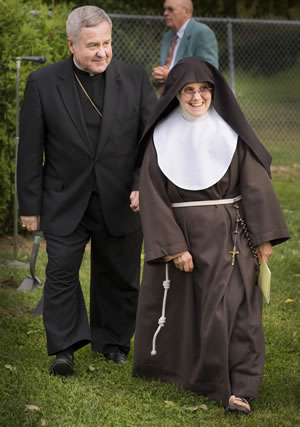
St. Louis Archbishop Robert J. Carlson walks with Sister Mary Michael, a Poor Clare nun, after a 2009 groundbreaking ceremony in St. Louis.

The theme of Pope Benedict XVI’s message for the upcoming World Day of Prayer for Vocations points to the important role Catholic home life plays in the promotion of vocations to the priesthood and religious life, said Archbishop Robert J. Carlson of St. Louis. [Formerly Auxiliary Bishop of the Archdiocese of St. Paul and Minneapolis, Bishop of Sioux Falls, SD, and Bishop of Saginaw, MI].

“The theme which the Holy Father chose places the burden on the local church to reflect on how it develops a culture of vocations,” said the archbishop, chairman of the U.S. Conference of Catholic Bishops’ Committee on Clergy, Consecrated Life and Vocations. “We know that the vocation comes out of the home.”

The papal message for the day of prayer, which will be observed May 15, was released Feb. 10 at the Vatican. The 2011 theme is “Proposing Vocations in the Local Church.”

“Every Christian community, every member of the church needs consciously to feel responsibility for promoting vocations,” especially in an era when God’s voice “seems to be drowned out by ‘other voices’ and his invitation to follow him by the gift of one’s own life may seem too difficult,” the pope said.

Pope Paul VI instituted the day of prayer in 1964 as a way for Catholics to focus on and pray for vocations.

In an interview with Catholic News Service while he was in Washington in March, Archbishop Carlson said the majority of newly ordained priests said they were influenced by the parish in their discernment for the priesthood.

According to results of a survey of members of the 2011 ordination class, released April 25, 66 percent of the respondents said it was their parish priest who encouraged them. Forty-two percent identified their mothers as having a major influence on their decision.

The annual national survey is conducted by the Center for Applied Research in the Apostolate at Georgetown University for the USCCB’s Secretariat of Clergy, Consecrated Life and Vocations.

CARA contacted ordinands by email, phone or fax to explain the survey; asked them to complete a brief survey online; and then followed up with respondents by email, phone or fax. This year, CARA reported that the response rate was 69 percent; 329 ordinands responded out of a total of 480 identified by theologates, houses of formation, religious institutes, and archdioceses and dioceses.

Survey results also showed that the average age of ordinands in the class of 2011 is 34. More than nine in 10, or 94 percent, reported they had some type of full-time work experience prior to entering the seminary, most often in education. On average, ordinands reported they were about 16 when they first considered becoming a priest.

Archbishop Carlson said parishes need to find a way to encourage the wider community to be more supportive of young men who choose a vocation to the priesthood, since many of them begin the discernment process at age 16.

Nine in 10 ordinands reported being encouraged to consider the priesthood by someone in their life. Of those responding ordinands who reported that they were encouraged to consider the priesthood, two in three (66 percent) say they were encouraged by a parish priest.

The survey showed that 57 percent of ordinands in the class of 2011 said they were discouraged from pursuing a vocation by friends and classmates; 52 percent said they were discouraged by a parent or other family member.

“Most young people don’t understand what discernment is all about,” Archbishop Carlson told CNS while he was in Washington to attend bishops’ committee meetings. “They have not been taught from the pulpit or in the religion classes how to discern.”

The archbishop said he was interested in the influence Catholic education had on vocations this year. Results showed that 47 percent of the ordinands surveyed went to a Catholic elementary school and were somewhat more likely to attend Catholic high school. Thirty-nine percent of them attended a Catholic university or college, compared to 7 percent of all U.S. Catholic adults.

“We are going to make sure our Newman chaplains and our campus ministers are talking to young people about vocations,” the archbishop added.

Asked if the clergy sex abuse scandal had had any effect on vocations, Archbishop Carlson said it has not affected the interest or number of vocations. He noted that the survey showed that amid this challenge, more young people are responding to vocations.

“They were not involved in the scandal, and they believe that as they live out their vocation they can make the whole community, the body of Christ, stronger,” he said.

The 2011 survey also showed a continued pattern of growing cultural diversity in the ordination class, especially religious order priests. Ten percent of the class are Asian/Native Hawaiian/Pacific Islander; 4 percent of the U.S. Catholic population are Asian.

Fifteen percent said they were Hispanic/Latino; by contrast, about 34 percent of the U.S. adult Catholics are Hispanic/Latino. The remaining results showed 69 percent are Caucasian, 5 percent African-American and 1 percent other.

“There is a beautiful mixture of the people who make up the church in the U.S.,” said Archbishop Carlson, but added there was a need to foster vocations in the Hispanic/Latino community to address the needs of that growing segment of the U.S. Catholic Church.

For young men, parents and youth ministers who have questions on the discernment process, every diocese has a local website and vocation director’s office. The USCCB also has a website http://www.ForYourVocation.org. According to the 2011 survey, the majority of young people turn to such websites for information first, said Archbishop Carlson.

The archbishop said he prays that those discerning the priesthood will have the courage to listen and respond to their vocation.

“We invite them to listen to what they are hearing deep within themselves as to how God might want them to live their life,” said the archbishop. “And then (we) give them the support so they can have the courage to say yes.” Catholic Spirit

Tweets at St. Pete’s: What happens when bloggers and the Vatican meet

.
While the Catholic News Service didn't interview Minnesota's delegates to the blogfest in Roma, the Ironic Catholic (from Winona) and the Desperate Irish Housewife (from Minneapolis), you might want to visit their web pages to learn what they learned, or what impact they had, or what they ate and who they drank with at their blogs. Both of them have multiple posts so browse a bit. These are two too funny ladies!!!

Guess which one is Italian and which is Irish!

Some things just can’t be done online. Like shake the hand of a blogging Benedictine nun (aka @Digitalnun on Twitter) and get her advice on how to create a profitable app with no start-up money.

Or drink prosecco, nibble on focaccia and discover while chatting with a scientist who blogs about biology and religion that he is a Protestant married to a Muslim and couldn’t believe he was invited to a Vatican event.

At a landmark “Blog Meet,” the pontifical councils for culture and for social communications brought together 150 bloggers — in the flesh — from all parts of the world May 2 to get a sense of their hopes and concerns. Once again, the church insisted the virtual world should only be a tool, not a substitute for, real human contact, even when the meeting underlines the extraordinary powers of new media.

Greeting people face-to-face also broke down some barriers and suspicions that have built up over the years between some bloggers and the sometimes communication-challenged Catholic hierarchy.

And create communion they did; the St. Peter-meets-tweeters blognic was a real coup — a mini Berlin Wall knock-down — as calling cards, emails and hugs were exchanged.

“The church has something to learn from bloggers,” Archbishop Claudio Celli, president of Vatican’s communications council, said in an interview with L’Osservatore Romano May 5.

By listening to inhabitants of the blogosphere, the church can learn not only what people in the pews are thinking and feeling, church leaders can get a sense of how important it is to speak about the faith in a language that is less “ecclesial” and more “understandable,” he said.

Of the many issues brought up during the four-hour meeting was defining what, if any, kind of relationship should exist between the church and bloggers.

That issue took on several forms.

On the one hand, some bloggers wanted to be on par with traditional media professionals and be included in the Vatican press hall loop when important news was set to break.

Jesuit Father Federico Lombardi, the Vatican spokesman, said only accredited journalists who have been vouched for by their employers and have pledged to follow journalistic ethics have that kind of access.

However, he said, bloggers have played a key role in clarifying the kind of mistakes and confusion that result when the secular press gets a story wrong.

Other bloggers expressed concern about authenticity and wondered if there could be some kind of “imprimatur” to show when online content reflects the faith. Others were quite happy to be left alone and exercise their freedom of speech unfettered by authority.

For the Vatican, the idea of “authenticity” is critical. The faithful need to know whether what they are reading is church teaching or someone’s personal interpretation or opinion.

In fact, the church’s initial wariness of the online medium may have stemmed from fears that the malleable and viral nature of digital texts meant church teachings could become diluted, polluted or convoluted when they hit the Web.

During a question-and-answer period at the end of the meeting, one audience member from the United States asked if there was a plan to create a sort of “mechanism” through which dioceses would be able to judge or control whether content coming out of Catholic newspapers, television outlets and blogs represented the “authentic teaching” of the church.

Another audience member spoke out against such a plan, saying many Catholic blogs are not connected to the church and want stay independent and free from regulation and Vatican or diocesan approval.

The panel made up of Vatican officials wasn’t able to address the concerns because of a lack of time. However, it was made clear at the beginning of the event that the Vatican’s goal with the meeting was not to regulate bloggers nor create a moral code of conduct, but rather to take the first step in starting a dialogue and looking at how blogging plays a role in speaking about faith.

Archbishop Celli said he hoped the dialogue would continue after the May 2 meeting and called on bloggers to take the next step.

Hilary White of the blog Orwell’s Picnic was already ahead of the game. She had scheduled an “alternative” blognic for May 3 to give bloggers who didn’t get invited to the Vatican Blog-stock a chance to meet and talk in a much more informal setting — specifically at an Irish-themed pub.

One of the most distinctive contrasts between the two gatherings, aside from the bar stools and beer, was the near total absence of clicking keys and heads hiding behind laptop screens.

People at the Vatican event were so connected to their mobile devices that the venue’s bandwidth was too saturated to operate smoothly.

When Thaddeus Jones, an official at the social communications council, was ready to show off a new Silverlight video player for a Vatican news portal, nothing but black hit the screen.

One person said it was “a Steve Jobs moment” referring to a similar glitch in 2010 when excessive Wi-Fi network congestion prevented the Apple CEO from showing off the new iPhone features at the product unveiling.

Maybe the old-fashioned pub decor inspired an old-fashioned tradition of just “sitting around and talking,” but it also showed that the Vatican blog meet was the catalyst it wanted to be for new pockets of dialogue to sprout up. Catholic News Service

Preparing for the new Roman Missal

.

Part of the rich legacy that we have inherited from the now Blessed John Paul II is a new Roman Missal, a text he issued in the Jubilee Year of 2000, but not released until 2002.

The Roman Missal is the red book that the priest or bishop uses at his chair and at the altar in which he finds the prayers for that particular liturgy. More often, we hear it called the “sacramentary.”

Of course, the official language of the 2002 Missal was Latin and so an English language translation was needed for the celebration of the Mass in the vernacular. That process took eight years of intense work, but received final approval in April 2010. We will begin to use this historic text on the first Sunday of Advent of this year.

Words will change

While the Mass itself is not changing — that is, the structure of the Mass as we have known it since the Second Vatican Council is not being modified — the words of the Mass will be changing, and in significant ways.

This new translation has been guided by a new standard of rules that sets out to provide a more exact rendering of the original Latin text. The text that we currently use was translated in 1974, and while the translation has served us well for many years, the church in her wisdom has determined that a revised translation is necessary, correcting and clarifying those points of the 1974 translation that perhaps were not as clear as they need to be, or that did not do adequate justice to the beauty or power of the original Latin texts.

We will also notice in the new translation a different “register,” a term used to describe the kind of speech in a particular setting. The new translation is written in a more formal register, highlighting the dignity and importance of the sacred liturgy and the One to whom we speak.

For example, contrast this prayer of the 1974 translation,

“Father,
your love never fails.
Hear our call.
Keep us from danger,
and provide for all our needs.”

with the 2010 version,

“O God,
whose providence never fails in its design,
Keep from us, we humbly beseech you,
all that might harm us
and grant all that works for our good.”

This is but one example of many in which a more elevated style of speech will be found in the newly translated text.

To be sure, the difference in the style of the language will, at first, be challenging for all of us. I believe that the changes will be most challenging for us priests, who have over the years memorized many of the prayers, especially the Eucharistic Prayer. I know this is the case with my own life.

To meet this challenge, we must keep in mind that these changes are meant to help us better celebrate the sacred mysteries of the Eucharist and thus lead us to a deeper union with God.

The purpose of the change in translation is not arbitrary, but has rather been undertaken so as to promote the devotion and prayer of the People of God.

As we read in “Liturgiam Authen­ticam,” the Vatican’s most recent document on inculturation and the translation of liturgical texts:

“By means of words of praise and adoration that foster reverence and gratitude in the face of God’s majesty, his power, his mercy and his transcendent nature, the translations will respond to the hunger and thirst for the living God that is experienced by the people of our own time” (no. 25).

In preparing for the new texts, we should also keep in mind that the sacred liturgy is one of the primary sources of expressing, and maintaining, the unity of the church.

We worship in the same way to communicate the fact that we are united in discipleship. Thus, rubrics and liturgical rules are not just about being fussy or nitpicky. Rather, obedience to the texts and rules of the liturgy help us stay unified as church, both on the local and universal level.

So you see, there is much more involved in the reception of the new translation than just a matter of which words we use. This reality touches on the core of our union as the Body of Christ.

Personally, I see the new missal as a great opportunity to stop and re-examine our understanding of the Mass so as to renew and deepen our appreciation for the mysteries that it contains.

To help us all in our efforts of catechesis and reception, I have asked the archdiocesan Office of Worship to begin a series of articles in The Catholic Spirit on the new Roman Missal, as well as to offer resources (many of which are online) to our parishes — resources that will help them prepare for the changes.

I urge pastors, deacons, catechists, teachers, worship committees, musicians, cantors and parish staff members to enter into this time of preparation with enthusiasm and with a positive spirit.

God love you!

18 New Clerical Assignments for the Twin Cities

.

Eighteen priests have been given new assignments in the Archdiocese of St. Paul and Minneapolis.

Father Jules Omba Omalanga was named as part-time chaplain for French-speaking African Catholics and part-time chaplain for North Memorial Hospital in Golden Valley, effective June 1. He has been serving as pastor of St. Philip in Minnea­po­lis. (See page 5A for additional information on St. Philip.)

The additional 17 assignments will begin Friday, July 1.

Father Rodger Bauman was nam­ed pastor of Guardian Angels in Oak­dale. He has served as pastor of St. Mary of the Lake in White Bear Lake since 2002 and previously served at St. Peter in Richfield, Holy Spirit in St. Paul, and St. Edward in Bloomington.

Father Douglas Ebert will serve as pastor at Guardian Angels in Chas­ka. He has been assistant pastor at All Saints in Lakeville since 2009.

Father Joseph Fink will be pastor of Immaculate Conception in Wat­er­town. He has served at St. Joseph in West St. Paul since 2009. He previously served at St. Mark, St. Bernard and St. John, all in St. Paul; St. Raphael in Crystal; St. Mary in Shakopee; St. Thomas the Apostle in Corcoran; St. Pius X in White Bear Lake; Most Holy Redeemer in Mont­gomery; and St. Peter in Mendota.

Father Paul Jarvis was named pastor of St. Joseph in Rosemount. He has been pastor of Guardian Angels in Chaska since 2007 and previously served at the Basilica of St. Mary in Minneapolis and Our Lady of Grace in Edina.

Father Paul Kammen will become pastor of St. Joseph and St. Peter (Delano Catholic Community) in Delano. He has served at St. Hubert in Chan­hassen since 2009 and previously at Holy Name of Jesus in Medina.

Father Abraham George Kochu­pu­ra­ckal, CMI, will be pastor of Nativ­ity of the Blessed Virgin Mary in Bloom­ington. He has served at Our Lady of the Lake in Mound since 2009 and previously at St. Elizabeth Ann Seton in Hastings, St. Anne in Le Sueur, Blessed Sacrament in St. Paul; and St. Dominic in North­field.

Father Thomas Krenik was named pastor of Risen Savior in Burnsville. He has been serving at St. Richard in Richfield since 1999 and as canonical administrator of Blessed Trinity Cath­olic School in Richfield since 2004. He previously served at St. Timothy in Blaine, Maternity of the Blessed Vir­gin in St. Paul and the St. Paul Seminary.

Father William Martin will be pastor of St. Richard in Richfield. He has been serving as pastor of Guar­dian Angels in Oakdale since 1998. He previously served at St. Mary in Waverly, Christ the King in Min­nea­polis and St. Margaret Mary in Golden Valley.

Father Kenneth O’Hotto will serve as pastor of St. Mary in Waverly. He has served as pastor of St. Michael in West St. Paul since 2003 and previously served at St. Anne in Le Sueur.

Father Timothy Rudolphi was named pastor of St. Patrick in Edina. He has served as pastor of St. Henry in Monticello since 2000. He previously served at Guardian Angels in Chaska, Risen Savior in Burnsville and Epiphany in Coon Rapids.

Father Eugene Tiffany will be pastor of Immaculate Conception in Co­lumbia Heights. He has served at St. Mark in St. Paul since 2009. He has served as pastor at Holy Spirit in St. Paul, St. Olaf in Minneapolis, All Saints in Lakeville, Holy Trinity in South St. Paul and St. Henry in Montecello.

Father Rolf Tollefson was named pastor of St. Hubert in Chanhassen. He has been serving as chaplain of the Marriage, Family and Life Office since 2008 and previously served at St. Charles Borromeo in St. Anthony.

Father Stephen Ulrick will be pastor of Holy Name of Jesus in Me­dina. He has served as pastor of Nativ­ity of the Blessed Virgin Mary in Bloomington since 2005. He also has served at St. Hubert in Chanhassen, St. Thomas Aquinas in St. Paul Park, as chaplain at United/Children’s Hospitals in St. Paul, St. Joseph in Hopkins and St. Matthew in St. Paul.

Father Anthony Vanderloop was named pastor of St. Henry in Monti­cello. He has served at St. Peter in Richfield since 2006 and as canonical administrator of Blessed Trinity Catholic School in Richfield since 2010. He previously served at St. Francis de Sales and St. Bernard, both in St. Paul.

Father Frank Wampach will serve as pastor at St. Joseph and St. Francis Xavier in Taylors Falls. He has served as pastor at Immaculate Conception in Wat­er­town since 1997. He previously served at St. Mary in Bellechester, St. Paul in Zum­bro­ta, Guradian Angels in Oakdale and St. Vincent de Paul in Brooklyn Park.

Father Timothy Wozniak was named pastor of St. Thomas Becket in Eagan. He has served as pastor of Risen Savior, Burnsville, since 1999. He has served at St. Thomas Aquinas in St. Paul Park, Assumption in Richfield, Basiclia of St. Mary in Minneapolis, St. John the Baptist in New Brighton and St. Edward in Bloomington.

Father Daniel Bodin will begin studies in canon law. He has served as pastor at St. Joseph in Taylors Falls since 2008. He also has served at St. Francis Xavier in Franconia and St. John Neumann in Eagan. Catholic Spirit


Thursday, May 12, 2011

Iowa parish to offer free kindergarten for parishioners

.
[Clinton, IA, Diocese of Davenport] Prince of Peace Schools will offer tuition-free kindergarten for parishioners beginning next year, thanks to a Prince of Peace Parish effort to further support Catholic education and increase school enrollment.

The move is the first step toward what parish and school leaders hope will eventually be a tuition-free, Catholic-school education for parishioners from kindergarten to 12th grade.

“It’s a way for parishioners to see that Catholic education is a long-term investment for our parish,” Principal Nancy Peart said. “Keeping our families strongly invested in faith development is critically important.”

To enroll a kindergartener for free, parish families must sign a covenant to attend Mass on weekends and holy days of obligation, teach Catholicism as a family, get involved in a parish ministry, work toward giving 5 percent of their income to the parish, and cooperate with school teachers and staff. Father Ken Kuntz, pastor of the Clinton parish since July, said parishioners’ fulfillment of that agreement is “between them and God.”


The priest considered eliminating tuition for parishioners after noticing enrollment in Prince of Peace Academy and College Preparatory dropped from 244 in fall 2009 to 219 in fall 2010. “We have a wonderful school, but too many empty seats, in my opinion,” he said. “My concern was how can we get more kids into our school?”

For some parish families, one of the biggest obstacles is the expense of tuition, said Karen Witt, development director for Prince of Peace Academy and College Preparatory. In a summer 2010 survey, “cost” was the top reason parishioners with elementary and high school students cited as to why those students don’t attend Prince of Peace.

Witt noted financial aid can lessen that burden; tuition starts at $2,182 for a parish student in first through eighth grade next year and $3,231 for a parishioner in high school. But she said Prince of Peace’s new effort will remove remaining financial barriers. “It’s a wonderful blessing for families to have this opportunity.”

To make up for lost tuition income, the parish will increase its subsidy to Prince of Peace Schools. That annual subsidy is now about $500,000 — more than 50 percent of annual offertory income, Fr. Kuntz said.

He hopes Prince of Peace will be able to eliminate tuition for one grade per year for the next 13 years. “Our parish has 1,700 families,” he said. “If 70 percent of those people gave 5 percent of the median income in Clinton, we could have a tuition-free school now. We’re not promoting something that doesn’t have a chance of being effective. But it will take time.”

He also noted that 76 non-parishioners are currently enrolled in Prince of Peace Schools, suggesting some tuition income will continue to come in even if tuition is eliminated for parishioners.


At least one parish family has decided to send a student to Prince of Peace Academy thanks largely to the prospect of free tuition. Angela Broadrick said she and her husband, who is a police officer in Camanche, were debating whether to enroll their daughter Lucy in kindergarten at Camanche Elementary or Prince of Peace next year. When the couple heard of plans for free kindergarten for Catholics who sign a covenant with the parish, “that put us over the edge.”

“What a blessing,” said Broadrick, who also has a 1-year-old daughter, Annie. “The more help we can get, the better.”

Pam Deluhery said she would have sent her son, Billy, to kindergarten at Prince of Peace next year even without free tuition, but is grateful for the parishioner covenant. “I think it’s a wonderful way to get families active in our parish. If we can get more people coming to church on a regular basis and taking part in ministries, it can really strengthen us.”

Fr. Kuntz said Prince of Peace’s “leap of faith” reflects the results of a survey showing most parishioners believe supporting a Catholic school is an important part of the parish’s mission. “If parishioners are practicing stewardship, they shouldn’t have to pay tuition because we look at it as our mission to provide Catholic education — much as parishes did when they were founded in this country,” he said.

“Every year, we feel a strong parish commitment to the school, and this demonstrates that dedication again,” Peart said. “It’s delightful to have this sense of community with our parish.”


[All the Catholic Elementary and High Schools in Wichita, KS, are free for parishioners.]

Tuesday, May 10, 2011

Oblates of Mary Immaculate (OMI) to commemorate founder’s death with Mass, open house May 22

.

Father Louis Studer (left), director of Christ the King Retreat Center in Buffalo, has been appointed vicar provincial of the U.S. Province of the Oblates, the order’s No. 2 leadership position. His replacement at Christ the King has not yet been announced. Father Gregory Gallagher (right), a native of St. Casimir in St. Paul, has been appointed the province’s administrative assistant. Currently he serves as director of the National Shrine of Our Lady of the Snows in Belleville, Ill. Both men will begin their three-year terms in Washington, D.C., in June.

The Missionary Oblates of Mary Immaculate, an international order of missionary priests and brothers with members serving in the Archdiocese of St. Paul and Minneapolis, will commemorate the 150th anniversary of the death of its founder with a Mass and open house at Christ the King Retreat Center in Buffalo Sunday, May 22.

“It’s an opportunity to take a look at the gift that St. Eugene [de Mazenod] was to the church, who he was, and what kind of legacy he leaves us,” said Oblate Father James Deegan, a staff member at the retreat center.

Oblate Father Louis Studer, director of Christ the King, will concelebrate the 2 p.m. Mass with Father Deegan. An open house will follow from 3 to 5 p.m. Christ the King Retreat Center is at 621 First Ave. S in Buffalo.

Oblates founder St. Eugene de Maze­nod was born into a wealthy family on Aug. 1, 1782. He was ordained a priest at age 29. “His conclusion was, ‘If Jesus gave everything for me, then I, in turn, had better give everything for Jesus,’” Father Deegan said.

St. Eugene started the Missionary Oblates of Mary Immaculate in France in 1816. The order received formal ap­proval from Pope Leo XII in 1826.

In 1837, St. Eugene was named bishop of Marseille, France. When he died on May 21, 1861, six Oblate bishops and more than 400 Oblate missionaries were working in 10 countries.

Pope John Paul II canonized him on Dec. 3, 1995.

Today, more than 4,000 Oblate priests and brothers serve in 68 countries. Members have been instrumental in founding 44 other religious communities and secular institutes, Father Deegan said.

In the archdiocese, the Oblates served for 75 years at St. Albert in Albertville. The also have served at Assumption in Richfield and St. Mary in St. Paul.

Currently, there are about 12 active and eight retired Oblates serving at St. Casimir in St. Paul and other area par­ishes, Regions Hospital in St. Paul, and Christ the King Retreat Center. One Oblate originally from St. Paul, Arch­bishop Roger Schwietz, currently serves as archbishop of Anchorage, Alaska [Prior to that, he was Bishop of Duluth]. Catholic Spirit

Sunday, May 8, 2011

Fr. John Paul Erickson to write Series to explain changes coming with new Roman Missal in the Catholic Spirit

.
The following is the first in a series of articles regarding the new Roman Missal, which will be used in the United States beginning on Nov. 27, the first Sunday of Advent.

“Lift up your hearts!”

These are pivotal words in the Mass, words spoken by the celebrant to the congregation during what is referred to as the “preface dialogue.”

They are pivotal words not only be­cause they form an integral part of the liturgy, but also be­cause they encapsulate beautifully the meaning of the Holy Sacrifice of the Mass and serve as a clarion call to that full, active and conscious participation in the liturgy that is our delightful duty as believers.

We are summoned by Christ to offer up our hearts in union with his own sacrifice — a sacrifice made present on the altar.

They are words meant to prompt devotion, remind us of love and call us to communion. Let our response be bold and zealous: “We lift them up to the Lord!”

This call to communion, a summons to offer up our lives to the Father in union with the total gift of self offered by Christ on the altar, lies at the very heart of the meaning of the whole Mass.

This meaning has always been found at the foundation of the liturgy of the church and must be the rock upon which we build any authentic understanding of the church’s prayer.

On Nov. 27 this year (the First Sunday of Advent), many of the words used at Mass to summon, remind and form us will be changing, but the foundation remains the same, as it always will.

Education necessary

It would be difficult to overestimate the importance of good catechesis during the months ahead as we prepare for the reception and use of these new words at Mass.

This catechesis is important not only because we need to know what to say on Nov. 27 and why we say it, but also because every time these sorts of changes occur, it is a privileged time to re-examine the Mass and the liturgy as a whole and to take a serious look again at our own devotion to the Mass and to the sacraments.

Change is often difficult, but it can also be immensely fruitful. Indeed, change, even difficult change, is most often necessary for life and real growth.

Beginning with this edition of The Catholic Spirit and continuing until Nov. 27, I am pleased to announce that Catholic Spirit readers will be encouraged to get to know these new texts, the reasons behind them, and some of the history of the Mass itself through a series of articles composed by writers from around the archdiocese and the English-speaking Catholic world.

I hope and pray that all who read these articles will find them helpful and be encouraged to truly pray the Mass.

In addition to these articles, parishes and pastors will be receiving practical guidance from the Office of Worship as to how to implement and prepare for these changes in the many communities of faith throughout this local church.

Good resources

I encourage all who have not already done so to visit the website of the U.S. Conference of Catholic Bishops and to examine the page the conference has produced on the new texts (http://www.usccb.org/romanmissal).

Many marvelous resources are found there, and the common questions asked about the new texts are answered. The site is simply the best resource out there on the new texts.

May God bless us all during these months of preparation and waiting for the historic changes to the words of the Mass.

May the Blessed Mother, who is the image of the church and a model of prayer, intercede for us and teach us how to truly pray with mind and heart renewed.

And may we all, clergy and laity alike, take this opportunity to refocus on the immutable meaning of the Mass, a summons to communion with Christ in the sacrifice of our hearts to the Father of all.

Lift up your hearts!

Father John Paul Erickson is director of the archdiocesan Office of Worship.


The series

» May 12: “Why a New Missal?” A brief background on where the new missal is coming from. We’ll trace its documentary history and its close connection to the reforms of the Second Vatican Council.

» May 26: “The New Translation is a Plus for Catholics.” An article explaining what will be gained in the new translation and the opportunity it affords us as praying Christians.

» June 9: “New Kids on the Block.” In addition to new words, the new missal brings with it the memorials of new saints.

» June 23: “The Lord be with you — and with your spirit.” Perhaps no other change has received more attention than this brief exchange. Why is it changing and what does the change mean?

» July 7: “The Act of Penitence.” Why is it important to acknowledge our sin as Mass begins? What is changing about the wording of this rite?

» July 21: “The Gloria.” It’s appropriate that our first liturgical exposure to this retranslated text will not be Nov. 27, but rather at the Vigil Mass of Christmas, when we will gather to celebrate the birth of Jesus Christ. Why? Because the new words sound an awful lot like the hymn of the angels at Bethlehem.

» Aug. 4: “The Creed, part 1.” Why does the Creed matter, and why is it changing from “We believe” to “I believe”?

» Aug. 18: “The Creed, part 2.”

» Sept. 1: “The Preface Dialogue.” It is right and just.

» Sept. 15: “The Roman Canon, part 1.” As a way of examining the Mass itself, we’ll explore the first Eucharistic Prayer, often called the Roman Canon. Many rich symbols and references are found within this ancient prayer, and by paying attention to the scriptural and traditional imagery, we can learn much about just what it is we are doing through, with and in Christ at the Mass.

» Sept. 29: “The Roman Canon, part 2.”

» Oct. 13: “The Roman Canon, part 3.”

» Oct. 27: “The Roman Canon, part 4.”

» Nov. 10: “Q&A.” As the implementation of the new missal becomes imminent, we will try to answer any remaining questions about the new texts and their use.

» Nov. 23: “Q&A, part 2.”

Catholic Spirit

Jennifer Roback Morse: Statement before the Minnesota Senate on the Marriage Amendment

.
Jennifer Roback Morse is the President and Founder of the Ruth Institute, a project of the National Organization for Marriage[1] for the promotion of heterosexual marriage and the opposition to same-sex marriage. The Institute's mission is to "make marriage cool" by promoting the idea of lifelong, committed marriage. She speaks on college campuses and at other venues around the country on issues concerning marriage. A PhD in economics, Morse is a former teacher of economics at both Yale University and George Mason University. She is now a part-time Research Fellow at the Acton Institute for the Study of Religion and Liberty.[3]
Emphases and Comments are mine.
==================================

Prepared remarks for the Judiciary Committee of the Minnesota State Senate, hearings on same sex marriage - April 29, 2011 St. Paul, Minnesota

We are here to consider giving the citizens of the State of Minnesota the opportunity to vote on a marriage amendment to their Constitution. The proposed amendment simply states "Only a union of one man and one woman shall be valid or recognized as a marriage in MN."

I am Dr. Jennifer Roback Morse, founder and president of the Ruth Institute, a project of the National Organization for Marriage. My doctorate is in economics, from the University of Rochester, in NY. I have taught at Yale and George Mason Universities. I have had fellowships with the University of Chicago, Cornell Law School, and the Hoover Institution at Stanford. I have written two books on the social purpose and significance of marriage. I am the mother of an adopted child and a birth child. My husband and I were foster parents in San Diego County for three years.

I urge you to allow the citizens of MN the opportunity to exercise their right to vote on the definition of marriage. Removing the requirement that spouses be of opposite sex is a redefinition of marriage. Redefining marriage redefines parenthood. Redefining marriage affects the balance of power between the state and civil society. The citizens of MN have the right to make up their own minds about these important issues.

The proposed amendment is nothing radical. The people of MN are entitled to say whether they want marriage to remain as the union of one man and one woman, or whether they want to take their chances with marriage being redefined by activist judges. Letting the citizens vote is just the decent thing to do.

The essential public purpose of marriage is to attach mothers and fathers to their children and to one another. We can see the importance of this purpose by taking the perspective of the child: What is owed to the child? Unlike adults, the child does not need autonomy or independence. The child is entitled to a relationship with and care from both of the people who brought him into being. Therefore, the child has a legitimate interest in the stability of his parents' union. But no child can defend these entitlements himself. Nor is it adequate to make restitution after these rights have been violated. The child's rights to care and relationship must be supported pro-actively, before harm is done, for those rights to be protected at all.

Marriage is adult society's institutional structure for protecting the legitimate interests of children. Without this public purpose, we would not need marriage as a distinct social institution.

We often hear the objection that some marriages don't have children. This is perfectly true. However, every child has parents. Depriving a child of relationships with his or her parents is an injustice to the child, and should not be done without some compelling or unavoidable reason. The objection that some marriages don't have children stands the rationale for marriage on its head. It views marriage strictly from the adult's perspective, instead of from the child's perspective.

Marriage is not simply a special case of the market, and family law is not simply a subset of property and contract law. Marriage exists to meet the social necessity of caring for helpless children, who are not and cannot be, contracting parties. Children are protected parties. And, marriage should protect the interests of both parents in pursuing their common project of rearing their children. If we replace this essential public purpose with inessential private purposes, marriage will not be able to do its job. But children will still need secure attachments to their mothers and fathers, a need which will go unfulfilled.

Same sex marriage redefines parenthood, as a side effect of redefining marriage. Up until now, marriage has made legal parenthood track biological parenthood, with adoption for exceptional situations. The legal presumption of paternity means that children born to a married woman are presumed to be the children of her husband. With this legal rule, and the social practice of sexual exclusivity, marriage attaches children to their biological parents.

Same sex couples of course, do not procreate together. So called Marriage Equality requires a dubious move from "presumption of paternity" to the gender neutral "presumption of parentage." This sleight of hand transforms the legal understanding of parenthood. The same sex partner of a biological parent is never the other biological parent. Rather than attaching children to their biological parents, same sex marriage is the vehicle that separates children from a parent.

No longer will the law hold that children need a mother and a father. In the wake of marriage redefinition in other states, courts are saying silly things like, "the traditional notion that children need a mother and a father to be raised into healthy, well-adjusted adults is based more on stereotype than anything else."[1]

This statement made by the Iowa Supreme Court in Varnum v Brien, is false as a general statement. Mountains of data show that children do need their mothers and their fathers,[2] and that children care deeply about biological connections.[3]

Please don't change the subject by saying that we already have lots of children unattached to their parents. We should be taking steps to place responsible limits on things like divorce, rather than careening headlong into further and more deeply entrenched institutionalized injustices to children.

Equating same sex parenting with opposite sex parenting will also marginalize men from the family. By legalizing same sex unions, the authority of the government declares that mothers and fathers are interchangeable. Society asserts that children do equally well with two mommies, two daddies or one of each. And when mothers and fathers are interchangeable, it is fathers who will be pushed aside.

In Canada, where same sex unions have been legal since 2005, the birth certificates reflect this marginalization of fathers. Each birth certificate in British Columbia has a place to mention the biological mother. The second parent is listed as "father or co-parent," and people check off whether the "other parent" is the father or co-parent. Fatherhood is officially reduced to a check-off box.

You might object that the birth certificates are purely symbolic, and that we could solve this symbolic problem of marginalizing men on the birth certificates by simply recording Parent A and Parent B. Very well. Suppose we do that. That must mean we would record two individuals as parents, without taking note of which one has any biological relationship to the child. The theory would be that the genetic connection between the child and one member of the lesbian couple for instance, cannot be permitted to "privilege" her in any way over the other member of the couple.

This suggestion makes plain how deeply same sex marriage will alter our social structure. The biological principle of determining parentage will have to be suppressed, and eventually replaced with another principle. That principle will be that the state will decide who counts as a parent.

We can already see this in disputed custody cases. Courts are awarding parenting rights to individuals who not related to the child, either through biology or adoption. Perfectly fit parents are having their parental rights diminished because they once had a sexual relationship with someone.[4] When courts 'eradicate the parent/non-parent dichotomy,' they must establish multi-part tests for determining whether a person warrants the status of "de facto parent." The court ends up scrutinizing the minutiae of family life.

Let us be clear: the alternative to the biological principle for determining parentage is the principle that the government decides who is a parent. Instead of simply recording parentage, the state will determine parentage, not in exceptional cases, but routinely. This is far too much discretion to allow the family courts. Those of you who think like libertarians should be particularly alarmed by this expansion of the state into the lives of ordinary citizens. This is what "getting the state out of the marriage business" will eventually come to mean.

In short, redefining marriage from the union of a man and a woman to the union of any two persons jettisons three foundational principles: first, the principle that children are entitled to a relationship with both parents, second, the biological principle for determining parentage, and third, the principle that the state recognizes parentage, but does not assign it.

I am often told I am on the "wrong side of History." The justice of "marriage equality" is overwhelming; the younger generation favors it; same sex marriage is inevitable. But there is ample reason to doubt this March of History storyline: we were told all these things about abortion too.

"You need to accept Roe v. Wade. Abortion is simple justice for women. Besides, the next generation will completely accept abortion. You are on the Wrong Side of History."

A funny thing happened on the way to History: the people did not perform as promised. In January 2010, I took a group of Ruth Institute students up to the West Coast Walk for Life in San Francisco. Official estimates place the attendance at over 35,000. But I wasn't counting. I was looking at the faces. I saw what anyone can see, if they care to look: the pro-life movement is a youth movement.

The average age of the walkers at the West Coast Walk for Life was probably around late twenties. Toward the front of the parade were the Berkeley Students for Life (yes, there is such a thing) and the Stanford pro-life club, (yes, they exist as well). Busloads of high school students, college students road-tripping in from all over the West Coast, families with small children, babies in arms, backpacks and strollers. The next generation is not going along quietly with the March of History.

And why should they?

It is the interests of children that the Abortion Regime sets aside in order to accommodate the desires of adults. And it is the interests of children that the redefinition of marriage will set aside as well. Remember the old pro-abortion slogan, "every child a wanted child?" Who can take that seriously today? Today's same sex marriage mantra, "Kids just need two adults who love them" will come to sound every bit as hollow.

Advocates of redefining marriage assure us that children will do fine, whatever the loving adults in their lives decide to do. IVF children will be so wanted by their legal parents that the lifetime separation from their natural parents will not trouble them. Children of unconventional family structures, held together by a series of contracts among adults,[5] those children will just have more adults to love them. Divorce, separation, complex custody quarrels, kids shuttling between four households with their sleeping bags and backpacks:[6] that's just anti-equality hysteria and will never happen.

But biology will reassert itself. Some women who have children with female partners will find that sharing the care of their children with another woman, is not as easy as sharing the care with the child's father. Some men who agree to be sperm donors as "friends" will find that they want more of a relationship with their own children than they had anticipated.[7] And some children are going to have feelings about their absent parents, uncomfortable questions about their origins, and complex emotions about being partially purchased.[8]

Advocates of so called marriage equality typically respond, "That's just biology," as if biology were nothing. They are asking people to set aside the natural attachment of parents to their own children, the natural difficulties of treating another person's child as if they were your own, the natural desires of children to know who they are and where they came from. Suppressing all these feelings in all these people will not be possible indefinitely. As time marches on, the brutality of the marriage "equality" regime will become just as obvious as the brutality of the abortion regime is today. Marriage is the right side of history.

And I don't think you can fall back on the idea that "nothing so terrible has happened in Massachusetts." Redefining marriage redefines the way generations relate to one another. It is foolishness to believe we would feel the full impact of such a profound change in a few years. It will take at least a generation, a full thirty years or more, before the full effects of redefining marriage work themselves out throughout the legal and social system.[9]

The only argument for redefining marriage is so-called "equality." Equality in this context takes a venerable American concept and twists it out of recognition. Equality used to mean limiting the power of the state to make irrelevant distinctions among citizens. But marriage equality is becoming a battering ram for smashing every aspect of social life that has any hint of sexual differentiation. No more mothers and fathers, only Parent 1 and Parent 2.

Let me remind you that a vast majority of African Americans completely reject same sex marriage. They are deeply offended by the high-jacking of the moral authority of their civil rights movement.

Previous generations of social experimenters have caused unimaginable misery for millions of people. Particular people advocated the policies that led to today's 50% divorce rate and 40% out of wedlock childbearing rate. None of these people has ever been held accountable.

The people of Minnesota are sensible mature people, who want to be accountable for what happens in their state. The people of Minnesota deserve a chance to vote. Redefining marriage will have far-reaching consequences that ought to be fully aired. Putting this amendment on the ballot will allow that discussion to take place. Something this significant should not be rammed down the throats of an unwilling citizenry by judges. Let the people vote.

http://traffic.libsyn.com/ruthinstitute/May03_11.mp3 Podcast

Friday, May 6, 2011

Cathy of Alexandria's Dad was admitted to the Emergency Room this evening

.
I just received an email from Cathy (Janice LaDuke) who is on her way to Bemidji in northern Minnesota. Her Dad, a widower for a long time, Cath is his only living child, was taken to the Emergency Room in the hospital there about 6:30 this evening. He lives in Cass Lake, nearby.

Cathy popular blog is "Recovering Dissident Catholic."

Your prayers for both of them would be greatly appreciated. They are very close and he was just down visiting her for Easter.

That's probably got to be a five hour drive for her.

Cathy's user name on Facebook is Catherine Alexandria if you'd like to leave her a message.

Ray Marshall

Tuesday, May 3, 2011

Duluth's Bp. Paul Sirba testifies for defense of marriage amendment

.

Bp. Sirba, formerly a priest of the Archdiocese of St.Paul-Minneapolis, testifies for defense of marriage amendment

The Catholic Spirit, Archdiocesan newspaper of my native place, has a piece about the testimony in defense of marriage given to the House Civil Law Committee of the Minnesota Legislature by His Excellency Most. Rev. Paul Sirba, Bishop of Duluth. For this statement he spoke for all the bishops of Minnesota.

From my personal experience, Bp. Sirba was one of the best priests I have ever known. I have known him for 30 years.
Emphases and [comments] by Father Z.

Bishop Paul Sirba of Duluth testified May 2 before the House Civil Law Committee in support of a bill (HF 1613) that would put a constitutional amendment on the ballot in 2012 to define marriage as a union between one man and one woman. [Make it so!]

“Based on God’s Word given in divine revelation, we believe that marriage creates a sacred bond between spouses,” said Bishop Sirba, speaking for the Catholic bishops of Minnesota. “We hold this to be true not only for ourselves, but for all humanity.” [And marriage can be defended also from the point of view of reason, without the reference to divine revelation.]

The church’s convictions about marriage “find ample support in principles which can be discovered by human reason and which have been reflected throughout human history,” he said.

The House bill, introduced by Rep. Steve Gottwalt (R-St. Cloud), was approved by the Civil Law Committee by a 10-7 vote. A companion bill in the Senate (SF 1308), authored by Sen. Warren Limmer (R-Maple Grove), was passed April 29 in the Senate Judiciary Committee, where Bishop John Quinn of Winona testified in support of the measure.

If both houses pass the measure, a question would be placed on the ballot in November 2012 asking voters: “Shall the Minnesota Constitution be amended to provide that only a union of one man and one woman shall be valid or recognized as a marriage in Minnesota?”

Bishop Sirba was the third of seven people to testify on behalf of the House bill. Hundreds of people were directed to a lower-level room to watch the proceedings via live broadcast, as only ticketed participants were allowed into the packed hearing room.

Testimony in support of the bill was also given by representatives from four other faith groups, University of St. Thomas School of Law professor Teresa Collett and Jennifer Roback Morse, founder and president of the Ruth Institute, [Participates at Acton Institute's summer university. Great speaker.] a project of the National Organization for Marriage. Amendment opponents also testified.

Bishop Sirba said “the committed relationship between one man and one woman calls forth the best of the spouses, not only for their own sake, but also for the well-being of their children and for the advancement of the common good.”

In defending the institution of marriage, he emphasized that “persons with same-sex attractions are our sisters and brothers, and should not be deprived of their authentic human rights, including the most fundamental rights of all — the right to life and the right to love.” [It is impossible for them to claim a right to marriage, which can only be between one man and one women.]

The Catholic Church opposes discrimination against any person based on a same-sex attraction, he said. “At the same time,” he added, “meeting authentic human needs does not require changing society’s definition of marriage.”

Bishop Sirba said the bishops believe the amendment is needed because several legislative proposals in the past few years have sought to “transform marriage from an institution focused on the needs of children into a totally new legal entity centered on the happiness of adults.” [Can we conclude from this that passage of legislation allowing same-sex couples to "marry" and then in some way adopt children, is a form of child abuse?]

To view the Minnesota Catholic Conference’s “Marriage Amendment Resource Page,” visit HERE.

WDTPRS kudos to Bp. Sirba.

New essay explains Church teaching on 'brain death,' organ donation

.
“Moral certitude of death can be achieved using either cardio-pulmonary or neurological criteria, according to the magisterium of the Church. Catholics may in good conscience offer the gift of life through the donation of their organs after death based on neurological or cardio-pulmonary criteria according to current Church teaching. This does not mean that the teaching is irreformable. It may be modified on the basis of future scientific discoveries. However, it does mean that, at this point in time, the teaching can be followed with a clear conscience.”

Confusion about Catholic moral teaching on “brain death” may be leading some doctors and ethicists to forbid organ donations in cases where the Church would allow it.

Dr. John Haas, head of the National Catholic Bioethics Center says the confusion stems from new doubts about the medical criteria for determining “brain death.”

The issue is critical in cases where a patient’s organs are to be donated for transplant. In order to be effective, organs must be “harvested” as close to the time of death as possible.

Currently, the Church permits doctors to use “brain death” or “neurological criteria for determining death” in making end-of-life and organ donation decisions.

But recently some have suggested that these criteria are no longer acceptable. A recent book by a Catholic doctor even claims that doctors who use “brain death” criteria are committing murder.

Haas is worried that this thinking — which runs counter to Church teaching — is gaining influence and causing confusion.

In a new essay published exclusively on the website of the Catholic News Agency, Haas argues that patients and doctors can follow the Church’s teaching with a “clear conscience.”

“It is understandable that pro-life Catholics are going to be very sensitive to any possible violation of the human person’s fundamental right to life. However, on occasion some misunderstand Catholic teaching in their pro-life zeal and deny that certain actions are morally permissible,” he writes.

The issue of “brain death” remains hotly debated in some Catholic medical circles.

“The idea that neurological criteria are not a licit means of determining death prior to organ harvesting seems to be gaining ground in certain Catholic circles,” Haas told CNA.

Some Catholic theologians and medical ethicists now believe that new brain research has raised questions about previous Catholic moral conclusions. They say this new research suggests that brain death criteria don’t provide doctors with the certainty that a person is truly dead.

Haas pointed to a recent article by E. Christian Brugger, a moral theologian at Denver’s St. John Vianney Theological Seminary and a senior ethicist at the Washington-based Culture of Life Foundation.

Brugger said that research has shown that some patients who have been “rightly diagnosed” as brain dead sill show “integrative bodily unity to a fairly high degree.” He said the research “raises a reasonable doubt that excludes ‘moral certitude’ that ventilator-sustained brain dead bodies are corpses.”

Brugger’s views have been widely circulated on the internet since being published earlier this year by the Catholic news agency, Zenit.

Haas says that despite the good intentions of Bruggers and others, their arguments run “contrary to the moral guidance the Church has provided the faithful on a critical life and death issue.”

Haas expressed concern that given Brugger’s status as an archdiocesean seminary professor, his arguments “could well unsettle consciences.”

“I fear that some Catholics, after reading Brugger’s piece, would think they would be morally compelled to refuse an organ transplant if the donor were judged to be dead using neurological criteria,” Haas said.

He acknowledged that questions remain about the moment of death and the proper safeguards needed before organs can be removed for transplant.

But he said: “The Church has provided guidance to the faithful that they can confidently follow with clear consciences.”

In his essay, Haas critiques the arguments by Brugger and others. He also explains the authoritative teaching of Blessed Pope John Paul II, as well as the Pontifical Academy for Life, and other Catholic institutions.

He concludes: “Moral certitude of death can be achieved using either cardio-pulmonary or neurological criteria, according to the magisterium of the Church. Catholics may in good conscience offer the gift of life through the donation of their organs after death based on neurological or cardio-pulmonary criteria according to current Church teaching. This does not mean that the teaching is irreformable. It may be modified on the basis of future scientific discoveries. However, it does mean that, at this point in time, the teaching can be followed with a clear conscience.”

Haas’ essay can be found here: http://www.catholicnewsagency.com/column.php?n=1568
Catholic News Agency

Dr. John Haas Related articles:

Sunday, May 1, 2011

Karol Wojtyla Beatified. "They Will Look Upon Him Whom They Have Pierced"

.
"However, [in 2000] he certainly never publicly asked forgiveness for the sexual abuse of children committed by priests. But there is also no record of anyone leaping up in 2000 to castigate him for this omission. The scandal was still not big enough, for the distracted masters of public opinion at the time. Now the same ones who were silent then [now] accuse him of that silence, they accuse him of letting himself be snared by the disgraced priest Marcial Maciel. But these are posthumous accusations that reek of hypocrisy."

Today almost everyone admires him. But in life he was opposed and mocked by many, even within the Church. His holiness is the same as that of the martyrs. His beatitude is the same as that of Jesus on the cross

by Sandro Magister


ROME, May 1, 2011 – In Polish, he used to say of himself in his last years: "I am a biedaczek, a wretch." A poor old man, sick and worn out. He, so athletic, had become the man of sorrows. And yet it was precisely then that his holiness began to shine, inside and outside of the Church.

Before that, instead, pope Karol Wojtyla was admired more as a hero than as a saint. His holiness began to conquer the minds and hearts of many men and women from all over the world when what Jesus had prophesied for the old age of the apostle Peter happened to him: "Amen, amen, I say to you, when you were younger, you used to dress yourself and go where you wanted; but when you grow old, you will stretch out your hands, and someone else will dress you and lead you where you do not want to go."

Now that he has been proclaimed blessed, John Paul II is unveiling to the world the truth of the saying of Jesus: "Blessed are the poor, for theirs is the kingdom of heaven."

He did not radiate holiness in the hour of his triumphs. Much of the acclaim that he received while he was traveling the world at a breathtaking pace was too biased and selective to be sincere. The pope who knocked down the iron curtain was a blessing in the eyes of the West. But when he fought in defense of the life of every man born upon the earth, in defense of the most fragile, smallest life, the life that has just been conceived but whose name is already written in heaven, then few listened to him and many shook their heads.

The story of his pontificate was for him a matter of lights and shadows, welcome and rejection, with strong opposition. But but his dominant profile, for many years, was not that of the saint, but of the combatant. When in 1981 he had a brush with death, shot for reasons still not entirely clear, the world bowed in reverence. It observed its minute of silence, and then went right back to the same old unfriendly song.

Many in the Church also distrusted him. For many, he was "the Polish pope," representing an antiquated, antimodern, populist Christianity. They looked not at his holiness but at his devotion, which wasn't a hit with those who were dreaming of an interior and "adult" Catholicism, so obligingly immersed in the world as to become invisible and silent.

And yet, little by little, from the crust of the pope as athlete, hero, fighter, devotee, his holiness also began to unveil itself.

The jubilee, the holy year of 2000, was the turning point. Pope Wojtyla wanted it to be a year of repentance and forgiveness. On the first Sunday of Lent that year, March 12, before the eyes of the world, he presided over an unprecedented penitential liturgy. Seven times, for the seven capital vices, he confessed the sins committed by Christians century after century, and asked God's forgiveness for all of them. Extermination of heretics, persecution of the Jews, wars of religion, humiliation of women... The pope's anguished face, already marked by illness, was the icon of that repentance. The world looked at him with respect. But also with derision. John Paul II exposed himself, defenseless, to blows and insults. He let himself be scourged. There were some who demanded more repentance each time, for yet more faults. And he beat his breast for all of it.

However, he certainly never publicly asked forgiveness for the sexual abuse of children committed by priests. But there is also no record of anyone leaping up in 2000 to castigate him for this omission. The scandal was still not big enough, for the distracted masters of public opinion at the time. Now the same ones who were silent then accuse him of that silence, they accuse him of letting himself be snared by the disgraced priest Marcial Maciel. But these are posthumous accusations that reek of hypocrisy.

The ones who understood what was true in the holiness of that pope were the millions and millions of men and women who bestowed on him the most grandiose collective "thank you" ever given to a man in the past century. The heads of state and government of almost two hundred countries who flocked to his funeral in Rome did so in part because they could not stay away from that wave of admiration that was sweeping over the world.

But John Paul II also wanted that jubilee of 2000 to be the year of the martyrs. The countless martyrs, many of them nameless, killed out of hatred for the faith in that "Dominus Iesus" whom the pope wanted to reaffirm as the only savior of the world, for the many who had forgotten about him.

And the world intuited this: that in the suffering figure of the pope was the beatitude that God had promised to the poor, to the afflicted, to those who hunger for justice, to the peacemakers, to the merciful. The pope mocked, opposed, suffering, the pope who was gradually losing the use of speech was sharing in the fate that Jesus had proclaimed to his disciples: "Blessed are you when they insult you and persecute you and utter every kind of evil against you falsely because of me."

The beatitudes are the biography of Jesus, and therefore of those who follow him with pure hearts. They are the image of the new world and of the new man that Jesus inaugurated, the overturning of worldly criteria.

"They will look upon him whom they have pierced." As beneath the cross, many today see in the beatified Karol Wojtyla an anticipation of paradise.


[This commentary was written by Sandro Magister for "La Tercera," the leading newspaper of Chile, and published on the day of the beatification of John Paul II, May 1, 2011]. Chiesa

St. Philip Parish in Minneapolis to close and merge with Ascension

.
I wonder how many know that Mass is offered in French in Minneapolis!

St. Philip Parish in Minneapolis to close and merge with Ascension

French chaplaincy to be created in Ascension and St. William's in Fridley

St Paul, MN, April 30, 2011 - Members of St. Philip in Minneapolis are being welcomed at other parish communities, after parish leaders determined the current community of 250 registered households is not sustainable for the long term. On June 1, 2011, St. Philip will merge with Ascension parish, whose church is a little over a half mile down the street from the St. Philip building.

Earlier this year, the pastor, parish trustees and members of the pastoral and finance councils at St. Philip reported to the Archdiocese that the challenges of growing costs and changing demographics had become insurmountable. Parishioners at St. Philip have been engaged and remain informed of the challenges facing their parish.

On March 31st, parish leaders sent a letter to Archbishop John C. Nienstedt, noting that there were no feasible alternatives to the merger of St. Philip with another parish. Archbishop John C. Nienstedt concurred with the local leaders’ assessment of the situation at their parish. “When the Archdiocese launched its strategic planning process a little more than two years ago, it was our hope that St. Philip could stabilize financially and would be able to remain open,” said Archbishop Nienstedt. “Unfortunately, over the past several months, it has become clear that this is simply not possible. I offer my condolences and prayerful support to all those who are impacted by this decision.”

Ascension parish is ready to warmly welcome families from St. Philip into all aspects of parish life. Welcoming events are being planned now. Ascension pastor, Reverend Michael O’Connell says, “Ascension Parish welcomes parishioners from St. Philip's as together we look toward a future full of hope.”

Since his arrival at St. Philip several years ago, Rev. Omalanga has ministered to a growing community of immigrants from French-speaking African countries. It is very important to note that while St. Philip is merging with Ascension, ministry to these members of the French-speaking African community will continue to be offered through a chaplaincy being established for this purpose. After the merger on June 1, Fr. Omalanga will be assigned to this French-speaking chaplaincy which will be based at St. William in Fridley. The pastor at St. William, Reverend Joseph Whalen says the members of St. William are excited about the arrival of this community. “The Saint William family is very happy to open our arms to these French-speaking African Catholics,” said Father Whalen. “We are excited about the opportunity to learn from and share with one another.”

Because of urgent financial pressures, it has been determined that the St. Philip church building should close. Parish leaders are working to determine if the St. Phillip’s community outreach programs can continue.

On April 29, 2011, a formal decree of parish merger was issued, in keeping with Catholic Church law. Parishioners affected by this merger, who believe they are negatively impacted by the decision, have until May 11, 2011 to request in writing that the Archbishop reconsider the decision. More information about the appeal of a parish merger may be found in Appendix A to the Strategic Plan (pdf). Archdiocese of StP-M